By Aeruxo_DISP_H |
FAA Aircraft Dispatcher Certificate (United States) ·
Korean MOLIT Flight Dispatcher License ·
15+ years active dispatch at a Northeast Asian LCC, ICN hub ·
Graduate researcher, Korea Aerospace University
About the Author →
The pilot’s voice was calm: “Incheon Dispatch, we just took a lightning hit. No abnormal indications. Continuing to destination. Will request maintenance inspection on arrival.” I noted the time, checked the aircraft’s system status on my screen — all green — and logged the event. The passengers probably heard a loud crack and saw a flash. The flight continued without incident. The aircraft landed on schedule.
That call is routine. What comes next is not always.
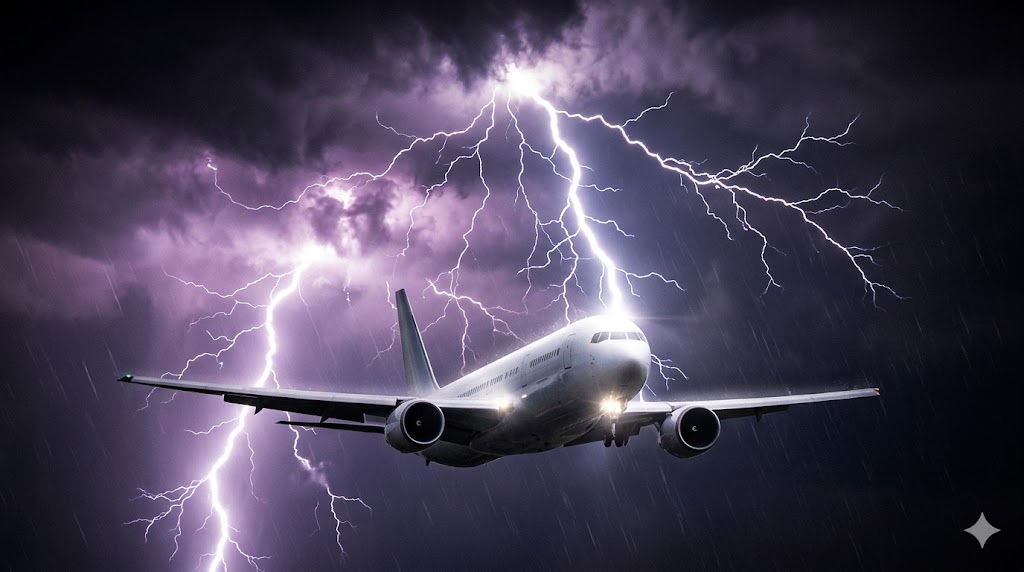
An airplane lightning strike sounds terrifying. Two hundred thousand amperes of electricity hitting a metal tube full of people at 35,000 feet — how can that possibly be safe? And yet it is. Commercial aircraft are struck by lightning an average of once or twice per year, and the last time a lightning strike brought down a modern commercial jet was over 60 years ago. But the part of the story passengers never hear is what happens after the aircraft lands — and what it means for the flights that were supposed to follow it.
After 15 years as a flight dispatcher routing aircraft around thunderstorms across Asia, I have handled dozens of lightning strike reports. This article explains what actually happens when lightning hits your plane, why the aircraft is designed to survive it, and what the operational consequences look like from inside an OCC when the inspection result is not the one we hoped for.

Key Takeaways
- Commercial aircraft are struck by lightning 1–2 times per year on average — roughly once per 1,000 flight hours. It is a routine event in flight, not an emergency.
- During an airplane lightning strike, the aircraft acts as a Faraday cage. The current flows along the conductive outer skin and exits through static wicks — never passing through the cabin.
- The last lightning-caused crash of a commercial jet was in 1963 (Pan Am Flight 214). Since then, design standards have eliminated the vulnerabilities that caused that accident.
- Post-landing inspection determines the real operational impact. Most strikes produce only minor cosmetic damage (Phase I). But a Phase II finding — deeper structural or system damage — grounds the aircraft for a minimum of two days, with direct consequences for every flight that aircraft was scheduled to operate.
- Dispatchers cannot fully predict or prevent in-flight lightning encounters. Flight plans are filed 6+ hours before departure based on forecast SIGWXs and prognostic charts. Real-time avoidance relies on PIREP monitoring and satellite imagery — but the aircraft’s own weather radar is the crew’s primary tool in the actual corridor, and even that does not catch everything.
This article is based on real-world experience inside an airline Operations Control Center (OCC), where lightning events, post-strike inspection outcomes, and the resulting aircraft scheduling consequences are managed in daily operations.
1. How Often Do Planes Get Hit by Lightning?
More often than you think. According to the National Weather Service and aircraft manufacturers including Airbus, a typical commercial aircraft experiences a lightning event once or twice per year — approximately once per 1,000 flight hours. Most strikes occur between 5,000 and 15,000 feet during climb and descent, where the aircraft passes through the electrically active layers of cumulonimbus clouds. At cruise altitude, lightning is much less common because the aircraft is typically above the main thunderstorm activity.
Here is a fact that surprises most people: aircraft often trigger their own lightning. The aircraft’s presence in an electrically charged atmosphere enhances the ambient electric field, essentially acting as a conductor that bridges areas of different electrical potential and initiating the discharge. So rather than being a passive victim of a bolt from the sky, the aircraft is frequently the catalyst for the event itself.
On our Korean LCC network, lightning events are most common during the summer monsoon season (June–September) when convective activity is highest across East Asia, and during the transitional seasons when frontal systems produce embedded thunderstorms that are harder to detect and avoid. The monsoon period is when I handle the largest volume of in-flight lightning reports — and when the post-landing inspection outcomes matter most for schedule integrity.
2. What Happens During an Airplane Lightning Strike
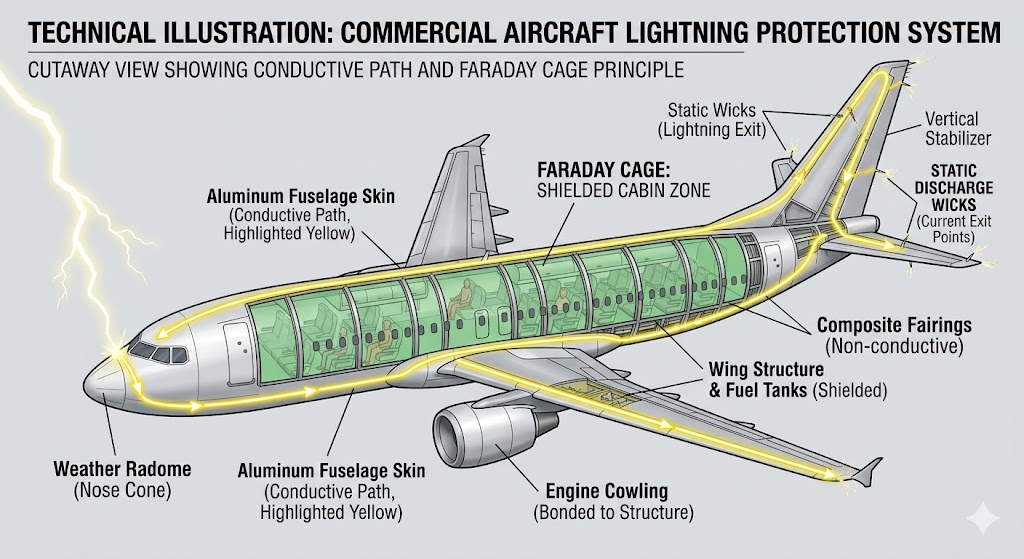
When lightning contacts the aircraft, the sequence happens in microseconds.
Entry point: The bolt typically attaches to a forward extremity — the nose radome, a wingtip, or an engine nacelle. These are the points closest to the approaching lightning channel.
Conduction along the skin: The current — up to 200,000 amperes — flows along the aircraft’s outer surface. On aluminum aircraft, the metal skin is an excellent conductor. The current travels through the fuselage from entry to exit point without penetrating the interior. This is the Faraday cage principle: a continuous conductive shell shields everything inside from external electrical fields.
Exit point: The current exits at a trailing extremity — typically the tail cone or the static discharge wicks mounted on the trailing edges of the wings and tail. These small metal rods are specifically designed to safely dissipate electrical charge from the aircraft.

What passengers experience: A bright flash visible through windows, a loud crack or bang, and possibly a momentary flicker of cabin lights. That is typically all. The loud noise can be startling, but it is simply the sound of the electrical discharge — not structural damage.
What happens to aircraft systems: In most cases, nothing. The electrical shielding protects avionics and wiring from surge damage. Occasionally a transient electrical disturbance may cause a brief instrument anomaly or minor system reset, but these are designed to be non-critical and self-correcting.
3. Why Modern Aircraft Survive Lightning: The Engineering Behind It
The reason modern aircraft handle lightning safely is not luck — it is decades of deliberate engineering driven by the one accident that changed everything.
The Pan Am Flight 214 Legacy (1963)
On December 8, 1963, a Pan American Boeing 707 was struck by lightning while holding near Elkton, Maryland. The bolt ignited fuel vapor in a wing tank, causing an explosion that destroyed the aircraft and killed all 81 on board. The investigation revealed that the fuel tank design allowed lightning energy to reach the fuel/air mixture inside.
This tragedy drove sweeping design changes that remain in effect today: fuel tank skins must be thick enough to prevent burn-through; every fastener, access door, and fuel vent must be designed and tested to prevent sparks from reaching fuel vapors; every component is electrically bonded to create continuous conductive paths that carry current along the outer skin rather than arcing across gaps. Before any commercial aircraft enters service, it undergoes rigorous lightning certification testing — engineers simulate strikes at multiple points, measuring current paths, temperatures, and spark potential.
The Composite Aircraft Challenge
Modern aircraft like the Boeing 787 and Airbus A350 use carbon fiber composite materials that are significantly less conductive than aluminum. The solution: embedded conductive mesh of copper or aluminum foil within the composite structure, creating current paths that carry lightning around the exterior just as aluminum skin does. These aircraft undergo even more extensive testing than their all-metal predecessors.
4. What the Dispatcher Knows — and Does Not Know — Before a Lightning Event

There is a structural limitation in how dispatchers manage lightning risk that passengers — and sometimes even crew — do not fully appreciate, and I want to be direct about it.
A flight plan is filed a minimum of six hours before departure. At that point, the primary weather reference tools are the valid SIGWX prognostic charts and significant weather forecasts — large-scale depictions of areas where thunderstorms, icing, and turbulence are expected. These are the best available tools at planning time, and they are genuinely useful for macro-level routing decisions: I can identify a frontal system that will be active across the planned route and adjust the course to avoid the forecast convective area. What I cannot do at T-6 hours is predict the exact position, intensity, and extent of individual thunderstorm cells that will be active in the corridor at the time the aircraft actually passes through.
📋 Dispatcher’s Note — The Gap Between Planning and Reality
Once the aircraft is airborne, my primary real-time tools shift from forecast charts to PIREP monitoring and satellite imagery. If a preceding aircraft on the same route reports severe turbulence or a lightning encounter at a specific altitude block, I pass that information to our aircraft before they reach the same position — giving the crew the most current available picture of what is ahead. But there is an irreducible gap: PIREPs come from aircraft that have already flown through the area, and satellite imagery shows cloud tops and development patterns rather than the internal electrical state of specific cells. The crew’s onboard weather radar is the highest-resolution tool available for real-time avoidance, and even that has limits — particularly for embedded convection hidden within larger cloud masses. Some lightning encounters are encounters we could not have fully prevented with any planning tool available at the time.
This is not a failure of the planning process — it is an honest description of its limits. The combination of SIGWX-based routing, real-time PIREP relay, and onboard weather radar avoidance produces a very low rate of significant encounters. But it does not produce zero. And when the encounter happens — when a crew reports a lightning hit despite all of the above — the question that moves from the crew’s hands to mine is: what did the inspection find?
5. After the Strike: Phase I, Phase II, and What They Mean for the Schedule
This is the part of lightning strike management that passengers never see — and that defines the operational reality of a lightning event far more than the strike itself.
Every lightning strike report triggers a mandatory post-landing inspection under the applicable Aircraft Maintenance Manual (AMM) procedures. Maintenance crews examine the entry and exit points for scorch marks, check the radome, inspect static wicks, test avionics systems, and assess any structural surfaces in the current path. The inspection result determines the aircraft’s status in one of two categories.
Phase I — Minor Damage: The Outcome We Hope For
Phase I findings are the most common result: small scorch marks or burn pits at the entry and exit points, minor radome damage, or static wick replacement. The damage is cosmetic and contained. Under AMM defer provisions, Phase I damage can be documented, the affected components deferred or addressed under an AMM-specified repair procedure, and the aircraft returned to service — typically within hours. For our operation, a Phase I finding usually means a 2–4 hour ground time for inspection and minor repair, a manageable delay that cascades into the day’s schedule but does not remove the aircraft from service.

Phase II — Significant Damage: The Outcome That Changes Everything
Phase II is a different situation entirely. When the inspection finds evidence of deeper penetration — current paths that reached structural members, fuel system components, or avionics wiring beyond the surface layer — the aircraft requires a comprehensive structural and systems inspection that cannot be deferred. Phase II inspection and repair grounds the aircraft for a minimum of approximately two days. Depending on the location and extent of the damage, it can extend significantly longer if composite repair or avionics replacement is required.
📋 Dispatcher’s Note — What a Phase II Finding Looks Like From the OCC
When maintenance calls and tells me an aircraft requires Phase II inspection, my immediate response is to pull that aircraft’s forward schedule and start rebuilding. Every flight that tail number was assigned to operate for the next 48 hours needs an alternative — a different aircraft, a slot transfer, or a cancellation. On a tight summer schedule with high load factors, reassigning those flights to remaining available aircraft means compressing turnaround times, extending crew duty windows to their regulatory limits, and accepting cascading delays that accumulate through the day and often into the next. During peak monsoon season, when convective activity is highest and multiple aircraft on our network may be encountering lightning within the same weather system, I have had phases where two or three aircraft were simultaneously under Phase II assessment — and the arithmetic of covering their combined schedule with the remaining fleet is genuinely difficult. The lightning strike itself is over in a microsecond. Its operational consequences can last days.
How Inspection Findings Are Made
One important nuance: not all lightning encounters are reported in flight. Some are identified during the routine post-flight external inspection that occurs after every landing, when maintenance crews notice characteristic burn pits or scorch marks at wing tips, tail surfaces, or the radome — even when the crew had no awareness of a strike during flight. The aircraft’s weather radar system and avoidance maneuvers reduce encounter probability, but they do not eliminate it entirely, and some strikes leave no in-flight indication whatsoever. The post-flight walkaround is the final safety net that catches what the flight itself did not announce.
6. Why We Avoid Thunderstorms — Lightning Is the Least of It

If aircraft can survive lightning, why do pilots and dispatchers work so hard to avoid thunderstorms? Because lightning is actually the least dangerous thing about a thunderstorm. Inside a mature cumulonimbus, the real threats are severe turbulence — vertical air currents that can exceed 100 km/h and stress airframe structures — wind shear microbursts on approach and departure that can cause sudden unrecoverable altitude loss, hail that causes physical impact damage to the radome and leading edges, and rapid icing from supercooled water droplets. Standard procedure is to maintain a minimum of 20 nautical miles lateral separation from any cumulonimbus cell. This protects against turbulence, wind shear, and hail far more than it protects against lightning.
During typhoon season across our Asian network, thunderstorm avoidance routing is one of my most time-consuming planning tasks — rerouting flights around cells, calculating fuel for deviations, and relaying PIREP updates to crews in real-time as the weather picture develops through the day. The additional fuel for a 50nm deviation around a convective area is a straightforward cost. The AOG cost of a Phase II lightning strike on an aircraft that flew too close to a cell it could have avoided is not.
7. What Passengers Should Know
If your plane is struck, you are safe. The Faraday cage principle ensures the current stays on the outside. You may hear a loud crack and see a flash — that is the extent of your experience in the cabin. The aircraft will almost certainly continue to its planned destination unless the crew detects a system anomaly, which is rare.
The flight after yours may not operate normally. The operational impact of a lightning strike falls not on the flight that was struck, but on the flights that were supposed to use that aircraft next. If the post-landing inspection produces a Phase II finding, those subsequent flights are cancelled or delayed — and passengers on those flights have no way of knowing that a lightning event on an earlier service is the root cause of their disruption.
Lightning does not cause turbulence. These are separate phenomena produced by the same storm. The crack of a lightning strike does not shake the aircraft. The turbulence you feel is caused by the air currents inside the storm system — entirely independent of the electrical discharge.
The aircraft avoidance system is layered but not perfect. Flight plans route around forecast convective areas. Airborne PIREP relay warns of active encounter zones. Onboard weather radar provides real-time avoidance guidance. But embedded convection within larger cloud systems and rapid cell development between PIREP reports mean that some encounters happen despite all of the above. When they do, the inspection result is what determines the real operational consequence.
Frequently Asked Questions
How often does an airplane lightning strike happen?
On average, each commercial aircraft is struck once or twice per year — roughly once per 1,000 flight hours. Most events occur between 5,000 and 15,000 feet during climb and descent through electrically active cloud layers. Despite this frequency, lightning-caused damage requiring extended grounding is relatively uncommon — the majority of strikes produce Phase I findings that are resolved within hours.
Can lightning bring down a commercial airplane?
In modern aviation, no. The last crash attributed to an airplane lightning strike was Pan Am Flight 214 in 1963. Since then, sweeping design changes — fuel tank protection, electrical bonding, certification testing — have eliminated the vulnerabilities. Modern aircraft are specifically designed and tested to survive lightning events without any safety compromise to occupants.
What is the difference between Phase I and Phase II lightning inspection?
Phase I findings are minor and surface-level — scorch marks, burn pits, static wick damage — that can be addressed under AMM defer provisions with the aircraft returning to service within hours. Phase II findings indicate deeper damage to structural members, fuel system components, or avionics wiring that requires comprehensive inspection and repair. A Phase II finding grounds the aircraft for a minimum of approximately two days, affecting every flight that aircraft was scheduled to operate during that period.
Why can’t dispatchers prevent lightning encounters through better routing?
Flight plans are filed 6+ hours before departure using SIGWX prognostic charts and significant weather forecasts — the best available tools at planning time, but unable to predict the exact position and intensity of individual thunderstorm cells that will be active in the corridor when the aircraft actually passes through. Once airborne, real-time PIREP relay and the crew’s onboard weather radar provide additional avoidance guidance, but embedded convection and rapid cell development create encounters that no planning system can entirely prevent. Some lightning events are operationally unavoidable given current forecast technology.
What do passengers experience during a strike?
Typically a bright flash visible through the windows and a loud crack or bang. Cabin lights may flicker momentarily. In most cases, that is the full extent of the passenger experience. The aircraft continues flying normally, and many passengers do not realize what happened. The Faraday cage design ensures that no electrical energy reaches the cabin interior.
Why do pilots avoid thunderstorms if lightning is survivable?
Because thunderstorms contain hazards far more dangerous than lightning: severe turbulence, wind shear microbursts, hail, and rapid icing. Standard procedure is to maintain at least 20 nautical miles from any cumulonimbus cell. Lightning is the least operationally concerning element of a thunderstorm for a modern aircraft in flight — the violent air currents, structural hail impact, and icing are the threats that dispatchers and pilots actively prioritize avoiding.
Does the pilot land immediately after a strike?
Usually not. If all systems operate normally — which is the typical outcome — the flight continues to its planned destination and a mandatory post-flight inspection is requested on arrival. Only if the crew detects a system anomaly would they consider diverting, and this is uncommon. The Phase I or Phase II determination happens after landing, not during the flight.
Have you experienced a lightning event on a flight — the crack, the flash, the flickering lights? Share what you observed in the comments. Passenger accounts of in-flight lightning help others understand what the experience actually feels like, and why the aircraft’s calm continuation afterward is exactly the designed response.
Disclaimer: The views expressed in this article are my own professional opinions based on 15+ years of operational experience. They do not represent the official position of any airline, aviation authority, or regulatory body.
About the Author
Aeruxo_DISP_H is a licensed aircraft dispatcher holding both the FAA Aircraft Dispatcher Certificate (United States) and the Korean Ministry of Land, Infrastructure and Transport (MOLIT) Flight Dispatcher License. He has 15+ years of active operational duty at a Northeast Asian low-cost carrier operating primarily from Incheon International Airport (ICN) across Japan, China, and Southeast Asia routes. He is currently a graduate researcher in aviation policy at Korea Aerospace University. The views expressed in this article are his own professional opinions and do not represent any airline, aviation authority, or regulatory body.

Licensed Flight Dispatcher with 15+ years of experience in airline operations control. Holds FAA Aircraft Dispatcher Certificate and Republic of Korea Flight Dispatcher License (MOLIT). Specializes in flight watch, NOTAM analysis, flight planning, and operational control at a Korean LCC. IOSA audit participant and author of multiple airline operational manuals, including Emergency Response, De-icing, and OCC Procedures.