By Aeruxo — Licensed flight dispatcher (study guide) | 15+ Years in Airline Operations
The call came in at 2:14 in the morning. “Dispatch, this is the
captain on Hotel-Juliet-Lima. We have hydraulic pressure loss on
system two. We’re declaring PAN PAN. Request priority handling at
Incheon and emergency services on standby.” Within 90 seconds, I had
coordinated with Incheon Approach, confirmed emergency services were
positioning, alerted the station manager, and was cross-checking our
alternate fuel with the crew. Forty-one minutes later, the aircraft
landed without incident. Emergency services stood down. Passengers
disembarked at the gate without knowing exactly what had just been
managed on their behalf.
The phrase “emergency landing” triggers images of flames, chaos,
and crash scenarios pulled from disaster films. The reality of how an
emergency landing actually unfolds — and how rarely it ends in serious
injury — is almost the inverse of that image. Modern aviation
emergencies are among the most well-rehearsed, systematically managed
events in any industry. After 15 years as a flight dispatcher
coordinating emergencies across Japan, China, and Southeast Asia, I
want to explain what an emergency landing actually is, the five
distinct types that exist in operations, and what happens from the
moment a crew declares one to the moment passengers step off
the aircraft.

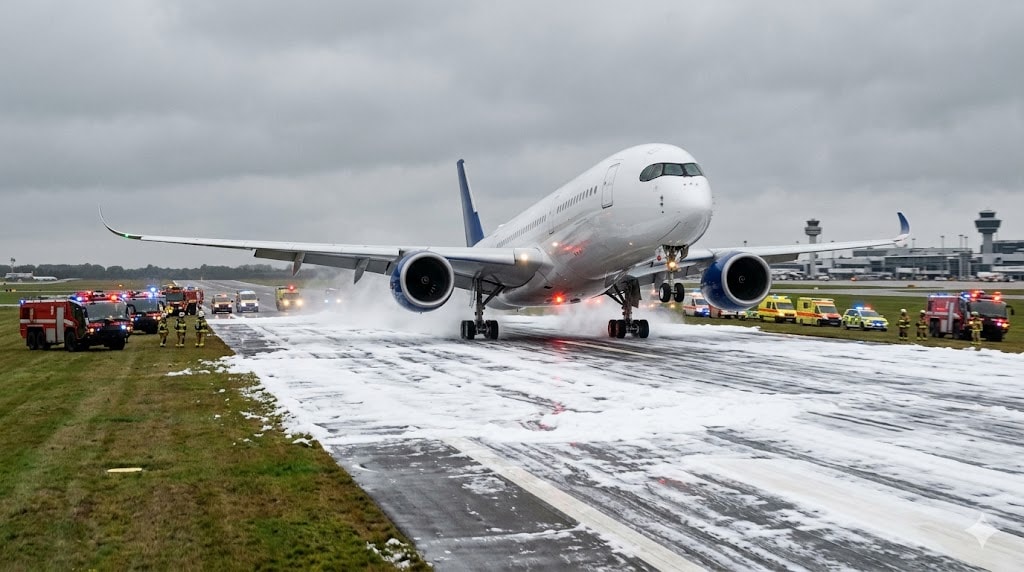
is among the most dramatic-looking events in aviation — and also among
the most carefully prepared. This level of response is activated for
precautionary landings where no fire exists yet.
Key Takeaways
- An emergency landing is not a crash. It is a
structured, declared event with defined procedures for the crew, ATC,
airport services, and dispatch — coordinated in parallel from the
moment of declaration. - There are two formal emergency levels: MAYDAY and PAN
PAN. MAYDAY is life-threatening and immediate; PAN PAN is
urgent but not immediately life-threatening. Both trigger emergency
services response. - Most emergency landings end without injury.
Precautionary and technical emergency landings — the vast majority of
declared events — result in passengers deplaning normally at the gate
or on the runway. - The dispatcher coordinates with ATC, airport operations,
maintenance, and the crew simultaneously from the moment the
emergency is declared. - Runway foaming and gear-up preparations are activated for
specific scenarios:not every emergency landing. Most
declarations result in a priority approach, not a foam runway.
This article is based on real operational experience supporting flight planning and emergency decision-making in an airline Operations Control Center (OCC).
1. What an Emergency Landing Actually Is
In aviation, “emergency landing” covers a range of events far
broader than the crash-scenario image most people carry. The technical
definition is any landing made necessary by an abnormal condition that
the crew determines requires an unplanned or expedited arrival. That
definition includes everything from a passenger’s medical crisis
requiring an immediate divert to a catastrophic structural failure
requiring a forced landing at the nearest available surface. The vast
majority of emergency landings fall at the benign end of that
spectrum — a hydraulic anomaly, a pressurization warning, a smoke
indication that may be an electrical fault rather than a fire — where
the aircraft is perfectly flyable and the emergency declaration exists
to ensure priority handling and resources are prepositioned.
Understanding this spectrum is the key to understanding why most
emergency landings produce no injuries. The system is designed to
escalate early, before conditions deteriorate, so that the aircraft
arrives with every possible resource already in position. On our
Korean LCC network, my experience with declared emergencies is that
the gap between what passengers imagine and what actually happens on
the ground is wider than almost any other event in aviation.
2. MAYDAY vs PAN PAN: The Two Levels of Emergency Declaration

emergency declarations with precise meanings. The choice of phrase
tells every listener — ATC, other aircraft, rescue services — exactly
what level of response is required.
International aviation uses two standardized distress phrases, each
carrying a specific meaning to every listener on the frequency.
MAYDAY (from the French m — aidez, “help me”)
is the highest level of distress declaration, signaling that the
aircraft is in grave and imminent danger requiring immediate
assistance. A MAYDAY requires full emergency response: all other
aircraft on the frequency must maintain radio silence unless
assisting, ATC clears airspace immediately, and full ARFF (Aircraft
Rescue and Fire Fighting) response is dispatched to the runway.
MAYDAY-level emergency landings include uncontrolled fire on board,
complete loss of control, dual engine failure, catastrophic structural
failure, or any situation where the crew believes immediate landing is
necessary for survival.
PAN PAN (from the French panne,
“breakdown”) signals an urgent situation that is serious but not
immediately life-threatening. The crew needs priority handling and
has declared an emergency, but the aircraft is not in immediate
danger. ATC provides priority routing and informs emergency services,
which position on standby rather than deploying onto the runway.
PAN PAN-level emergency landings include single hydraulic system
failure, single engine failure on a multi-engine aircraft,
pressurization anomaly, fuel concern requiring priority approach, or
a medical emergency requiring immediate landing. My hydraulic call
above was a PAN PAN — the aircraft had redundant hydraulic systems and
was fully controllable; we needed priority handling and standby
services, not a foam runway.
According to
SKYbrary’s emergency communications
guidance, crews are trained to choose the appropriate level rather
than automatically escalating to MAYDAY. A well-calibrated PAN PAN
declaration ensures resources are ready without triggering a response
that consumes ARFF capacity needed elsewhere.
3. The 5 Types of Emergency Landing
Not all emergency landings look the same. After 15 years of
handling them operationally, I categorize them into five distinct
types with different triggers, procedures, and outcomes.
Precautionary emergency landing. This is the most
common type by a wide margin. The aircraft has an anomaly that is not
immediately dangerous but that the crew determines warrants an
expedited landing rather than continuing to the planned destination.
Examples include a single hydraulic warning, a cabin air quality
issue, or an avionics anomaly. The aircraft is fully controllable,
emergency services stand by, and the aircraft lands normally and taxis
to the gate. Passengers may or may not be informed of the reason for
the early or unscheduled arrival.
Medical emergency landing. A passenger or crew
member requires immediate hospital care that cannot wait for the
scheduled arrival. The dispatcher coordinates with the nearest
suitable airport, confirms medical facilities are available, and
arranges ground medical response. This type of emergency landing does
not typically involve ARFF response unless the medical situation has
a safety component — an incapacitated crew member, for example. I cover
this scenario in detail in my
in-flight medical emergency article.

simultaneous communication with the crew, ATC, airport operations,
maintenance control, and the duty manager — while tracking the
aircraft’s position and fuel state in real time.
Technical emergency landing. A mechanical failure
has compromised one or more aircraft systems to a degree that requires
immediate landing, but the aircraft remains flyable. Single engine
operations, partial hydraulic loss, or a pressurization issue that
requires descent to a lower altitude all fall into this category.
The crew works through the relevant abnormal checklist, declares PAN
PAN or MAYDAY depending on severity, and coordinates the approach.
Emergency services are positioned. The landing is typically uneventful
because the aircraft’s redundant systems keep it controllable and the
approach is flown normally.
Gear-up (belly) emergency landing. Landing gear
fails to extend or lock down — one of the rarest but most visually
dramatic types of emergency landing. The crew cycles the gear,
attempts the alternate extension system, and if unsuccessful, prepares
for a gear-up landing. The runway is foamed, emergency services
deploy, and the aircraft lands on its belly — fuselage contacting the
runway directly and decelerating via friction. Structural damage
occurs but is typically limited. Modern aircraft fuselage structures
are designed to withstand this load, and injuries are uncommon in
documented gear-up emergency landings. Before accepting this outcome,
the crew and I exhaust every alternative: low-altitude gear-down
visual inspection by another aircraft or tower, alternative gear
extension methods, attempting to shake the gear loose with maneuvers.
Forced landing (engine failure or fuel exhaustion).
The most severe type, where the aircraft has lost power and must land
wherever conditions allow — an airport, a field, a road, or water
(ditching). Modern multi-engine commercial aircraft are designed and
certified for extended operations on a single engine. True forced
landings in commercial aviation — where all engines have failed — are
extraordinarily rare and almost always involve unique circumstances
such as fuel exhaustion due to calculation error or volcanic ash
engine flame-out.
4. What the Dispatcher Does During an Emergency Landing
When a crew declares an emergency, my role shifts from planning
support to active coordination, and the sequence is fast and
simultaneous. First, I acknowledge and assess: I
confirm the nature of the emergency with the crew, the aircraft’s
current position and fuel state, and the intended divert or
destination airport. If the crew has not yet identified a suitable
airport, I identify the nearest options with the correct runway
length, emergency services, and handling capability immediately.
Second, I coordinate with airport operations.
I contact the destination airport’s operations center or coordinate
through ATC to ensure emergency services are notified and positioned.
For a MAYDAY with gear uncertainty or fire indication, I request ARFF
deploy to the runway threshold. For a PAN PAN, I request standby
positioning. The difference matters because full ARFF deployment to
an active runway occupies resources that may be needed elsewhere.
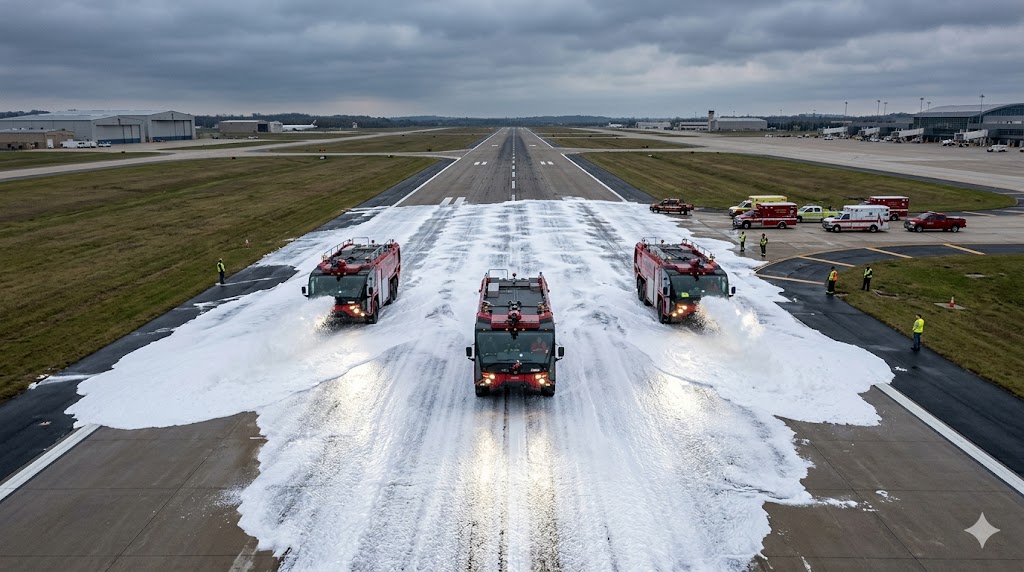
emergency landing scenarios. The foam reduces friction heat during
the belly slide and suppresses fuel-ignition risk. Most emergency
landing declarations do not reach this stage.
Third, I notify internal stakeholders simultaneously.
The duty manager, maintenance control, and station management at the
destination are all notified in parallel, not sequentially. Maintenance
needs to be ready for an immediate post-landing inspection. Station
needs to handle the passengers and coordinate ground transport if the
aircraft parks on a remote stand rather than a gate. Fourth,
I monitor fuel and alternate status throughout the approach
to ensure the aircraft is not forced into a second emergency due to
fuel state — particularly critical if a go-around becomes necessary
after the initial approach. Every call, every decision, and every
coordination step is logged with timestamps to support the mandatory
incident investigation that follows any emergency landing declaration.
5. Why Most Emergency Landings End Without Injury

damage — but the fuselage is designed to sustain this load. Emergency
services are pre-positioned precisely so they can respond within
seconds if fire develops.
The outcome statistics for commercial aviation emergency landings
are genuinely reassuring once you understand the system that produces
them. Early declaration is the first reason: crews
are trained and culturally incentivized to declare early. A PAN PAN
declared when a single hydraulic system shows a warning — while the
aircraft is fully controllable — gives the system maximum time to
prepare. The phrase “declare early, cancel later” is embedded in
airline emergency training, and it directly improves outcomes by
converting surprise emergencies into managed ones.
Redundant aircraft systems are the second factor.
Commercial aircraft are certificated with multiple redundant systems
for every safety-critical function. Loss of one hydraulic circuit
still leaves two others. Single engine failure on a twin-engine
aircraft leaves an engine with more than enough thrust to land safely.
The aircraft is designed so that a single failure does not produce a
catastrophic outcome — it produces an abnormal that the remaining
systems manage. Trained crews with rehearsed procedures
compound this: every emergency scenario has an abnormal checklist that
crews complete in simulator training repeatedly. An
engine failure at altitude produces a specific, memorized sequence
of actions — not improvisation. The emergency landing that follows is
the product of a checklist, not panic.
Finally, controlled conditions and pre-positioned resources
complete the picture. Unlike a road accident or a building fire, an
emergency landing happens at a known location, at a controlled speed
within the aircraft’s certified landing envelope, on a surface designed
for aircraft operations. By the time the aircraft arrives, ARFF
vehicles are in position, medical response is ready, and the runway
is clear. If something does go wrong during touchdown, response time
is measured in seconds rather than minutes. The variables are managed
in ways that civilian emergencies almost never are.
6. What Passengers Should Do During an Emergency Landing

seconds across all exits on modern commercial jets — a certification
requirement. The most important passenger action is following crew
instructions immediately and leaving carry-on baggage behind.
If you are on board during an emergency landing, your role is
specific and simple. Listen to the crew without
negotiation or delay. Every instruction — brace position, seatbelt
tightening, electronics off, window shades up, tray tables stowed’
has a reason rooted in accident investigation data. The brace
position is not theatrical. Research consistently shows it
reduces head impact injury and keeps passengers conscious and mobile
for evacuation. If the crew instructs brace, assume it immediately.
Leave everything behind during an evacuation.
Carry-on bags block slides, slow evacuation, and have directly
contributed to fatalities in documented accidents. The slides must be
clear — there are no exceptions. Move away from the aircraft after
evacuating, upwind if possible, and wait for emergency services to
direct you. The area around a landed aircraft after an emergency
landing carries fuel spill and fire risk that is not always visible.
The final practical preparation you can make before any flight is
counting the rows to the two nearest exits during the
safety demonstration. In a smoke-filled cabin, you cannot see. That
count is the only navigation you will have. For more on this, my
seat selection article covers exit proximity in detail.
Frequently Asked Questions
What is an emergency landing?
An emergency landing is any unplanned or expedited landing made
necessary by an abnormal condition on board. This ranges from a
passenger medical crisis requiring an immediate divert to a
catastrophic system failure requiring landing at the nearest available
airport. Both formal emergency levels — MAYDAY (grave and imminent
danger) and PAN PAN (urgent but not immediately life-threatening)—
trigger structured coordination between the crew, ATC, airport
operations, and the dispatcher.
What is the difference between MAYDAY and PAN PAN?
MAYDAY is the highest level of distress declaration, signaling
grave and imminent danger requiring immediate assistance. It triggers
full ARFF deployment to the runway. PAN PAN is an urgency declaration
for serious situations that are not yet immediately life-threatening,
triggering emergency services standby rather than full deployment.
Crews choose the appropriate level based on actual severity — not every
serious situation warrants a MAYDAY, and calibrating correctly ensures
resources are deployed where they are needed.
How common are emergency landings?
Emergency declarations are more common than passengers realize,
but the vast majority are precautionary PAN PAN declarations that
result in a priority approach and normal landing. Full MAYDAY-level
emergency landings with ARFF deployment are significantly rarer.
Gear-up landings and forced landings are genuinely exceptional events
in commercial aviation — notable enough that each one generates
significant industry documentation and investigation.
Does the dispatcher know about an emergency landing?
Yes. The crew is required to notify dispatch of any emergency
declaration. In practice, I am usually notified within minutes of
the declaration and become an active coordinator for the remainder
of the flight — managing divert options, fuel, airport coordination,
and internal notifications simultaneously while monitoring the
aircraft’s progress.
What happens after an emergency landing?
After any emergency landing, the aircraft undergoes a mandatory
maintenance inspection before returning to service. Every declaration
is documented and subject to a mandatory safety report under ICAO
and national aviation authority requirements. Depending on severity,
a formal investigation may follow. The documentation process is
thorough precisely because the lessons of each event are used to
refine the procedures that make the next one safer.
Are gear-up landings survivable?
Yes. Documented gear-up emergency landings in commercial aviation
have an excellent survival record precisely because the system
activates well in advance. The aircraft fuselage is engineered to
withstand belly-slide loads. The runway is foamed to reduce friction
heat and suppress ignition. ARFF vehicles are at the threshold. The
deceleration is controlled and predictable. Structural damage occurs;
serious injury is uncommon in modern documented cases.
What should passengers do during an emergency landing?
Follow crew instructions immediately and without negotiation. Assume
the brace position if instructed. During evacuation, leave all
carry-on baggage at your seat — bags on slides have caused fatalities
in documented events. Move away from the aircraft after evacuating.
The single most useful preparation you can make before any flight is
counting the rows to the two nearest exits while the safety
demonstration is in progress.
Have you been on a flight that declared an emergency or made an
unplanned diversion? Share your experience in the comments — passenger
accounts help other travelers understand what to expect.
Disclaimer: The views expressed in this article are my own
professional opinions based on 15+ years of operational experience.
They do not represent the official position of any airline, aviation
authority, or regulatory body.

Licensed Flight Dispatcher with 15+ years of experience in airline operations control. Holds FAA Aircraft Dispatcher Certificate and Republic of Korea Flight Dispatcher License (MOLIT). Specializes in flight watch, NOTAM analysis, flight planning, and operational control at a Korean LCC. IOSA audit participant and author of multiple airline operational manuals, including Emergency Response, De-icing, and OCC Procedures.