By Aeruxo — Licensed Flight Dispatcher | 15+ Years in Airline
Operations
The PIREP arrived on my screen 11 minutes before our aircraft
reached the final approach fix: “MOD WIND SHEAR. 800 FT AGL.
AIRSPEED FLUCTUATION PLUS/MINUS 20 KT. B737. 1312Z.” I had
already been watching the weather radar — a line of convective
cells was pushing across the approach corridor faster than the
TAF had predicted. I called the crew immediately. They acknowledged,
requested the current ATIS, and advised they were evaluating a
possible hold. Four minutes later they elected to hold at the fix
for 20 minutes. The convective line passed. The wind shear PIREPs
stopped. The aircraft flew the approach in nil wind shear and
landed normally. The passengers were 22 minutes late. They were
safe because a pilot who landed 11 minutes before them reported
exactly what they had encountered, and because both the crew and
I treated that report as the operational boundary it was.
Wind shear is the Aviation Weather (recommended reading) hazard that killed more
passengers per event than almost any other in the history of
commercial aviation — and the one that the public understands least.
Unlike turbulence, which shakes the aircraft, or lightning, which
makes a dramatic bang, wind shear acts invisibly on the aircraft’s
aerodynamic performance. It does not feel like danger until the
aircraft has already lost the energy it needs to fly. After 15
years dispatching flights through the convective weather systems
of East Asia and studying the accident history that drove the
detection systems now protecting every approach, I want to explain
exactly what wind shear is, why microbursts are the most dangerous
variant, and how the system that exists today was built on the
lessons of specific disasters.
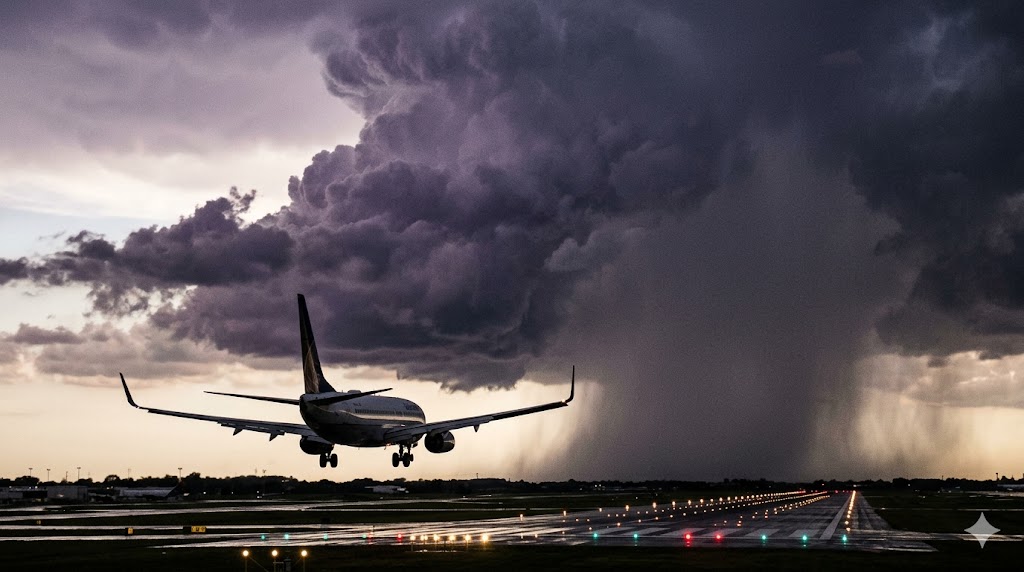
cell crossing the approach path at low altitude, where the aircraft
has minimum airspeed, maximum configuration drag, and no altitude
margin to recover from an energy loss.
Key Takeaways
- Wind shear is a rapid change in wind speed or
direction over a short distance. On approach, it changes
the aircraft’s airspeed and lift without any pilot input — creating
energy states the crew must correct before the aircraft reaches
the ground. - A microburst is the most lethal form of wind shear.
A column of descending air hits the ground and spreads outward,
producing a headwind-to-tailwind transition that first increases
airspeed then collapses it, all within seconds at low altitude. - Delta Air Lines Flight 191 in 1985 is the
defining accident in wind shear history — 135 fatalities that drove
the mandatory installation of LLWAS, airborne predictive wind shear
systems, and the PIREP reporting culture that protects approaches today. - Modern wind shear detection uses three overlapping
systems: LLWAS ground sensors at the airport, airborne
predictive wind shear radar onboard the aircraft, and real-time
PIREP reports from preceding aircraft. - A wind shear escape maneuver is a specific, trained
procedure:not a normal go-around. It demands maximum
thrust, specific pitch attitude, and acceptance of stick shaker
activation as the crew recovers energy at the lowest possible
altitude.
This article is based on real-world experience monitoring convective weather and wind shear risks in an airline Operations Control Center (OCC), including real-time PIREP analysis and approach safety decisions.
1. What Wind Shear Actually Is
Wind shear is defined as a change in wind velocity — speed,
direction, or both — over a defined distance or altitude band.
At cruise altitude, wind shear exists wherever jet streams and
atmospheric layers create speed differentials between adjacent
air masses, and it produces the clear-air turbulence that shakes
passengers in their seats. At low altitude during approach and
departure, wind shear produces a fundamentally different and more
dangerous threat: it changes the aircraft’s indicated airspeed
without any change in aircraft attitude or thrust, altering the
lift being generated at the precise phase of flight where altitude
and speed margins are smallest.
An aircraft on final approach maintains a target airspeed
calculated to provide adequate lift at the current weight and
configuration with a defined margin above the stall. If the wind
suddenly shifts from a headwind to a tailwind — reducing the effective
airspeed by 20 knots — the aircraft’s lift decreases, and the
aircraft begins to descend faster than the glidepath. The crew
must add thrust and pitch to recover the airspeed and glidepath.
At 500 feet above the ground with full flaps and landing gear
down, the aircraft’s aerodynamic drag is at its highest and its
energy margin is at its lowest. The recovery from an unexpected
20-knot airspeed loss at that altitude requires immediate,
maximum-rate response. Wind shear does not announce itself — the
first indication is the altimeter unwinding and the airspeed
dropping simultaneously.
Why Wind Shear Is Dangerous During Landing
Wind shear is most dangerous during landing because the aircraft is at low altitude, low energy, and high drag configuration…
2. The Microburst: Why Wind Shear Kills

encounters an increasing headwind (airspeed rises, pilots reduce
thrust), then enters the downdraft column (pushed toward the ground),
then encounters a tailwind (airspeed collapses). The entire sequence
can occur in under 60 seconds at approach speed.
A microburst is a small but intense column of air that descends
from a thunderstorm cell, hits the ground, and spreads outward
radially in all directions. The descending column typically has
a ground footprint of less than 4 kilometres in diameter — small
enough to be crossed entirely by an approaching aircraft in under
60 seconds at approach speed. This compact geometry is what makes
the microburst specifically lethal: the entire wind shear sequence
from entry to exit occurs at low altitude in a time frame that
leaves no margin for gradual recognition and response.
The sequence an aircraft experiences when flying through a
microburst on approach follows a consistent and deceptive pattern.
Entering the outflow headwind: the aircraft
encounters increasing headwind, airspeed rises above target, lift
increases. The autopilot or the pilot responds naturally by reducing
thrust to maintain the target speed. Crossing into the
downdraft: the downward-moving air column pushes the
aircraft toward the ground. The aircraft begins to descend below
the glidepath. Thrust that was reduced is no longer available
immediately — jet engines require several seconds of spool-up to
reach maximum thrust. Exiting into the outflow tailwind:
the headwind transitions to a tailwind. Airspeed drops suddenly
and significantly — the 20 knots of headwind that was adding to
airspeed is replaced by 20 knots of tailwind subtracting from it.
The aircraft has now lost 40 knots of effective airspeed. At 300
feet above the ground with engines spooling up and airspeed below
minimum approach speed, the aircraft is at the edge of controlled
flight with no altitude to recover.
3. Delta 191: The Accident That Changed Everything

the microburst cell crossed the approach path in the final mile
before the runway. The aircraft entered the headwind, crossed
the downdraft, encountered the tailwind, and impacted the ground
one mile short of the threshold. 135 of 163 people aboard were
killed.
On August 2, 1985, Delta Air Lines Flight 191, a Lockheed
L-1011 on approach to Dallas/Fort Worth International Airport,
flew through a microburst at low altitude. The aircraft encountered
the classic headwind-downdraft-tailwind sequence. The crew applied
maximum thrust, but the energy loss was too sudden and the altitude
too low. The aircraft struck the ground one mile short of the
runway threshold at 162 knots groundspeed. Of the 163 persons
aboard, 135 were killed, along with one person on the ground.
The NTSB investigation found that the microburst wind shear
encountered was beyond the crew’s ability to recover from given
the aircraft’s energy state at the point of encounter — not pilot
error, but an encounter with a phenomenon for which neither
detection technology nor escape procedures were adequately
developed at that time.
The regulatory and technological response to Delta 191 was
comprehensive and permanent. The FAA mandated the installation
of Low Level Wind Shear Alert Systems (LLWAS) at all certificated
airports above a defined traffic threshold. It required the
development and installation of airborne predictive wind shear
detection systems on transport category aircraft. It formalized
wind shear PIREP reporting procedures so that pilots who encounter
wind shear on approach are required to report it immediately for
the benefit of following aircraft. It drove the development of
specific wind shear escape maneuver procedures and their
integration into airline training programs. According to the
NTSB accident report for Delta
Air Lines Flight 191, the investigation produced 26 safety
recommendations — one of the most consequential single-accident
regulatory responses in US aviation history.
4. The Three Systems That Detect Wind Shear Today

measure wind speed and direction. The system compares readings
from multiple sensors simultaneously — a difference indicating
microburst outflow triggers an immediate alert to ATC and the
crew on approach.
LLWAS (Low Level Wind Shear Alert System) is
a network of anemometers positioned around the airport perimeter
and at the runway thresholds. The system continuously compares
wind readings from all sensors simultaneously. When the difference
between sensors exceeds a defined threshold — indicating that
outflow from a microburst is producing dramatically different
wind conditions at different points on the airport — the system
generates an automatic alert to the ATC tower, which issues an
immediate wind shear alert to all aircraft on approach and
departure frequencies. LLWAS detects wind shear that has already
reached the airport surface. It provides real-time information
but no advance warning of what is approaching.
Airborne predictive wind shear radar provides
the advance warning that LLWAS cannot. Modern commercial aircraft
carry weather radar systems with wind shear detection algorithms
that analyse the Doppler shift of precipitation returns in the
approach corridor. When the system detects the diverging outflow
pattern characteristic of a microburst ahead, it issues a
PREDICTIVE WIND SHEAR alert in the cockpit up to 90 seconds
before the aircraft would encounter the hazard — enough time to
execute a go-around before entering the microburst. PIREPs
(Pilot Reports) are the third layer — the real-time
human intelligence from the crew of the preceding aircraft.
A PIREP reporting moderate wind shear at 800 feet on approach,
like the one that triggered my hold decision at the opening of
this article, provides specific altitude and airspeed deviation
data that neither LLWAS nor the weather radar can match in
operational relevance. The three systems together create
overlapping coverage that the single-layer detection available
in 1985 could not provide.

display provides up to 90 seconds of advance warning — enough time
to initiate a go-around before the aircraft enters the microburst.
The alert is mandatory equipment on modern commercial aircraft.
5. The Wind Shear Escape Maneuver
If an aircraft encounters unexpected wind shear on approach
without sufficient advance warning to go around before entry, the
crew executes a wind shear escape maneuver — a specific procedure
that is distinct from a normal go-around and trained separately
in simulator sessions. Thrust to maximum immediately:
not the normal go-around thrust setting, but the maximum available,
including any reserved thrust modes the aircraft has. The response
to the microburst’s energy drain requires every newton of thrust
the engines can produce, and engine spool-up time means the
command must precede the full need by several seconds.
Pitch to the escape attitude:a specific nose-up
pitch attitude defined in the aircraft’s procedures, typically
higher than a normal go-around attitude, designed to arrest the
descent rate as quickly as possible. Accept stick shaker
activation:the wind shear escape maneuver may require
flying closer to the aircraft’s aerodynamic stall margin than any
other normal procedure permits. The stick shaker — the stall warning
that vibrates the control column — may activate during the maneuver,
and crews are trained to accept it and maintain the escape attitude
rather than reducing pitch. Do not retract gear or flaps
immediately:configuration changes require attention and
time that the initial recovery phase cannot afford. The priority
is altitude and airspeed recovery. Configuration follows when
positive climb is established. The wind shear escape maneuver is
one of the most demanding procedures in commercial aviation
training specifically because it requires accepting warnings that
would normally demand an opposite response.
6. What the Dispatcher Does About Wind Shear

PIREP reports are the three sources I monitor for any flight
approaching a destination with active convective activity. A
SIGMET for low-level wind shear at a destination triggers an
immediate alternate fuel check and crew notification.
Wind shear at the destination directly affects my release
decision and alternate fuel calculation. The primary tool is the
destination terminal forecast (TAF), which I cross-reference
against SIGMET advisories and convective SIGMET (CONVECTIVE SIGMET)
issuances covering the arrival corridor. A SIGMET for low-level
wind shear or microburst activity at or near the destination
during the arrival window triggers three simultaneous actions:
I check alternate fuel adequacy, contact the crew to advise them
of the current advisory, and begin monitoring real-time PIREP
reports from aircraft on approach. If the PIREPs begin reporting
moderate or severe wind shear, I escalate to recommending a hold
or divert decision to the crew, with the alternate fuel calculation
already completed so the crew has the numbers they need without
having to request them.
The PIREP monitoring sequence is the most time-sensitive part
of this work because wind shear conditions at an airport can change
within minutes. A microburst that produced severe wind shear reports
for 20 minutes may dissipate completely as the parent thunderstorm
moves through. Conversely, a clear approach corridor can be
contaminated within minutes by a new cell. I maintain a rolling
15-minute window of PIREPs for any destination where convective
activity is within 20 nautical miles of the airport. For how
convective weather affects broader route planning across our
East Asian network — including the typhoon season routing challenges
that produce the most complex wind shear environments I manage’
my
typhoon season article covers the full seasonal weather
framework. For how thunderstorm avoidance interacts with our
lightning management procedures, my
lightning strike article addresses the same convective
threat from a different angle.
What Passengers Should Know About Wind Shear
A go-around in deteriorating weather on approach is
the correct outcome, not a failure. When a crew initiates
a go-around during an approach to a thunderstorm-affected airport,
they may be responding to a LLWAS alert, a predictive wind shear
warning, or a PIREP from the aircraft ahead. All three are the
detection system functioning exactly as designed. The go-around
is the system working. The alternative — continuing an approach
into a detected wind shear environment — is what the detection
system exists to prevent.
Holding delays near thunderstorm-affected airports
are wind shear management, not ATC inefficiency. When
aircraft are held at altitude or directed to wait for a convective
line to pass before beginning their approach, the delay is a
deliberate, coordinated decision to keep aircraft above the wind
shear environment until it has moved or dissipated. Twenty minutes
of holding is a trivial cost compared to the alternative, and
every minute the crew and dispatcher spend monitoring the weather
during that hold is a minute of active safety management.
The firm, fast approach in gusty conditions is
deliberate. In conditions with reported wind shear,
crews add an approach speed increment — typically 5 to 20 knots
above the normal approach speed — to provide an energy buffer
against unexpected airspeed loss. The landing that results is
firmer and faster than a calm-weather arrival. Passengers who
notice a faster, firmer touchdown in stormy conditions are
noticing the crew’s correct response to the wind shear environment,
not a rough landing. For a complete explanation of how different
weather conditions affect approach speed and landing technique,
my
snow and ice operations article covers the contaminated-surface
speed addition that operates on the same principle.
Frequently Asked Questions
What is wind shear in aviation?
Wind shear in aviation is a rapid change in wind speed or
direction over a short distance or altitude band. At low altitude
during approach and departure, wind shear changes the aircraft’s
indicated airspeed and lift without any pilot input, creating
energy states that require immediate correction. The most dangerous
form is the microburst — a small, intense column of descending air
that produces a headwind-to-tailwind transition as the aircraft
crosses through it at approach speed and low altitude.
What is a microburst and why is it dangerous?
A microburst is a small, intense downburst of air from a
thunderstorm that hits the ground and spreads outward radially.
An aircraft flying through a microburst on approach first encounters
an increasing headwind that raises airspeed — triggering a natural
thrust reduction — then crosses into the downdraft column that pushes
it toward the ground, then encounters a sudden tailwind that
collapses airspeed. The entire sequence can occur in under 60
seconds. At low altitude with engines at reduced thrust and
maximum drag configuration, the energy deficit produced by this
sequence can exceed the aircraft’s ability to recover before
ground contact.
What happened in the Delta 191 wind shear accident?
Delta Air Lines Flight 191 encountered a microburst wind shear
on approach to Dallas/Fort Worth on August 2, 1985. The aircraft
flew through the classic headwind-downdraft-tailwind sequence at
low altitude, lost energy faster than the crew could recover,
and impacted the ground one mile short of the runway. 135 of
163 persons aboard were killed. The NTSB investigation produced
26 safety recommendations that drove the mandatory installation
of LLWAS, airborne predictive wind shear systems, and formalized
PIREP reporting — the detection infrastructure that protects
approaches today.
How does LLWAS detect wind shear?
LLWAS (Low Level Wind Shear Alert System) is a network of
wind sensors positioned around the airport perimeter and runway
thresholds that continuously compare readings from all sensors
simultaneously. When the difference between sensors exceeds a
threshold — indicating that microburst outflow is producing
dramatically different conditions at different airport locations’
the system generates an automatic alert to ATC, which issues
an immediate wind shear alert to all aircraft on approach and
departure frequencies. LLWAS detects wind shear that has reached
the airport surface; it does not provide advance warning of
approaching microbursts.
What does airborne predictive wind shear do?
Airborne predictive wind shear systems use the aircraft’s
weather radar in Doppler mode to detect the diverging outflow
pattern of microbursts ahead of the aircraft. When the system
detects a microburst signature in the approach corridor, it issues
a PREDICTIVE WIND SHEAR alert to the crew up to 90 seconds before
the aircraft would enter the hazard zone. This advance warning
is sufficient for the crew to execute a go-around before entering
the microburst — addressing the detection gap that cost Delta 191
its recovery window.
What is a wind shear escape maneuver?
The wind shear escape maneuver is a specific emergency procedure
trained separately from the normal go-around for use when an
aircraft has already entered a microburst wind shear encounter
at low altitude. It requires immediate application of maximum
available thrust, pitch to the defined escape attitude, and
acceptance of stick shaker activation if the maneuver brings
the aircraft near the stall margin. Gear and flap retraction
are deferred until positive climb is established. The maneuver
is designed to arrest the descent rate caused by the microburst
downdraft as quickly as possible, prioritising altitude recovery
over all other actions.
Does the dispatcher know about wind shear at the destination?
Yes. Wind shear SIGMETs, convective weather radar, and real-time
PIREPs from aircraft on approach are the three sources I monitor
for any flight approaching a destination with active convective
activity. A SIGMET for low-level wind shear at the destination
during the arrival window triggers an alternate fuel check, crew
notification, and active PIREP monitoring. If PIREPs begin
reporting moderate or severe wind shear, I recommend a hold or
divert to the crew, with the fuel numbers already calculated.
The dispatcher’s weather monitoring does not duplicate the crew’s
weather radar — it provides a ground-based perspective on developing
situations before the aircraft is close enough to detect them
with onboard sensors.
Have you experienced a sudden, sharp speed change or an
unexpected firm pitch during an approach in stormy weather? It
may have been a wind shear encounter or a speed addition for wind
shear conditions. Share what you felt in the comments — passenger
accounts of wind shear approaches help others understand what
the aircraft’s response to weather actually feels like from
the cabin.
Disclaimer: The views expressed in this article are my own
professional opinions based on 15+ years of operational experience.
They do not represent the official position of any airline,
aviation authority, or regulatory body.

Licensed Flight Dispatcher with 15+ years of experience in airline operations control. Holds FAA Aircraft Dispatcher Certificate and Republic of Korea Flight Dispatcher License (MOLIT). Specializes in flight watch, NOTAM analysis, flight planning, and operational control at a Korean LCC. IOSA audit participant and author of multiple airline operational manuals, including Emergency Response, De-icing, and OCC Procedures.