By Aeruxo — Licensed Flight Dispatcher | 15+ Years in Airline
Operations
The SIGMET was valid for our entire route: “OCNL SEV ICING
FL080-FL200. EMBEDDED CB. TOPS FL350.” I had three aircraft
releasing into that corridor within the next two hours. The first
crew requested FL240 — above the icing layer. The second requested
a re-route around the primary embedded cell. The third, operating
a different aircraft type with a higher icing certification limit,
accepted the route with the penetration altitude adjusted to stay
above FL200. All three flights completed normally. None of the
crews saw anything dramatic through the windshield. None of the
passengers knew that one of the most dangerous phenomena in
Aviation Weather (recommended reading) had been actively managed around them for the
entire flight.
Aircraft icing is the aviation weather hazard that receives the
least passenger attention and the most dispatcher concern of any
meteorological threat. Unlike turbulence, which passengers feel,
or lightning, which they see, aircraft icing is invisible from
the cabin, develops silently, and does its damage by degrading
the aerodynamic performance of the wing before anyone on board
notices anything is wrong. The accidents it has caused include
some of the most technically complex investigations in aviation
history — including Air France Flight 447, which killed 228 people
when pitot tube icing caused a cascade of failures the crew could
not diagnose in time. After 15 years dispatching flights through
icing environments across East Asia and studying the physics and
history of in-flight icing, I want to explain exactly what aircraft
icing does, why it is dangerous in ways that are not obvious, and
what the systems protecting every flight actually involve.
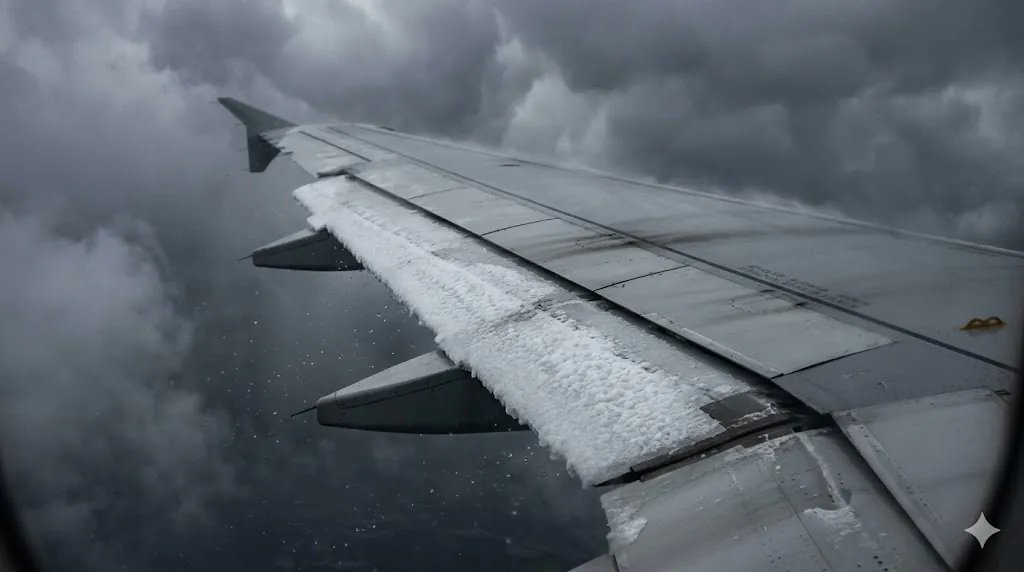
rough, opaque, and aerodynamically destructive. Even a thin layer
of ice on the leading edge changes the wing’s airflow pattern
enough to reduce lift and increase stall speed significantly.
Key Takeaways
- Aircraft icing occurs when supercooled water droplets
in clouds impact the aircraft surface and freeze on contact.
It is entirely different from ground frost or snow — it forms in
flight, in specific atmospheric conditions, and attacks the
aerodynamic surfaces the aircraft depends on to fly. - Even a thin layer of ice on the wing leading edge
dramatically reduces lift and raises stall speed.
The smooth surface that generates lift becomes rough and distorted’
changing the airflow pattern in ways that can make the aircraft
stall at speeds well above the normal clean-wing stall speed. - Pitot tube icing is a separate and catastrophic threat.
It does not affect aerodynamics — it feeds false airspeed data to
the flight computers. Air France 447 in 2009 was the deadliest
aircraft icing accident in history, caused by pitot tube blockage
rather than structural ice. - Anti-icing and de-icing are two different systems
with different principles and applications. Modern commercial
aircraft use both, and the specific combination depends on the
aircraft type, flight phase, and icing severity. - Dispatchers are prohibited from releasing flights into
known severe icing conditions unless the aircraft is
certified for that environment — a regulatory boundary, not a
judgment call.
This article is based on real-world flight dispatch experience and supported by publicly available aviation safety data and regulatory guidance.
1. What Aircraft Icing Actually Is
Aircraft icing forms when an aircraft flies through air
containing supercooled water droplets — liquid water that remains
liquid below the normal freezing point of 0°C because it lacks
the nucleation site needed to trigger crystallisation. Supercooled
water droplets exist in clouds between approximately -40°C and
0°C. When these droplets impact the aircraft’s surface, the
physical shock of impact provides the nucleation trigger and they
freeze instantly on contact. The type of ice that forms depends
on the droplet size, temperature, and the rate of impact.
Rime ice forms at colder temperatures from
small droplets that freeze immediately on impact, creating a
rough, white, opaque deposit that traps air bubbles. It builds
primarily on the leading edge of surfaces and has relatively low
density. Glaze ice (also called clear ice) forms
at temperatures closer to 0°C from larger droplets that spread
slightly before freezing, creating a smooth, dense, clear layer
that conforms to the surface shape and extends further back from
the leading edge than rime ice. Glaze ice is denser, heavier,
and more aerodynamically damaging than rime ice because it
changes the wing profile over a larger area. Mixed ice
is a combination of both types, often the most operationally
challenging because its irregular shape is the hardest to model
for de-icing system design.
2. What Aircraft Icing Does to a Wing

edge, creating a rough deposit that distorts the smooth aerofoil
profile. The disrupted airflow above the contaminated surface
reduces lift and moves the stall angle of attack significantly
lower than the clean-wing value.
A wing generates lift by accelerating airflow over its curved
upper surface, creating a low-pressure zone that produces an
upward force. This mechanism depends critically on the smoothness
and shape of the wing’s leading edge and upper surface. Ice
accumulation on the leading edge changes both. The rough texture
of rime ice disrupts the laminar airflow that the smooth leading
edge produces, causing turbulent separation earlier in the
pressure recovery curve. The shape distortion of glaze ice changes
the effective camber of the aerofoil in a way the wing was not
designed for. Both effects reduce the maximum lift the wing can
generate and lower the angle of attack at which the wing stalls.
The operational consequence is an increase in stall speed’
the minimum speed at which the aircraft can maintain level flight.
NASA research has demonstrated that even a layer of ice with
the texture of coarse sandpaper on the wing leading edge can
reduce maximum lift by 30 percent and increase stall speed by
a proportional amount. An aircraft certified to approach at 140
knots may stall at 155 knots with leading edge contamination’
meaning the approach speed the crew is flying is below the actual
stall speed, without any indication in the cockpit that the
aerodynamic margins have disappeared. Aircraft icing does not
feel dangerous from inside the aircraft until the stall itself
occurs, by which point the altitude available to recover may
already be insufficient.
3. Pitot Tube Icing: The Invisible Killer

pressure difference between ram air entering the open tip and
static pressure. Ice blocking the opening gives the flight
computer false — or zero — airspeed data. Pitot heat is always
on during flight for exactly this reason.
Structural icing attacks what the wing can do. Pitot tube
icing attacks what the crew knows. The pitot tube is the primary
source of airspeed data for the aircraft’s flight management
systems, autopilot, and stall warning system. It works by
measuring the pressure of ram air entering an open forward-facing
tube and comparing it to static pressure. When ice blocks the
opening of the pitot tube, ram air pressure cannot enter — the
airspeed indication freezes at its last value, or drops to zero,
or produces a false reading depending on how the blockage
progresses. The aircraft’s flight computers receive airspeed
data that does not reflect what the aircraft is actually doing.
On June 1, 2009, Air France Flight 447, an Airbus A330, was
cruising at 35,000 feet over the Atlantic Ocean when it flew
through a region of ice crystals associated with a large
cumulonimbus system. The pitot tubes on the aircraft ingested
ice crystals that temporarily blocked the static ports, causing
all three airspeed indicators to give inconsistent readings.
The autopilot disconnected. The aircraft’s flight computers
degraded from Normal Law to Alternate Law, removing the
automated stall protections. The crew, confronted with unreliable
airspeed indications and an aircraft that was no longer behaving
as they expected, applied nose-up inputs that placed the aircraft
in an aerodynamic stall from which it did not recover. The
aircraft struck the Atlantic Ocean four minutes after the
pitot tube event began. All 228 people aboard were killed.
According to the
BEA official investigation
report on Air France 447, the direct cause was the temporary
inconsistency of airspeed measurements caused by the obstruction
of the pitot tubes by ice crystals.

inconsistent airspeed data ? autopilot disconnected ? flight
computers degraded to Alternate Law ? stall protections removed ?
crew made nose-up inputs ? aerodynamic stall ? no recovery.
228 fatalities. The investigation drove a global pitot tube
replacement program across Airbus A330 and A340 fleets.
4. Anti-Ice vs De-Ice: How Aircraft Are Protected

engines circulates through ducts inside the leading edge, keeping
the surface above freezing and preventing ice formation. The
distinction between preventing ice (anti-ice) and removing it
(de-ice) determines which system is used at which flight phase.
Commercial aircraft use two fundamentally different approaches
to managing aircraft icing, and understanding the distinction
matters for understanding the protection envelope. Anti-icing
prevents ice from forming in the first place by heating the surface
above the freezing point before ice accumulates. Wing leading edge
anti-ice uses hot bleed air extracted from the engine compressor
stages, routed through piccolo tubes inside the leading edge
to heat the outer skin. Pitot tube and angle-of-attack probe
anti-ice uses electric heating elements embedded in the probe.
Engine inlet anti-ice uses bleed air to prevent ice formation
in the engine intake, which would otherwise shed ice into the
compressor with potentially catastrophic results.
De-icing removes ice that has already formed.
Pneumatic de-ice boots — rubber bladders bonded to the leading
edges that inflate and deflate to crack and shed accumulated ice’
are used on some turboprop and regional jet aircraft where bleed
air extraction would impose too large a performance penalty.
On modern large commercial jets, the preference is anti-icing
over de-icing because preventing accumulation is more reliable
than managing it after the fact. The failure mode of an anti-ice
system is “ice may accumulate”; the failure mode of a de-ice
boot is “ice may not shed correctly,” which can leave irregular
residual ice shapes that are more aerodynamically damaging than
the original accumulation. Pitot heat is always on from before
takeoff to after landing on commercial operations — it is not
activated when icing conditions are encountered; it runs
continuously because the cost of forgetting to activate it
is potentially catastrophic.
5. The FKIA Rule: How Aircraft Icing Limits Dispatch
Commercial aircraft certification includes a specific category
for icing operations: Flight Into Known Icing (FIKI) certification.
An aircraft certified for FIKI has demonstrated through flight
testing that its anti-ice and de-ice systems can maintain
acceptable performance throughout the icing envelope defined
in FAR/CS Part 25 Appendix C — a standardised representation of
the supercooled liquid water content, droplet size, and temperature
conditions the aircraft must tolerate. An aircraft without FIKI
certification cannot legally be dispatched into known icing
conditions. This is a regulatory prohibition, not an operational
preference.
From the dispatch desk, the FIKI rule translates into a specific
check on every flight release: is the route, altitude, or
destination forecast to contain known icing conditions, and is
this aircraft type certified for that environment? SIGMETs for
moderate or severe aircraft icing are the primary trigger — a
Moderate Icing SIGMET covering the departure or destination
airport during the operational window requires me to verify that
the aircraft is FIKI certified and that the penetration altitude
avoids the most severe layers. Severe Icing SIGMETs are a harder
boundary: dispatch into severe icing conditions is prohibited
for all aircraft types regardless of certification, because
no commercial aircraft is certificated to handle the accumulation
rates that severe icing produces. The practical response to a
Severe Icing SIGMET is the same as the response to a Category 3
hurricane advisory — route around it, adjust altitude to avoid it,
or hold until it passes. According to the
SKYbrary in-flight icing
reference, severe icing is defined as a rate of accumulation
so great that icing control equipment fails to reduce or control
the hazard, and immediate diversion is necessary.
6. What the Dispatcher Does About Aircraft Icing

for aircraft icing dispatch assessment. The SIGMET gives the
forecast layer extent; the PIREP gives the actual severity
reported by crews currently flying through it — often a more
operationally reliable indicator than any forecast.
Aircraft icing assessment begins in the pre-flight weather
analysis and continues through the flight release and active
monitoring phases. Pre-flight, I check the
applicable SIGMETs and AIRMETs for icing along the route and
at the destination, cross-reference the forecast icing layers
against the planned cruise altitude, and verify the aircraft
type’s FIKI certification against the conditions. If the route
penetrates a forecast icing layer, I assess whether the cruise
altitude can be adjusted to avoid the primary accumulation layer
or whether the crew needs to request a different altitude block
from ATC. The objective is to plan the flight to avoid the icing
core rather than rely entirely on the anti-ice systems to manage
it.
Active monitoring during the flight focuses
on PIREPs — pilot reports of actual icing conditions encountered
by other crews along the same route at similar altitudes. A
PIREP reporting moderate icing at FL180 when my aircraft is
planned at FL170 is more operationally relevant than any forecast,
because it reflects current conditions rather than model output.
I monitor PIREPs continuously on icing-risk routes and pass
relevant reports to the crew proactively. If PIREPs indicate
severe icing developing along the route, I assess whether an
altitude change or re-route is needed before the aircraft reaches
that position — giving the crew maximum time to request the
clearance from ATC rather than requiring an urgent deviation
request at the point of encounter. For how winter weather broadly
affects our ground operations and departure preparation, my
snow and ice operations article covers the ground-side icing
management that complements the in-flight protection systems.
What Passengers Should Know About Aircraft Icing
The aircraft that takes off in freezing conditions has
already been treated. Ground de-icing — the orange or green
fluid sprayed on the aircraft before departure in winter — removes
existing contamination from the wing surfaces and provides a
limited holdover time during which new accumulation is inhibited.
That procedure is entirely separate from in-flight anti-icing.
Ground de-icing addresses what is on the wing before takeoff;
in-flight anti-icing addresses what forms during the flight.
Both are mandatory for their respective phases. Passengers who
see orange fluid spraying the aircraft through the terminal window
are watching the ground side of a two-part icing protection
system.
The aircraft anti-ice systems run automatically in
icing conditions. On most modern commercial aircraft,
pitot heat is always on, and wing anti-ice activates automatically
when the ice detection system senses icing conditions. The crew
has oversight and manual control, but the system does not require
the crew to recognise visible icing before activating protection.
A passenger who looks out the window at a cloud-covered wing and
sees no ice accumulation on the leading edge is seeing the anti-ice
system working correctly — the heat is preventing formation, not
removing it after the fact. The most important implication
of aircraft icing for passengers is the same as every
other aviation safety system: the protection exists, it is
engineered and certified, and the dispatchers and crews manage
the icing environment before passengers are ever aware it exists.
For the statistical framework that puts all these hazard management
systems in perspective, my
aviation safety article covers how the cumulative effect of
these systems produces the safety record commercial aviation
holds.
Related Reading from Aeruxo:
- How Flights Operate in Snow and Ice Conditions
- What Is Wind Shear? 6 Facts From a Flight Dispatcher
- Landing in Fog Explained: How Aircraft Land in Near-Zero Visibility
Frequently Asked Questions
What is aircraft icing?
Aircraft icing occurs when an aircraft flies through air
containing supercooled water droplets — liquid water below 0°C
that freezes on contact with the aircraft’s surfaces. It forms
on wing leading edges, engine inlets, pitot tubes, and control
surfaces during flight through clouds in the icing temperature
range. Structural aircraft icing degrades aerodynamic performance
by changing the wing profile. Pitot tube icing corrupts airspeed
data fed to the flight computers. Both are addressed by separate,
independent protection systems.
How does aircraft icing affect a wing?
Ice on a wing leading edge disrupts the smooth airflow that
generates lift by creating surface roughness and changing the
wing’s aerofoil shape. The result is reduced maximum lift and
a higher stall speed — the aircraft can stall at airspeeds
significantly above its normal clean-wing minimum. Even a thin
layer of ice with a texture equivalent to coarse sandpaper can
reduce maximum lift by 30 percent. The danger is that this
degradation is invisible from the cockpit until the wing actually
stalls, at which point altitude may be insufficient for recovery.
What happened in Air France 447 related to aircraft icing?
On June 1, 2009, Air France Flight 447 flew through an area
of ice crystals over the Atlantic Ocean. The crystals blocked
the pitot tubes, causing all three airspeed indicators to give
inconsistent readings. The autopilot disconnected and the flight
computers degraded to Alternate Law, removing automated stall
protections. The crew applied nose-up inputs in response to
the confusing flight instruments, placing the aircraft in an
aerodynamic stall from which it did not recover. All 228 people
aboard were killed. The investigation found the direct cause
was pitot tube blockage by ice crystals and drove a global
replacement program for Thales pitot tubes on Airbus A330
and A340 aircraft.
What is the difference between anti-icing and de-icing?
Anti-icing prevents ice from forming by keeping surfaces above
the freezing point before any accumulation occurs — using hot engine
bleed air for wing leading edges and electric heating for pitot
tubes and probes. De-icing removes ice that has already formed,
typically using pneumatic rubber boots that inflate and crack
accumulated ice off leading edge surfaces. Modern large commercial
jets primarily use anti-icing because preventing accumulation is
more reliable than managing it after formation. De-ice boots are
more common on turboprop and regional aircraft.
What is a FIKI certification for aircraft icing?
Flight Into Known Icing (FIKI) certification is a regulatory
approval confirming that an aircraft’s anti-ice and de-ice systems
can maintain acceptable performance throughout the icing envelope
defined in aviation certification standards. An aircraft without
FIKI certification cannot be legally dispatched into known icing
conditions. Severe icing conditions are prohibited for all aircraft
regardless of certification, because no commercial aircraft is
certified for the accumulation rates that severe icing produces.
How does the dispatcher manage aircraft icing risk?
Before flight release, the dispatcher checks SIGMETs and
AIRMETs for icing along the route, verifies the aircraft’s FIKI
certification against forecast conditions, and plans cruise
altitude to avoid the primary icing layer where possible. During
the flight, real-time PIREPs from other aircraft in the same
airspace are monitored continuously and passed to the crew
proactively. If PIREPs indicate severe icing developing along
the route, the dispatcher assesses whether an altitude change or
re-route is needed before the aircraft reaches that position.
Is the orange fluid sprayed on aircraft the same as in-flight
anti-icing?
No. Ground de-icing fluid removes existing ice and frost from
the aircraft’s surfaces before takeoff and provides a limited
holdover time during which new accumulation is inhibited. It is
a ground procedure that addresses contamination present before
departure. In-flight anti-icing uses hot engine bleed air and
electric heating to prevent ice forming on the wing leading edges,
engine inlets, and probes during the flight itself. Both are
mandatory for their respective phases and are independent systems
with different physics, different activation timing, and different
regulatory requirements.
Have you ever looked out the window during a winter flight
and noticed steam or heat shimmer along the wing leading edge?
That is the anti-ice system in operation. Share what you have
observed in the comments — passenger observations of aircraft
systems help others understand what they are actually seeing
during flight.
Disclaimer: The views expressed in this article are my own
professional opinions based on 15+ years of operational experience.
They do not represent the official position of any airline,
aviation authority, or regulatory body.

Licensed Flight Dispatcher with 15+ years of experience in airline operations control. Holds FAA Aircraft Dispatcher Certificate and Republic of Korea Flight Dispatcher License (MOLIT). Specializes in flight watch, NOTAM analysis, flight planning, and operational control at a Korean LCC. IOSA audit participant and author of multiple airline operational manuals, including Emergency Response, De-icing, and OCC Procedures.