By Aeruxo — Licensed flight dispatcher (study guide) | 15+ Years in Airline Operations
The ATIS at Gimpo was reporting 50 meters RVR. To put that in
perspective: standing at one end of a 50-meter swimming pool, you
would not be able to see the other wall. Yet I was tracking an
Airbus A320 on final approach — autopilot engaged, autothrottle active,
the aircraft flying a precision beam it could not see, descending at
exactly 750 feet per minute toward a runway it would not visually
acquire until approximately four seconds before the wheels touched.
The aircraft landed on centerline within two meters. The crew’s hands
were on the controls but never touched them.
Landing in fog is one of the most technically sophisticated
achievements in modern aviation — and one of the least understood by
the passengers sitting in the back. The instrument systems, crew
certifications, airport infrastructure, and operational procedures
that make landing in fog possible represent decades of engineering
specifically designed to remove human dependence on visibility as a
prerequisite for a safe landing. After 15 years dispatching flights
across East Asia — where winter sea fog at coastal airports and summer
monsoon mist regularly push visibility to near zero — I want to explain
exactly how landing in fog works, what the limits are, and what
actually causes a fog-related cancellation or divert.

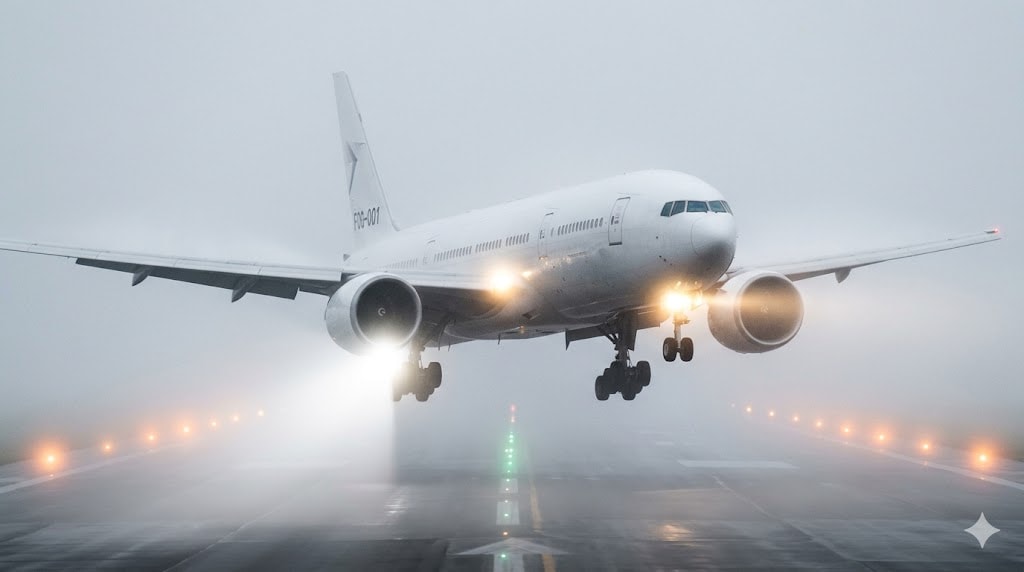
it cannot see toward a runway that will not be visible until seconds
before touchdown. The system is precise enough to land without the
pilot touching the controls.
Key Takeaways
- Landing in fog does not require the pilot to see the
runway. ILS (Instrument Landing System) guides the aircraft
with radio beams to within meters of the threshold before visual
reference is required — or, in CAT III operations, not required at all. - There are three ILS categories (CAT I, II, III)
with progressively lower visibility minimums. CAT IIIc operations have
zero visibility minimums — a fully automated landing in conditions where
nothing outside the windshield is visible. - RVR (Runway Visual Range) is the operational measurement
used for landing in fog decisions:not general visibility.
RVR measures what pilots can see along the runway surface
specifically. - Fog cancellations happen when RVR falls below the
aircraft’s certified category or when the airport’s ground
movement infrastructure cannot safely operate in the conditions. - Both the aircraft and the crew must be certified
for low-visibility operations. CAT III landing in fog requires specific
aircraft equipment, crew training, and airport certification — not every
combination qualifies.
This article is based on real operational experience supporting flight planning and low-visibility operations in an airline Operations Control Center (OCC).
1. Why Normal Visual Approaches Fail in Fog
Under normal conditions, a pilot on final approach acquires visual
reference to the runway at several miles out — using the runway itself,
its lights, the surrounding terrain, and the airport environment to
continuously verify alignment and descent rate. Visual reference is a
constant cross-check against the instruments, and experienced pilots
use it unconsciously throughout every approach. Landing in fog
eliminates this cross-check entirely. Without instrument guidance, the
pilot has no external visual reference until the aircraft is already
at or below safe minimum altitude — too late to correct alignment or
approach angle. Before instrument landing systems existed, fog
consistently produced catastrophic outcomes for aircraft attempting
visual approaches at low visibility.
The solution was to remove the pilot’s dependence on outside visual
reference entirely and replace it with an electronic reference that
works regardless of visibility. The ILS approach is that solution, and
understanding it converts landing in fog from a frightening concept
into a logical, well-engineered procedure.
2. How ILS Makes Landing in Fog Possible

runway: the localizer (horizontal alignment) and the glideslope
(vertical descent path). The aircraft follows the intersection of both
beams to the threshold regardless of what is visible outside the
windshield.
The Instrument Landing System is a ground-based radio navigation
system that projects two beams from the runway threshold.
The localizer transmits a narrow horizontal beam
along the runway centerline extended outward. Deflection left or right
of this beam is displayed on the cockpit instruments as a needle
deviation — the pilot or autopilot keeps the needle centered to remain
aligned with the runway. The glideslope transmits a
diagonal beam at approximately 3 degrees above horizontal from the
threshold, defining the correct descent path to the touchdown zone.
A needle above center means the aircraft is below the beam; below
center means above it. The pilot tracks the beam down to the runway.
The intersection of the localizer and glideslope beams defines a
precise three-dimensional path from the outer marker to the runway
threshold — an aircraft tracking both needles centered is on that exact
path in any visibility condition.
For the most demanding landing in fog scenarios — CAT III operations’
the autopilot does not just assist. It flies the entire approach and
lands the aircraft. Autoland systems track the ILS beams with precision
no human pilot can match in zero visibility, flare the aircraft at
the correct height, reduce thrust, and place the aircraft on the
runway centerline within certification tolerances. During a CAT IIIa
or IIIb autoland, a pilot’s primary role is monitoring — confirming that
the systems are performing correctly and being ready to execute a
go-around if any system indicates a fault. If all systems are normal,
the aircraft lands itself. I have dispatched hundreds of these
approaches. The outcome is uniformly precise, and the touchdowns are
typically smoother than hand-flown landings because the autopilot
executes the flare with metronomic consistency.
3. The Three ILS Categories: How Low Can You Go?
ILS approaches are certified in three categories with progressively
lower visibility minimums, each defining the lowest conditions under
which a landing in fog can be legally attempted. CAT I
requires a Decision Height (DH) of 200 feet above the runway with RVR
of 550 meters. At CAT I minimums, the pilot must have visual reference
to the runway environment at decision height — if not, a go-around is
mandatory. This is the most common ILS approach and is available at
virtually every instrument-equipped airport. Most airline pilots fly
the majority of their careers using CAT I approaches.

along the actual runway surface — a more operationally relevant number
than general prevailing visibility. Multiple sensors along the runway
give touchdown, midpoint, and rollout RVR values.
CAT II reduces DH to 100 feet and RVR to 300
meters. At this level, visual reference at decision height includes
only the runway markings or lights directly ahead — not the full runway
environment. Both the aircraft and crew must be CAT II certified, and
the airport’s ILS equipment must meet higher accuracy and integrity
standards than CAT I. CAT III is the most demanding
landing in fog category and is subdivided into three levels. CAT IIIa
requires DH of 50 feet and RVR of 200 meters. CAT IIIb requires RVR
of 50 — 75 meters with no DH requirement — the aircraft commits to landing
before the runway is visible. CAT IIIc is zero/zero: no visibility
requirement at all, landing entirely by instruments in conditions where
nothing outside the windshield can be seen.
According to
SKYbrary’s ILS reference,
CAT III operations require the complete combination of certified
aircraft, certified crew, and certified airport infrastructure — a
single uncertified element in that chain eliminates the operation,
regardless of how capable the other two components are.
4. RVR: The Number That Actually Controls Landing in Fog
A common confusion around landing in fog decisions involves the
visibility figure. Weather reports give prevailing visibility in meters
or statute miles — the general distance a person can see in a given
direction. But prevailing visibility is not what pilots and dispatchers
use to assess landing in fog conditions. The operational figure is
RVR: Runway Visual Range, measured by sensors
positioned at the side of the runway that project a light beam along
the surface and measure attenuation by fog or precipitation. RVR gives
the specific distance visible along the runway — the surface a landing
aircraft actually needs to see — rather than the general atmosphere.
RVR can differ significantly from prevailing visibility because
runway lights enhance contrast against the fog. High-intensity runway
lighting allows pilots to see the lights at a distance that exceeds
what they could see in natural daylight conditions. A runway reporting
200m RVR in fog can be operable for CAT IIIa landing in fog when
prevailing visibility is listed at 50 meters — because the lights
penetrate the fog in ways that natural objects cannot. On our Korean
LCC network, I monitor RVR values for three points along the runway:
touchdown zone, midpoint, and rollout end. For a CAT IIIb landing in
fog approach, all three values must meet or exceed the certified
minimum — a single sensor below limits cancels the approach regardless
of what the other two report.

glideslope and localizer needles are centered by the autopilot, not
the pilot’s hands. The runway environment outside the windshield is
invisible until seconds before touchdown — or not at all.
5. What the Dispatcher Does During Low-Visibility Operations

that the destination’s RVR meets the aircraft’s certified category,
that the crew holds the required low-visibility certification, and
that the airport’s LVO procedures are active.
Landing in fog operations involve dispatcher coordination long
before the aircraft is anywhere near the destination.
Pre-departure, I check the destination TAF for fog
formation and dissipation timing, verify the aircraft’s certified ILS
category against the forecast RVR, and confirm the crew’s
low-visibility certification on the flight plan. If forecast RVR is
below our CAT III threshold or the aircraft is not CAT III equipped,
I calculate whether a divert is needed and ensure alternate fuel is
loaded. For some winter coastal routings where fog is nearly certain
on arrival, I pre-plan two alternates before the aircraft pushes
back.
During the flight, I track METAR updates at the
destination every 30 minutes and more frequently when conditions are
marginal. A typical scenario is landing in fog that is forecast to
lift by arrival time — but doesn’t. If METAR RVR falls below operating
minimums while the aircraft is en route, I contact the crew to discuss
options before they reach a point where fuel for a divert is no longer
available. When RVR drops below CAT I minimums, airports activate
formal Low Visibility Procedures (LVP)—restricting aircraft ground
movement to prevent vehicles or other aircraft from interfering with
the ILS signal. I confirm LVP is active before releasing a crew for a
CAT II or III landing in fog approach. For more on
go-around coordination when fog approaches don’t succeed, I cover
the full decision sequence separately.
6. When Fog Actually Cancels or Diverts a Flight

centerline and edge lights remain visible to pilots on approach’
providing the visual reference that completes the final seconds of a
low-visibility landing in fog.
Landing in fog does not automatically cancel flights — but specific
conditions do produce cancellations or diversions that passengers find
confusing when they assume “the plane can land in fog.”
RVR below the aircraft’s certified category is the
most common cause: an aircraft certified for CAT IIIa landing in fog
(200m RVR minimum) cannot legally attempt the approach if RVR drops to
150m. No exceptions. The crew will hold for conditions to improve, or
divert to an alternate with adequate RVR. Aircraft not
certified for current conditions produces the same outcome
differently — an older or differently-equipped aircraft may be CAT I
only, meaning landing in fog is not possible below 550m RVR. On our
network, some slot-restricted routes have specific aircraft type
requirements for exactly this reason.
Crew certification is a third, often overlooked
cause of fog-related diversions. A captain may hold a type rating but
not the specific low-visibility qualification, which requires recurrent
simulator training in autoland procedures. Without it, the crew’s
minimums revert to CAT I regardless of aircraft capability.
Airport LVP not active or ILS unserviceable removes
the protection required for CAT III landing in fog — if the airport has
not activated Low Visibility Procedures, or if the ILS is under
maintenance, approaches revert to the highest available category that
is serviceable. According to the
FAA Aeronautical Information Manual,
ILS categories and their protected areas are standardized across ICAO
member states, ensuring consistent protection at any certified airport.
Finally, even when landing in fog is technically possible,
ground movement limitations can paralyze airport
operations. Taxiing, gate assignment, pushback, and departure
sequencing all slow or stop when movement area visibility falls below
limits. Accumulated arrival delays produce ground congestion that
affects subsequent departures, which is why fog at a major hub creates
cascading
delays well beyond the fog-affected window — sometimes lasting
into the evening when the fog itself lifted by mid-morning.
7. What Passengers Should Know About Landing in Fog
The aircraft is more capable than you think. Many
passengers assume fog means danger. In equipped aircraft with certified
crews at certified airports, landing in fog is a precision operation
with a safety record equal to or better than clear-weather approaches.
The engineering that makes it possible has been refined over decades
specifically to eliminate the variability that made early fog
operations risky. The smooth autoland is the fog landing.
A CAT III landing in fog often produces the smoothest touchdown of any
approach type — because the autopilot flares with metronomic precision
that no human pilot can consistently replicate under any conditions.
Holding in fog is normal and correct. If your
flight circles for 20 — 40 minutes before landing, the crew may be
waiting for RVR to reach minimums or for airport LVP to activate.
This is preferable to a divert. Fog delays compound
differently than other weather delays:because fog slows
both arrivals and ground movement, a 90-minute fog event at a hub
can produce 4 — 6 hours of cascading schedule disruption. If your
flight is delayed due to fog at a connecting hub, it may be waiting
for a slot that opened after the fog lifted — the aircraft can land;
the system is managing the backlog. For the full delay mechanism,
my
flight delay article explains how weather disruption propagates
through a network. For related winter weather operations, my
flying in snow and ice article covers the broader low-visibility
winter challenge.
Frequently Asked Questions
Can planes land in fog with zero visibility?
Yes — under CAT IIIc certification. This requires a fully
autoland-capable aircraft, crew certified for zero-visibility
operations, and an airport with CAT IIIc certified ILS infrastructure
and Low Visibility Procedures active. The aircraft tracks electronic
beams to the runway threshold and lands by autopilot with no visual
reference required. CAT IIIc is the least common certification level
but is in operation at major international hubs worldwide.
What is ILS and how does it help landing in fog?
The Instrument Landing System projects two intersecting radio beams
from the runway threshold: a horizontal localizer beam that defines the
runway centerline extended outward, and a diagonal glideslope beam at
approximately 3 degrees that defines the correct descent path. An
aircraft — or its autopilot — tracking the intersection of both beams is
precisely on the approach path regardless of visibility. ILS removes
the pilot’s dependence on outside visual reference for approach
tracking, making landing in fog possible at any certified airport.
What is RVR and why does it matter for landing in fog?
Runway Visual Range is the measured distance a pilot can see along
the actual runway surface, measured by sensors at the runway edge that
account for the contrast enhancement provided by high-intensity runway
lighting. Unlike general prevailing visibility, RVR reflects what
pilots actually see along the approach surface. The minimum RVR for
each ILS category is the hard limit below which the approach cannot
legally be commenced — there is no discretion, and no exceptions.
What is the difference between CAT I, CAT II, and CAT III?
The three ILS categories define progressively lower visibility
minimums for landing in fog. CAT I requires decision height of 200
feet and 550 meters RVR — the pilot must see the runway environment at
that height. CAT II requires 100 feet DH and 300 meters RVR. CAT III
removes the decision height constraint and reduces RVR to 200 meters
(IIIa), 50 — 75 meters (IIIb), or zero (IIIc). Each category requires
corresponding aircraft certification, crew qualification, and airport
infrastructure certification.
Why do some flights divert in fog while others keep landing?
Different aircraft types have different certified ILS categories.
A CAT III certified aircraft at a CAT III airport with a CAT III
qualified crew can land in fog at 200 meters RVR while a CAT I-only
aircraft on the same runway must divert. The aircraft type, crew
certification, and airport certification all determine which category
applies — and a single uncertified element in that chain reverts the
operation to the next available category, regardless of actual
conditions.
Does the pilot touch the controls during an autoland?
During a certified CAT III autoland for landing in fog, the
autopilot manages the approach, flare, touchdown, and deceleration.
The pilot monitors all systems, confirms automation callouts, and is
prepared to execute a go-around if any anomaly appears. If all systems
are nominal, the pilot does not touch the controls through touchdown.
After the aircraft decelerates, the pilot takes over for taxi.
Autoland is not pilot assistance — it is the pilot, in the conditions
that demand it.
Can fog cancel my flight even after the aircraft lands?
Yes — through the cascade effect. Fog slows ground movement, delays
departures, backs up gate availability, and disrupts crew scheduling.
Even after landing in fog resumes normally, the schedule disruption
from the fog period can persist for hours. If your inbound aircraft
was delayed by fog at another airport, your departure may be delayed
even though your departure airport is clear — one of the least intuitive
delay mechanisms in airline operations.
Have you ever looked out the window during a foggy landing and
seen nothing until the last second? Share the experience in the
comments — it helps passengers understand what landing in fog actually
feels like from the cabin.
Disclaimer: The views expressed in this article are my own
professional opinions based on 15+ years of operational experience.
They do not represent the official position of any airline, aviation
authority, or regulatory body.

Licensed Flight Dispatcher with 15+ years of experience in airline operations control. Holds FAA Aircraft Dispatcher Certificate and Republic of Korea Flight Dispatcher License (MOLIT). Specializes in flight watch, NOTAM analysis, flight planning, and operational control at a Korean LCC. IOSA audit participant and author of multiple airline operational manuals, including Emergency Response, De-icing, and OCC Procedures.