By Aeruxo_DISP_H |
FAA Aircraft Dispatcher Certificate (United States) ·
Korean MOLIT Flight Dispatcher License ·
15+ years active dispatch at a Northeast Asian LCC, ICN hub ·
Graduate researcher, Korea Aerospace University
About the Author →
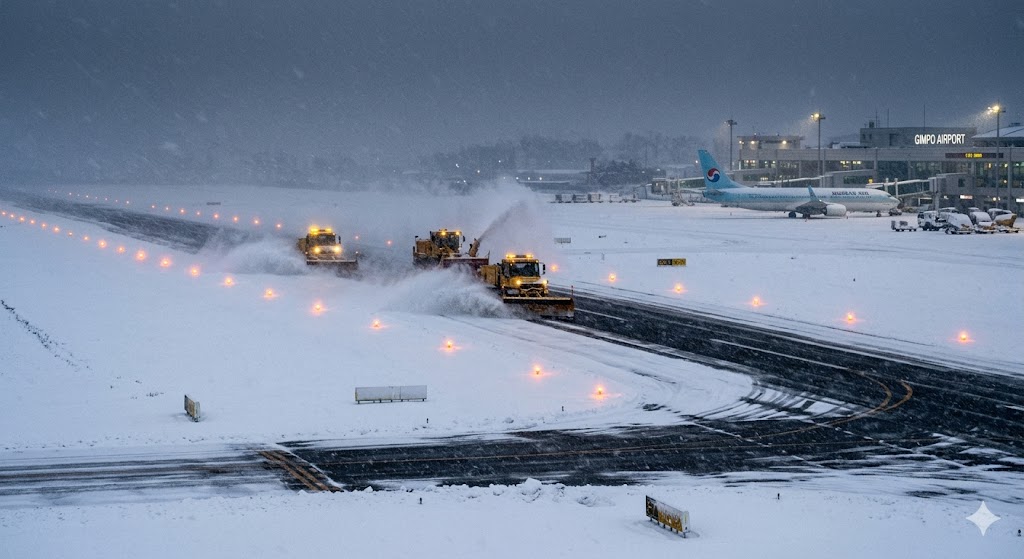
It was a December morning, and New Chitose Airport in Sapporo was disappearing. Not gradually — rapidly. The METAR I pulled at 08:00 local showed 3,000 meters visibility with light snow. By 08:30, it was 800 meters. By 09:00, the airport had dropped to 200 meters in heavy snow with blowing drifts across the runway. Two of our flights were inbound, one was 45 minutes out, and the other was just pushing back from Incheon.
Back at Incheon, a different kind of chaos was unfolding — one with no dramatic weather event to point at, no typhoon to blame, no single decision that went wrong. Just snowfall. Light to moderate, falling steadily across the apron. And within 40 minutes of the snow starting, the ground movement picture at one of Asia’s busiest airports had become a dispatcher’s worst operational scenario: aircraft queued from a dozen different stands, all converging toward a small number of de-icing pads, under the jurisdiction of four different ground handling companies, with a control tower trying to sequence them all on frequencies not designed for this kind of coordination.
Flying in snow is not the hard part. Managing the ground is.
After 15 years dispatching flights across East Asia — with heavy exposure to Korean winter operations at Incheon and Japanese winter destinations in Hokkaido — I want to explain exactly how flying in snow affects flight operations, why the delays compound in ways that seem out of proportion to the weather, and why a structural problem in how de-icing operations are organized at major Korean airports continues to produce the same delays every winter despite post-season reviews and inter-agency meetings that have been happening for years.
Key Takeaways
- Yes, planes can fly in snow. Modern commercial aircraft are designed and certified for winter operations. The challenge is not flying through snow — it is ensuring the aircraft is clean before takeoff and the runway is safe for landing.
- De-icing at Korean hub airports is a structural coordination problem, not just a weather problem. Each airline’s aircraft can only be de-iced by its contracted ground handler, at that handler’s designated pad — and those pads are fixed locations scattered across the airport. When snow falls simultaneously across the entire apron, every airline’s aircraft converges toward its own handler’s pad at the same time, creating ground movement conflicts that no amount of post-season review has solved.
- The holdover time countdown begins the moment de-icing fluid is applied — and if ATC ground movement delays consume that window before the aircraft reaches the runway, the aircraft must return to the pad and start over.
- Winter delays cascade faster than summer delays because de-icing queues, runway closures for snow removal, and reduced visibility all compound simultaneously rather than sequentially.
- A structural fix exists but has not been implemented: centralized runway-entry de-icing pads, accessible to all aircraft regardless of their contracted handler, would allow ATC to manage and predict ground movement far more effectively than the current distributed pad system.
This article is based on real-world experience inside an airline Operations Control Center (OCC), including 15 winters of managing de-icing coordination, ground movement delays, and the systemic issues that cause them to repeat every season.
1. Can Planes Actually Fly in Snow? The Short Answer
Yes. Absolutely yes. Commercial aircraft routinely fly in snow, through snow, and to snow-covered airports. At cruising altitude — around 35,000 feet — the outside temperature is typically -40°C to -60°C. The aircraft is designed for this environment. Snow and cold are not inherently dangerous for a properly prepared airplane.
The challenges of flying in snow are almost entirely about two things: the ground and the transition between ground and air. Specifically, ice and snow on the aircraft’s surfaces must be removed before takeoff — even a thin, almost invisible layer of frost on the wings disrupts the carefully engineered shape that produces lift. Runway conditions change constantly during active snowfall, affecting takeoff and landing performance calculations. And visibility can drop suddenly during snow squalls, bringing operations to a halt within minutes.
So when your winter flight is delayed, it is not because the aircraft cannot handle the cold. It is because the ground environment requires additional preparation, verification, and sometimes patience before the aircraft can safely depart or land. And at a major hub airport during simultaneous snowfall across the entire apron, that preparation process runs into a coordination problem that is structural rather than meteorological.
2. De-Icing: The Safety Requirement That Becomes a Logistics Problem at Scale

Why De-Icing Is Non-Negotiable
Aircraft wings are engineered to a precise aerodynamic shape. That shape generates lift — the force that keeps 70 tonnes of metal in the air. Ice, snow, or even frost disrupts this shape. The roughness on the wing surface breaks up the smooth airflow, reducing lift and increasing drag. Studies have shown that contamination as thin as sandpaper on the wing’s leading edge can reduce lift by up to 30% and increase drag by 40%. At takeoff, when the aircraft is heavy, slow, and close to the ground, this loss of lift can be catastrophic. This is the Clean Aircraft Concept — and it is an absolute regulatory requirement, not a preference. No aircraft under my dispatch will take off with contaminated wing surfaces. Full stop.
The de-icing process itself is a two-step procedure. Step 1 (De-icing): hot Type I fluid — typically heated to 60–80°C, orange in color — is sprayed over the wings, tail, and fuselage to melt and remove existing ice, snow, or frost. Step 2 (Anti-icing): a thicker Type IV fluid — usually green — is applied over the cleaned surfaces, forming a protective gel layer that prevents new accumulation during taxi to the runway. This protection is temporary. From the moment the anti-icing fluid is applied, a holdover time countdown begins — a limited window that depends on temperature and precipitation intensity. If the aircraft does not reach the runway and begin takeoff within that window, it must return to the pad and start over.
The Critical Constraint: De-Icing Fluids Are Classified as Waste
Here is the constraint that non-aviation professionals rarely understand, and that explains why de-icing cannot simply happen anywhere on the apron: both Type I and Type IV de-icing fluids are classified as industrial waste. They cannot be allowed to drain freely onto the airport surface and into the drainage system. They must be collected and processed. As a result, de-icing operations are restricted to designated pad facilities — specific, environmentally engineered areas of the airport with fluid collection infrastructure underneath.
This is a non-negotiable environmental and regulatory requirement. The pads exist for a reason. But the location, number, and allocation of those pads is the source of the structural problem I want to explain in detail.
3. The Structural Problem: Why Korean Hub Airport De-Icing Creates Gridlock Every Winter
At a major Korean hub airport during snowfall, the de-icing coordination challenge is not a weather problem. It is an organizational architecture problem — and it is one that has been discussed at post-season inter-agency reviews involving airlines, ground handlers, and ATC every year I have been in this business, without producing a solution that changes the outcome.
📋 Dispatcher’s Note — How the System Is Currently Structured
Each airline at a Korean hub airport has a contracted ground handling company. That contract specifies which ground handler performs all ramp services for that airline’s aircraft — including de-icing. De-icing can only be performed by the contracted handler, at that handler’s designated de-icing pad. The pad is a fixed location in the airport’s ground movement area. Different airlines have different handlers, and different handlers have different pad locations scattered across the airport. When snow falls, every airline’s aircraft needs de-icing. Every aircraft must taxi to its handler’s specific pad. All of this happens simultaneously, across an airport with dozens of active stands, under a ground movement control frequency that was not designed to manage this volume of simultaneous non-sequential taxi movements.
Picture what this looks like on the ground during a snowfall event at a major Korean hub.
At 07:30, snow begins falling across the apron. By 07:45, the first de-icing requests are coming in from crews completing their walkaround checks. By 08:00, aircraft from a dozen different stands — representing five or six different airlines, each assigned to a different contracted handler — are all requesting pushback and taxi for de-icing simultaneously. Each aircraft must route to its own handler’s pad, which may be located at the opposite end of the airport from its parking stand. Aircraft from different airlines are now crossing each other’s taxi paths, converging on different sections of the airport, each following a route dictated by its handler’s pad location rather than by optimal ground traffic flow.
ATC ground control is attempting to sequence this movement on a frequency shared by all aircraft — departures, arrivals, towing operations, and de-icing movements all competing for clearance simultaneously. The ground controller knows that aircraft heading to Pad A, Pad B, and Pad C will inevitably cross each other’s routes. Conflict resolution requires sequencing that adds taxi time to every movement. Aircraft that were planned for a 08:30 departure are still taxiing to de-icing pads at 09:00. Their holdover time starts at 09:15. By the time they reach the runway threshold at 09:40, the holdover clock is already more than half consumed — and if there is a departure queue, it may expire before they get airborne.
📋 Dispatcher’s Note — Why Post-Season Reviews Don’t Fix It
Every winter, the same sequence of events produces the same ground movement gridlock. Every spring, the airlines, ground handlers, and ATC meet in a post-season review to discuss what went wrong and how to improve next year. I have participated in these discussions. The conversation is always the same: better communication, earlier de-icing requests, more precise sequencing by ATC. The problem is that none of these solutions addresses the root cause. As long as each airline’s aircraft can only be de-iced by its contracted handler at that handler’s fixed pad location, simultaneous snowfall will always produce simultaneous multi-directional taxi movements toward scattered pad locations. No amount of coordination protocol can overcome the geometry of the current system. The delay is structural, not procedural.
4. A Structural Solution: Runway-Entry De-Icing Pads
The fix, in my view, is architectural rather than procedural — and it has been demonstrated to work at airports in Europe and North America that have implemented it.
The concept is straightforward: instead of scattered handler-specific pads distributed across the airport’s stand areas, establish centralized de-icing pad facilities at the runway entry points — the holding areas just before each runway threshold where aircraft already queue for departure clearance. Every aircraft that requires de-icing, regardless of its contracted ground handler, would taxi directly to the runway-entry pad, receive de-icing treatment there, and then proceed directly onto the runway for departure.
This architecture solves the structural problem in three ways simultaneously.
Ground movement simplification. Instead of aircraft from dozens of stands routing to scattered pad locations across the airport in crossing paths, every departing aircraft follows the same logical taxi sequence: stand → taxiway → runway-entry pad → runway. The movement is unidirectional and predictable. ATC ground control is sequencing a flow, not arbitrating a conflict. The convergence problem disappears because all aircraft converge at the same point — the runway entry — which is where they were already going.
Holdover time optimization. When de-icing occurs immediately before runway entry rather than 20–30 minutes of taxi time before it, the holdover clock starts at the point of maximum proximity to takeoff. The risk of holdover time expiry before reaching the runway is dramatically reduced. Re-de-icing due to expired holdover — one of the most operationally wasteful outcomes in the current system — becomes rare rather than routine.
ATC traffic predictability. A runway-entry pad gives ATC a single, fixed reference point for de-icing throughput. The controller can see exactly how many aircraft are in the de-icing queue, estimate the time to de-icing completion for each, and sequence departures against that estimate. In the current distributed system, the controller has no visibility into the de-icing status of aircraft scattered across multiple handler pads — they can only observe what is on the taxiway, not what is happening at the pad. Runway-entry de-icing converts an opaque, distributed process into a visible, centralized one that integrates directly into departure sequencing.
📋 Dispatcher’s Note — What Would Change for the OCC
From the operations control perspective, runway-entry de-icing would change how I plan and monitor winter departures fundamentally. Currently, the de-icing phase of a winter departure is the most opaque part of the process — I know when the aircraft pushed back, and I know when it called ready for takeoff, but what happened in between at the pad is invisible to me unless the crew or handler calls with an update. With runway-entry de-icing, the sequence becomes: pushback → taxi to runway → de-icing → takeoff. The timeline is linear and trackable. If the de-icing queue is three aircraft long and each treatment takes 20 minutes, I can calculate that my aircraft will be airborne in approximately 60 minutes from reaching the pad. That predictability allows me to plan the destination-side operation — gate assignment, ground handling readiness, crew rest calculations — with real numbers rather than estimates against an invisible clock.
The environmental requirement that drove the current pad system — fluid collection — is equally addressable at a runway-entry location. The engineering challenge of building fluid collection infrastructure at a runway threshold area is real but not greater than the challenge of building it at a stand-area pad. Several major European airports including Amsterdam Schiphol and Stockholm Arlanda operate centralized runway-entry de-icing facilities with full fluid recovery systems. The technology exists. The operational benefit is demonstrated. The structural problem at Korean hub airports is one of implementation priority, not technical feasibility.
5. The Dispatcher’s Winter Workload: Everything Gets Harder

Beyond the de-icing coordination challenge at departure, winter operations require calculations and monitoring that simply do not exist in summer. Every flight requires contaminated runway performance analysis — recalculating landing and takeoff distances against the reported runway condition code (0–6 scale, where 6 is dry and 0 is unreliable). A runway with compacted snow (code 3) can require 30–50% more landing distance than a dry runway. If the required distance exceeds available runway length, I either need to reduce aircraft weight, select a longer-runway alternate, or delay until conditions improve.
Winter flights carry additional fuel for multiple reasons: longer taxi times from de-icing and snow removal operations, potential holding at the destination during runway closures, higher probability of go-arounds during visibility fluctuations, and diversion contingency if the destination closes unexpectedly. Alternate airport selection becomes more complex because the same weather system affecting the destination may also affect the obvious alternate — when Sapporo New Chitose is buried in snow, Asahikawa may be worse, requiring me to plan as far as Sendai or Haneda, which significantly increases the fuel requirement.
I monitor METARs every 15–30 minutes for destination and alternate airports during active winter weather, and I watch the SPECI reports that airports issue when conditions change rapidly. One technique I have developed: reading the synoptic charts at the start of my shift before reviewing TAFs. Understanding where the fronts are and how fast they are moving gives me a mental model that lets me anticipate changes before the forecasts update — when I see a front approaching Hokkaido at 30 knots, I can estimate when conditions will deteriorate and act accordingly, sometimes before the TAF has been amended.
6. Hokkaido in Winter: My Hardest Classroom

If you want to understand flying in snow at its most demanding, study Hokkaido. New Chitose Airport receives some of the heaviest snowfall of any major commercial airport in the world — snowfall rates can exceed 5 cm per hour during peak events, and temperatures can drop below -15°C. The airport has an impressive snow removal operation: dedicated fleets of snowplows, rotary blowers, and sweepers working continuously. But even so, temporary runway closures for snow clearing are frequent and extended closures during blizzard conditions are not uncommon.
A typical challenging Hokkaido day from my desk illustrates how the cascade develops:
07:30: New Chitose TAF shows TEMPO heavy snow with 500m visibility between 09:00 and 15:00. I have three flights planned: 08:00, 11:00, and 14:00 departures. I release the 08:00 flight with 1,500 kg extra fuel for possible holding, with Asahikawa as primary alternate and Hakodate as secondary in my notes.
09:15: The first flight is 30 minutes from landing. New Chitose METAR has dropped to 800m in heavy snow. The airport announces a 30-minute runway closure for snow removal. I send ACARS to the crew: fuel check, expected reopen 09:45. They hold. Runway reopens at 09:52. They land at 10:08 — 38 minutes behind schedule. De-icing required for the return departure adds another 25 minutes. The aircraft that was supposed to depart Sapporo at 10:40 now departs at 11:30.
10:30: The 11:00 departure from Incheon — which was supposed to use the aircraft now delayed in Sapporo — has no aircraft. I push its departure to 13:30, contingent on the Sapporo aircraft returning by 12:45. The crew for the 14:00 departure will now be tight on duty time if the 13:30 also slips. I alert crew scheduling.
This is the daily reality of winter dispatching to Hokkaido — slower and more grinding than a typhoon cancellation, but just as demanding in aggregate. And it continues, day after day, for three months.
7. Korean Winter vs. Japanese Winter: Two Different Challenges
Most passengers assume winter is winter. From a dispatcher’s perspective, Incheon in winter and Sapporo in winter are entirely different operational environments.
Incheon (ICN) in winter typically sees moderate cold (-5°C to -10°C), occasional light to moderate snowfall, and periodic freezing fog. De-icing is required frequently but snowfall accumulation is usually manageable relative to Hokkaido. The biggest operational challenge at Incheon is not the weather itself — it is the de-icing coordination problem I described above: multiple airlines, multiple handlers, multiple pad locations, simultaneous demand, and a ground movement picture that becomes congested within minutes of snowfall beginning.
Sapporo New Chitose (CTS) in winter is a completely different challenge. The weather is more extreme, but the airport’s operational readiness for that weather is also far greater. New Chitose has decades of institutional experience with severe winter operations. Its snow removal capability, its de-icing pad capacity, and its operational procedures for extreme snowfall events are calibrated for the environment it operates in. Paradoxically, I sometimes find Sapporo easier to manage operationally during its severe winter events than Incheon during moderate Korean winter snowfall — because New Chitose has infrastructure and procedures designed for what it regularly faces, while Incheon’s de-icing coordination system was not designed with simultaneous multi-airline de-icing demand in mind.
The intermediate destinations — Osaka Kansai, Fukuoka, Nagoya Chubu — rarely see significant winter weather, but when they do, I worry more about a rare snow event at Kansai than a routine snowfall at New Chitose. Kansai does not receive heavy snow often enough to maintain the same level of winter operations readiness, and a rare event at an underprepared airport can cause more disruption than a severe event at a prepared one.
8. Why Winter Delays Cascade Faster
In my article on flight delays, I explained the domino effect — how one delayed flight propagates through an aircraft’s daily schedule. In winter, this effect is amplified by multiple compounding factors that operate simultaneously rather than sequentially.
De-icing adds time at every stop. A 25-minute de-icing procedure at departure plus another 25 minutes at the turnaround station adds nearly an hour to a round trip that might only have a 30-minute schedule buffer. The buffer is consumed before the aircraft even gets airborne. Runway closures for snow removal are unpredictable and recurring — an airport might close for 30 minutes every two hours during steady snowfall, and each closure delays every aircraft in the queue. Ground handling slows down: loading and unloading baggage in snow and ice takes longer, pushback tractors move more carefully on slippery ramps, fueling trucks move slower. Every ground operation takes 10–20% longer.
The net effect: a schedule that works perfectly in summer becomes structurally stressed in winter. An aircraft operating a Seoul–Sapporo–Seoul rotation with 45-minute turnarounds in summer will almost certainly fall behind in winter because those 45-minute turnarounds become 70-minute turnarounds with de-icing — and that 25-minute overage per rotation accumulates into 90 minutes or more of total delay by the end of the day. This is not the airline being inefficient. It is the fundamental physics of winter operations.
9. Practical Tips for Winter Travelers
Book the earliest flight of the day. Winter delays compound throughout the day. The first morning departure has the least accumulated delay, the freshest crew, and the cleanest aircraft. By afternoon, multiple de-icing cycles, runway closures, and ground delays have stacked up across the entire operation.
Allow generous connection times in winter. If you are connecting through Incheon in January, do not book a 90-minute connection. Make it 3–4 hours minimum. A de-icing delay on your inbound, combined with a gate change and security recheck, can easily consume two hours.
Do not be surprised if a flight behind yours was delayed when yours was not. De-icing holdover times, runway queue positions, and ATC sequencing mean that two flights scheduled 20 minutes apart can have dramatically different experiences of the same weather event. It is not preferential treatment — it is the combined effect of timing, pad allocation, and holdover clock management.
If flying to Hokkaido in winter, build in a buffer day. The same advice I give for typhoon season destinations: add a buffer day. A one-day delay in Sapporo due to a blizzard is manageable with flexibility. Without it, it becomes a crisis.
Pack essentials in your carry-on. During winter disruptions, checked baggage may not follow you if you are rebooked onto a different flight. Keep medications, phone chargers, and any critical items accessible.

Frequently Asked Questions
Can planes take off and land in snow?
Yes. Commercial aircraft regularly operate in snowy conditions worldwide. The key requirements are that the aircraft must be de-iced before departure to ensure clean aerodynamic surfaces, and the runway must be adequately cleared with acceptable braking conditions. Airports in snowy regions like Hokkaido, Scandinavia, and northern North America have extensive snow removal and de-icing capabilities specifically for this purpose. Flying in snow is routine — it requires additional preparation time, not additional risk.
Why does de-icing cause such long delays at Korean airports?
The delay is not just from the de-icing procedure itself — it is from the coordination structure that surrounds it. Each airline’s aircraft can only be de-iced by its contracted ground handler at that handler’s designated pad facility. When snow falls simultaneously across the airport, every airline’s aircraft routes toward its own handler’s pad at the same time, from different stand locations, crossing each other’s taxi paths. ATC must sequence this simultaneous multi-directional movement on a frequency shared with all other ground operations. The result is ground movement congestion that compounds the time cost of de-icing itself. This structural problem has been discussed at post-season inter-agency reviews for years without a resolution that changes the underlying architecture.
What is holdover time and why does it cause re-de-icing?
Holdover time is the period during which Type IV anti-icing fluid remains effective after application — typically 20–45 minutes depending on temperature and precipitation intensity. If the aircraft does not reach the runway and begin its takeoff roll before holdover time expires, the protection is no longer reliable and the aircraft must return to the de-icing pad for a second treatment. In the current system, where de-icing occurs at stand-area pads followed by a long taxi to the runway, holdover time expiry during a slow taxi or ATC queue is a real and recurring operational problem.
Why is flying in snow more disruptive at some airports than others?
Airport preparedness varies significantly. Hokkaido airports like New Chitose have decades of institutional experience with severe winter operations and infrastructure calibrated for it — their snow removal fleets, de-icing capacity, and operational procedures are designed for what they regularly face. An airport that rarely experiences snow events has not built the same level of operational readiness. A rare moderate snow event at an unprepared mid-latitude airport can cause more disruption than a severe blizzard at a winter-specialized airport.
Is it more dangerous to fly in winter?
No. Winter flying is not more dangerous — it is more operationally complex. The additional procedures exist precisely to maintain the same level of safety regardless of season. The risk of winter flying is schedule-related, not safety-related. You are more likely to experience delays, go-arounds, and diversions during winter, but the safety of the flight itself is not compromised by correctly executed winter operations procedures.
What happens if the runway is too icy for landing?
If the runway condition report shows braking action below safe limits for the aircraft type and weight, the flight cannot land at that airport. Options include holding and waiting for conditions to improve (if fuel permits), diverting to an alternate airport with better conditions, or waiting for the airport to perform additional runway treatment. I assess this before departure and update continuously during the flight. No aircraft under my dispatch will attempt to land on a runway that does not meet the required performance criteria.
Why was my flight cancelled when there was only light snow?
Several compounding reasons. The light snow at your departure airport may be heavier snow at the destination or at the airport where your aircraft originated. Accumulated de-icing delays throughout the day may have pushed the crew past their legal duty time limits. The forecast may show conditions deteriorating further, making a proactive cancellation preferable to stranding the aircraft and passengers at a closing airport. Winter cancellations are almost always the result of multiple compounding factors rather than a single threshold event.
Flying to Hokkaido this winter, or have you experienced an unexplained ground delay at Incheon on a snowy morning? Leave a comment — I will answer from a dispatcher’s perspective on what was most likely happening behind the scenes.
Disclaimer: The views expressed in this article are my own professional opinions based on 15+ years of operational experience. They do not represent the official position of any airline, aviation authority, or regulatory body.
About the Author
Aeruxo_DISP_H is a licensed aircraft dispatcher holding both the FAA Aircraft Dispatcher Certificate (United States) and the Korean Ministry of Land, Infrastructure and Transport (MOLIT) Flight Dispatcher License. He has 15+ years of active operational duty at a Northeast Asian low-cost carrier operating primarily from Incheon International Airport (ICN) across Japan, China, and Southeast Asia routes. He is currently a graduate researcher in aviation policy at Korea Aerospace University. The views expressed in this article are his own professional opinions and do not represent any airline, aviation authority, or regulatory body.

Licensed Flight Dispatcher with 15+ years of experience in airline operations control. Holds FAA Aircraft Dispatcher Certificate and Republic of Korea Flight Dispatcher License (MOLIT). Specializes in flight watch, NOTAM analysis, flight planning, and operational control at a Korean LCC. IOSA audit participant and author of multiple airline operational manuals, including Emergency Response, De-icing, and OCC Procedures.