By Aeruxo — Licensed flight dispatcher (study guide) | 15+ Years in Airline Operations
I still remember the first time I sat down at an OCC workstation and realized: this is where every flight is planned and monitored. Not at the boarding gate, not in the cockpit — but right here, in a windowless room full of glowing screens, where a flight dispatcher quietly builds the invisible blueprint that carries 180 passengers across the sky.
For over 15 years, I have been doing exactly that at a Korean low-cost carrier. My desk covers routes from Incheon and Gimhae to Osaka, Fukuoka, Tokyo Narita, Bangkok, Manila, Da Nang, Ho Chi Minh City, Denpasar, Singapore, and dozens of other destinations across Japan, China, and Southeast Asia. Every single one of those flights — whether it is a 2-hour hop to Kansai or a 6-hour run to Bali — starts with me.
This article is the one I wish existed when I was starting out. It is a complete, honest look at what a flight dispatcher actually does, how we plan your route, and why this profession matters more than most passengers will ever realize.

Key Takeaways
- A flight dispatcher shares legal joint responsibility with the Captain for the safe conduct of every commercial flight — we have the authority to delay, divert, or cancel any flight.
- Every flight gets a unique plan — even the daily Incheon-Osaka run gets a fresh plan every single day based on that day’s winds, weather, and operational reality.
- Fuel planning is a high-stakes balancing act between safety and economics. At an LCC where margins are razor-thin, every extra kilogram of fuel matters — but we never compromise the safety calculation.
- Southeast Asia routes bring unique challenges that textbooks do not teach: monsoon thunderstorms that rewrite your plan in minutes, volcanic ash from Indonesian eruptions, and typhoons that can shut down half your network overnight.
- Irregular operations (IROPS) are where dispatchers earn their keep — re-planning 20+ flights simultaneously during a typhoon while managing crew duty limits, aircraft repositioning, and passenger rebooking is controlled chaos at its finest.
This article is based on real-world experience inside an airline Operations Control Center (OCC), where flight dispatchers are responsible for planning and monitoring commercial flights.
1. The Flight Dispatcher: A Role Most Passengers Never Know Exists
Let me start with a confession: when I tell people at dinner parties that I am a flight dispatcher, about 90% of them think I work at an airport check-in counter. The other 10% assume I am an air traffic controller. Neither is correct.
A flight dispatcher plans your flight. We decide the route, calculate the fuel, analyze the weather, select the alternate airports, verify that the aircraft can safely perform under the given conditions, and then issue a legal document — the dispatch release — that authorizes the flight to depart. Under the regulations followed by Korean airlines (aligned with ICAO Annex 6), the flight dispatcher shares joint responsibility with the Captain for the safe conduct of the flight.
That last part is important. It means I can — and occasionally do — refuse to release a flight. If I assess that the weather is too dangerous, the fuel margins are too tight, or the aircraft has a mechanical limitation that makes the planned route unsuitable, the flight does not go. Period. The Captain can disagree, and we will discuss it, but neither of us can override the other. Both signatures are required.
At a typical Korean LCC, a single flight dispatcher manages 10 to 20 flights simultaneously. On a busy summer day with Japan and Southeast Asia routes at full capacity, I might be juggling an Incheon-Bangkok that just pushed back, a Gimhae-Fukuoka that needs re-routing around a squall line, a Manila-bound flight that is running short on its slot time, and three Osaka flights that are all stacking up because Kansai approach is in a ground delay program — all at once. It is the most mentally demanding job I have ever done, and after 15 years, I still find it deeply satisfying.
2. Before the Passengers: How a Flight Plan Is Built
Every commercial flight begins at a flight dispatcher’s workstation, hours before the first passenger arrives at the airport. Here is how the process unfolds — not from a textbook, but from my desk.
2.1 Route Selection: It Is Never Just a Straight Line
Passengers assume their flight takes the shortest path. It almost never does. The “great circle route” — the shortest distance between two points on a globe — is just the starting point. In reality, the route I file is shaped by a dozen competing factors.

Take a routine Incheon-to-Bangkok flight. The great circle would cut straight across China and Vietnam. But Chinese overflight fees are expensive. So I often route via the East China Sea and the South China Sea instead — slightly longer in distance, but significantly cheaper in airspace charges and sometimes faster if the upper winds cooperate. On a good day with strong tailwinds along the coastline, the “longer” route actually arrives earlier.
Or consider Incheon to Denpasar (Bali). That is a 6-hour flight on a 737-800, pushing close to the aircraft’s range limits depending on payload. The routing decision here is not just about distance — it is about fuel. Do I route through the Philippines, which is shorter but means flying over mountainous terrain with fewer diversion options? Or do I swing east through Palau airspace, which is longer but keeps us closer to suitable alternates? The answer changes with every flight depending on winds, weather, and how many passengers are on board.
Wind optimization is everything on these routes. The East Asian jet stream in winter can produce 150+ knot headwinds on westbound Japan flights. A Tokyo Narita to Incheon flight that takes 2 hours 20 minutes eastbound might take 3 hours westbound. The fuel difference is enormous. I spend a significant amount of time analyzing upper wind charts to find the altitude and routing that gives us the best wind advantage — or at least minimizes the headwind penalty.
There are also the practical considerations that no textbook covers. I know from experience that ATC in certain FIR (Flight Information Region) areas tends to give direct routing more readily at certain times, which saves fuel. I know which airways get congested during peak hours and which alternate routings to have ready. This kind of institutional knowledge takes years to develop, and it is what separates a new dispatcher from an experienced one.
2.2 Weather Analysis: Reading the Sky Before the Pilots Do
If route selection is the skeleton of the flight plan, weather analysis is the nervous system. It touches everything.

For every flight, I analyze METARs and TAFs for the departure, destination, and alternate airports. I check significant weather charts for turbulence, thunderstorms, icing, and jet stream positions at cruising altitudes. I review all active SIGMETs and AIRMETs along the route. I study upper wind and temperature data at multiple flight levels. And I watch real-time satellite imagery to track developing weather systems.
But the real challenge on our routes is not just reading the data — it is interpreting it through the lens of regional experience.
Southeast Asia has weather patterns that will humble you. The Intertropical Convergence Zone (ITCZ) produces massive cumulonimbus buildups that can appear in 20 minutes and dissipate in 30. During monsoon season (roughly June through October), the entire corridor from Vietnam to the Philippines becomes a minefield of embedded thunderstorms. TAFs will show “TEMPO TS” — temporary thunderstorms — for hours on end, and the forecasts are often only marginally accurate because convective weather in the tropics is inherently chaotic.
I have learned to read satellite imagery like a weather radar. When I see a cluster of bright white returns developing over the South China Sea at 3 PM local time, I know from years of pattern recognition that by the time my evening Bangkok flight arrives in the area three hours later, those cells will have matured into a line of severe thunderstorms. That is when I pre-emptively add extra fuel and brief the crew on potential deviations — before the official SIGMET is even issued.
Japan routes have a completely different set of weather challenges. Winter operations into Hokkaido airports (New Chitose, for example) mean heavy snowfall, crosswinds, and rapidly changing conditions. I have had flights where the destination METAR was reporting 8 km visibility, and by the time the aircraft was 30 minutes out, visibility had dropped to 800 meters in a sudden snow squall. Having the right alternate selected — and enough fuel to reach it — is the difference between a safe diversion and a fuel emergency.
Then there are typhoons. Working at a Korean LCC operating to Japan and Southeast Asia means typhoon season (June through November) is my most intense period. A single typhoon can simultaneously affect routes to Okinawa, Taiwan, the Philippines, and southern Japan. I will come back to this in the IROPS section — it deserves its own discussion.
2.3 Fuel Planning: Where Safety Meets Economics
At a full-service carrier, fuel planning is important. At an LCC, it is existential. Fuel is typically the single largest operating cost, and when your average ticket price is competing with carriers charging under $100 for an Incheon-Osaka fare, every kilogram of unnecessary fuel eats directly into the margin.
But — and I cannot stress this enough — we never compromise safety for fuel savings. The regulatory minimums exist for a reason, and they are the floor, not the ceiling.

Every flight plan I build includes five fundamental fuel components:
Trip Fuel is the fuel needed to fly from departure to destination at the planned altitude, route, and speed, accounting for actual wind and temperature. A winter Incheon-to-Narita flight with a 120-knot headwind burns drastically more trip fuel than the same route in summer with a 30-knot tailwind. Same aircraft, same route, completely different fuel requirement.
Contingency Fuel covers unforeseen deviations — unexpected headwinds, ATC routing changes, or altitude restrictions. Typically 5% of trip fuel or a fixed amount, depending on regulatory framework.
Alternate Fuel is the fuel to fly from the destination to the designated alternate airport. This is where experience matters enormously. If I am dispatching to Kansai with marginal weather, I might designate Chubu (Centrair) as the alternate — close enough to minimize fuel carriage but far enough to likely have different weather. But if a broad frontal system covers all of Kansai, I might need Fukuoka or even Hiroshima as the alternate, which significantly increases the fuel requirement and may force a payload reduction.
Final Reserve Fuel is the untouchable minimum — 30 minutes of holding fuel. If the crew expects to land with less than this, they must declare a fuel emergency. In 15 years, I have never had a flight land below final reserve. That is not luck — it is planning.
Taxi Fuel covers engine start, taxi-out, and taxi-in. At Incheon during peak hours, taxi times can stretch to 25 minutes. At a congested airport like Bangkok Suvarnabhumi, it can be even longer. Underestimate this, and you start the flight already behind on fuel.
Beyond the minimums, I often carry extra fuel (discretionary) for specific reasons. Here is a real example: during rainy season, I am dispatching an evening flight to Ho Chi Minh City. The TAF shows TEMPO CB — temporary cumulonimbus. I know from experience that Tan Son Nhat airport gets hammered by afternoon convective storms that often delay arrivals with holds or missed approaches. So I add 800 kg of extra fuel — enough for one missed approach and 15 minutes of holding. The Captain calls me during the briefing and says, “I was going to ask for exactly that.” That kind of alignment between the dispatcher and the crew is what makes the system work.
One night several years ago, I added 1,500 kg of extra fuel to a flight bound for Manila because I did not trust the forecast. The TAF showed improving weather, but the satellite imagery told a different story — a massive convective complex was building offshore and moving toward the airport. The flight ended up holding for 25 minutes and executing two missed approaches before landing on the third attempt. Without that extra fuel, they would have diverted to Clark — an operational disruption that would have cost the airline far more than the price of 1,500 kg of jet fuel.
2.4 Aircraft Performance: Can This Airplane Actually Do This Flight?
This is the part of flight planning that passengers never think about, but it can make or break a flight before it even starts.
For every flight, I verify takeoff and landing performance. This includes runway length, runway condition (dry, wet, contaminated), temperature, wind, and aircraft weight. At most of our Japanese and Southeast Asian destinations, this is routine. But there are exceptions that keep you sharp.
Hot-and-high airports are the classic challenge. During summer, temperatures at some Southeast Asian airports can exceed 35°C on the tarmac. Higher temperatures mean thinner air, which degrades engine performance and increases required takeoff distances. On a fully loaded 737-800 departing Denpasar (Bali) on a hot afternoon, the numbers can get tight. I may need to limit the passenger count or reduce cargo to ensure we have adequate takeoff performance margins. That decision has real commercial consequences — potentially leaving revenue passengers behind — which is why the flight dispatcher needs to make it early enough for the operations team to adjust.
Short runways are another consideration. Some regional Japanese airports have shorter runways than our mainline destinations, which limits maximum takeoff weight and therefore range and payload. I calculate these limitations for every flight and communicate them to the load control team before passenger check-in begins.
2.5 Alternate Airport Selection: The Backup Plan You Hope to Never Need
Selecting the right alternate airport is one of those skills that looks simple on paper but requires deep operational knowledge in practice. The alternate must meet weather minimums, have a runway suitable for the aircraft type, and ideally offer ground handling services, fuel, and — for international diversions — customs and immigration capability.
Over the years, I have developed a mental database of alternates for every route we fly. For Tokyo Narita, my go-to alternate is usually Haneda or Chubu, depending on weather patterns. For Osaka Kansai, Chubu or Kobe. For Bangkok Suvarnabhumi, U-Tapao or Don Mueang. For Manila, Clark is the obvious choice. For Denpasar (Bali), Surabaya or Lombok.
But the “obvious” choice is not always the right one. During typhoon season, when a storm is tracking through the Ryukyu Islands, my flights to Okinawa (Naha) might need alternates as far away as Taipei or Fukuoka. The storm is moving, the alternates are moving in and out of weather minimums, and I am constantly recalculating — sometimes updating the alternate selection multiple times before the flight departs.
3. The Dispatch Release: Where the Flight Dispatcher Signs on the Line
Once the flight plan is complete, I prepare the dispatch release — the legal document authorizing the flight. This is not paperwork for the sake of paperwork. It is a binding commitment that says: I, the flight dispatcher, have analyzed all relevant factors and I am satisfied that this flight can be conducted safely.
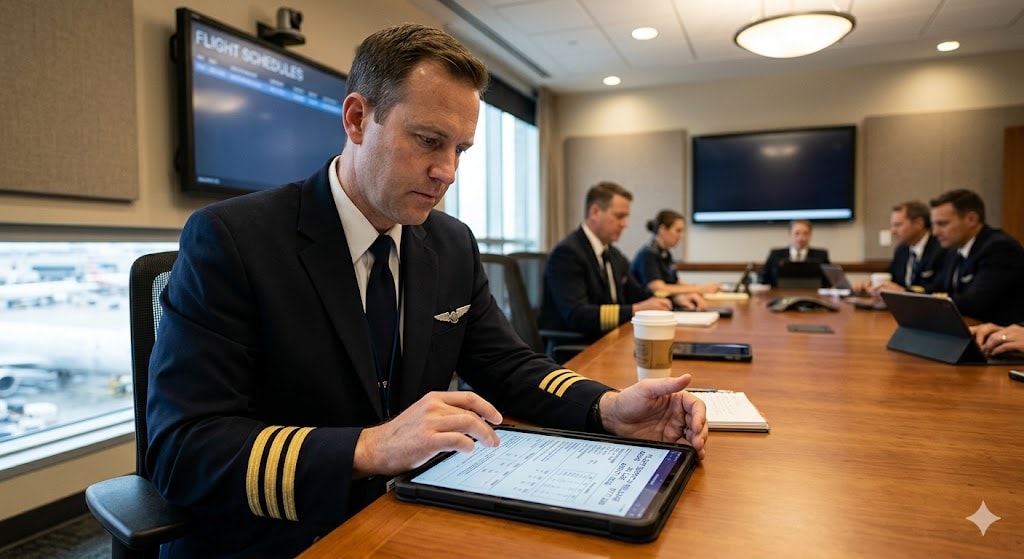
The release contains the route, fuel calculations, weather summary, NOTAM information, alternate airports, and any special operational notes. Both my name and the Captain’s name go on it. Both of us must agree before the flight departs.
The pre-departure briefing between the flight dispatcher and the crew is a moment I take seriously every single time. Even after thousands of flights, I never phone it in. I walk through the weather, highlight anything unusual, discuss the fuel load, and confirm the operational strategy. Most briefings take 5-10 minutes. Some — when weather is complex or the route has unusual considerations — take longer.
I have had Captains push back on my fuel recommendations, both up and down. “Why did you add 500 kg? The weather looks fine.” And I explain my reasoning — maybe the satellite imagery shows something the TAF has not caught yet, or maybe I know from experience that this particular approach gets backed up at that time of day. Usually, after the discussion, we agree. Occasionally, we compromise. The system works because both parties bring different perspectives: the pilot has cockpit experience and airmanship; the flight dispatcher has the big-picture view of weather trends, system-wide operations, and historical pattern recognition.
In rare cases — perhaps once or twice a year in my experience — we genuinely disagree. When that happens, we escalate to the Chief Dispatcher or Director of Operations. In 15 years, I have never had a case where the disagreement was not resolved through this process. The joint responsibility system is not perfect, but it is the best model aviation has developed for operational decision-making.
4. After Takeoff: The Job Is Not Over
A common misconception — even within the airline industry — is that the flight dispatcher’s job ends once the aircraft takes off. In reality, it intensifies.
I monitor every flight on my desk from pushback to arrival. Using satellite-based tracking systems, I see each aircraft’s position, altitude, speed, and heading updated in near real-time. If something changes — weather deteriorates at the destination, a new SIGMET is issued along the route, or ATC imposes an unexpected restriction — I communicate with the crew through ACARS (Aircraft Communications Addressing and Reporting System), sending updated weather, suggesting altitude changes, or proposing alternate routing.
On Southeast Asia routes, in-flight monitoring is especially active during convective season. I have sent ACARS messages like: “CB activity building rapidly along your route between waypoints XYZAB and ABCDE. Suggest deviation 30nm left. Updated destination weather follows.” The crew might reply: “Concur. Requesting FL380 for ride quality.” And we work together in real time, the pilot in the sky and the flight dispatcher on the ground, navigating through the same weather system from two different vantage points.
This is the part of the job that I find most rewarding. When a flight I planned encounters a challenge, and the preparation I built into the plan — the extra fuel, the alternate I selected, the route I chose — proves to be exactly what was needed, there is a quiet professional satisfaction in that. The crew will never know exactly why their flight went smoothly. But I will.
5. Typhoon Season: When Everything Changes at Once
If you want to understand what a flight dispatcher truly does, watch one during a typhoon.
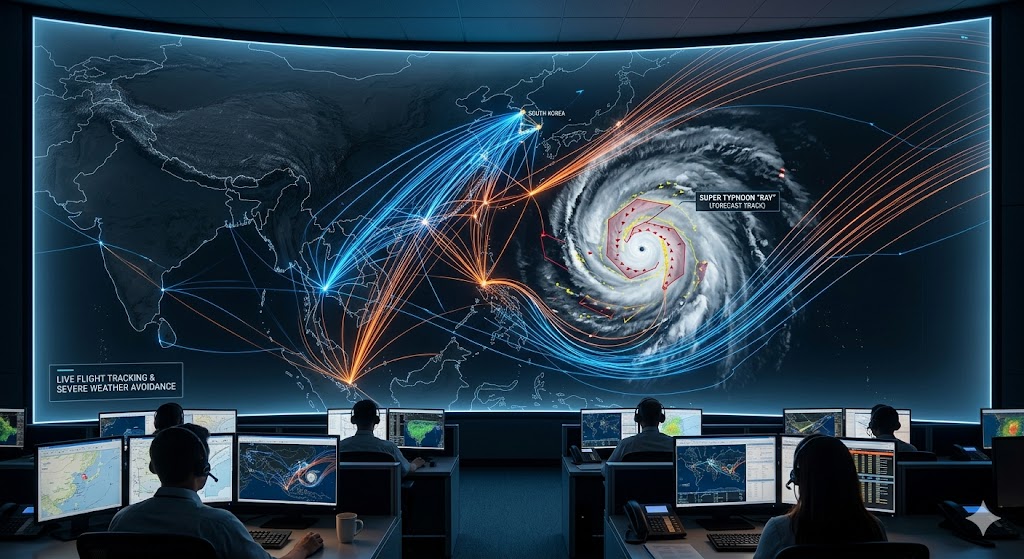
Working at a Korean LCC with heavy exposure to Japan, Taiwan, and Southeast Asia means that typhoon season — roughly June through November — is the most demanding period of the year. A single typhoon can simultaneously threaten Okinawa, Taipei, Manila, and the southern Japanese islands, affecting a dozen or more flights on our schedule.
Here is what a real typhoon day looks like from my desk:
It starts 3-5 days out, when the typhoon is still far out over the Western Pacific. I begin tracking the forecast models — GFS, ECMWF, and the Japan Meteorological Agency’s own typhoon track predictions. At this stage, I am not making decisions yet. I am building scenarios. If the typhoon tracks north toward Okinawa, which flights are affected? If it curves west toward Taiwan, how does that change the picture? I prepare contingency plans for each scenario so that when the decision point comes, we are ready.
At 48 hours out, the picture usually becomes clearer. This is when the real decisions begin. Flights to Okinawa might need to be cancelled proactively — better to cancel early and give passengers time to rebook than to send the aircraft and risk getting stranded. Flights to Taipei or Manila might need rerouting to avoid the typhoon’s outer bands. Flights that are still operating need extra fuel for deviations and potential diversions.
Then the typhoon hits, and the OCC transforms into a war room.

I have managed IROPS events where we cancelled 15 flights in a single day, diverted 3 aircraft already airborne, re-routed 8 others around the storm system, and then — once the typhoon passed — worked through the night to build the recovery schedule that would get our aircraft and crews repositioned for the next morning’s operations.
The triage process is critical. Airborne flights get priority — an aircraft in the sky with limited fuel needs immediate attention. Then ground stops at affected airports. Then schedule adjustments for the next 24-48 hours. Each decision cascades: cancelling one flight means that aircraft will not be in position for its next scheduled flight, which means another flight might need a different aircraft, which means the crew assignment changes, which affects duty time limits. It is a massive three-dimensional puzzle where every piece affects every other piece.
One typhoon I particularly remember hit during peak summer. We had flights inbound to Naha (Okinawa) when the typhoon accelerated faster than forecast. I made the call to divert two flights — one to Fukuoka, one to Kagoshima — while they still had fuel options. The Naha-bound passengers were unhappy. But two hours later, Naha airport closed entirely. Those passengers were safe in Fukuoka and Kagoshima, not circling above a closed airport with dwindling fuel. That is the kind of decision a flight dispatcher makes — unpopular in the moment, essential in hindsight.
6. The Volcanic Ash Factor: Indonesia Routes
Operating to Indonesia brings a challenge that most dispatchers in other regions rarely face: volcanic ash.
Indonesia has over 120 active volcanoes. When one of them erupts — and this happens more often than you might think — the ash cloud can extend across aviation corridors and reach cruising altitudes. Volcanic ash is not just a visibility issue. It can damage jet engines, sandblast windshields, contaminate cabin air, and in extreme cases, cause engine failure.
The Darwin Volcanic Ash Advisory Centre (VAAC) issues advisories for our region, and I monitor these closely whenever we have Denpasar, Surabaya, or Jakarta flights. I have re-routed flights around ash clouds from Mount Agung (Bali), adjusted altitudes to stay below ash layers from Mount Sinabung (Sumatra), and on a few occasions, cancelled flights entirely when the ash concentration was too high to safely operate.
What makes volcanic ash especially tricky is that it is invisible at night and often not detected by conventional weather radar. Unlike aircraft turbulence, which the aircraft can fly through with structural safety, volcanic ash poses a direct threat to the engines. The decision to avoid, re-route, or cancel is one of the more consequential calls a flight dispatcher makes on Indonesia routes.
7. What 15 Years Taught Me That No Textbook Could
I want to end with something personal, because I think it matters.
When I started as a flight dispatcher, I thought the job was primarily technical — learn the regulations, run the numbers, file the plan. And for the first year or two, that is mostly what it was. I was focused on not making mistakes, on getting the fuel right, on filing the correct route.
But over time, the job became something more. I started recognizing weather patterns before the models caught them. I developed an instinct for which flights would be “problem children” that day. I learned to read the hesitation in a pilot’s voice during a briefing and know that they had a concern they had not yet articulated. I built relationships with ATC coordinators in different FIRs who would give me a heads-up when congestion was building.
None of that is in any training manual. It comes only from doing the job, day after day, year after year, through typhoons and snowstorms and volcanic eruptions and the thousand small decisions that nobody notices when they go right.
Flight planning software has become remarkably sophisticated — it can optimize routes across dozens of variables in seconds. But it cannot feel that something is “off” about a forecast. It cannot hear the stress in a controller’s voice that suggests the traffic situation is worse than the official flow advisory indicates. It cannot weigh the institutional memory that last time this weather pattern appeared, things deteriorated faster than anyone predicted.
A flight dispatcher integrates all of this — the data, the experience, the human communication, the gut instinct refined by thousands of flights — into a single decision: is this flight safe to go? That integration is something no algorithm can replicate, and it is why the joint responsibility dispatch system remains essential to aviation safety.
After 15 years, I still take a moment before I sign each dispatch release. Not because I am unsure, but because I understand the weight of it. My name on that document means I have done everything within my knowledge and ability to ensure that this flight will arrive safely. Across all the flights I have dispatched in my career, every single one has. That is not a streak I intend to break.
Learn more about our mission and operational background on the About Aeruxo page.
All insights in this article are based on practical airline dispatch experience combined with standard operational procedures used in commercial aviation.
Related Reading from Aeruxo:
- ETOPS Explained: How Twin-Engine Flights Stay Safe Over Oceans
- What Is Wind Shear? 6 Facts From a Flight Dispatcher
- Why Flight Delays Happen in Real Airline Operations
Frequently Asked Questions
What is the difference between a flight dispatcher and an air traffic controller?
Air traffic controllers manage the real-time separation and sequencing of aircraft within specific airspace sectors — they keep aircraft from hitting each other. Flight dispatchers plan the entire flight before departure and monitor it through arrival — we design the route, calculate the fuel, analyze weather, and share legal responsibility with the Captain. Controllers focus on tactical traffic separation; dispatchers focus on strategic flight safety. Both are essential, but they are entirely different professions.
How long does it take to plan a single flight?
It depends on complexity. A routine Incheon-Osaka flight with clear weather might take 15-20 minutes. An Incheon-Denpasar (Bali) flight with convective weather and tight fuel margins takes 30-45 minutes. During irregular operations, I might need to completely re-plan a flight in 10-15 minutes under time pressure — which is where years of experience become invaluable.
Can a flight dispatcher cancel a flight?
Yes. Under the joint responsibility system, the flight dispatcher has the legal authority to delay, divert, or cancel a flight for safety reasons. This authority is independent of the Captain’s. In my 15+ year career, I have exercised this authority when weather, mechanical conditions, or operational factors warranted it. It is never a decision I take lightly, but it is a responsibility I take seriously.
Do flight dispatchers work only during the day?
The OCC operates 24 hours a day, 365 days a year. Flight dispatchers work rotating shifts covering days, evenings, nights, weekends, and holidays. A red-eye flight departing Incheon at midnight still needs a flight dispatcher to plan and monitor it. The OCC never closes — aircraft never stop flying.
How does a flight dispatcher become qualified?
You must pass examinations covering meteorology, navigation, aircraft performance, regulations, and operational procedures. Many countries issue dispatcher certificates or licenses based on ICAO Annex 6 standards. Training typically takes several months, followed by airline-specific training and ongoing recurrent testing. At my airline, dispatchers also receive route-specific qualification for different operational areas — a dispatcher qualified for Japan routes might need additional training before handling Southeast Asia routes due to the different weather challenges, airspace structures, and regulatory environments.
Is flight dispatching a stressful job?
It can be extremely stressful, particularly during irregular operations. Monitoring 15+ flights while simultaneously planning new ones, managing diversions, and coordinating with multiple departments under time pressure is inherently intense. But the training and experience prepare you for it. Honestly, the routine days can feel underwhelming — it is the challenging days, the ones where your planning and decision-making genuinely make a difference, that remind you why you chose this profession.
Have a question about flight dispatch or airline operations? Leave a comment below — I will answer from an operational perspective.
Disclaimer: The views expressed in this article are my own professional opinions based on 15+ years of operational experience. They do not represent the official position of any airline, aviation authority, or regulatory body. Specific airline details have been generalized to protect operational security.

Licensed Flight Dispatcher with 15+ years of experience in airline operations control. Holds FAA Aircraft Dispatcher Certificate and Republic of Korea Flight Dispatcher License (MOLIT). Specializes in flight watch, NOTAM analysis, flight planning, and operational control at a Korean LCC. IOSA audit participant and author of multiple airline operational manuals, including Emergency Response, De-icing, and OCC Procedures.