By Aeruxo — Licensed flight dispatcher (study guide) | 15+ Years in Airline
Operations
The call came from the gate agent at 0645: “We have 168
confirmed passengers for a 154-seat aircraft. Revenue management
released 14 oversales. We need volunteers by 0710 or we go to
involuntary.” I had already pulled the passenger list — four
passengers were traveling on non-revenue standby passes, two
were booked on the lowest fare bucket with change restrictions,
and three had checked in last. I gave the gate agent the priority
order for involuntary denied boarding, confirmed the next
available flights with open seats for rerouting, and checked
the compensation budget against the airline’s denied boarding
policy. By 0708, six passengers had volunteered for the later
flight in exchange for a travel credit and hotel accommodation.
The aircraft departed with every seat filled and no involuntary
bumping required. The passengers who chose to stay had a free
night in a hotel and a voucher worth three times their original
ticket value. The airline had a full flight.
Airline overbooking is the single most misunderstood practice
in commercial aviation from the passenger perspective — and the
one that generates more justified anger than almost any other
operational procedure. Most passengers believe it is simply
greed: selling more seats than exist to maximize revenue
regardless of the impact on passengers. The reality is more
nuanced, mathematically grounded, and — when the system works as
designed — actually beneficial to the average traveler. When it
fails, as it spectacularly did on United Airlines Flight 3411
in 2017, the consequences are visible to the entire world. After
15 years working in airline operations and managing oversale
situations directly, I want to explain exactly how airline
overbooking works, why airlines do it, what your rights are
when it affects you, and how to protect yourself from ever
being the passenger who gets bumped involuntarily.
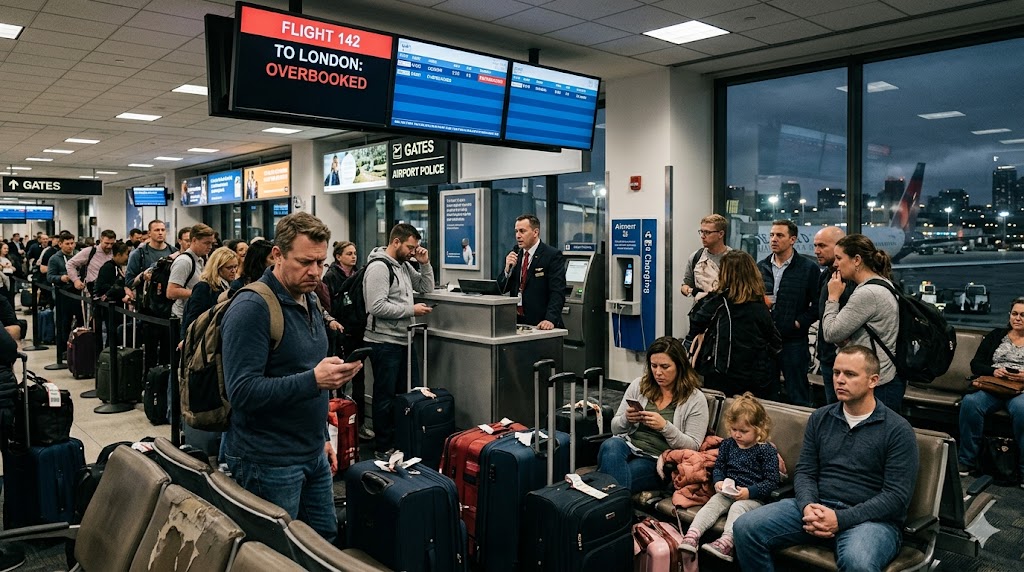
confirmed passengers than available seats, a compensation offer
being made, and a clock counting down to departure. How this
moment resolves depends on which passengers volunteer, which
airline policies apply, and what your legal rights are — all of
which most passengers do not know before they need to.
From the OCC, overbooking shows up as a load factor problem —
specifically, when the passenger count exceeds the aircraft’s structural
payload limit or when late-loading passengers push the weight and balance
outside certified limits. In practice, revenue management systems are
calibrated precisely enough that true weight-limit overbooking is extremely
rare on modern widebody operations. What I have seen more frequently is
the downstream effect: an overbooked flight generates denied boardings at the gate,
which generates misconnected passengers, which generates baggage tracing requests,
rebooking coordination, and hotel voucher authorizations — all of which land
in the OCC within the same 30-minute window. The overbooking decision is made weeks
in advance by a revenue algorithm. The operational consequences arrive all at once on departure day.
Key Takeaways
- Airline overbooking is legal, deliberate, and
mathematically rational:based on historical no-show
data that means a flight sold to 100 percent capacity typically
departs with 8 to 15 percent of seats empty without it. - There are two types of denied boarding:
Voluntary (VDB), where passengers accept compensation to take
a later flight, and Involuntary (IDB), where the airline removes
a confirmed passenger without consent. IDB triggers mandatory
compensation in most jurisdictions. - The United Airlines Flight 3411 incident in 2017
was not a standard airline overbooking event — it was an operational
crew positioning request mishandled as an oversale situation,
with consequences that cost the airline over $1.4 billion in
market value within days. - Your legal rights when bumped involuntarily vary
significantly by region. The European Union (EU 261/2004)
provides the strongest passenger protections globally. US DOT
regulations provide meaningful but different protections. Most
Asian carriers operate under significantly weaker passenger
rights frameworks. - Early check-in is the single most effective
protection against involuntary denied boarding from
airline overbooking — and understanding the voluntary offer
calculation tells you exactly when to accept one.
- Airlines overbook flights to compensate for no-show passengers.
- Most overbooking situations are resolved voluntarily with compensation offers.
- Involuntary denied boarding (IDB) triggers legal compensation in many countries.
- Your rights depend on your region (EU, US, Asia differ significantly).
- Early check-in reduces your risk of being bumped.
1. Why Airlines Overbook in the First Place
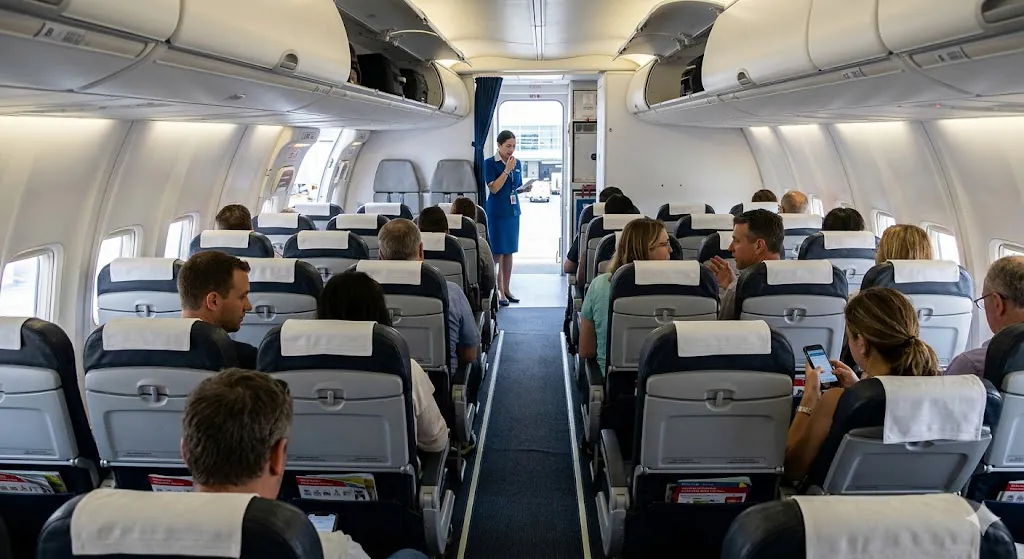
who purchased tickets but did not board. On a 180-seat aircraft,
10 to 15 empty seats due to no-shows is a routine occurrence
without airline overbooking — representing revenue that was sold
and then not consumed, with a seat that could have carried
another passenger sitting empty.
Airline overbooking exists because a predictable percentage
of passengers who purchase tickets do not board the aircraft they
are booked on. No-show rates on commercial flights historically
range from 5 to 15 percent depending on the route, fare mix,
and season. A business traveler who books a refundable fare on
a morning departure may cancel at the last moment when a meeting
is postponed. A connecting passenger may miss the second segment
because the first flight was delayed. A passenger who booked
months in advance may simply not show up without cancelling.
On a 180-seat aircraft with a 10 percent no-show rate, that
is 18 empty seats at departure — 18 units of perishable inventory
that generated no revenue despite having been sold.
Airline revenue management systems analyze historical no-show
rates by route, day of week, season, fare class, and booking
lead time to calculate the number of seats above capacity that
can be sold while maintaining a high probability that the
departing flight will be full. If the model predicts that a
given flight will have 12 no-shows, selling 12 additional seats
above the 180-seat capacity fills the aircraft and maximizes
revenue per flight. When the model is correct — which it is the
vast majority of the time — no passenger is affected, the flight
departs full, and the airline earns revenue that would otherwise
have been lost to no-shows. When the model is incorrect and
fewer passengers no-show than predicted, the airline has more
confirmed passengers than seats — and the airline overbooking
management process begins.
2. Voluntary vs Involuntary: The Two Outcomes of Airline
Overbooking
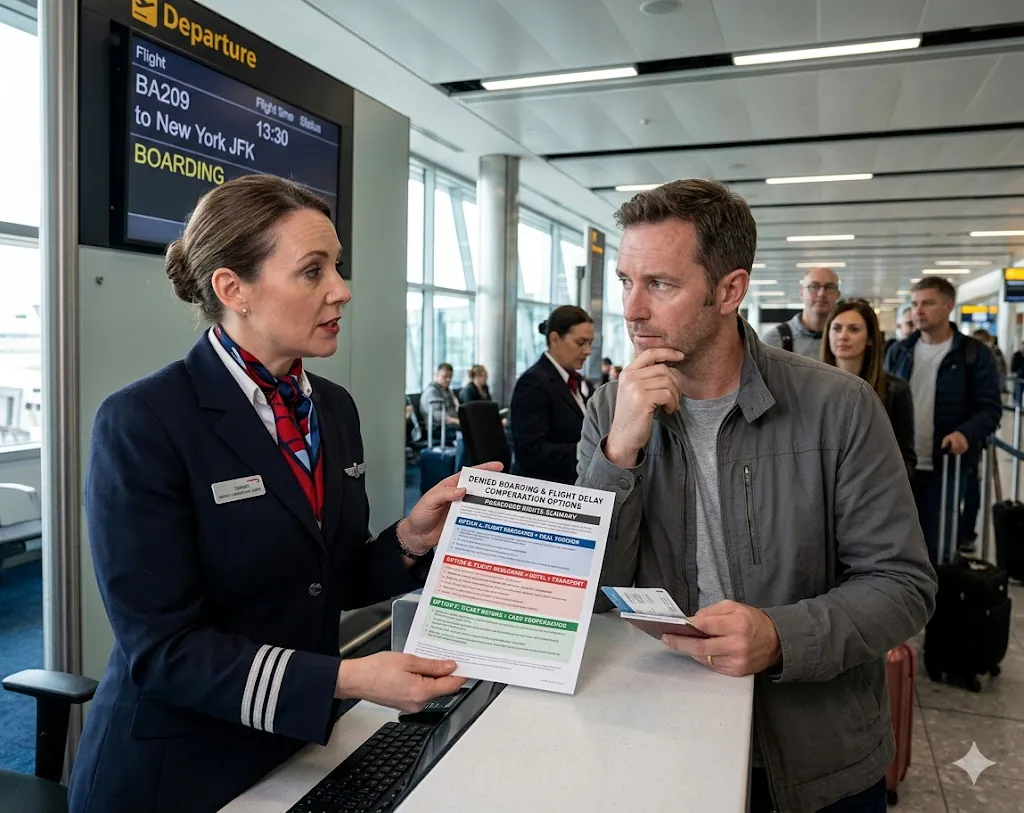
presents a compensation package — travel credit, meal voucher, hotel
if overnight required — in exchange for taking a later flight. The
passenger evaluates the offer against the value of their original
schedule. This is the airline overbooking resolution that benefits
both parties when executed correctly.
When an airline overbooking situation produces more confirmed
passengers than seats, the resolution process follows a strict
sequence. Voluntary Denied Boarding (VDB) is
always attempted first. The gate agent announces that volunteers
are needed to take a later flight in exchange for compensation’
typically a travel credit, meal vouchers, and hotel accommodation
if the rerouted flight is the following day. The airline sets
a maximum compensation budget and increases the offer if
volunteers are insufficient at the initial amount. VDB is a
purely commercial transaction: the volunteer assesses whether
the inconvenience of the delay is worth the compensation offered
and decides freely. Most airline overbooking situations are
resolved at this stage without any passenger being removed from
a flight they did not choose to leave.
Involuntary Denied Boarding (IDB) occurs
when insufficient volunteers come forward and the airline must
remove confirmed passengers without their consent. This triggers
mandatory compensation requirements in jurisdictions with passenger
protection regulations. Airlines apply a priority order for IDB
selection that is typically defined in their conditions of carriage:
non-revenue standby passengers first, then unaccompanied minors
last, with various rules about passengers who checked in latest,
booked at the lowest fare, or have no onward connections in
between. The specific priority order varies by airline but is
always defined in advance — an IDB selection is not arbitrary. It
follows a pre-established order that the airline is required to
apply consistently.
3. The United Airlines Flight 3411 Case: What Actually Happened
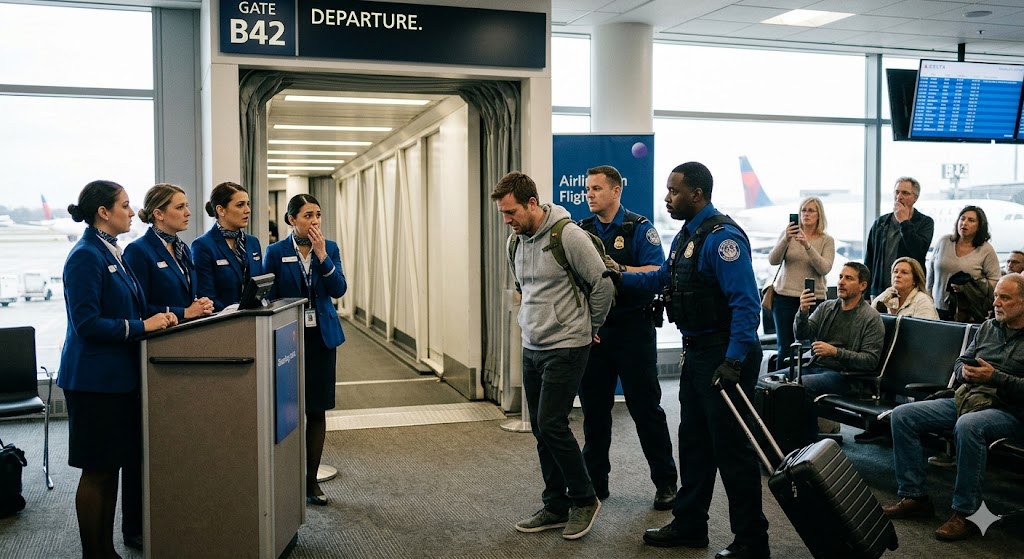
personnel: the outcome that airline overbooking management is
specifically designed to avoid through adequate voluntary
compensation offers. The United Flight 3411 incident in 2017
demonstrated the reputational and financial cost when that
process fails catastrophically.
On April 9, 2017, United Airlines Flight 3411 from Chicago
O — Hare to Louisville was fully boarded when the airline determined
it needed to position four crew members on the aircraft for
operational reasons. Four passengers were selected for involuntary
removal under what the airline initially described as an airline
overbooking situation — though the crew positioning request was
technically distinct from a standard oversale. Dr. David Dao,
a 69-year-old physician, refused to leave the aircraft, citing
a patient he needed to see the following morning. Aviation
security officers forcibly removed him, causing a concussion,
a broken nose, and the loss of two teeth. Passenger videos of
the removal spread globally within hours.
The commercial consequences were immediate and severe. United
Airlines’ stock fell approximately 4 percent — representing over
$1 billion in market capitalization — within two days. The airline
reached a confidential settlement with Dr. Dao within weeks.
The incident triggered a global legislative review of passenger
protection rights and caused United to permanently change its
policies on the use of law enforcement to remove seated passengers.
The case is the defining modern example of what happens when
airline overbooking management breaks down — not because the
mathematics of overbooking are wrong, but because the compensation
offered was insufficient to produce voluntary resolution, and
the involuntary enforcement was executed in a way that no
reasonable passenger would accept as proportionate. The lesson
from Flight 3411 is not that airline overbooking is wrong — it
is that adequate voluntary compensation offers prevent the
situations that make involuntary enforcement necessary, and
that enforcement of IDB must never involve force against a
seated, compliant passenger.
4. Your Legal Rights When Airline Overbooking Affects You
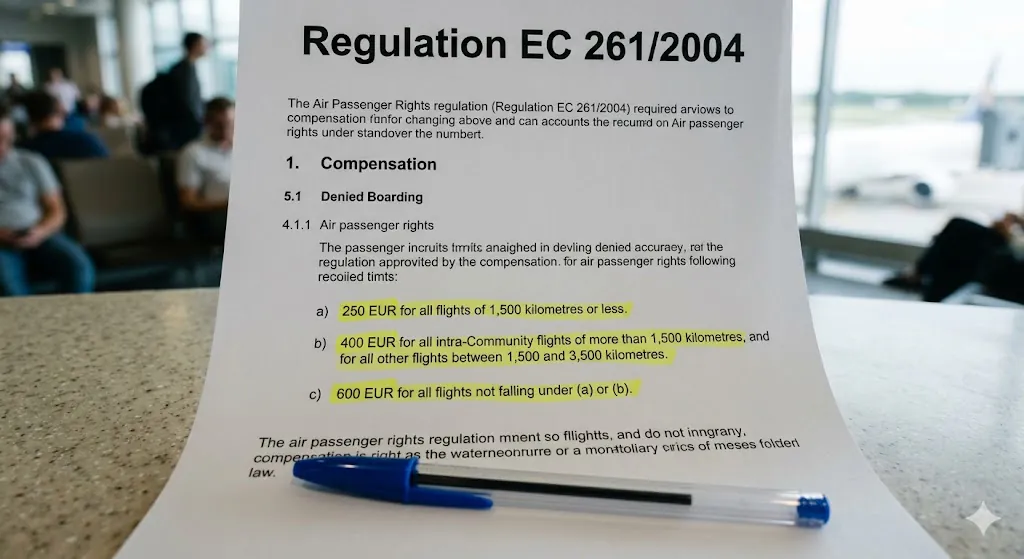
overbooking passenger protections globally: mandatory cash
compensation of —250 to —600 depending on flight distance,
plus meals, refreshments, and accommodation when required. These
are legal rights, not the airline’s discretionary offers — and
most passengers do not claim them.
Legal protections against airline overbooking vary dramatically
by jurisdiction, and knowing the applicable framework before you
need it is the difference between accepting a voucher worth less
than your legal entitlement and claiming the full compensation
you are owed. European Union (EU 261/2004) is
the strongest framework globally. If you are denied boarding
involuntarily on a flight departing from any EU airport, or
arriving at an EU airport on an EU-based carrier, you are entitled
to: cash compensation of —250 (flights under 1,500 km), —400
(1,500 to 3,500 km), or —600 (over 3,500 km); meals and
refreshments proportionate to the wait; hotel accommodation if
an overnight stay is required; and transport between the airport
and hotel. These are legal entitlements, not discretionary offers’
the airline is legally required to pay them in cash (not vouchers)
unless you specifically accept an alternative.
United States DOT regulations provide a
different framework: for domestic flights, IDB passengers are
entitled to 200 percent of their one-way fare (maximum $775) if
the airline arranges alternative transport arriving within one
to two hours of the original arrival, or 400 percent (maximum
$1,550) if the delay exceeds two hours. International flights
have different thresholds. Critically, these amounts represent
the minimum — airlines may offer more to attract volunteers — and
they apply only to IDB, not VDB. Most Asian carriers
operate under significantly weaker domestic passenger rights
frameworks, and passengers on Korean, Japanese, or Southeast
Asian domestic routes should check their specific carrier’s
conditions of carriage rather than assuming EU or US-equivalent
protections apply. According to the
US DOT Fly-Rights passenger
guide, denied boarding compensation is one of the most
commonly unclaimed passenger entitlements in commercial aviation’
because most affected passengers do not know the specific amounts
they are owed before they accept a lesser offer.
5. What the Dispatcher Does During an Airline Overbooking
Situation
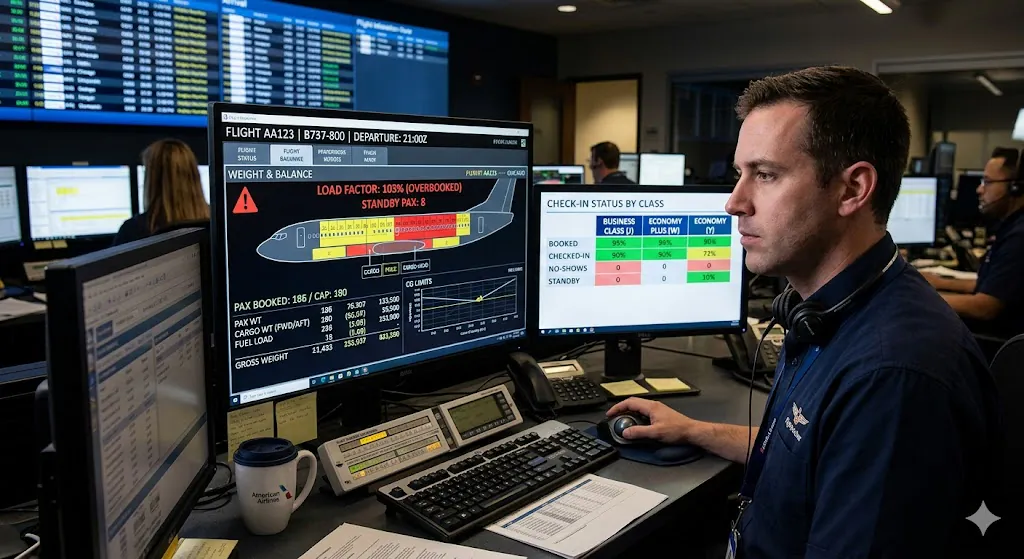
shows every seat’s status, the overbooking count, and the weight
implications of the final passenger manifest. The dispatcher’s
interest in an oversale situation is structural and operational’
the final passenger count directly affects the weight and balance
calculation that determines takeoff performance.
The dispatcher’s direct involvement in airline overbooking
is primarily through the load control function — ensuring that the
final passenger count, combined with cargo and fuel, produces a
weight and balance within the aircraft’s certified limits for
takeoff. An aircraft sold to 103 percent of seat capacity has a
theoretical maximum passenger weight 3 percent above the seating
capacity assumption, and this affects the takeoff weight, landing
weight, and fuel calculation that the dispatcher certifies on
the operational release. If the oversale situation is not resolved
before departure and every oversold passenger somehow boards,
the weight and balance may require a fuel adjustment or a cargo
offload to remain within certified limits — a situation that creates
operational pressure as the departure clock runs down.
More directly, the dispatcher is responsible for identifying
rerouting options for displaced passengers — the next available
flights with open seats on the same route, connecting options
through alternate hubs, or partner carrier seats that can be
confirmed for IDB passengers who must be rerouted. When I receive
an oversale call from a gate agent, I pull available seats on
the next three departures on the route, check partner carrier
availability through our interline agreements, and give the
gate agent a rerouting menu with confirmed seat availability
before the voluntary offer announcement is made. A gate agent
who can offer a confirmed seat on a specific later flight — rather
than a standby position — generates significantly more volunteers
at lower compensation cost. The operational groundwork of the
airline overbooking resolution is as important as the passenger-
facing offer itself. For how these delay and disruption cascades
affect broader network operations, my
flight delay article covers the network effects that oversale
situations contribute to.
How to Protect Yourself From Airline Overbooking
Check in as early as possible. Most airline
IDB priority systems begin with passengers who checked in last.
An online check-in 24 hours before departure — or even earlier
if the airline allows it — places you near the front of the check-in
sequence and near the back of the IDB candidate list. On heavily
oversold routes during peak travel periods, the difference between
checking in at T-24 hours and checking in at the airport can
be the difference between keeping your seat and being asked to
volunteer. Select your seat at booking:passengers
with assigned seats are generally treated differently in IDB
priority sequences than passengers traveling without seat
assignments, particularly on carriers where seat selection is
a paid add-on that signals fare commitment level.
Know your legal rights before the gate agent speaks
to you. The voluntary offer made at the gate is
calibrated to the minimum amount the airline expects will attract
sufficient volunteers — not to the maximum compensation available.
If you are willing to volunteer, understanding that you can
negotiate upward within the VDB budget the airline has set gives
you a negotiating position most passengers do not use. If you
are selected for IDB and do not wish to accept, know the specific
compensation amounts your jurisdiction mandates and confirm in
writing before leaving the gate area that you are being denied
boarding involuntarily — not voluntarily. The documentation of
IDB status is necessary to claim the mandatory compensation that
the airline is legally required to pay. Never give up
your boarding pass until you have confirmed alternative
travel arrangements in writing and received any applicable
compensation, travel credits, or hotel vouchers — once the boarding
pass is surrendered, your leverage in the negotiation is
significantly reduced. For the broader framework of how airlines
manage flight disruptions from the operational side, my
flight cancellation article covers the decision chain that
determines which passengers are most affected by disruptions
across the network.
Related Reading from Aeruxo:
- Why Flight Delays Happen in Real Airline Operations
- How Airlines Decide to Cancel Flights
- Lost Luggage: 5 Key Facts From a Flight Dispatcher
Frequently Asked Questions
What is airline overbooking?
Airline overbooking is the deliberate practice of selling more
confirmed tickets for a flight than the aircraft has available
seats. It is based on historical data showing that a predictable
percentage of passengers — typically 8 to 15 percent depending on
the route — do not board their booked flight due to cancellations,
missed connections, or no-shows. By selling seats to cover the
expected no-show rate, airlines ensure that flights depart at
or near full capacity, maximizing the revenue per departure and
keeping ticket prices lower than they would be if the no-show
seats were simply lost.
Is airline overbooking legal?
Yes. Airline overbooking is legal in virtually all commercial
aviation jurisdictions, including the United States, the European
Union, and most Asian countries. What is regulated is not the
practice of overbooking itself but the treatment of passengers
when overbooking results in denied boarding — specifically, the
mandatory compensation amounts for involuntary denied boarding
and the required level of assistance (meals, accommodation,
rerouting) that airlines must provide to affected passengers.
What is the difference between voluntary and involuntary
denied boarding?
Voluntary Denied Boarding (VDB) occurs when a passenger agrees
to give up their seat in exchange for compensation — a travel credit,
meal vouchers, or hotel accommodation — and takes a later flight
by choice. Involuntary Denied Boarding (IDB) occurs when the
airline removes a confirmed passenger without their consent because
insufficient volunteers came forward. IDB triggers mandatory cash
compensation requirements in most jurisdictions, while VDB
compensation is negotiated between the airline and the volunteer
and may be offered in the form of travel credits rather than cash.
How much compensation am I owed if bumped involuntarily?
In the European Union, EU 261/2004 mandates cash compensation
of —250 for flights under 1,500 km, —400 for flights between
1,500 and 3,500 km, and —600 for flights over 3,500 km — plus
meals, refreshments, and hotel accommodation as required. In
the United States, DOT regulations require 200 percent of the
one-way fare (maximum $775) for delays of one to two hours, or
400 percent (maximum $1,550) for delays over two hours. These
are minimum legal requirements; airlines may offer more to
attract volunteers or resolve disputes.
What happened on United Flight 3411 and what changed
afterward?
On April 9, 2017, United Airlines needed to position four
crew members on a fully boarded flight. After insufficient
volunteers came forward, Dr. David Dao was involuntarily selected
and physically removed by security officers when he refused to
leave, sustaining injuries including a concussion and broken nose.
Passenger videos spread globally, causing United’s market
capitalization to fall over $1 billion within two days. United
subsequently changed its policies to prohibit using law enforcement
to remove seated, compliant passengers and increased the maximum
VDB compensation it could offer. The incident prompted legislative
reviews of passenger rights in multiple jurisdictions.
How can I avoid being bumped due to airline overbooking?
Check in as early as possible — most IDB priority systems favor
late check-in passengers for removal first. Select a seat at
booking rather than traveling with an unassigned seat. If
volunteering for VDB, negotiate the compensation upward within
the airline’s budget rather than accepting the first offer — most
airlines set initial VDB offers below their maximum authorized
amount. If selected for IDB against your will, document your
status in writing before leaving the gate, confirm your
rerouting in writing, and claim the mandatory cash compensation
your jurisdiction requires rather than accepting a lesser voucher.
Does the dispatcher know about airline overbooking on a
specific flight?
Yes. The load control function — which the dispatcher coordinates
or directly manages depending on the airline structure — monitors
the final confirmed passenger count against the aircraft’s
certified weight and balance limits. An oversale situation that
affects the final passenger count has direct operational
implications for the takeoff weight calculation, fuel planning,
and cargo manifest. The dispatcher also identifies rerouting
options for displaced passengers before the gate agent makes
the voluntary offer announcement, so that confirmed alternative
seat availability can be offered rather than a standby position’
a detail that significantly affects how many passengers volunteer
at a given compensation level.
Have you ever been bumped or offered compensation due to
airline overbooking? Did you know your legal rights before you
accepted the offer? Share your experience in the comments — passenger
accounts of overbooking situations help others understand what
to do — and what not to accept — when they face the same situation.
Disclaimer: The views expressed in this article are my own
professional opinions based on 15+ years of operational experience.
They do not represent the official position of any airline, aviation
authority, or regulatory body. Specific passenger rights regulations
vary by jurisdiction — consult the applicable aviation authority
or a consumer rights advisor for guidance on your specific
situation.

Licensed Flight Dispatcher with 15+ years of experience in airline operations control. Holds FAA Aircraft Dispatcher Certificate and Republic of Korea Flight Dispatcher License (MOLIT). Specializes in flight watch, NOTAM analysis, flight planning, and operational control at a Korean LCC. IOSA audit participant and author of multiple airline operational manuals, including Emergency Response, De-icing, and OCC Procedures.