By Aeruxo — Licensed flight dispatcher (study guide) | 15+ Years in Airline
Operations
The call came from the ground controller at 0247 local time:
“All aircraft, all vehicles, hold position. Runway 14R is active.
Repeat, hold position.” Two minutes earlier, a cargo freighter
had begun its takeoff roll on 14R. My aircraft was cleared to
taxi via November, Juliet, cross 14R, and continue to Gate 32.
The crew had read back the crossing clearance correctly. But the
controller had given the crossing clearance before issuing the
takeoff clearance to the freighter — a sequencing error that placed
two aircraft on the same runway simultaneously. The freighter
crew saw my aircraft’s lights at the crossing point with 800 metres
of runway remaining. They rotated early. My aircraft passed beneath
them with approximately 12 metres of vertical clearance. Nobody
declared an emergency. The flight continued to the gate. The
incident report I filed the following morning ran to four pages.
A runway incursion is any unauthorized presence on an active runway,
and most of the danger comes from timing, not speed.
A runway incursion is the unauthorized presence of an aircraft,
vehicle, or person on a runway that is active or about to become
active. It is not a mid-flight emergency. It does not involve
turbulence, mechanical failure, or weather. It happens on the
ground, at walking or taxiing speed, in the moments between
gate pushback and takeoff clearance — the phase of flight that
passengers pay the least attention to and that aviation safety
data consistently identifies as one of the highest-risk phases
of the entire operation. The one of the most significant accidents
in aviation safety history was a runway incursion.
After 15 years working in airline operations and analyzing
the systems built to prevent the specific sequence of failures
that produces runway incursions, I want to explain exactly what they are,
why they keep happening despite decades of safety investment,
and what protects your aircraft every time it crosses a runway.
This article is based on operational dispatch experience and
supported by international aviation safety standards and publicly
available investigation reports.
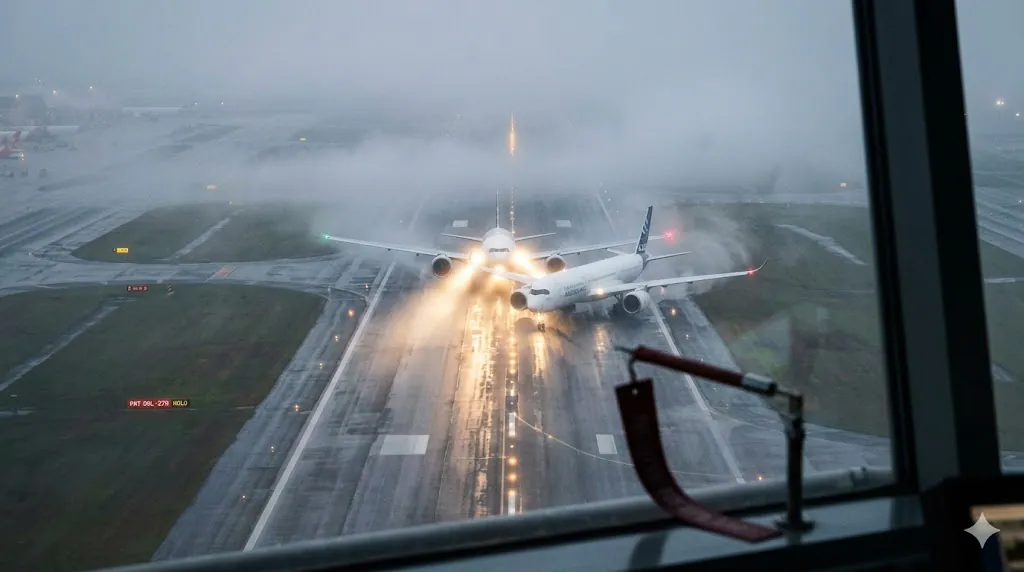
another crossing the runway threshold. This scenario — two aircraft
on the same runway simultaneously — produced the deadliest accident
in aviation history at Tenerife in 1977 and remains a primary
safety focus at every major airport today.
In 15 years at the OCC, the most unsettling calls were never the
in-flight emergencies. They were the ground movement incidents —
the moments when an aircraft or vehicle appeared somewhere on the surface
movement chart that it was not supposed to be. I remember one pre-dawn departure
at a major hub where my aircraft received a taxi clearance that routed it
across an active runway. The crew read back the clearance correctly, began taxiing,
and I was watching the position readout when the ground controller issued
a STOP instruction. A cargo aircraft was on its takeoff roll. The crew stopped.
It was a controller sequencing error — identical in structure to Tenerife,
just with a functioning radio and a crew that heard the stop call.
That incident is why I read every ATIS and ground movement note before
any departure at an unfamiliar airport.
Key Takeaways
- A runway incursion is the unauthorized presence of any
aircraft, vehicle, or person on a protected runway surface.
It is categorized by severity from Category A (collision or near
miss with major potential) to Category D (little or no chance of
collision but still a reportable event). - The deadliest aviation accident in history was a runway
incursion. The 1977 Tenerife collision killed 583 people
when a KLM Boeing 747 began its takeoff roll while a Pan Am 747
was still on the runway — in fog, with radio communication failures
that neither crew nor controller could immediately resolve. - Most runway incursions involve communication errors,
readback/hearback failures, or incorrect situational awareness
on the airport surface:particularly in low visibility
when visual confirmation of the runway environment is not possible. - RAAS (Runway Awareness and Advisory System)
provides real-time audio and visual alerts when an aircraft
approaches or enters a runway without the expected clearance’
the onboard last line of defence after ATC procedures have failed. - Hot spots — specific locations on airport surfaces where
runway incursion risk is historically elevated:are
charted on taxi diagrams and briefed to crews before every ground
movement at complex airports.
1. What a Runway Incursion Actually Is
The ICAO definition of a runway incursion encompasses any
occurrence on an aerodrome involving the incorrect presence of
an aircraft, vehicle, or person on the protected area of a surface
designated for the landing and takeoff of aircraft. The key word
is “incorrect”—a runway incursion does not require a collision or
even a close call. An aircraft taxiing onto a runway without
clearance in conditions where no other aircraft is anywhere nearby
is still a runway incursion, still reportable, and still triggers
a mandatory investigation. The severity classification system
ranges from Category A — a collision or a separation so small that
only chance prevented a collision — through Categories B and C
for decreasing separation, to Category D for incidents with
little collision potential but constituting a reportable breach
of runway protection.
The distinction between a runway incursion and a runway
excursion matters because passengers often confuse the two.
A runway excursion is an aircraft departing the runway surface
laterally or longitudinally during landing or takeoff — an aircraft
going off the end or side of the runway it is supposed to be
on. A runway incursion is an aircraft or vehicle entering a
runway it is not supposed to be on. One is a stopping problem;
the other is a navigation and authorization problem. Both are
serious; both generate mandatory safety reports; both have
contributed to fatal accidents. But they involve completely
different causes, detection systems, and prevention procedures.
2. Tenerife: Why the Deadliest Accident Was a Runway Incursion
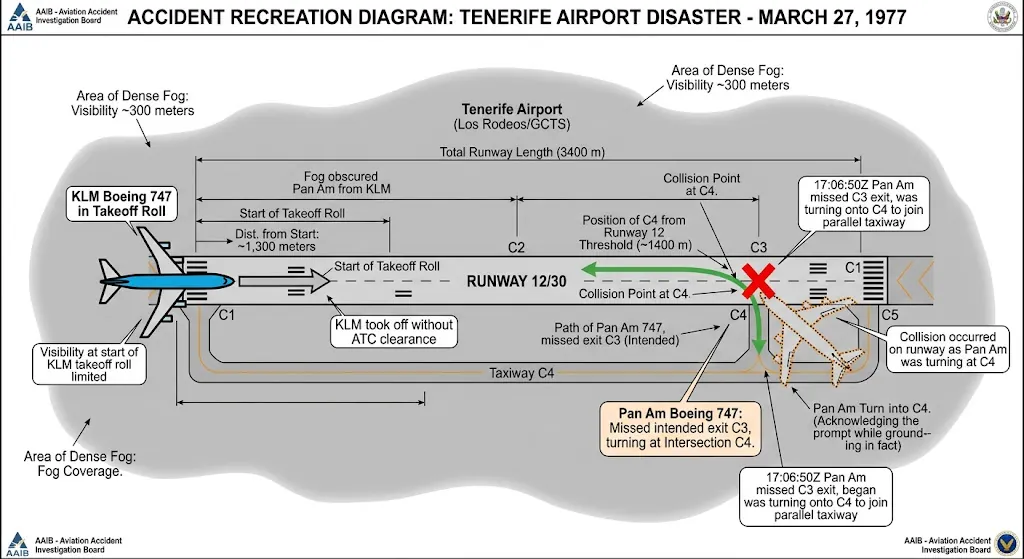
roll while the Pan Am 747 was still on the runway at intersection
C4. Dense fog prevented either crew from seeing the other. The
collision killed 583 people — the deadliest runway incursion in
aviation history and the accident that drove the most fundamental
changes to aviation communication procedures.
On March 27, 1977, two Boeing 747s — KLM Flight 4805 and Pan
American Flight 1736 — collided on the runway at Los Rodeos Airport
in Tenerife, Canary Islands. The collision killed 583 people,
making it the deadliest accident in commercial aviation history.
The mechanism was a runway incursion: the KLM aircraft began
its takeoff roll while the Pan Am aircraft was still on the runway,
taxiing to the intended exit taxiway. Dense fog — visibility below
300 metres — prevented either crew from seeing the other. A cascade
of communication errors, readback ambiguities, and a fundamental
misunderstanding between the KLM captain and the ATC controller
about whether the Pan Am aircraft had cleared the runway produced
a situation where the KLM crew believed they had takeoff clearance
when they did not.
The Tenerife disaster produced the most fundamental procedural
changes in aviation communication history. Standard
phraseology for ATC clearances was overhauled globally:
the word “takeoff” became exclusively reserved for actual takeoff
clearance — controllers no longer used “takeoff” in any context
except the clearance itself, eliminating the ambiguity that
contributed to the KLM crew’s misunderstanding. Readback
requirements for critical clearances were standardized:
crews must read back runway-in-use clearances, takeoff clearances,
and holding instructions verbatim, and controllers must correct
any incorrect readback before the clearance is actioned.
Crew Resource Management (CRM) training was formalized
as a mandatory component of airline training following the finding
that the KLM first officer expressed doubts about whether the
Pan Am aircraft had cleared the runway — doubts that were not
effectively raised against a highly experienced captain. According
to the
SKYbrary Tenerife accident
reference, the collision’s investigation produced safety
recommendations that remain foundational to modern aviation
communication standards forty-seven years later.
3. Why Runway Incursions Keep Happening
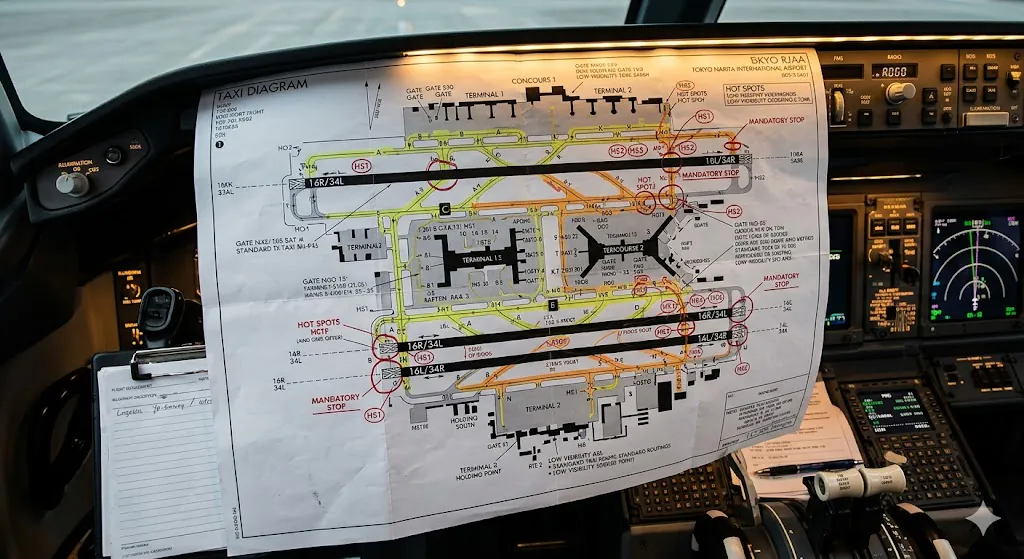
taxiways, multiple runway crossing points, hot spots marked with
circles, and holding positions at every runway intersection.
Navigating this chart in low visibility, at night, in an unfamiliar
airport, while managing radio communications is the environment
in which runway incursions occur.
Runway incursions continue to occur at a rate that aviation
safety agencies consider unacceptably high despite decades of
procedural improvement, technology deployment, and crew training.
The reasons are structural. Airport surface complexity
at major hubs has increased significantly as traffic
volumes have grown — airports designed in the 1960s now handle
aircraft volumes their taxiway geometry was never intended for,
creating routing patterns that require multiple runway crossings,
counterintuitive taxi paths, and dense traffic on the ground
movement area simultaneously. Communication ambiguity
remains the primary proximate cause of most runway incursions
despite the phraseology improvements driven by Tenerife — partial
readbacks, frequency congestion, similar-sounding callsigns, and
non-standard phraseology from non-native English-speaking crews
or controllers continue to generate readback/hearback errors at
a measurable rate.
Confirmation bias in low visibility is the
most insidious contributing factor. A crew expecting to be cleared
to cross a runway, in conditions where they cannot see whether
the runway is clear, and hearing an ATC transmission that sounds
like — but is not — a crossing clearance, will frequently taxi onto
the runway. The cognitive mechanism that produces this error is
the same one that makes humans effective at pattern recognition
in ambiguous situations; it is not carelessness, it is the
predictable failure mode of human perceptual processing under
workload and uncertainty. Airport hot spots:
specific intersections and crossing points with a documented
history of incursion incidents — are identified precisely because
the geometry of certain taxiway-runway intersections reliably
produces higher error rates than the surrounding ground movement
environment. Knowing a hot spot exists does not eliminate the
risk; it targets crew attention and additional procedural
safeguards at the specific location where the geometry makes
errors most likely.
4. RAAS: The Last Line of Defence Against a Runway Incursion
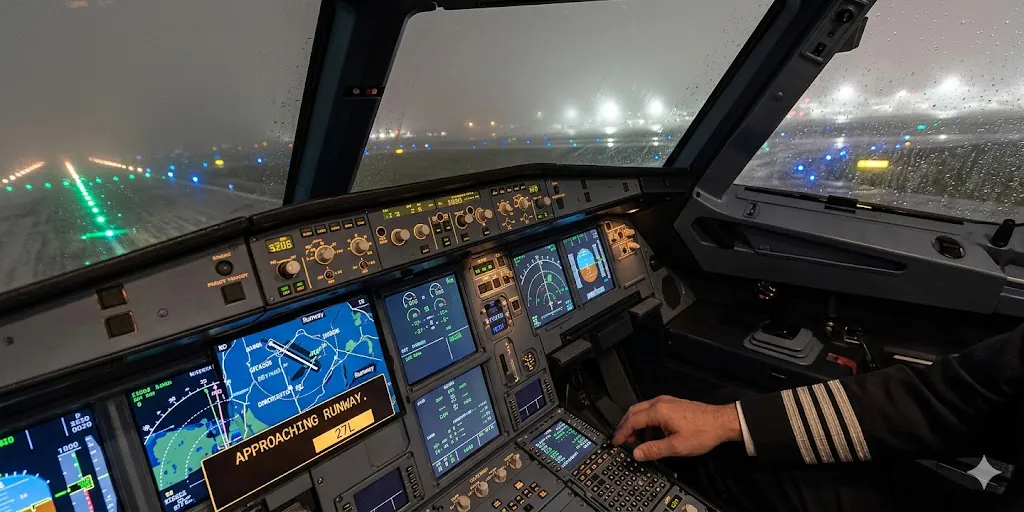
the aircraft’s position relative to runways using GPS and airport
database data, and issues audio and visual alerts when approach
to an active runway is not consistent with the expected clearance.
It is the onboard backstop after ATC procedures have not prevented
the incursion.
RAAS (Runway Awareness and Advisory System) is an onboard
system that uses GPS position data and an internal airport database
to monitor the aircraft’s position relative to runway surfaces
continuously during ground operations. It issues audio advisories’
“APPROACHING RUNWAY,” “ON RUNWAY,” “RUNWAY DISTANCE REMAINING”—
at decision points during taxi that alert the crew when the
aircraft is approaching or entering a runway. The system does
not know whether the crew has or has not received a clearance;
it issues advisories based purely on position relative to the
runway surface, giving the crew a consistent position-awareness
cue regardless of what they heard — or thought they heard — on the
ATC frequency.
RAAS does not prevent runway incursions the way an ATC clearance
prevents them — it is an advisory system, not a control system.
The crew can continue onto the runway despite a RAAS advisory.
But it provides a consistent trigger for the crew to pause and
verify their clearance at the specific moment when the geometry
of the situation makes an incursion possible. The value of the
system is not in its authority but in its timing — an audio advisory
at the holding point gives the crew a cue to re-verify clearance
at exactly the point where a readback error would otherwise go
undetected. Airport Surface Detection Equipment (ASDE-X)
provides the ground-side equivalent: radar or multilateration
systems that give ATC a real-time picture of all aircraft and
vehicles on the airport surface, allowing controllers to detect
and issue conflict alerts when a runway incursion is developing.
According to the FAA Runway Safety program
resources, the combination of RAAS, ASDE-X, and enhanced
pilot and controller training has produced measurable reductions
in Category A and B runway incursion rates at the airports where
all three elements are deployed.
5. Runway Holding Points and Stop Bars: The Physical Defence
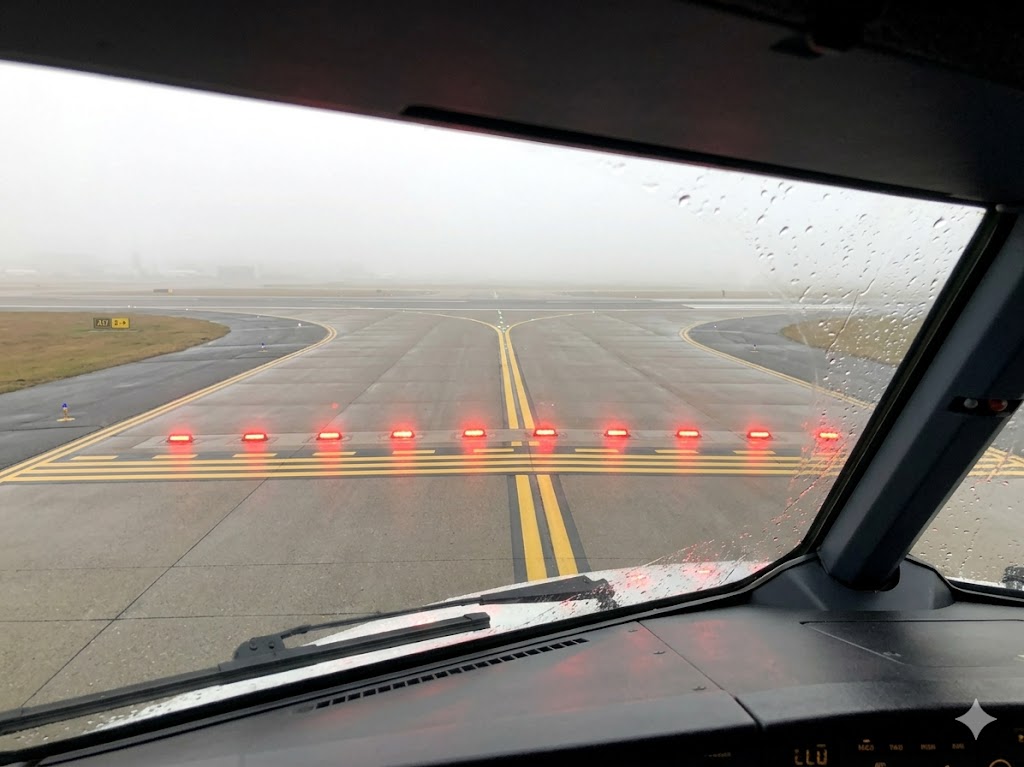
runway (do not cross without clearance), double dashed lines facing
away (may be crossed). Red stop bar lights at Category II/III
holding points add a physical visual barrier — a lit stop bar must
not be crossed under any circumstances without specific clearance
and confirmation of light status change.
The physical infrastructure of runway incursion prevention
centers on the holding point — the taxiway marking system that
defines the boundary of the protected runway area. The standard
holding point is a set of yellow lines across the taxiway: two
solid lines on the runway side (do not cross toward the runway
without clearance) and two dashed lines on the far side (may
be crossed when exiting the runway). The asymmetric design ensures
that the mandatory stop boundary is visually unambiguous regardless
of which direction the aircraft is approaching.
At airports operating in Category II and III low-visibility
conditions — where visual confirmation of the runway is impossible’
illuminated stop bars are added at runway holding points. These
red in-pavement lights extend across the full taxiway width and
are controlled from the ATC tower. A lit stop bar is an absolute
prohibition on crossing: the crew must hold regardless of any
clearance received until the controller extinguishes the stop bar,
providing a positive, visible confirmation that the clearance was
intended. When the stop bar goes off and the centreline lead-on
lights ahead illuminate, the clearance is confirmed by the
physical state of the lighting, not solely by the radio transmission.
This dual-confirmation system exists because Tenerife demonstrated
that radio communication alone cannot be relied upon as the sole
defence against runway incursion in low visibility.
6. What the Dispatcher Knows About Runway Incursion Risk
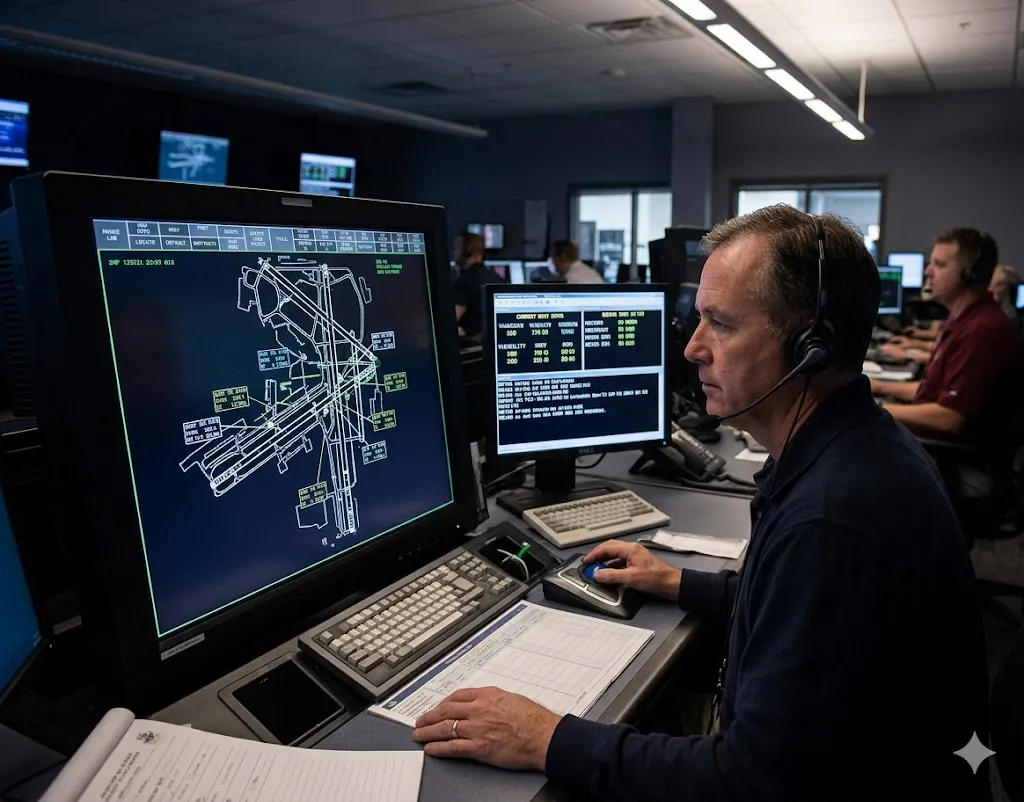
a real-time radar picture of all aircraft and vehicles on the
airport surface. A controller who can see a runway incursion
developing has seconds to issue a stop instruction — milliseconds
in the Tenerife scenario, where fog removed that option entirely.
The dispatcher’s direct involvement in runway incursion prevention
is limited — surface movement is managed by ATC and the crew. But
the dispatcher’s role in creating the conditions that either
increase or decrease runway incursion risk is real and specific.
Route-level airport familiarity is the first
factor: when I release a crew to an unfamiliar airport with a
complex ground movement environment, I brief the relevant hot
spots, include the latest NOTAM for any taxiway or holding point
changes, and flag low-visibility procedures if the destination
weather is below CAT I minima. A crew approaching an airport
for the first time in low visibility needs the ground movement
brief as much as they need the approach brief — and that brief
is part of the operational release package I prepare.
Low-visibility operations planning is the
second intersection. When destination visibility is forecast
below 550 metres RVR — the threshold at which CAT II/III low
visibility procedures activate, including illuminated stop bars
and reduced surface movement speeds — I verify that the destination
airport is CAT II/III certified, that LVP procedures are available,
and that the crew holds the relevant low-visibility ground
movement authorisation for the aircraft type. An aircraft arriving
in CAT III conditions at an airport without operational ASDE and
stop bar infrastructure faces a runway incursion risk environment
similar to Tenerife — where the only runway protection is radio
communication in conditions where neither crew nor controller
can see the runway. For how low-visibility conditions affect
the complete arrival and approach sequence, my
landing in fog article covers the full instrument approach
framework that operates in parallel with the surface movement
protections described here.
What Passengers Should Know About Runway Incursions
The taxi phase is not routine. The portion of
your flight between pushback and the runway threshold is the phase
where runway incursions occur. Passengers who are looking at their
phones, stowing bags, or tuning out the safety briefing during
this phase are tuning out the phase of the operation that produces
the deadliest accident type in aviation history. This is not an
argument for passenger anxiety — it is an argument for understanding
that the crew’s attention during taxi is intensive and their
communication workload is high. The seatbelt sign is on during
taxi for reasons that include runway incursion risk.
The pause at a holding point is mandatory.
When the aircraft stops at the yellow lines before the runway
and the crew makes a radio call you can partially hear, they are
doing the most important safety check of the ground movement
sequence: verifying that they have explicit clearance to cross
the runway before the nose crosses the holding point. In low
visibility or at complex airports, this check may take longer
than passengers expect. Impatience from the cabin during a
holding-point stop is not appropriate; the crew is doing exactly
what decades of runway incursion accident history has proven is
necessary. If you hear an ATC radio transmission during
taxi that sounds like a runway clearance being read back, pay
attention— the crew is performing the verification step
that exists because Tenerife demonstrated the cost of not
performing it. For how all the surface movement, approach, and
emergency systems on a commercial aircraft work together to
protect every flight, my
aviation safety article covers the statistical safety record
that these systems collectively produce.
Related Reading from Aeruxo:
- Runway Excursion Explained: Causes, Risks, and How Aircraft Stop Safely
- Midair Collision Explained: How Aircraft Avoid Collisions in Flight
- Landing in Fog Explained: How Aircraft Land in Near-Zero Visibility
Frequently Asked Questions
What is a runway incursion?
A runway incursion is the unauthorized presence of an aircraft,
vehicle, or person on a runway that is active or protected for
landing and takeoff operations. It is classified by severity from
Category A — where a collision occurred or was narrowly avoided’
through Category D, which involves little collision potential but
still constitutes a reportable breach of runway protection. Runway
incursions occur during the ground movement phase of flight and
represent one of the highest-risk events in commercial aviation
safety statistics.
What caused the Tenerife disaster?
The 1977 Tenerife collision killed 583 people when a KLM Boeing
747 began its takeoff roll while a Pan Am Boeing 747 was still on
the runway in dense fog. The immediate cause was a runway incursion
produced by a cascade of communication errors and readback
ambiguities that led the KLM captain to believe he had takeoff
clearance when he did not. Contributing factors included non-standard
phraseology, frequency congestion, a failure of crew resource
management to surface the first officer’s concerns, and fog that
prevented either crew from visually confirming the runway was clear.
How is a runway incursion different from a runway excursion?
A runway excursion is an aircraft departing the runway surface
it is supposed to be on — going off the end or side during landing
or takeoff. A runway incursion is an aircraft or vehicle entering
a runway it is not authorized to be on. One is a stopping and
directional control problem during the takeoff or landing roll;
the other is a navigation and authorization problem during ground
movement. Both are serious and both generate mandatory safety
reports, but they involve completely different causes, prevention
systems, and accident histories.
What is RAAS and how does it prevent runway incursions?
RAAS (Runway Awareness and Advisory System) uses GPS position
data and an internal airport database to monitor the aircraft’s
position relative to runway surfaces during ground operations.
It issues audio advisories when the aircraft approaches or enters
a runway, providing a consistent position-awareness cue that
alerts the crew to verify clearance at the specific moment when
the runway boundary is closest. RAAS does not prevent a crew from
crossing the runway but provides the right-time trigger for
clearance verification that catches readback errors before the
aircraft crosses the holding point.
What is an airport hot spot?
An airport hot spot is a location on the airport surface with
a documented history of runway incursion incidents or surface
movement errors. Hot spots are typically intersections or crossing
points where the taxiway geometry creates confusion about routing,
sight lines are restricted, or runway proximity is not immediately
apparent. They are charted on taxi diagrams with numbered circle
markings, briefed to crews in the ground movement brief, and
subject to enhanced ATC attention during surface movement
operations. Knowing a hot spot exists focuses crew attention at
exactly the location where geometry makes errors most likely.
What are illuminated stop bars and why do they matter for
runway incursions?
Illuminated stop bars are rows of red in-pavement lights
installed across taxiways at runway holding points at airports
certified for Category II and III low-visibility operations.
They are controlled from the ATC tower and provide a positive,
visible confirmation of clearance status: a lit stop bar is
an absolute prohibition on crossing regardless of radio
transmissions; extinguishing the bar and illuminating the
centreline lead-on lights ahead provides physical confirmation
that the clearance to cross is valid. The dual-confirmation
system exists because Tenerife demonstrated that radio
communication alone is insufficient protection against runway
incursion in conditions where the runway cannot be visually
confirmed.
Why is the taxi phase the most dangerous part of a flight for
runway incursion risk?
Runway incursions occur exclusively during ground movement’
between pushback and takeoff clearance, or between landing rollout
and the parking gate. This phase concentrates high communication
workload, complex navigation on unfamiliar airport surfaces,
potential low-visibility conditions that remove visual confirmation,
and the specific human factors failure modes — confirmation bias,
readback errors, frequency congestion — that produce the errors
leading to runway incursions. The cruise phase, where passengers
perceive the most risk, is statistically the safest part of the
flight. The taxi phase, where passengers perceive no risk at all,
is where the deadliest accident in aviation history occurred.
Have you ever noticed the aircraft pausing at the yellow
lines before the runway and wondered what the crew was waiting
for? Now you know — that pause is the runway incursion prevention
check. Share your observations from the cabin in the comments’
passenger awareness of the taxi phase helps others understand
what is happening at the most underappreciated moment of the
flight.
Disclaimer: The views expressed in this article are my own
professional opinions based on 15+ years of operational experience.
They do not represent the official position of any airline, aviation
authority, or regulatory body.

Licensed Flight Dispatcher with 15+ years of experience in airline operations control. Holds FAA Aircraft Dispatcher Certificate and Republic of Korea Flight Dispatcher License (MOLIT). Specializes in flight watch, NOTAM analysis, flight planning, and operational control at a Korean LCC. IOSA audit participant and author of multiple airline operational manuals, including Emergency Response, De-icing, and OCC Procedures.