By Aeruxo — Licensed flight dispatcher (study guide) | 15+ Years in Airline
Operations
Every safety briefing on every commercial flight includes some
version of the same instruction: in the unlikely event of a water
landing, your seat cushion may be used as a flotation device. Most
passengers tune this out entirely — the probability feels too remote,
the scenario too cinematic to engage with seriously. Then January
15, 2009 happened. US Airways Flight 1549 struck a flock of Canada
geese at 2,800 feet over New York City, lost thrust in both engines
simultaneously, and Captain Chesley Sullenberger landed the aircraft
on the Hudson River 208 seconds later. All 155 people on board
survived. The aircraft floated intact. Passengers stood on the wings.
Ferry boats arrived within minutes. It was the most successful
airplane ditching in commercial aviation history — and it was
successful not because of luck, but because of engineering,
training, and a crew that executed every element of the ditching
procedure correctly under conditions no simulator had fully prepared
them for.
Airplane ditching — the deliberate emergency landing of an aircraft
on water — is the procedure passengers hear referenced but almost never
understand. After 15 years as a flight dispatcher coordinating
emergency responses and studying the documented history of water
landings, I want to explain what airplane ditching actually involves,
what makes the difference between survival and catastrophe, and why
the systems in place are more capable than most passengers imagine.
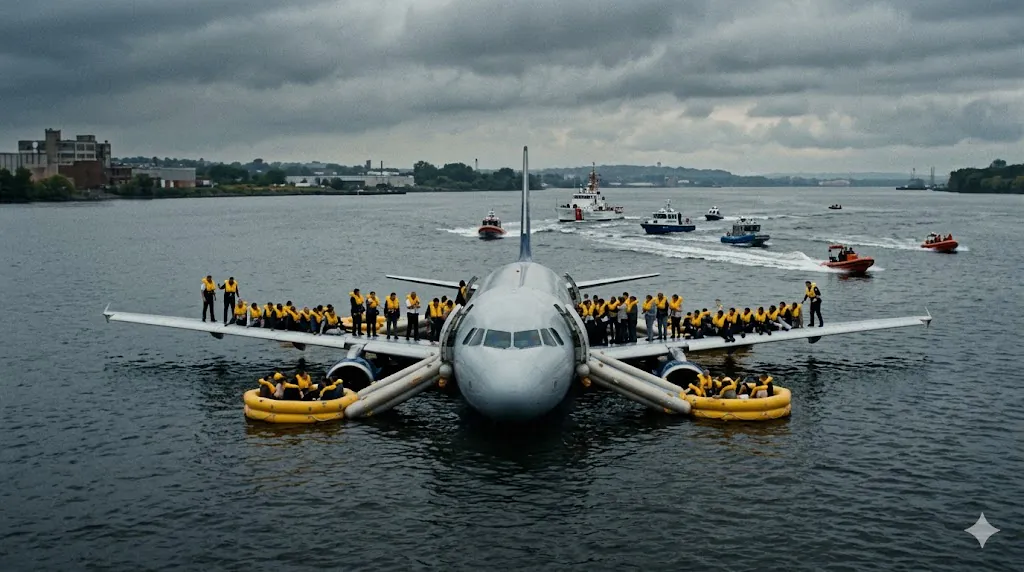
water, slides deployed as rafts, passengers on the wings and in
rafts, rescue arriving. Every element of this outcome depends on
the crew executing the ditching checklist correctly and passengers
following instructions immediately.
Key Takeaways
- Airplane ditching is a defined, trained emergency
procedure:not a crash into water. Crews train for it in
simulators, and aircraft are certified with ditching performance
data that determines the survivable approach speed and configuration. - The Hudson River landing succeeded because the crew
had time to run the ditching checklist:208 seconds from
bird strike to water contact, every action was correct. Preparation,
not luck, produced that outcome. - Modern widebody aircraft float for significant periods
after ditching when the fuselage remains intact. Evacuation
time and flotation time are certified parameters, not assumptions. - The evacuation slide doubles as a life raft
on most commercial aircraft — a detail almost no passenger knows
and that critically changes the survival calculus after airplane
ditching. - Life vest inflation timing is the most common fatal
error in ditching evacuations. Inflating inside the
aircraft before exiting has drowned passengers who were then
trapped by rising water inside the fuselage.
This article is based on real operational experience coordinating emergency scenarios in an airline Operations Control Center (OCC).
1. What Airplane Ditching Actually Is
Airplane ditching is the deliberate, controlled emergency landing
of an aircraft on water. The word “deliberate” is critical — it
distinguishes a ditching from an uncontrolled impact with water,
which is a crash. A properly executed airplane ditching uses the
same aerodynamic principles as a normal landing: controlled descent
rate, correct approach speed, flap configuration optimised for the
surface, and a flare that reduces the vertical velocity at water
contact to a survivable value. The water surface is less forgiving
than a runway — it does not compress, and asymmetric contact with
a wingtip or engine nacelle can cause the aircraft to cartwheel’
but a wings-level, nose-slightly-high water contact at the correct
speed produces deceleration forces the aircraft and its occupants
can survive.
The trigger for an airplane ditching decision is the loss of
all thrust over water with insufficient altitude or distance to
reach a suitable runway. The dual engine failure of Flight 1549 is
the most famous example, but airplane ditching has also been
performed following fuel exhaustion, structural failure, and
catastrophic systems failures over open ocean on extended overwater
routes. The crew’s primary objective in the seconds before an
airplane ditching is to configure the aircraft optimally and run
as much of the ditching checklist as time allows — because each
completed checklist item improves the probability of a survivable
outcome.
2. The Ditching Checklist: What the Crew Does Before Water Contact
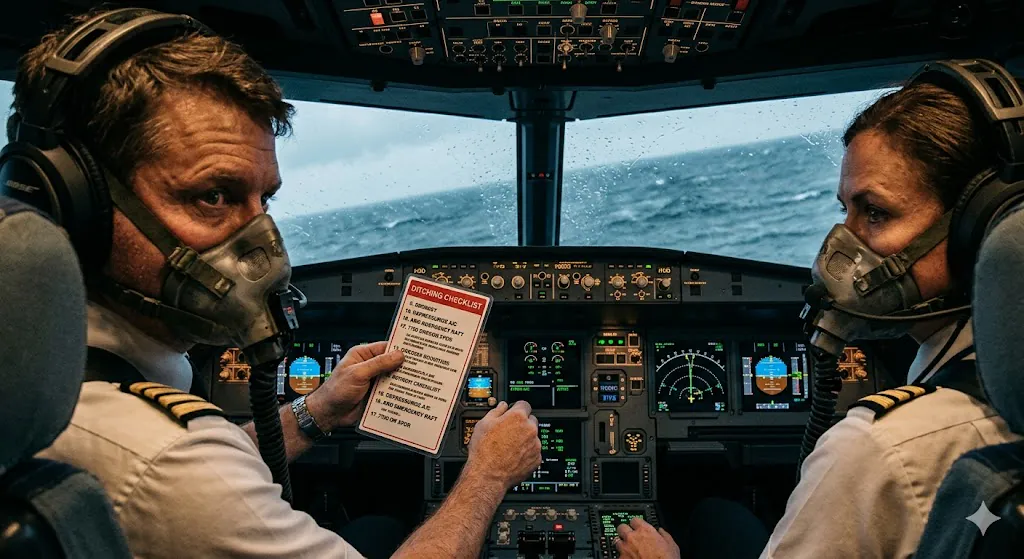
could allow water ingress, optimises flap and gear configuration
for water contact, and activates the emergency systems that
passengers will need immediately after landing. Time available
determines how much of it the crew completes.
The airplane ditching checklist is designed to maximise two
things: the survivability of the water contact itself, and the
flotation time available for evacuation after contact. Gear
up is the first configuration item — landing gear extended
during a ditching would dig into the water surface and cause the
aircraft to pitch violently nose-down. Flaps to the
recommended ditching setting:typically a partial extension
that optimises the approach speed and attitude without creating
excessive drag. All unnecessary systems secured:
air conditioning packs, pressurization outflow valves, and any
openings that could allow water to enter the fuselage faster than
the sealed structure would permit. Each item completed translates
directly into lower approach speed, more controlled water contact,
or longer flotation time.
The item the crew may not have time for in a sudden dual-engine
failure at low altitude is the full checklist — Flight 1549 had 208
seconds, during which Sullenberger managed to set the transponder,
brief the cabin crew, and configure the aircraft while simultaneously
flying a power-off approach to a river in the middle of a major
city. Most checklist items were not completed because there was no
time. The outcome was still survivable because the crew’s airmanship
produced a controlled water contact and because the aircraft’s
structural integrity remained intact. More time equals
more checklist equals better outcome:which is why
over-ocean flights on long routes give dispatchers and crews
significantly more preparation time than the Hudson scenario allowed.
Is Airplane Ditching Survivable?
Yes — airplane ditching is highly survivable when executed correctly…
3. How Long a Commercial Aircraft Actually Floats
The assumption most passengers carry is that an aircraft on water
sinks immediately. The engineering reality is more nuanced. A
commercial aircraft fuselage is a pressurized cylinder — essentially
a sealed tube with controlled openings. When that cylinder contacts
water with its structure intact and its major openings closed, it
displaces water and generates buoyancy. Modern widebody aircraft
certified for extended overwater operations carry flotation time
calculations as part of their certification data — the period the
aircraft can be expected to remain at the surface with progressive
flooding before sinking below the waterline.
The practical flotation time depends on the extent of structural
damage at impact, the sea state, and how quickly water enters
through fuselage openings. In the Hudson River landing, the aircraft
remained at the surface long enough for all 155 occupants to
evacuate and for rescue boats to arrive — approximately 24 minutes
before the aircraft began to sink. That outcome reflected a low-speed,
wings-level contact in calm water with minimal structural damage.
Open-ocean ditching in significant wave height produces a different
picture — wave action accelerates flooding and reduces the window for
evacuation. The certified ditching performance data accounts for
representative sea states, and route planning for overwater flights
considers the expected sea state in the ditching survival analysis.
According to the
FAA Advisory Circular AC 25-17A
on transport airplane cabin interiors, flotation and evacuation
time requirements are defined certification standards, not
assumptions, for aircraft certificated for extended overwater
operations.
4. The Evacuation Slide as a Life Raft
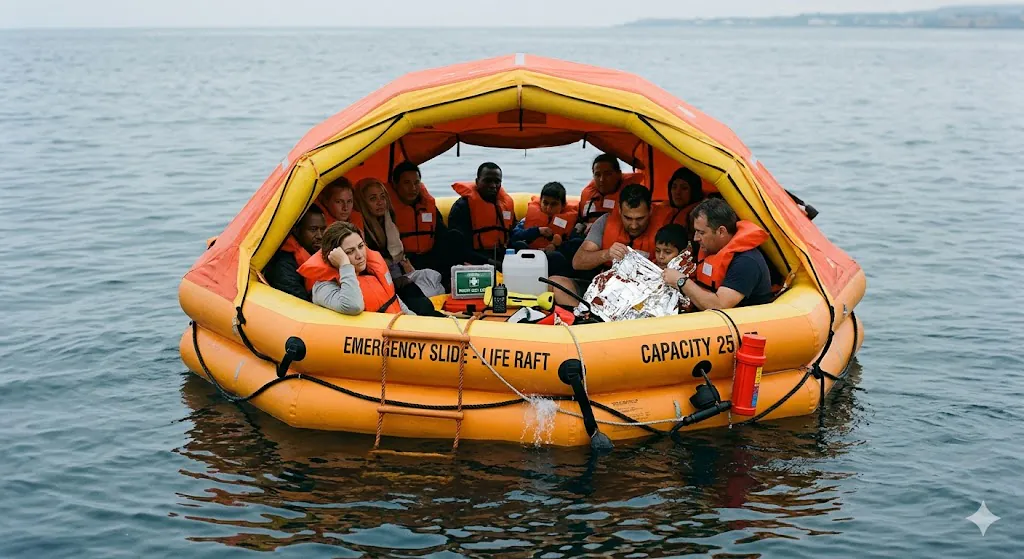
the aircraft converts into a life raft when detached from the
fuselage. It carries survival equipment, a canopy, and enough
buoyancy for the passengers assigned to that exit. Almost no
passenger knows this before they hear the safety briefing.
One of the least-known facts about commercial aircraft equipment
is that the evacuation slides installed at the doors are designed
to convert into life rafts after airplane ditching. The slide
deploys normally, passengers exit the aircraft, and once everyone
assigned to that exit has evacuated, the slide is detached from
the fuselage door sill and floats free as a raft. Pre-packed
survival equipment — signaling devices, a sea anchor, bailing
equipment, and in some configurations a canopy for weather
protection — is contained in the slide/raft assembly and becomes
accessible once it is floating free.
The slide/raft capacity is matched to the number of passengers
assigned to each exit in the aircraft’s emergency evacuation plan.
The cabin crew’s door assignment during an airplane ditching
evacuation is specifically choreographed to ensure passengers
exit into the correct rafts for their section of the cabin. This
choreography is trained in the cabin crew’s annual water survival
training — a requirement for cabin crew on aircraft certificated
for overwater operations that includes actual water entry, raft
boarding practice, and survival equipment familiarization. The
slide/raft is not a backup emergency device — it is the primary
post-ditching survival platform, and its design and certification
are as rigorous as the aircraft itself.
5. The Life Vest Rule That Saves Lives
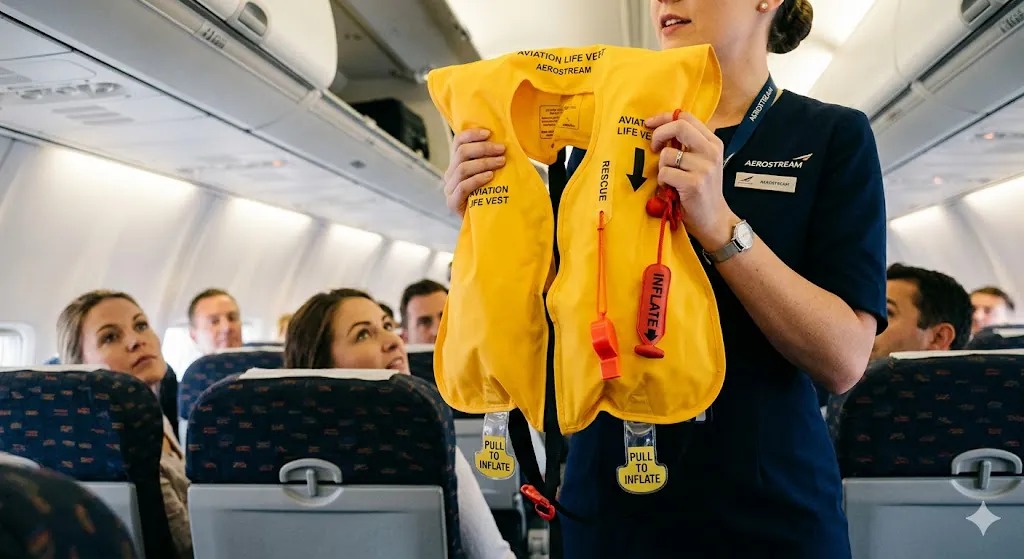
inflate inside the aircraft. An inflated vest traps a passenger
against the ceiling of a flooding, sinking fuselage. Inflate only
after exiting through the door or window.
The safety briefing instruction to inflate the life vest only
after exiting the aircraft is not a formality — it reflects a
documented and repeated cause of preventable death in ditching
accidents. Accident investigation records include cases where
passengers inflated their life vests inside the cabin, were lifted
by the vest’s buoyancy to the ceiling as the fuselage flooded,
and were unable to dive back down to reach an exit. An inflated
vest generates significant upward force in water — sufficient to
hold a person against an overhead surface in a flooding aircraft.
A passenger inside a sinking aircraft who inflates their vest has
effectively anchored themselves to the ceiling.
The correct sequence is: retrieve the vest from under the seat,
place it over the head, secure the waist straps, and exit through
the assigned door or window before pulling the inflation cord.
In the water or on the slide, inflate immediately. The sequence
is designed for the specific geometry of exiting a flooding
aircraft — uninflated, a person can move through water and through
exits; inflated, they cannot. Knowing this rule before
you need it is the difference between the vest saving your life
and preventing your escape. According to
SKYbrary’s airplane ditching
reference, premature life vest inflation inside the aircraft
is documented as a contributing factor in ditching fatalities
and is addressed in the safety briefing specifically because
the instinct to inflate immediately is natural and dangerous.
What the Dispatcher Does During an Airplane Ditching
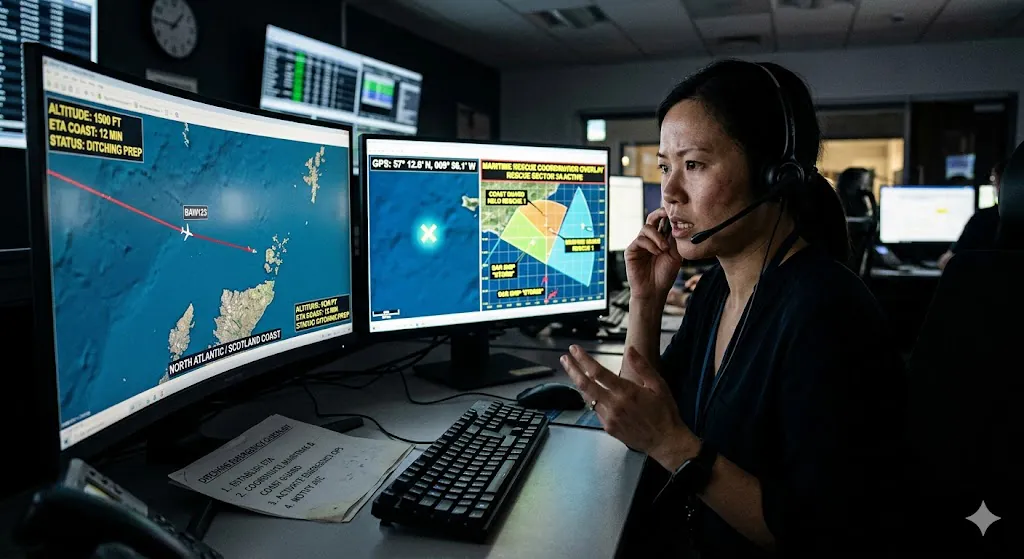
emergency includes transmitting the aircraft’s last known GPS
coordinates to maritime rescue coordination centers and alerting
coast guard and naval rescue assets — before the aircraft contacts
the water, if time permits.
An airplane ditching is one of the fastest-developing emergencies
in commercial operations — the time from the precipitating event to
water contact can be measured in seconds to minutes, leaving minimal
time for dispatcher coordination with the crew. My role shifts to
parallel rescue coordination that begins the moment any indication
of a dual-engine failure or catastrophic fuel loss over water
reaches the OCC. The aircraft’s last known GPS position and track
are extracted immediately and transmitted to the relevant maritime
rescue coordination center — in our Pacific operations, that is the
Japan Coast Guard or US Coast Guard Western Pacific, depending on
position.
I simultaneously notify the airline’s emergency response structure,
which activates the crisis team and begins passenger manifest
preparation for handoff to rescue authorities. The manifest — names,
nationalities, and contact details for all persons on board — is the
document rescue coordinators need to account for survivors and notify
next of kin. Preparing and transmitting this document before the
aircraft contacts the water gives rescue authorities a head start
on the accountability process that begins the moment the aircraft
is on the water. For any overwater operation where the route passes
through extended oceanic segments, the dispatcher has already filed
the position reporting waypoints and the search-and-rescue authority
contacts as part of the flight release package — the ditching emergency
protocol builds on that pre-existing coordination structure rather
than starting from scratch. The full framework for how extended
overwater operations are planned and dispatched is covered in my
ETOPS article.
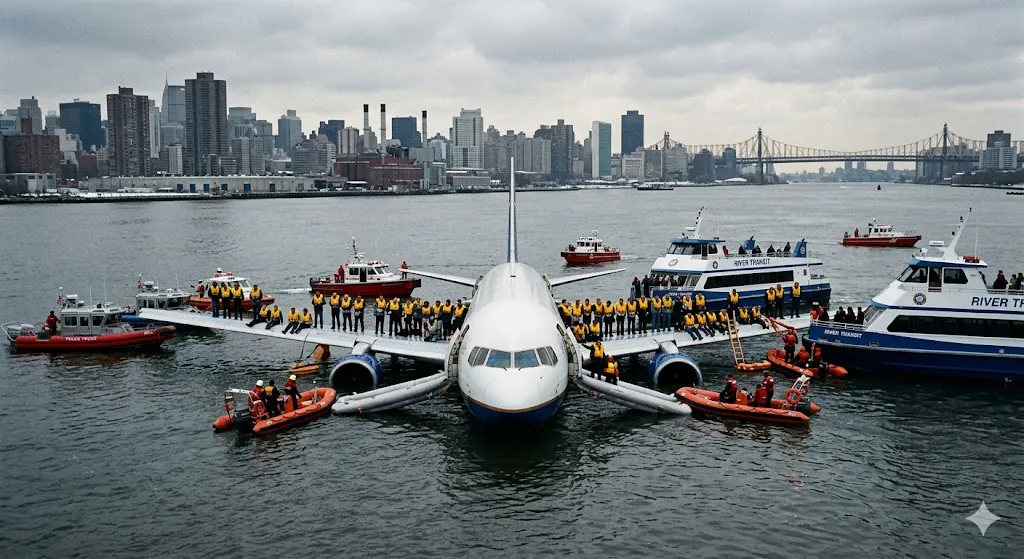
successful airplane ditching: intact aircraft, complete evacuation,
all 155 survivors, rescue within minutes. Every element of that
outcome was the result of training, engineering, and correct
procedure execution — not chance.
What Passengers Should Know About Airplane Ditching
Pay attention to the safety briefing — specifically the
life vest location and the do-not-inflate-inside instruction.
The life vest under your seat is there because the aircraft is
certificated for overwater flight and the regulator requires it.
The briefing about not inflating inside is there because people
who ignored that instruction have died when they did not need to.
Two minutes of attention before every overwater flight is the only
preparation required and the most valuable thing you can do.
Know where your nearest exit is and count the rows to
it. In a ditching evacuation, the cabin may be dark, smoky,
or flooded at floor level. Exits are found by memory and by feel,
not by sight. This is the same preparation relevant to any
evacuation — fire, hard landing, or water landing — and the cost is
counting rows once during the safety demonstration.
Do not inflate your life vest inside the aircraft.
This instruction appears three times in this article because it
is the most violated and most consequential rule in ditching
survival. Retrieve it, put it on, secure it, exit first, inflate
outside. The vest is not useful until you are in the water; inside
the aircraft, it is a hazard.
Modern commercial aircraft are far more survivable in
a ditching than the scenario implies. The Hudson River
outcome — all 155 passengers surviving a dual-engine failure over
a major city with a water landing — demonstrated what correct
procedure and engineering can achieve. The aircraft floated. The
slides deployed as rafts. Rescue arrived in minutes. The system
works when everyone executes their role correctly, and your role
as a passenger is simpler than you think: know your exit, keep
your seatbelt on until you need to move, retrieve and don your
vest before exiting, and do not inflate it until you are clear.
For the broader framework of how aviation safety systems protect
passengers across every phase of flight, my
aviation safety article covers the statistical context that
makes the probability of needing any of this clear.
Related Reading from Aeruxo:
- Emergency Landing Explained: What Really Happens and Why It’s Usually Safe
- Fuel Dump Explained: Why Aircraft Jettison Fuel and How It Works
- Is Flying Safe? What Aviation Experts Know About Flight Safety
Frequently Asked Questions
What is airplane ditching?
Airplane ditching is the deliberate, controlled emergency landing
of an aircraft on water when no suitable runway is reachable. It is
distinguished from an uncontrolled water impact by the crew’s ability
to configure the aircraft, run the ditching checklist, and execute a
controlled approach and flare. A successful airplane ditching produces
a survivable water contact, intact fuselage, and time for evacuation
before the aircraft sinks.
Has airplane ditching ever been successfully completed?
Yes. The most famous successful airplane ditching in the modern
era is US Airways Flight 1549 on January 15, 2009 — the Miracle on
the Hudson. Captain Sullenberger landed the aircraft on the Hudson
River after a dual bird strike caused both engines to fail, and all
155 people on board survived. Several other successful ditchings
appear in aviation history, including Ethiopian Airlines Flight 961
in 1996, where 50 of 175 passengers survived a ditching off the
Comoros Islands after a hijacking — though the survival rate was lower
because the hijackers prevented a controlled approach configuration.
Why should you not inflate a life vest inside the aircraft?
An inflated life vest generates significant upward buoyancy force
in water — enough to hold a person against the ceiling of a flooding,
sinking fuselage. Passengers who inflate their vests inside the
cabin before exiting risk being pinned against the overhead structure
as the fuselage fills with water, unable to dive back down to reach
an exit. The correct sequence is to put the vest on uninflated,
exit the aircraft through the door or window, and inflate only after
clearing the fuselage. Inflation in the water or on the slide is
immediate and correct; inflation inside the aircraft is potentially
fatal.
How long does a commercial aircraft float after ditching?
Flotation time depends on the extent of structural damage at water
contact, sea state, and the speed of water ingress through openings.
In the Hudson River landing, the aircraft remained at the surface
for approximately 24 minutes. In open ocean conditions with wave
action, the window is shorter. Modern aircraft certificated for
extended overwater operations carry certified flotation time data
as part of their type certification — it is an engineering parameter,
not an assumption.
What does the evacuation slide have to do with airplane
ditching?
The evacuation slides installed at aircraft doors are designed
to convert into life rafts after a ditching. Once passengers have
exited and the slide is detached from the door sill, it floats free
as a raft with pre-packed survival equipment. The capacity of each
slide/raft is matched to the number of passengers assigned to that
exit in the evacuation plan. This means the primary post-ditching
survival platform is already aboard every aircraft equipped with
evacuation slides — passengers simply need to exit in the correct
direction and board the appropriate raft.
What does the dispatcher do during an airplane ditching?
The dispatcher immediately extracts the aircraft’s last known GPS
coordinates and transmits them to the relevant maritime rescue
coordination authority. Simultaneously, the passenger manifest is
prepared and transmitted to rescue authorities, the airline’s
emergency response structure is activated, and the crisis team
begins the accountability and next-of-kin notification process.
The dispatcher cannot communicate with the crew during the final
approach to water — the crew’s attention is entirely on the ditching
sequence — so the dispatcher’s role is to have the rescue coordination
infrastructure activated before the aircraft contacts the water.
Is the seat cushion actually useful as a flotation device?
Yes. Aircraft seat cushions are required by regulation to provide
a minimum level of buoyancy adequate to support an average adult
in water. In a ditching where the slide/raft system is not available
or accessible, the seat cushion provides meaningful flotation support
for a person in the water awaiting rescue. It is not equivalent to
a life vest — it does not keep the face above water without active
effort — but it provides sufficient buoyancy to significantly reduce
the energy required to stay afloat. The safety briefing reference to
the seat cushion is not a formality; it is a genuine survival tool
for the specific scenario where no other flotation is available.
Have you ever paid close attention to where the life vest
is stored on a flight over water? Share your thoughts or questions
in the comments — understanding what the safety briefing is actually
telling you is the most useful preparation for any overwater
flight.
Disclaimer: The views expressed in this article are my own
professional opinions based on 15+ years of operational experience.
They do not represent the official position of any airline, aviation
authority, or regulatory body.

Licensed Flight Dispatcher with 15+ years of experience in airline operations control. Holds FAA Aircraft Dispatcher Certificate and Republic of Korea Flight Dispatcher License (MOLIT). Specializes in flight watch, NOTAM analysis, flight planning, and operational control at a Korean LCC. IOSA audit participant and author of multiple airline operational manuals, including Emergency Response, De-icing, and OCC Procedures.