By Aeruxo — Licensed flight dispatcher (study guide) | 15+ Years in Airline
Operations
The TCAS alert came through on ACARS as a post-flight report:
“RA EVENT. FL350. CLIMB ISSUED. SEPARATION ACHIEVED.” The crew’s
debrief note was three lines long. They had been cruising at 35,000
feet over the East China Sea when TCAS detected a conflicting
aircraft on an adjacent track at the same altitude. The system
issued a Resolution Advisory — climb — and the crew responded within
two seconds. The conflicting aircraft received the coordinated
opposite advisory — descend — and its crew also complied immediately.
The two aircraft passed each other with 1,200 feet of vertical
separation instead of zero. Neither crew declared an emergency.
The flight continued. Passengers noticed nothing.
A midair collision is the scenario that keeps aviation safety
professionals more focused than almost any other threat — not because
it happens, but because the consequences when it does are absolute
and the system designed to prevent it operates on margins measured
in seconds and hundreds of feet. The good news, which is rarely
communicated to passengers, is that the modern aviation system
applies not one but four independent layers of protection between
your aircraft and every other aircraft in the sky. Understanding
those layers — and what happens when they are tested — converts the
fear of a midair collision from a vague existential dread into a
concrete appreciation of why the threat is managed as rigorously
as it is. After 15 years dispatching flights across some of the
world’s busiest airspace, I want to explain exactly how the system
works.
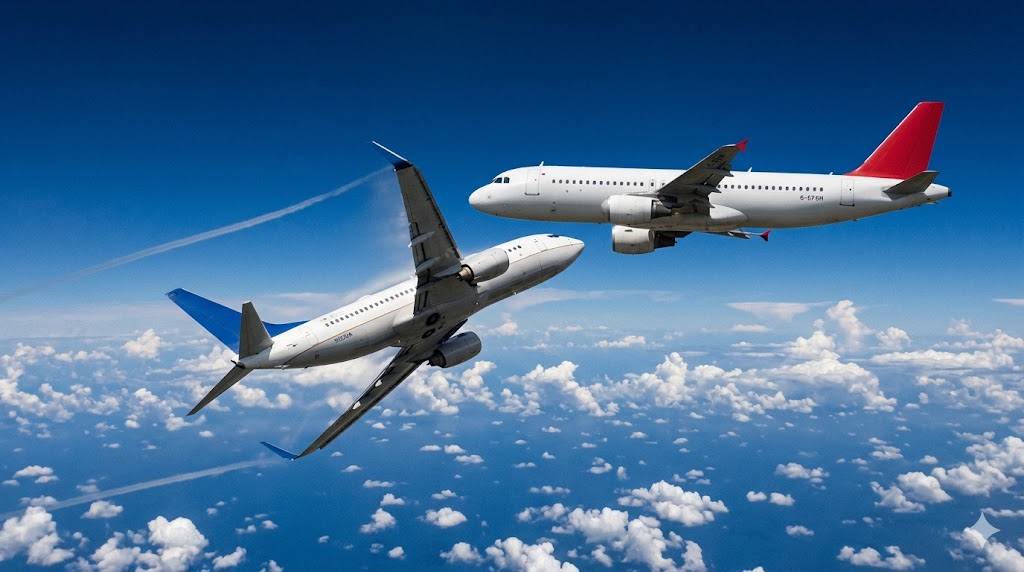
automated layer of protection against a midair collision. At this
point, three prior layers of separation have already failed. TCAS
exists because the system is designed to survive failures, not
just prevent them.
The dispatcher does not directly prevent midair collisions —
that is ATC’s domain in the air and TCAS’s domain in the cockpit.
What the dispatcher controls is the flight plan routing that determines
where the aircraft will be and at what altitude. Over 15 years filing routes
across Asia-Pacific airspace, I developed a pattern of reviewing our filed
routings against known traffic flow congestion points — particularly in busy
oceanic transition areas where ATC radar coverage becomes intermittent
and procedural separation replaces radar separation. A route that saves
12 minutes of fuel burn is not worth filing if it places the aircraft
in high-traffic airspace during peak hours with reduced separation standards.
That consideration — airspace exposure as a risk factor — is something
dispatchers actively manage on every long-haul route.
Key Takeaways
- The modern aviation system applies four independent
layers of separation between aircraft: strategic planning,
ATC procedural separation, ATC radar separation, and TCAS onboard
collision avoidance. A midair collision requires all four to fail
simultaneously. - TCAS (Traffic Collision Avoidance System) is mandatory
on all commercial aircraft above 5,700 kg in most ICAO
member states. It operates independently of ATC and issues
Resolution Advisories directly to crews. - When TCAS issues a Resolution Advisory, crews must
follow it immediately:even if it contradicts an ATC
instruction. This rule exists because of a specific accident where
failure to follow the RA was fatal. - Midair collisions between commercial jets at cruise
altitude have not occurred since TCAS became mandatory.
The collision history that exists is associated with ATC failures
before TCAS was installed or involved aircraft not equipped with
the system. - Oceanic airspace without radar coverage
represents the greatest separation challenge — and the one where
dispatcher coordination plays the most direct role in maintaining
the separation layers.
This article is based on real operational experience coordinating emergency scenarios in an airline Operations Control Center (OCC).
1. The Four Layers That Prevent a Midair Collision
The aviation system does not rely on a single mechanism to prevent
a midair collision. It layers four independent barriers, each
designed to catch failures in the layer before it. Layer
one is strategic separation:flight plan coordination that
assigns routes, altitudes, and timing to keep aircraft on tracks
that do not intersect. Two aircraft flying from Tokyo to Los Angeles
on parallel oceanic tracks separated by 50 nautical miles and
assigned different altitudes will never come within collision range
of each other without something going significantly wrong. Strategic
separation is the reason the vast majority of flights complete
without any traffic conflict ever developing.
Layer two is ATC procedural separation:the
controlled assignment of routes, altitudes, and speeds within
controlled airspace that maintains minimum separation distances
between all aircraft on the frequency. In radar-covered airspace,
controllers maintain a minimum of 3 to 5 nautical miles horizontal
separation or 1,000 feet vertical separation between aircraft. In
non-radar oceanic airspace, procedural separation uses position
reports and time-based longitudinal separation — typically 10 to 15
minutes between aircraft on the same route and altitude — to maintain
a buffer that the absence of radar requires. Layer three
is ATC short-term conflict alert:automated radar systems
that detect projected conflicts between tracked aircraft and alert
the controller before the separation minimum is breached, giving
the controller time to issue a corrective instruction. These systems
run continuously on every radar screen in controlled airspace and
generate alerts minutes before a projected conflict reaches minimum
separation.
Layer four is TCAS:the onboard traffic
collision avoidance system that operates independently of all
ground-based systems and issues resolution advisories directly
to the crew based on the aircraft’s own sensors. TCAS is the
layer that catches failures in the first three — it activates when
a potential midair collision threat exists despite strategic
planning, ATC separation, and conflict alert having all had the
opportunity to prevent it.
2. How TCAS Works — And What a Resolution Advisory Actually Is

diamonds for non-threat aircraft, amber circles for Traffic Advisories,
red squares for Resolution Advisories. The RA symbol includes a
vertical speed command the crew must follow immediately.
TCAS (Traffic Collision Avoidance System) works by actively
interrogating the transponders of nearby aircraft and calculating
the closure rate and projected closest point of approach of each
traffic target. When the system determines that a traffic target
will come within a defined proximity threshold, it issues a Traffic
Advisory (TA)—an alert that a potential conflict exists, prompting
the crew to look for the traffic visually and prepare for a possible
maneuver. If the projected conflict continues to develop and reaches
a threshold where a collision avoidance maneuver is required, TCAS
issues a Resolution Advisory (RA)—a specific vertical speed command
that, when followed, will provide safe vertical separation from the
conflicting aircraft.
The critical feature of TCAS is coordination. When TCAS on one
aircraft issues an RA, it simultaneously communicates with the TCAS
on the conflicting aircraft through a dedicated data link. The two
systems coordinate their RAs to be complementary — if one aircraft
receives a “CLIMB” RA, the other receives a “DESCEND” RA. Both
aircraft maneuver away from each other simultaneously, maximizing
the separation achieved. The system assumes both crews will comply
immediately — the RA calculations are based on a defined response
time that leaves no margin for hesitation or ATC coordination.
According to SKYbrary’s ACAS reference,
the TCAS RA response time requirement is 5 seconds from alert to
maneuver initiation — faster than most verbal ATC instructions can
be issued, acknowledged, and executed.

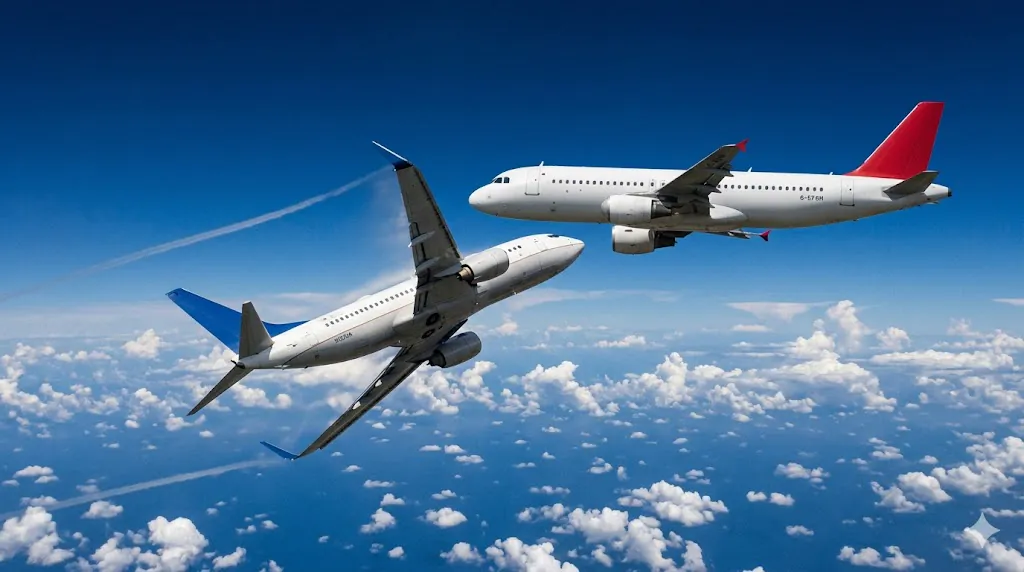
between both aircraft simultaneously — one climbs, one descends.
The separation achieved by both crews following their respective
RAs is calculated to provide safe vertical clearance from the
projected collision point.
3. The Rule That Exists Because of a Midair Collision
The most important operational rule governing TCAS RA compliance
exists because of a specific midair collision that demonstrated
the consequence of not following it. On July 1, 2002, a Bashkirian
Airlines Tu-154 and a DHL Boeing 757 collided over “berlingen,
Germany, killing all 71 people aboard both aircraft. The investigation
found that the Bashkirian crew followed an ATC instruction to
descend — which conflicted with the TCAS RA they had received to
climb — rather than following the TCAS RA. The DHL crew followed their
TCAS RA to descend. Both aircraft descended into each other instead
of diverging.
The “berlingen accident produced the unambiguous regulatory response
that defines TCAS RA compliance today: when a TCAS RA is
issued, the crew must follow it immediately, even if it contradicts
an ATC instruction. The ATC controller does not have the
same real-time collision geometry data that TCAS has. TCAS sees
the closure rate, the altitude, and the coordinated RA on both
aircraft simultaneously. The controller sees a radar return that
is seconds behind real time. In a conflict that has reached the
RA threshold, TCAS has more accurate and more timely data than
the controller — and the procedure reflects that reality. After an
RA is followed, the crew notifies ATC immediately and resumes
normal ATC instructions once the conflict is resolved.
4. Where Midair Collision Risk Is Highest

controlled airspace, with automated conflict alerts when projected
tracks will breach minimum separation. The controller has minutes
to resolve a conflict that TCAS will address in seconds if ATC
intervention fails.
Controlled radar airspace over major continental routes is the
safest environment for midair collision avoidance — all four separation
layers are active, controllers have real-time radar, and TCAS
provides the final backstop. The areas of highest residual
risk are those where the outer layers are thinner. Oceanic
airspace without radar coverage is the primary example — over the
Pacific, Atlantic, and Indian Oceans, aircraft are beyond radar
range for most of their crossing. Separation is maintained through
position reports, CPDLC (Controller Pilot Data Link Communications),
and ADS-B where coverage exists, but the procedural separation
margins are larger and less dynamically responsive than radar
separation. TCAS remains active throughout oceanic crossings and
provides the conflict avoidance capability that radar-based ATC
cannot.
Airport terminal areas during high-traffic periods
present a different concentration risk — multiple aircraft converging
on the same airport at similar altitudes in a confined volume of
airspace, with approach controllers sequencing them onto final
approach. The speed of events in a terminal area and the density
of traffic make conflict alert systems and TCAS particularly
important here. Uncontrolled airspace:where visual
flight rules aircraft operate without ATC separation services — is
the environment where the majority of actual midair collisions
occur historically, most between general aviation aircraft rather
than commercial jets. Commercial aircraft operating under
Instrument Flight Rules in controlled airspace have the full
benefit of all four separation layers; VFR general aviation
operating outside controlled airspace relies primarily on the
pilots’ visual traffic scan and, increasingly, portable collision
avoidance technology.
5. The Dispatcher’s Role in Midair Collision Prevention
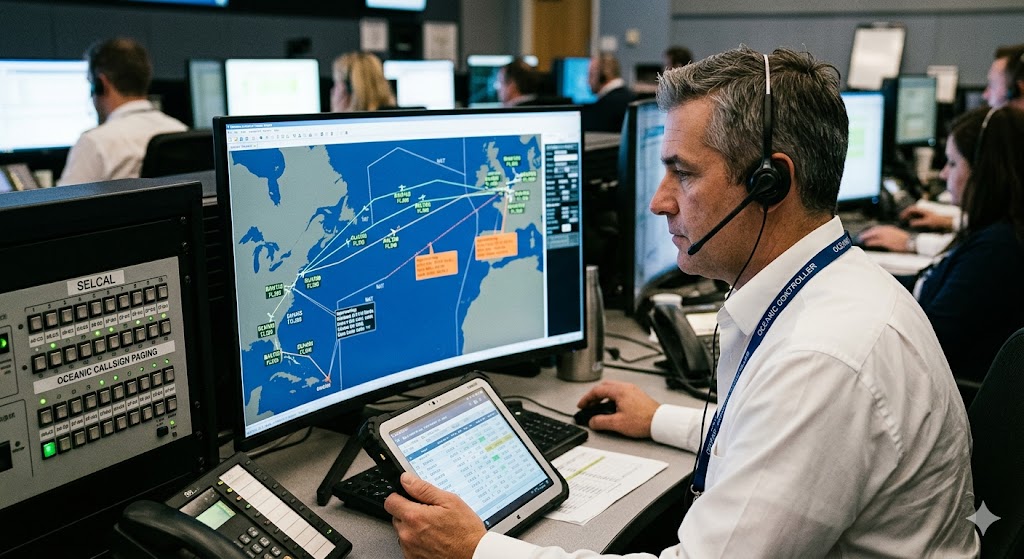
separation management is most direct. I assign altitudes and
tracks that maintain the required procedural separation from all
other aircraft in the same oceanic system — separation that ATC
cannot maintain by radar because no radar exists.
Dispatcher involvement in midair collision prevention is most
direct in oceanic route planning, where procedural separation
depends on the flight plan parameters rather than real-time radar
monitoring. When I file an oceanic crossing, I specify the requested
oceanic track, entry and exit fixes, and requested cruise altitude.
The Oceanic Control Center assigns a track and altitude that
maintains the required separation from all other aircraft in the
oceanic system — but the quality of that separation depends on the
accuracy and timeliness of the flight plans filed by every
dispatcher for every aircraft in the system.
A flight plan filed with an incorrect estimated entry time,
or a cruise altitude that conflicts with an already-assigned
aircraft, creates a separation problem that the oceanic controller
must resolve before the aircraft enters the system. I verify
oceanic track availability and altitude conflicts before filing
specifically because a conflict discovered at the oceanic entry
fix requires a last-minute re-route or altitude change that the
crew cannot always accommodate without fuel penalty. SELCAL
monitoring and position reporting during the oceanic
crossing are the procedural backbone of maintaining the separation
I filed — the crew reports their position at each waypoint, and
deviations from filed altitude or track are coordinated with
Oceanic Control immediately. A deviation without coordination
can compress the separation margin with another aircraft on an
adjacent track in ways that neither crew nor controller can see
until TCAS detects the conflict. For how oceanic planning intersects
with our extended operations on twin-engine aircraft, my
ETOPS article covers the full oceanic route framework.
6. What Passengers Should Know About Midair Collision Risk

a mandatory safety report and investigation — even when no collision
occurred. The investigation findings drive procedure and technology
improvements that make the next potential event less likely.
Commercial jets at cruise altitude have not collided
with each other since TCAS became mandatory. This is not
a coincidence — it is the direct result of the four-layer separation
system functioning as designed. The “berlingen collision in 2002,
the last involving TCAS-equipped commercial jets, resulted from
crew non-compliance with the RA. The regulatory and training
response to that accident has made RA compliance the single most
drilled emergency response in commercial aviation. The system is
not infallible, but it is genuinely multi-layered in a way that
makes simultaneous failure of all four layers extraordinarily
unlikely.
When the aircraft banks or changes altitude unexpectedly,
TCAS may be the reason. A TCAS RA typically produces a
sudden, firm pitch change — the crew responding immediately to the
vertical speed command without the gradual initiation of a normal
maneuver. Passengers who experience an unexpected climb or descent
without announcement are sometimes experiencing a TCAS RA response.
The crew’s priority in those seconds is the maneuver, not the PA
system. An announcement explaining the event typically follows once
the conflict is resolved and the aircraft has returned to its
assigned altitude. The brief, firm maneuver is the system
working correctly:not evidence that a collision nearly
happened, but evidence that the fourth and final layer of protection
activated and performed as designed. For a complete picture of how
all the safety systems on a commercial aircraft interact to protect
passengers, my
aviation safety article covers the statistical framework that
puts midair collision risk in its proper context.
Related Reading from Aeruxo:
- Wake Turbulence Explained: What It Is and How Aircraft Stay Safe
- Runway Incursion Explained: What It Is, Why It Happens, and How Airports Prevent It
- Is Flying Safe? What Aviation Experts Know About Flight Safety
Frequently Asked Questions
What is a midair collision in aviation?
A midair collision is a collision between two aircraft while both
are in flight. In commercial aviation, the term is also applied to
near-miss events where aircraft come within the TCAS activation
threshold without colliding — events that generate mandatory safety
reports and investigations regardless of outcome. True midair
collisions between TCAS-equipped commercial jets at cruise altitude
have not occurred since TCAS became a regulatory requirement in
the early 1990s.
What is TCAS and how does it prevent a midair collision?
TCAS (Traffic Collision Avoidance System) is an onboard system
that interrogates the transponders of nearby aircraft, calculates
their closure rate and projected closest point of approach, and
issues Resolution Advisories — specific vertical speed commands’
when a potential midair collision threat is detected. TCAS operates
independently of ATC and coordinates complementary RAs between both
conflicting aircraft simultaneously, directing one to climb and the
other to descend. Crews are required to follow RAs immediately,
even if they conflict with ATC instructions.
Why must pilots follow TCAS even if ATC says otherwise?
TCAS has access to real-time closure geometry and coordinated
RA data from both conflicting aircraft simultaneously — information
the ATC controller does not have with the same precision and
timeliness. The “berlingen collision in 2002 occurred because one
crew followed an ATC instruction instead of their TCAS RA, causing
both aircraft to descend into each other rather than diverging.
The regulatory response to that accident established unambiguous
RA compliance as a mandatory procedure: when TCAS issues an RA,
the crew follows it, notifies ATC, and returns to clearance once
the conflict is resolved.
How does ATC prevent midair collisions?
ATC prevents midair collisions through two mechanisms: active
separation management — assigning routes, altitudes, and speeds
that maintain minimum separation between all aircraft under their
control — and short-term conflict alert systems that detect projected
separation breaches automatically and alert the controller in time
to issue a corrective instruction. In radar-covered airspace, the
minimum separation standard is 3 to 5 nautical miles horizontal
or 1,000 feet vertical. In oceanic non-radar airspace, procedural
separation using position reports and time-based longitudinal
margins maintains the equivalent buffer.
Where do most midair collisions actually occur?
Most midair collisions occur in uncontrolled airspace between
general aviation aircraft operating under Visual Flight Rules,
where ATC separation services are not mandatory and collision
avoidance depends on visual traffic scanning. Commercial jets
operating under IFR in controlled airspace have access to all
four separation layers and have an essentially unblemished modern
record in controlled airspace since TCAS became mandatory. The
risk profile for a passenger on a commercial flight is therefore
fundamentally different from the statistical picture of midair
collisions in general aviation.
What does a TCAS maneuver feel like to passengers?
A TCAS Resolution Advisory response produces a sudden, firm
pitch change — typically a rapid climb or descent initiated without
the gradual entry of a normal maneuver, because the crew is
responding immediately to a vertical speed command. Passengers
experience an unexpected altitude change without prior announcement,
sometimes accompanied by a change in engine sound as thrust is
adjusted to achieve the commanded vertical speed. The crew’s
priority is the maneuver, not the PA system. An explanation
typically follows once the conflict is resolved. The maneuver
itself lasts between 30 seconds and several minutes, depending
on how long the conflict geometry requires before TCAS issues
a “CLEAR OF CONFLICT” advisory.
Has a midair collision ever involved a TCAS-equipped aircraft?
Yes — the 2002 “berlingen collision involved aircraft equipped with
TCAS. The collision occurred because one crew followed an ATC
instruction that conflicted with their TCAS RA instead of following
the RA, causing both aircraft to descend into each other. The DHL
crew that followed their RA survived; the Bashkirian crew that
did not follow theirs did not. The accident drove the definitive
regulatory clarification that RA compliance supersedes ATC
instructions — a rule now understood and trained by every commercial
pilot globally. No midair collision between two TCAS-equipped
aircraft operating with both crews following their RAs has
occurred.
Have you ever experienced a sudden unexpected climb or bank
during a flight that was not announced in advance? It may have been
a TCAS response. Share what you felt in the comments — passenger
accounts of TCAS maneuvers help others understand what the system
looks like from the cabin.
Disclaimer: The views expressed in this article are my own
professional opinions based on 15+ years of operational experience.
They do not represent the official position of any airline, aviation
authority, or regulatory body.

Licensed Flight Dispatcher with 15+ years of experience in airline operations control. Holds FAA Aircraft Dispatcher Certificate and Republic of Korea Flight Dispatcher License (MOLIT). Specializes in flight watch, NOTAM analysis, flight planning, and operational control at a Korean LCC. IOSA audit participant and author of multiple airline operational manuals, including Emergency Response, De-icing, and OCC Procedures.