\
\
By Aeruxo — Licensed flight dispatcher (study guide) | 15+ Years in Airline Operations
\
\
The message came through 22 minutes after departure: “ENGINE\
INDICATING ABNORMAL OIL PRESSURE. RETURNING TO BASE.” I already had\
the aircraft’s current fuel load on my screen — 142 tonnes at takeoff,\
burning approximately 9 tonnes per hour per engine. Maximum landing\
weight for the type was 213 tonnes. The math was straightforward and\
uncomfortable: the aircraft was 31 tonnes above its maximum certified\
landing weight. Options were three — hold for two hours and burn down\
to landing weight, accept an overweight landing, or initiate a fuel\
dump. I called the crew with the numbers. They elected to dump. Six\
minutes later, passengers looking out the window saw white mist\
trailing from the wings and assumed something had gone catastrophically\
wrong. Nothing had. The aircraft was preparing to land safely.
\
\
A fuel dump — or fuel jettison, in the technical literature — is one\
of the least understood procedures in commercial aviation, primarily\
because it is visible. Passengers who notice the fuel trails from the\
wing nozzles often interpret them as a sign that the aircraft is\
losing fuel it cannot afford to lose, or that the aircraft is\
structurally failing. In reality, a fuel dump is an engineering\
solution to a weight problem, activated deliberately and controlled\
precisely by the flight crew in coordination with dispatch. After 15\
years managing fuel calculations across dozens of emergency return\
scenarios, I want to explain exactly why aircraft dump fuel, what\
the procedure involves, and why the sight of it outside your window\
is reassuring, not alarming.
\
\
\

dedicated nozzles on the wing trailing edges. The fuel atomizes\
into droplets small enough to evaporate before reaching the ground.\
The procedure is controlled, certified, and coordinated with ATC.
\
\
\
\
Key Takeaways
\
\
- \
- A fuel dump solves a weight problem, not a fuel\
problem. Aircraft have different maximum takeoff and\
maximum landing weights. When a return or divert is needed shortly\
after departure, a fuel dump burns down the margin safely and\
quickly. - Not all aircraft can dump fuel. Most\
narrow-body jets — the Boeing 737, Airbus A320 family — do not have\
fuel dump systems. They either hold and burn, accept an overweight\
landing, or plan routes that preclude the scenario. - Dumped fuel does not reach the ground as liquid.\
Fuel jettison nozzles atomize the fuel into a fine mist that\
evaporates rapidly. ATC assigns specific fuel dump areas and\
altitudes to further minimize any ground impact. - The dispatcher calculates whether a fuel dump is\
needed:alongside the crew — the moment a return or divert\
is declared. The decision involves current weight, landing weight\
limit, burn-off rate, and the time cost of holding. - An overweight landing is also a certified option\
in genuine emergencies, but it requires a mandatory post-landing\
structural inspection and almost always takes the aircraft out of\
service temporarily.
\
\
\
\
\
\
\
This article is based on real operational experience supporting flight planning and decision-making in an airline Operations Control Center (OCC), including real-world fuel management and emergency return scenarios.
\
\
\
\
1. Why Aircraft Have Different Takeoff and Landing Weights
\
\
\
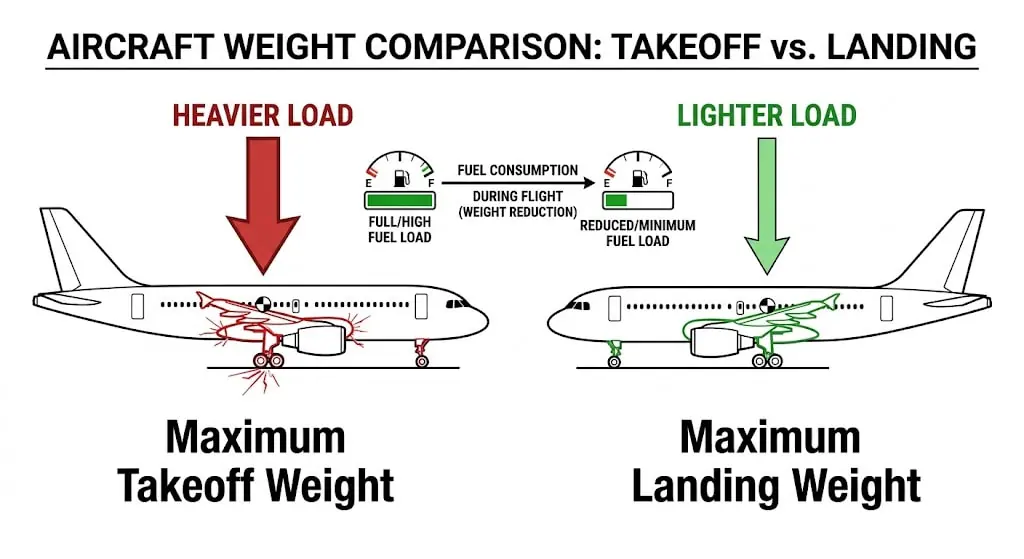
maximum takeoff weight are significantly higher than the landing\
gear is certified to absorb at touchdown. The gap between these two\
limits is what creates the need for a fuel dump on early returns.
\
\
Every commercial aircraft is certificated with two distinct weight\
limits that are not equal: Maximum Takeoff Weight (MTOW) and Maximum\
Landing Weight (MLW). The gap between them — which can be 20 to 60\
tonnes on a widebody aircraft — exists because the structural loads\
experienced during landing are fundamentally different from those at\
takeoff. At takeoff, the aircraft accelerates smoothly on the runway\
and the wings generate lift that effectively reduces the gear load\
as speed increases. At landing, the aircraft descends and impacts\
the runway surface: the landing gear must absorb the entire vertical\
load of the aircraft in a fraction of a second, transmitting that\
force through the gear struts, the wing box, and the fuselage\
structure.
\
\
Aircraft are designed and stress-tested to handle these impact\
loads at or below MLW. Above MLW, the landing gear, wing-to-fuselage\
attachments, and associated structure experience loads beyond their\
certified design envelope. This does not mean the aircraft breaks — it\
means the structural margins that account for variations in sink rate,\
runway surface, and pilot technique are reduced to the point where\
they can no longer be guaranteed. A perfectly executed smooth landing\
above MLW may cause no immediate damage. A firm but normal touchdown\
above MLW may cause fatigue damage that is not visible externally\
but that compromises long-term structural integrity. This is why the\
limit exists and why the post-landing structural inspection after an\
overweight landing is mandatory — not precautionary.
\
\
\
\
2. When a Fuel Dump Becomes Necessary
\
\
A fuel dump becomes the operational solution when three conditions\
converge: the aircraft must return to the departure airport or divert\
to an alternate significantly earlier than planned, the current fuel\
load exceeds MLW, and the time available before landing is insufficient\
to burn down to MLW through normal engine consumption. On a long-haul\
route, a widebody aircraft at takeoff may carry 80 to 140 tonnes of\
fuel — enough to exceed MLW by 30 to 60 tonnes. Burning that fuel\
through normal cruise takes hours. A mechanical issue detected 20\
minutes after departure leaves no time to burn down conventionally.
\
\
The alternatives to a fuel dump each carry their own costs.\
Holding and burning is the lowest-risk option when\
time permits — the aircraft circles at a fuel-efficient altitude and\
speed until weight is within limits. For an aircraft 15 tonnes above\
MLW burning 8 tonnes per hour total, holding burns approximately\
two hours of the crew’s and passengers’ time while consuming no\
additional infrastructure. For a non-urgent defect that does not\
compromise immediate safety, holding is usually the preferred path.\
An overweight landing is available when the emergency\
is genuine enough that no delay is acceptable — a cargo fire, an\
incapacitated crew member, or a structural indication that makes\
holding unsafe. Accepting the overweight landing trades the structural\
inspection and likely out-of-service period against the risk of\
continued flight. A fuel dump sits between these\
options: faster than holding, without the structural consequence of\
an overweight landing, but requiring the equipment to be installed\
and the coordination overhead of ATC clearance and an assigned\
dump area.
\
\
\
\
3. How the Fuel Dump System Actually Works
\
\
\
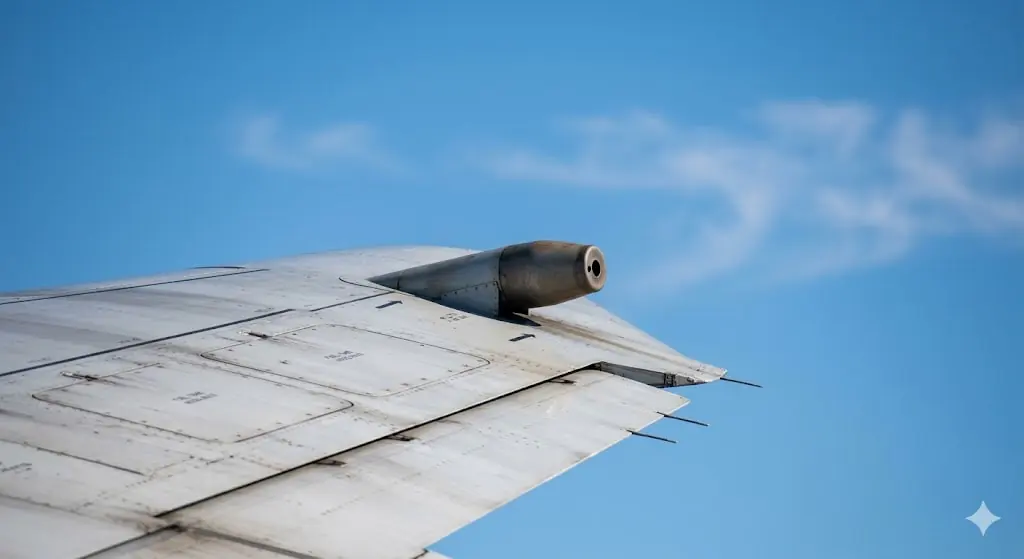
trailing edges, separate from the normal fuel system vents. They\
are connected to electrically operated dump valves that the crew\
controls from the cockpit fuel management panel.
\
\
Aircraft equipped with fuel dump systems have dedicated jettison\
nozzles built into the wing structure, typically at or near the\
wingtips and on the wing trailing edges. These nozzles are connected\
by dedicated plumbing to the main fuel tanks through electrically\
operated dump valves. The system is completely separate from the\
normal fuel transfer and venting systems, and is only activated by\
deliberate crew action from the fuel management panel in the cockpit.\
When the dump valves open, fuel flows from the tanks through the\
jettison plumbing and exits the nozzles as a high-velocity atomized\
spray — breaking the fuel into droplets fine enough that they evaporate\
before reaching the ground at normal fuel dump altitudes.
\
\
The dump rate varies by aircraft type but is typically engineered\
to reduce weight to MLW within 10 to 30 minutes from a fully loaded\
state. The crew sets a target weight on the fuel management system,\
and many modern aircraft automatically close the dump valves when\
that weight is reached — preventing accidental over-dump. ATC assigns\
a specific fuel dump area, typically over unpopulated terrain or\
water, and a minimum altitude that ensures complete evaporation of\
the mist before it can reach the ground as liquid. According to\
SKYbrary’s fuel jettison reference,\
environmental studies have consistently shown that properly conducted\
fuel dumps at the assigned altitudes produce no measurable ground\
contamination — the fuel evaporates completely in the atmosphere before\
reaching the surface.
\
\
\
\
4. Which Aircraft Cannot Dump Fuel — And What They Do Instead
\
\
The majority of the world’s commercial aircraft do not have fuel\
dump systems installed. The Boeing 737 series, Airbus A320 family,\
Embraer E-jet series, and most regional jets fly without jettison\
capability. The engineering rationale is straightforward: on aircraft\
where the gap between MTOW and MLW is relatively small, the holding\
time required to burn down to MLW is acceptable, and the weight and\
complexity cost of installing a dump system exceeds the operational\
benefit. A Boeing 737-800 at maximum takeoff weight typically needs\
only 45 to 90 minutes of holding to reach MLW — a manageable delay\
for most non-critical return scenarios.
\
\
For these aircraft, the operational response to an overweight\
return situation follows a different tree. If the defect or emergency\
permits holding, the aircraft holds and burns. If the situation\
requires immediate landing above MLW — a genuine MAYDAY-level emergency\
‘the crew accepts the overweight landing, executes it with the\
smoothest possible technique to minimize gear loads, declares the\
overweight landing to the tower, and the aircraft undergoes mandatory\
structural inspection before returning to service. Airlines operating\
fleets of narrow-body aircraft plan their fuel loads with MLW as a\
constraint where possible precisely because the overweight landing\
inspection takes the aircraft out of service for hours to days,\
depending on the inspection findings. On our Korean LCC network,\
where the fleet is predominantly narrow-body, I calculate MLW margins\
on every release — particularly for shorter routes where a return\
shortly after departure is a realistic scenario.
\
\
\
\
5. What the Dispatcher Calculates During a Fuel Dump Decision
\
\
\
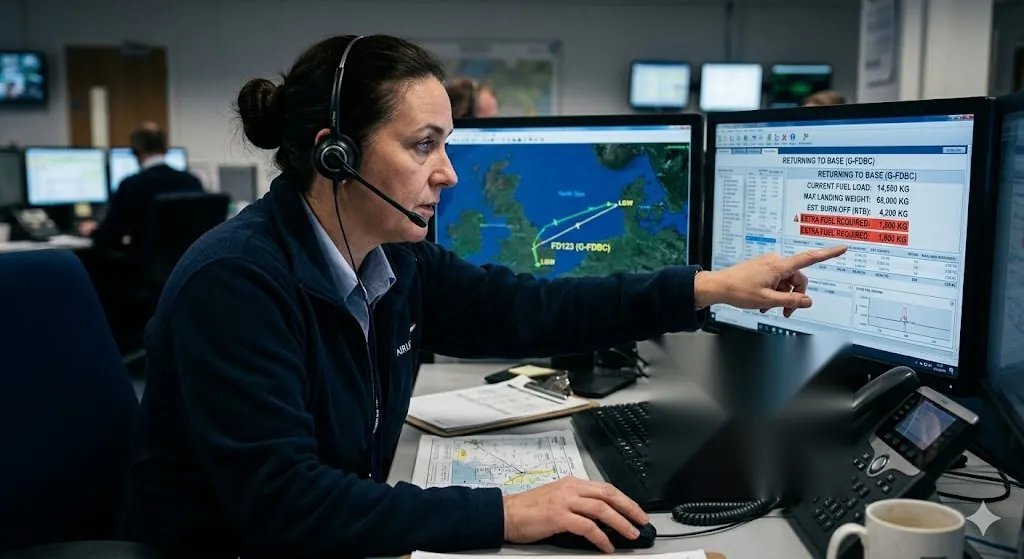
calculations: current weight, MLW limit, burn-off rate, and the\
time cost of each option. I run these numbers the moment a return\
or early divert is declared, so the crew has options immediately.
\
\
The moment a crew advises of an intention to return or divert,\
my fuel calculation runs simultaneously with the crew’s abnormal\
checklist. Current fuel load minus MLW gives the excess to be\
eliminated. Total fuel flow (both engines combined) gives the\
natural burn-off rate. Dividing excess by burn rate gives the\
holding time required to reach MLW naturally. I present that number\
to the crew alongside the fuel dump option and the overweight landing\
option, with my assessment of the time available based on the\
nature of the defect. The crew decides, and I execute the\
administrative side of whatever they choose.
\
\
If a fuel dump is elected, I coordinate with ATC for the assigned\
dump area and altitude — ATC will not approve a fuel dump without\
directing the aircraft to a suitable location, and that coordination\
takes one to three minutes. I notify the destination airport of the\
return timeline, confirm emergency services readiness regardless of\
whether the defect requires them, and begin the maintenance\
notification sequence so inspection resources are available on\
arrival. If an overweight landing is elected, I notify the tower\
of the intended overweight landing weight so they can prepare the\
mandatory post-landing inspection request. The full divert and\
return coordination I describe in my\
\
flight diversion article runs in parallel with all of this’\
station, gate, passenger handling, and connecting flight impacts\
are all being managed simultaneously.
\
\
\
but the structural loads on gear struts and wing attachments exceed\
normal design margins. The mandatory post-landing inspection exists\
because the damage may not be visible externally.
\
\
\
\
What Passengers Should Know About a Fuel Dump
\
\
\
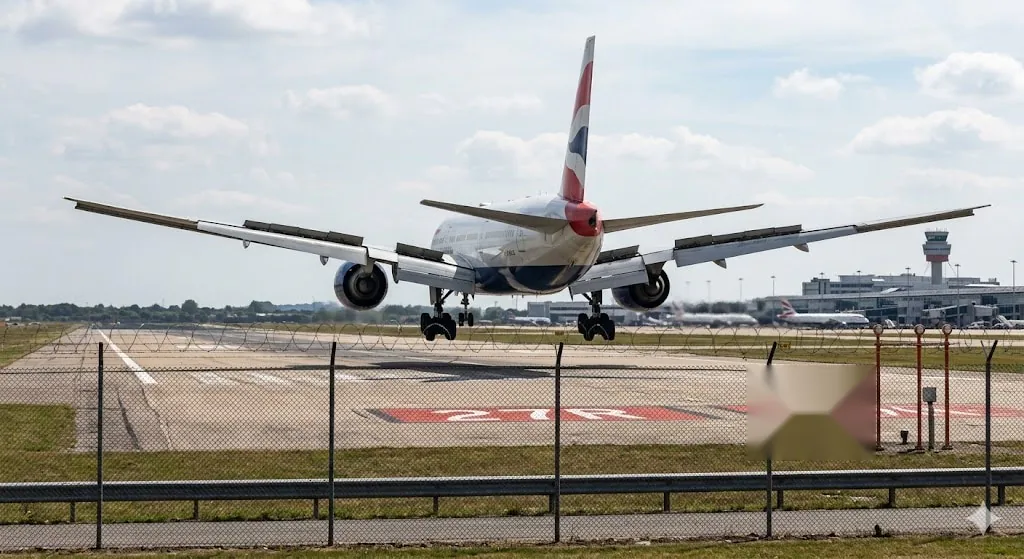
technical issue approaches with full flaps, landing gear extended,\
and — if a fuel dump was conducted — at or near maximum landing weight.\
The approach looks and feels identical to a normal landing.
\
\
If you see mist or trails from the wings, the aircraft is\
not failing. A fuel dump is a deliberate, controlled\
procedure that takes place because the crew and dispatcher have\
decided it is the correct preparation for landing. It means a\
decision has already been made about where and when to land, and\
the fuel dump is the engineering preparation for that landing. The\
aircraft is under full control throughout, the fuel dump system\
is doing exactly what it was designed to do, and the crew is\
running a normal checklist while it happens.
\
\
The fuel dump does not leave the aircraft fuel-starved.\
Dump systems have automatic cut-off at the target weight, and the\
target is always set above the minimum fuel required to reach the\
destination safely. Dumping to MLW on a return to base still leaves\
reserve fuel that meets regulatory minimums. The aircraft is not\
dumping everything — it is dumping the specific excess that prevents\
a normal landing. The approach and landing that follow a\
fuel dump are normal in every respect:the aircraft is at\
its intended weight, within its certified performance envelope, and\
the crew is not managing any additional abnormality beyond the\
original defect that triggered the return. For passengers, the\
landing will feel no different from any other arrival.
\
\
Expect a longer-than-usual time on the ground after\
landing. Whether the aircraft conducted a fuel dump or\
an overweight landing, a maintenance inspection is required before\
it returns to service. That inspection takes time, and the aircraft\
that brought you back may not be the aircraft that takes you to your\
destination when operations resume. Airline rebooking procedures\
for mechanical returns are covered in more detail in my\
\
flight delay article—the process is more organized than it\
appears from the gate, and the priority is always getting passengers\
rerouted on the next available option.
\
\
\
\
\
Related Reading from Aeruxo:
\
- \
- Emergency Landing Explained: What Really Happens and Why It’s Usually Safe
- Rapid Decompression on a Plane: What Happens in the First 30 Seconds
- ETOPS Explained: How Twin-Engine Flights Stay Safe Over Oceans
\
\
\
\
Frequently Asked Questions
\
\
What is a fuel dump on an airplane?
\
A fuel dump, or fuel jettison, is a procedure where an aircraft\
releases fuel from dedicated wing nozzles to reduce its weight before\
landing. It is used when an aircraft must return to the departure\
airport or divert to an alternate shortly after takeoff, before it\
has burned enough fuel to reach its Maximum Landing Weight through\
normal engine consumption. The fuel is atomized into a fine mist\
that evaporates before reaching the ground at the altitudes ATC\
assigns for the procedure.
\
\
Why do aircraft have different takeoff and landing weight limits?
\
The structural loads on landing gear and wing attachments at\
touchdown are significantly higher than at takeoff, because the\
aircraft must absorb the vertical impact load of the entire aircraft\
weight in a fraction of a second. Aircraft are certified to handle\
these loads at or below their Maximum Landing Weight. Above that\
limit, the structural margins are reduced to the point where they\
cannot be guaranteed to accommodate normal landing variations — which\
is why exceeding MLW triggers a mandatory structural inspection even\
when no external damage is visible.
\
\
Does dumped fuel reach the ground?
\
At the altitudes ATC assigns for fuel dump procedures, the fuel\
atomizes into droplets small enough to evaporate completely before\
reaching the ground surface. ATC directs aircraft to designated dump\
areas over unpopulated terrain or water and specifies minimum\
altitudes for the procedure. Environmental studies of properly\
conducted fuel dumps have found no measurable ground contamination’\
the evaporation process is complete at normal operating altitudes.
\
\
Can all aircraft dump fuel?
\
No. Most narrow-body commercial aircraft — the Boeing 737, Airbus\
A320 family, and regional jets — do not have fuel dump systems. The\
gap between their MTOW and MLW is small enough that holding and\
burning to landing weight is manageable for most return scenarios.\
Widebody long-haul aircraft — Boeing 747, 777, 787, Airbus A330, A340,\
A350 — typically have fuel dump systems because their MTOW-to-MLW gap\
can exceed 60 tonnes, making hold-and-burn impractical for emergency\
returns.
\
\
What happens if an airplane lands overweight without a fuel dump?
\
An overweight landing is certified for genuine emergencies where\
immediate landing is required. The crew executes the landing with\
the smoothest possible technique, declares the overweight condition\
to the tower, and the aircraft undergoes a mandatory structural\
inspection before returning to service. The inspection may find no\
damage — in which case the aircraft is cleared after the inspection’\
or may find fatigue indications that require repair. Either outcome\
takes the aircraft out of service for hours to days.
\
\
Who decides whether to do a fuel dump?
\
The decision is made jointly by the crew and the dispatcher. The\
dispatcher calculates the current excess weight, the burn-off time\
required to reach MLW naturally, and the time available based on\
the nature of the defect. The crew weighs those numbers against the\
urgency of landing and the overhead of fuel dump coordination. In\
most cases the crew makes the final call, with the dispatcher\
providing the numerical inputs and coordinating the ATC clearance\
and destination preparation simultaneously.
\
\
Is a fuel dump the same as an emergency?
\
Not necessarily. A fuel dump can be conducted as a precautionary\
measure for a non-critical defect that simply requires a return to\
base before the aircraft has burned down to MLW. In those cases,\
no MAYDAY or PAN PAN is declared — the fuel dump is a weight\
management procedure, not an emergency response. When a fuel dump\
accompanies a genuine emergency declaration, it is being conducted\
simultaneously with emergency response procedures, but the dump\
itself is still a routine weight-reduction tool. The emergency is\
the defect; the fuel dump is the preparation for landing safely\
at the correct weight.
\
\
\
\
Have you ever looked out the window and seen mist trailing\
from the wings, or been on a flight that returned shortly after\
takeoff? Share what you experienced in the comments — passenger\
accounts help others understand what these procedures actually\
look like from the cabin.
\
\
Disclaimer: The views expressed in this article are my own\
professional opinions based on 15+ years of operational experience.\
They do not represent the official position of any airline, aviation\
authority, or regulatory body.
\
\
\

Licensed Flight Dispatcher with 15+ years of experience in airline operations control. Holds FAA Aircraft Dispatcher Certificate and Republic of Korea Flight Dispatcher License (MOLIT). Specializes in flight watch, NOTAM analysis, flight planning, and operational control at a Korean LCC. IOSA audit participant and author of multiple airline operational manuals, including Emergency Response, De-icing, and OCC Procedures.