By Aeruxo — Licensed flight dispatcher (study guide) | 15+ Years in Airline Operations
The ACARS came in at cruise: “CARGO SMOKE. FWD HOLD. DESCENDING.” Three words and an altitude trend — that was all I needed to shift every other task off my desk. Within 60 seconds I had the nearest three divert airports on my second screen, had checked their runway lengths, confirmed emergency services were available, and was pulling up weather. The crew declared MAYDAY on the frequency. ATC was already clearing their airspace. Eleven minutes later the aircraft was on the ground. Emergency services found no active fire — the smoke detector had triggered on a cargo shipment that had overheated, not ignited. The aircraft was evacuated as a precaution, inspected, and returned to service the following morning. Not a single injury.
An airplane fire is the scenario that produces more passenger dread than almost any other — and, in my 15 years dispatching flights across Asia, it is also one of the emergency types I have seen most consistently resolved without catastrophic outcome when procedures are followed correctly. The reason is not luck. Commercial aircraft carry more fire detection and suppression technology than almost any other vehicle in existence, and the procedures that govern the response have been refined over decades of documented events. Understanding what an airplane fire response actually involves — and why modern systems are designed the way they are — changes the threat from an unmanageable catastrophe into a serious but handleable emergency.

crew response: throttle to idle, fire handle pulled, halon discharged.
The engine is shut down and sealed. In most cases, the fire is
extinguished before the aircraft reaches the divert airport.
Key Takeaways
- Modern commercial aircraft have continuous fire detection
in every zone where fire can start: engines, APU, cargo holds,
lavatory, and equipment bays. A warning is not an indication the
aircraft is on fire — it is the detection system doing exactly what it
is designed to do. - Engine fire suppression uses halon: a chemical
agent discharged directly into the engine nacelle that extinguishes
fire by interrupting the chemical combustion chain. Most engine fires
are resolved before the aircraft lands. - Cargo fires are the most dangerous type of airplane fire
because suppression agents can control but not always extinguish a
cargo hold fire. The only reliable resolution is getting the aircraft
on the ground quickly. - Most smoke and fume events in cabins are not airplane
fires. Electrical odors, galley smoke, and hydraulic fluid
fumes trigger a large proportion of in-flight smoke reports — all are
treated as fire events procedurally, but most are resolved without
active combustion. - The dispatcher’s role during an airplane fire is immediate
alternate identification and priority coordination, because
the crew has no time to negotiate — they are running a checklist with
seconds counted.
This article is based on real operational experience supporting emergency response and safety monitoring in an airline Operations Control Center (OCC), including real-world in-flight fire scenarios.
1. Where Airplane Fires Start: The Detection Zones

physically possible. Each zone has independent sensors and, where
relevant, independent suppression systems — so a warning in one zone
does not indicate fire elsewhere.
Every commercial aircraft operates with continuous fire and smoke
detection across a defined set of zones, each monitored by independent
sensor systems. Engine nacelles are monitored by
thermal detection loops — sensing elements that run through the engine
compartment and trigger a warning if temperature anywhere along their
length exceeds a defined threshold. A single loop failure produces a
fault indication; an actual fire warning requires the detection
threshold to be exceeded across the zone. The APU
(Auxiliary Power Unit) compartment has its own thermal
detection loop and its own suppression system, completely independent
of the engine fire system — because the APU can continue running on the
ground and presents a unique ignition risk separate from the propulsion
engines.
Cargo holds use optical smoke detectors rather
than thermal sensors, because cargo fires typically produce smoke
before they produce significant heat. Forward and aft holds are
monitored independently, and both have suppression agent capability’
though, as I will cover below, cargo hold suppression has important
limitations. The lavatories carry smoke detectors
and a small automatic suppression device concealed inside each waste
bin — designed specifically because lavatory fires from improperly
disposed cigarettes have caused fatal accidents in aviation history.
Equipment bays below the cabin floor, where avionics
and electrical systems are housed, carry their own smoke detection
connected to a centralized warning system.
2. Engine Fire: The Most Dramatic, Most Manageable Type

closes the fuel shutoff valve, cuts bleed air, disconnects hydraulics
and electrics from the affected engine, and arms the halon discharge
buttons. It is the single most practiced abnormal procedure in
commercial aviation.
An engine fire warning during flight triggers one of the most
rehearsed checklists in commercial aviation. The procedure is practiced
in simulator training repeatedly because the response window is narrow
and the sequence must be correct. When the fire bell sounds and the
red fire handle illuminates, the crew confirms which engine, reduces
thrust to idle, and pulls the fire handle for the affected engine.
Pulling the handle simultaneously closes the fuel shutoff valve
(stopping fuel flow to the fire), cuts engine bleed air, disconnects
hydraulic and electrical connections from the engine, and arms the
halon suppression system. The crew then discharges the first halon
bottle into the nacelle.
Halon (halogenated hydrocarbon) suppresses fire not by cooling or
smothering but by interrupting the chemical chain reaction of
combustion — making it highly effective in the enclosed nacelle
environment even in conditions where traditional agents would fail.
If the fire warning persists after the first discharge, the second
bottle is discharged. In the majority of documented engine fire events,
the fire warning clears within the first discharge sequence and does
not return. The aircraft then continues to the nearest suitable airport
on the remaining engine — a scenario that every commercial pilot is
certified to handle and that the aircraft is specifically designed and
performance-tested to support. As I cover in my
engine failure article, a twin-engine commercial jet is fully
certified for extended single-engine operations.
3. Cargo Fire: Why It Is the Most Serious Airplane Fire Type
Cargo hold airplane fires are categorically more dangerous than
engine fires for a reason that is not immediately intuitive: the
suppression agent can control the fire’s spread and intensity, but it
cannot guarantee extinguishment. Halon in the cargo hold depresses
oxygen concentration to a level that prevents active combustion — but
some materials, particularly lithium batteries, can sustain thermal
runaway without atmospheric oxygen, releasing their own oxygen
internally as part of the chemical decomposition process. This means
a cargo fire involving lithium battery shipments cannot be fully
suppressed by halon alone.
The procedural response to a cargo fire warning reflects this
reality. Unlike an engine fire, where the goal is to suppress and
then continue to the nearest airport at reasonable speed, a cargo fire
triggers the most urgent possible response: maximum descent rate,
MAYDAY declaration, and landing at the absolute nearest suitable
airport regardless of other considerations. Every minute of flight
time after cargo fire detection is a minute in which the suppression
agent is depleting and the fire is potentially progressing behind it.
According to
FAA Advisory Circular AC 120-80B on
in-flight fires, the time available from cargo fire warning to
structural compromise in documented events is highly variable’
reinforcing the principle that no time should be spent on anything
other than getting the aircraft on the ground.
From the dispatcher’s perspective, a cargo fire MAYDAY triggers a
different calculation than other emergencies: I am not looking for the
nearest airport with the best facilities. I am looking for the nearest
airport with a runway long enough for the aircraft type — period. Medical
facilities, fuel availability, and handling capacity are secondary
considerations. The crew needs pavement under the wheels in the minimum
possible time, and my job is to have that airport identified and the
slot coordinated before they need to ask.
4. Smoke in the Cabin: What It Usually Is
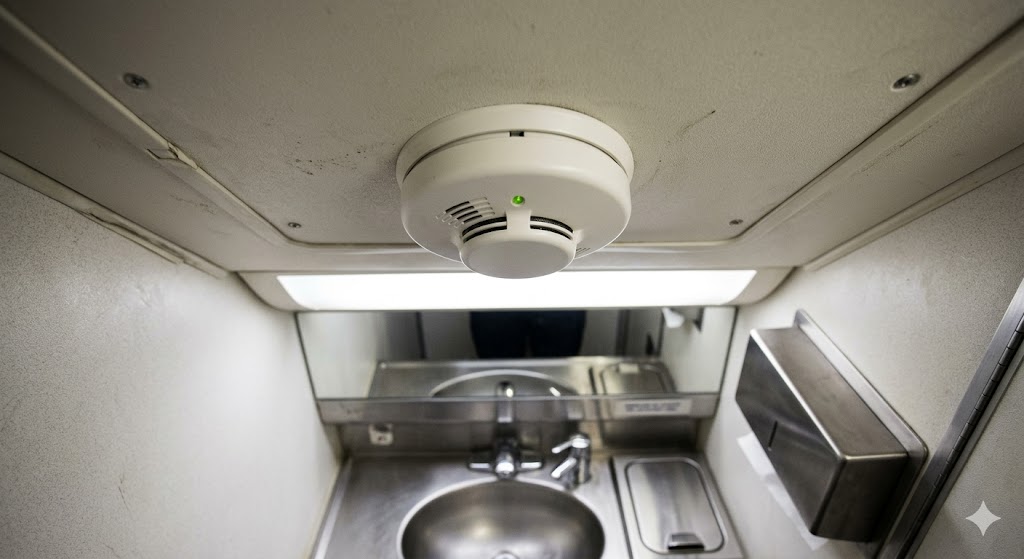
warning system and a small automatic suppression device inside the
waste bin. The history of lavatory fires from improperly discarded
smoking materials drove some of the most consequential fire safety
regulations in aviation.
The majority of smoke and fume events reported by passengers or
cabin crew during flight are not airplane fires in the combustion sense.
Electrical odors and acrid smells from avionics,
wiring insulation, or electrical components constitute a significant
proportion of in-cabin smoke events. The smell of burning plastic or
hot electronics is distinctive and alarming, but in most cases
represents a component overheating rather than active combustion.
Galley smoke from a burned food item, an overheated
oven, or a spilled liquid contacting a heating element is another
common source. Hydraulic fluid fumes entering the
cabin through the air conditioning system occur when hydraulic fluid
contacts hot engine components — producing a characteristic acrid smell
that triggers smoke event reports even when no visible smoke is
present.
None of this means the crew treats these events casually. Every
smoke or fume event in a commercial aircraft is treated as a potential
airplane fire until proven otherwise — because the consequence of
underreacting to a real fire is catastrophically worse than
overreacting to a false alarm. The crew dons oxygen masks, identifies
the source, isolates systems as needed, and coordinates with dispatch
for a possible divert. Most of these events are resolved at altitude
without requiring an emergency landing. A small proportion escalate
to confirmed fire or require diversion as a precaution. All generate
a full post-flight maintenance inspection and incident report
regardless of outcome.
5. What the Dispatcher Does During an Airplane Fire Emergency

identifying the nearest suitable airport, checking runway lengths,
confirming emergency services capability, and coordinating ATC slot
requests — while the crew is running a checklist with no time to spare
for external coordination.
When an airplane fire ACARS message or MAYDAY call reaches me, the
crew is running a memory checklist. They cannot simultaneously navigate,
suppress the fire, communicate with ATC, and coordinate a divert — so
the dispatcher absorbs the divert coordination entirely, working in
parallel rather than waiting for the crew to ask. My immediate sequence
is: identify the three nearest suitable airports for the aircraft type,
check runway lengths and elevation, confirm ARFF capability, pull
current weather, and calculate whether the remaining fuel covers the
divert with adequate reserve. For a cargo fire, the nearest suitable
airport with adequate pavement wins regardless of other factors — I flag
it to ATC immediately so they can begin clearing airspace for the
approach.
The maintenance and station coordination follows the same parallel
structure: I am notifying the station manager at the divert airport,
alerting maintenance control for an immediate post-landing inspection,
and logging every action with timestamps before the aircraft is even
on final approach. After an airplane fire event — even one where no
active combustion was confirmed — the aircraft does not return to service
until maintenance has cleared it and the relevant aviation authority
notification has been filed. The documentation trail starts the moment
the ACARS arrives, not after the aircraft lands. For how the full
divert coordination process unfolds operationally, my
flight diversion article covers the complete sequence from
declaration to gate arrival.
6. What Passengers Should Know About an Airplane Fire

slides deploy, passengers move, fire services respond. The 90-second
evacuation certification requirement exists because fire can reach
critical structural temperature faster than that — every second of
delay matters.
A fire warning does not mean the cabin is on fire.
Detection systems are intentionally sensitive. A warning anywhere on
the aircraft — engine, cargo hold, lavatory — triggers a full crew
response, but the warning itself does not confirm active combustion.
Most airplane fire warnings resolve during the crew’s response sequence
before the aircraft reaches any divert airport. If you smell
smoke or burning, report it to the crew immediately:do not
assume someone else has already done so, and do not attempt to
investigate the source yourself. The crew’s response to a confirmed
or suspected airplane fire depends on early and accurate information
from everyone in the cabin.
If the crew orders an evacuation, move immediately and
leave everything. The 90-second certification requirement for
aircraft evacuation exists because structural fire damage can reach
critical temperature faster than that. Every second spent retrieving
luggage from the overhead bin is a second that reduces the margin for
everyone behind you. After landing following an airplane fire event,
do not re-board the aircraft under any circumstances
until cleared by fire services and airline officials — even if the
aircraft appears undamaged and the fire has been confirmed as
extinguished. Post-fire structural integrity must be assessed by
qualified engineers before any human re-enters the aircraft.
Understanding the complete picture of aviation safety systems — of which
airplane fire detection and suppression is one part — is what my
aviation safety article covers in full.
Frequently Asked Questions
How common are airplane fires?
In-flight fire events — including smoke and fume reports that trigger
fire procedures — are more common than most passengers realize, but the
vast majority are resolved without active combustion. True in-flight
fires reaching the stage of MAYDAY declaration and emergency landing
are significantly rarer. The statistical outcome of confirmed airplane
fire events handled correctly by trained crews is overwhelmingly
survivable, which reflects the depth of the detection, suppression,
and crew training systems deployed across the commercial fleet.
What triggers an engine fire warning on an airplane?
Engine fire warnings are triggered by thermal detection loops
running through the engine nacelle that sense temperature above a
defined threshold. True engine fires — fuel or oil igniting within the
nacelle — are one cause, but false warnings from single loop failures,
maintenance sensor issues, or thermal anomalies not involving actual
combustion also occur. The crew procedure is identical regardless:
confirm the warning, shut down the engine, discharge halon, and land
at the nearest suitable airport. The cause is determined on the ground.
Why is a cargo fire the most dangerous airplane fire?
Cargo hold suppression agents control the fire’s spread by reducing
oxygen concentration, but some materials — particularly lithium batteries,
which can sustain thermal runaway internally without atmospheric
oxygen — cannot be fully extinguished by halon alone. Combined with
limited crew access to the cargo hold in flight and the variable time
from suppression to potential structural compromise, cargo fires
demand the most urgent response in commercial aviation: maximum
descent and landing at the nearest available airport.
What do the pilots do when an airplane fire warning sounds?
The crew immediately runs the memory items for the affected zone:
confirm the fire warning, identify the location, reduce thrust or shut
down the affected system, discharge suppression agent (for engine or
cargo), don oxygen masks if required, declare MAYDAY or PAN PAN
depending on severity, and coordinate with ATC for priority handling
to the nearest suitable airport. The checklist sequence is trained
to memory because the response window is too narrow to permit
reference lookups during the most critical actions.
Can passengers smell an airplane fire before the crew knows about it?
Yes — particularly for electrical fumes or hydraulic fluid odors that
enter the cabin before automated detection triggers. Passengers seated
near avionics bays or over wing fuel tanks have reported smelling
burning before formal fire warnings activated. This is exactly why
passenger reports to cabin crew are part of the detection system: the
crew depends on passenger reports as a supplementary layer of awareness,
and every report is taken seriously regardless of whether automated
detection has triggered.
What should I do if I smell smoke on a plane?
Immediately call a flight attendant — use the call button and verbally
report the smell, describing the type (burning plastic, acrid chemical,
smoke) and your location. Do not investigate the source or attempt to
handle any burning material yourself. Do not assume someone else has
already reported it. Once you have reported, return to your seat,
fasten your seatbelt, and note where the two nearest exits are. The
crew response will be immediate and will determine whether the event
requires diversion or can be resolved at altitude.
Why do aircraft lavatories have automatic fire suppression?
Lavatory fires from improperly discarded smoking materials have
caused fatal accidents in aviation history, most notably the Air
Canada DC-9 accident at Cincinnati in 1983, which killed 23 of 46
occupants. The investigation found that a lavatory fire was not
detected early enough and that suppression was inadequate. Mandatory
automatic suppression devices inside lavatory waste bins, combined with
mandatory smoke detectors connected to the cockpit warning system, were
among the regulatory responses. The no-smoking prohibition on commercial
aircraft exists in part because of this history.
Have you ever experienced a smoke smell or an unexpected
announcement about an aircraft system during a flight? Share what
happened in the comments — passenger accounts help others understand
what these events actually look like from the cabin.
Disclaimer: The views expressed in this article are my own
professional opinions based on 15+ years of operational experience.
They do not represent the official position of any airline, aviation
authority, or regulatory body.

Licensed Flight Dispatcher with 15+ years of experience in airline operations control. Holds FAA Aircraft Dispatcher Certificate and Republic of Korea Flight Dispatcher License (MOLIT). Specializes in flight watch, NOTAM analysis, flight planning, and operational control at a Korean LCC. IOSA audit participant and author of multiple airline operational manuals, including Emergency Response, De-icing, and OCC Procedures.