By Aeruxo — Licensed flight dispatcher (study guide) | 15+ Years in Airline Operations
“So the airplane autopilot basically flies the whole thing, right? The pilots just sit there?” I have heard this question more times than I can count — from friends, family, and passengers who assume that modern automation has made pilots redundant.
The short answer is no. The longer answer is more nuanced, more interesting, and — if you understand what airplane autopilot actually does and does not do — far more reassuring than the myth of the pilotless cockpit.
After 15 years as a flight dispatcher watching pilots interact with airplane autopilot systems on every flight I manage, I can tell you exactly what this technology handles, where its limits are, and why trained human pilots remain absolutely essential. This article is my complete, honest explanation — for passengers who want to understand who is really flying the plane.

Key Takeaways
- Airplane autopilot is a tool, not a replacement for pilots. Think of it as cruise control for the sky — it maintains heading, altitude, and speed, but someone must program it, monitor it, and take over when conditions change.
- Pilots manually fly takeoff on every commercial flight. The airplane autopilot is not engaged until the aircraft is safely climbing, typically above 1,000-2,000 feet.
- Autoland exists but is rarely used. Only about 1-3% of commercial landings use fully automatic landing systems, typically in very low visibility conditions. Pilots hand-fly the vast majority of landings.
- The airplane autopilot cannot handle emergencies. Engine failures, severe turbulence, depressurization, medical diversions — all of these require immediate human judgment and manual flying skills.
- Pilotless commercial aircraft are decades away, if they arrive at all. The regulatory, technical, and passenger confidence barriers are enormous.
This article is based on real-world experience monitoring automated flight operations in an airline Operations Control Center (OCC).
1. What Airplane Autopilot Actually Does
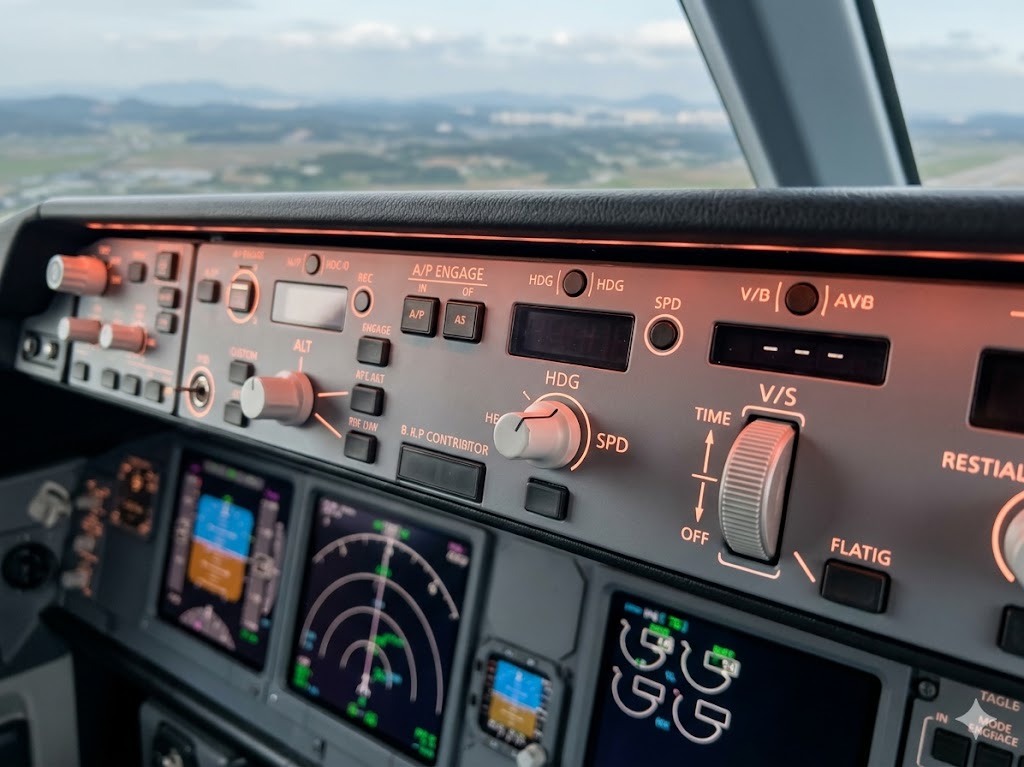
The airplane autopilot is a computer system that controls the aircraft’s flight path based on instructions programmed by the pilots. It can maintain a specific heading, hold an assigned altitude, follow a pre-programmed navigation route, and manage the aircraft’s speed (when paired with an autothrottle system).
Here is what the airplane autopilot does during a typical flight on our Korean LCC network:
During climb: After the pilots manually fly the takeoff and initial climb, they engage the system — typically above 1,000-2,000 feet. It then follows the programmed climb profile: climbing at the assigned speed, turning to follow the departure route, and leveling off at the assigned cruise altitude.
During cruise: This is where the system does its heaviest work. It maintains the assigned altitude, follows the navigation route programmed into the Flight Management System (FMS), and — with autothrottle — manages the engine power to maintain the target speed. This is the phase that makes people think pilots “do nothing.” But as I will explain, the pilots are doing plenty.
During descent and approach: The system can manage the descent profile, following altitude and speed constraints along the arrival route. On an ILS approach, it can track the localizer (lateral guidance) and glide slope (vertical guidance) down to the runway. On some aircraft and at some airports, it can even perform the landing itself — but this is the exception, not the rule.
What the system is not doing during any of this: making decisions. It does not evaluate weather. It does not communicate with ATC. It does not assess fuel status. It does not decide to divert. It does not respond to medical emergencies. It does not detect bird strikes. It does not manage engine failures. It executes the plan that the pilots give it — nothing more.
2. What the Airplane Autopilot Cannot Do

This is the part that surprises most passengers. The airplane autopilot — despite its name — is remarkably limited in its capabilities. It is a path-follower, not a decision-maker. Here is what it cannot do:
It cannot take off. Every commercial takeoff is manually flown by the pilots. The acceleration down the runway, the rotation, the initial climb — these are human-controlled on every single flight. The FAA and other regulators require human control during this critical phase.

It cannot avoid weather. When a line of thunderstorms blocks the route, the system will fly straight into it unless the pilot intervenes. Weather avoidance — interpreting radar returns, choosing a deviation path, requesting ATC clearance — is entirely a human skill. The system follows the route it was given. If that route goes through a storm, it will attempt to follow it into the storm.
It cannot handle emergencies. An engine failure, a cabin depressurization, a bird strike, a hydraulic system malfunction — none of these can be managed by automation. The pilots must diagnose the problem, execute the appropriate checklist, communicate with ATC and the dispatcher, and fly the aircraft manually if needed. This is why pilots train extensively for emergencies in simulators every six months.
It cannot communicate. All communication with ATC, with me in the OCC, and with the cabin crew is done by the human pilots. The system does not talk to anyone. It does not request altitude changes, negotiate weather deviations, or coordinate diversions.
It cannot land in most conditions. This deserves its own section, because it is the biggest misconception.
3. The Autoland Myth: Why Pilots Still Land the Plane

Yes, autoland technology exists. Modern aircraft equipped with Cat III ILS capability can, under specific conditions, fly the approach and execute the landing without the pilot touching the controls. It is impressive technology.
But here is the reality: autoland is used on roughly 1-3% of all commercial landings. It is reserved almost exclusively for very low visibility conditions (Cat II and Cat III approaches) where the pilots cannot see the runway until the final seconds — or at all. In normal weather — which is the vast majority of flights — pilots manually fly the approach and landing.
Why? Several reasons:
Not all airports support autoland. The airport must have a certified Cat III ILS system, which requires precise ground equipment and regular calibration. Many airports — including several on our Southeast Asian network — do not have this capability.
Not all aircraft are certified for autoland. The aircraft must have redundant systems (dual or triple autopilots) that meet the certification requirements. Our 737-800 fleet is capable, but the specific configuration and maintenance status must support it on any given day.
Pilots prefer to hand-fly. This is not ego — it is proficiency. A pilot who relies entirely on automation for landing loses the manual flying skills that are essential during emergencies, crosswind conditions, and non-standard approaches. Most airlines actively encourage pilots to hand-fly approaches to maintain proficiency.
The system has lower crosswind limits than humans. The airplane autopilot’s autoland capability typically has lower crosswind limits than a skilled pilot flying manually. In moderate crosswinds — a daily occurrence at many airports — the pilot manually flying the approach will outperform the automated system.
4. What Pilots Actually Do When Automation Is Engaged
If the airplane autopilot is managing the flight path, what are the pilots doing during cruise? This is the question that fuels the “pilots just sit there” myth. Here is the real answer:
Monitoring. Pilots continuously cross-check the system’s performance against what it should be doing. Is the altitude correct? Is the speed on target? Is the navigation following the cleared route? Does the fuel consumption match the plan? Is the airplane autopilot responding correctly to ATC instructions? Monitoring is an active, cognitively demanding task — not passive observation.
Weather management. Throughout the flight, pilots evaluate weather radar returns, receive updated weather reports from ATC and the dispatcher (me), and make decisions about route modifications to avoid turbulence or storms. This is entirely human work.
Communication. Pilots are in constant contact with ATC, receiving and acknowledging clearances, reporting positions over oceanic tracks, and coordinating with me via ACARS for operational updates. On a busy flight across Chinese airspace, ATC communications can be nearly continuous.
Planning ahead. Good pilots are always thinking 30 minutes ahead of the aircraft. What is the weather at the destination? Are there NOTAMs affecting the arrival? What is the fuel status relative to the plan? Is the approach briefing complete? What is the missed approach procedure? This continuous forward planning is the essence of professional airmanship.
Managing abnormalities. Minor system annunciations, cabin crew requests, ATC reroutes, weather deviations — the continuous flow of small operational adjustments that keep the flight running smoothly. The system handles the stick-and-rudder work; the pilots handle everything else.

5. The Danger of Too Much Automation
Here is something the aviation industry takes very seriously: over-reliance on the airplane autopilot can degrade pilot skills and situational awareness.
When pilots spend most of their flying hours monitoring rather than manually controlling the aircraft, their hand-flying skills can atrophy. Their ability to quickly recognize when the system is doing something wrong — called “automation surprise” — can diminish. Several high-profile accidents have been linked to automation dependency:
The crash of Air France Flight 447 in 2009 involved the disconnection of the automation at high altitude over the Atlantic when airspeed sensors (pitot tubes) froze. The crew’s response to the sudden manual-flying situation was inadequate, and the aircraft stalled and crashed. The investigation highlighted the risks of pilots losing manual flying proficiency in a highly automated cockpit.
This is why airlines and regulators now emphasize “balanced” automation use — engaging the system when it adds safety and efficiency, but also deliberately hand-flying portions of the flight to maintain proficiency. As I discussed in my aviation safety article, the system learns from every accident and adjusts training and procedures accordingly.
6. The Dispatcher’s Relationship with Automation
From my desk in the OCC, the airplane autopilot is an ally that makes my job easier — but it does not replace my vigilance any more than it replaces the pilots’.
When I watch flights in cruise on my tracking display, the smooth, predictable tracks I see are the system following the routes I built in the flight plan. The automation is executing the plan precisely — which frees the crew to focus on monitoring weather, managing fuel, and communicating with ATC.
But when conditions change — a typhoon shifts track, volcanic ash closes a sector, weather at the destination deteriorates below minimums — the automation has no response. It will continue following the original plan into the problem unless the humans intervene. That intervention is the crew’s job in the cockpit and my job from the OCC. Together, we adjust the plan while the airplane autopilot keeps the aircraft stable and on course during the transition.
That is the real relationship between humans and automation in aviation: the system handles the routine so that the humans can focus on the exceptional. It is a partnership, not a replacement. And it works remarkably well — as long as both sides do their jobs.
7. Will Pilots Ever Be Replaced?
The honest answer: not in our lifetimes. Here is why:
Certification barriers are enormous. Getting a pilotless aircraft certified for commercial passenger operations would require demonstrating safety levels that exceed current two-pilot operations — a bar that is extraordinarily high. No regulatory authority is close to approving this.
Passengers will not accept it. Surveys consistently show that the majority of passengers are unwilling to fly on a pilotless aircraft. Public trust is a prerequisite for commercial viability, and that trust currently requires human pilots.
The edge cases are unsolved. The airplane autopilot handles normal operations well. But aviation safety is defined by how the system handles abnormal operations — the engine failure over the ocean at 3 AM, the depressurization over mountainous terrain, the simultaneous medical emergency and weather diversion. Current automation cannot replicate the situational judgment, creativity, and adaptability that human pilots bring to these scenarios.
Cargo might go first. Autonomous cargo aircraft are closer to reality than passenger aircraft, because they remove the passenger confidence variable. Several companies are developing and testing autonomous cargo operations. But even in cargo, full certification is likely years or decades away.
For the foreseeable future, the model will remain what it is today: highly capable airplane autopilot systems assisting highly trained human pilots, with each compensating for the other’s limitations.
8. What Passengers Should Take Away
The next time someone tells you “the airplane autopilot flies the whole thing,” you can confidently correct them:
The system follows instructions. Pilots give those instructions, monitor their execution, and take over when the system cannot handle the situation — which happens on virtually every flight in some form, whether it is a weather deviation, a crosswind approach, or an ATC reroute.
The existence of sophisticated automation does not make pilots less important. It makes them differently important. Instead of hand-flying every minute of a 5-hour flight (which would be exhausting and actually less safe), they manage the flight strategically — making the decisions that automation cannot make, and stepping in with manual skills when the situation demands it.
This partnership between human expertise and machine precision is one of the reasons flying is the safest form of transportation. Neither pilots nor the airplane autopilot could achieve this safety record alone. Together, they achieve something extraordinary — and from my OCC desk, I get to watch it happen every single shift.
Learn more about our mission and operational background on the About Aeruxo page.
Frequently Asked Questions
Does the airplane autopilot fly the entire flight?
No. Takeoff is always manually flown by the pilots. The system is typically engaged during climb (above 1,000-2,000 feet) and manages most of the cruise phase. Descent and approach may be partially automated, but the vast majority of landings (97-99%) are manually flown by the pilots. Even when the system is engaged, pilots are actively monitoring, communicating, and managing the flight.
Can the airplane autopilot land the plane?
Yes, in specific conditions. Autoland capability exists on many modern commercial aircraft and is used during very low visibility approaches (Cat II/III ILS). However, it requires specific airport equipment, aircraft certification, crew training, and weather conditions. In normal visibility, pilots manually fly the landing. Autoland accounts for roughly 1-3% of all commercial landings.
What happens if the airplane autopilot fails?
The pilots take over manual control. This is a well-practiced scenario — pilots train for automation failures regularly in the simulator. A failure of the system is not an emergency; it simply means the pilots manually fly the aircraft for the remainder of the flight. Commercial aircraft are designed so that the loss of automation does not affect the aircraft’s flyability — it just increases the crew’s workload.
Are pilots really necessary with modern automation?
Absolutely. The system cannot take off, cannot avoid weather, cannot handle emergencies, cannot communicate with ATC, and cannot make operational decisions. It is a sophisticated path-following tool that requires human programming, monitoring, and intervention. The aviation industry’s exceptional safety record depends on the partnership between skilled pilots and capable automation — neither alone is sufficient.
Do pilots get bored during long flights with the airplane autopilot engaged?
Maintaining vigilance during long cruise phases is a genuine challenge — one that the industry addresses through structured monitoring procedures, regular crew task-sharing, and in some cases controlled rest protocols during night flights. Professional pilots manage this through discipline and training. But yes, maintaining alertness during stable, uneventful cruise is one of the underappreciated challenges of modern airline flying.
Will airplanes ever fly without pilots?
Not for commercial passenger operations in the foreseeable future. The regulatory, technical, and public acceptance barriers are enormous. Autonomous cargo aircraft may arrive sooner, but even these face significant certification challenges. For passenger flights, the two-pilot model with advanced automation assistance is likely to remain the standard for decades. The technology exists to automate more of the flight, but the judgment, adaptability, and public trust that human pilots provide cannot yet be replicated by machines.
Have a question about how automation works in the cockpit? Leave a comment — I will explain from a dispatcher’s perspective.
Disclaimer: The views expressed in this article are my own professional opinions based on 15+ years of operational experience. They do not represent the official position of any airline, aviation authority, or regulatory body.

Licensed Flight Dispatcher with 15+ years of experience in airline operations control. Holds FAA Aircraft Dispatcher Certificate and Republic of Korea Flight Dispatcher License (MOLIT). Specializes in flight watch, NOTAM analysis, flight planning, and operational control at a Korean LCC. IOSA audit participant and author of multiple airline operational manuals, including Emergency Response, De-icing, and OCC Procedures.