By Aeruxo — Licensed flight dispatcher (study guide) | 15+ Years in Airline Operations
The pilot’s voice came over the radio, calm but clipped: “Incheon Tower, we had a bird strike on takeoff roll. Continuing departure. Will advise.” I checked the flight tracking display. The aircraft was climbing normally. Altitude, speed, heading — all exactly as expected. Two minutes later, the follow-up: “No abnormal indications. Continuing to destination. Will request maintenance inspection on arrival.”
That was it. A bird strike happened. The flight continued. The passengers probably did not even know.
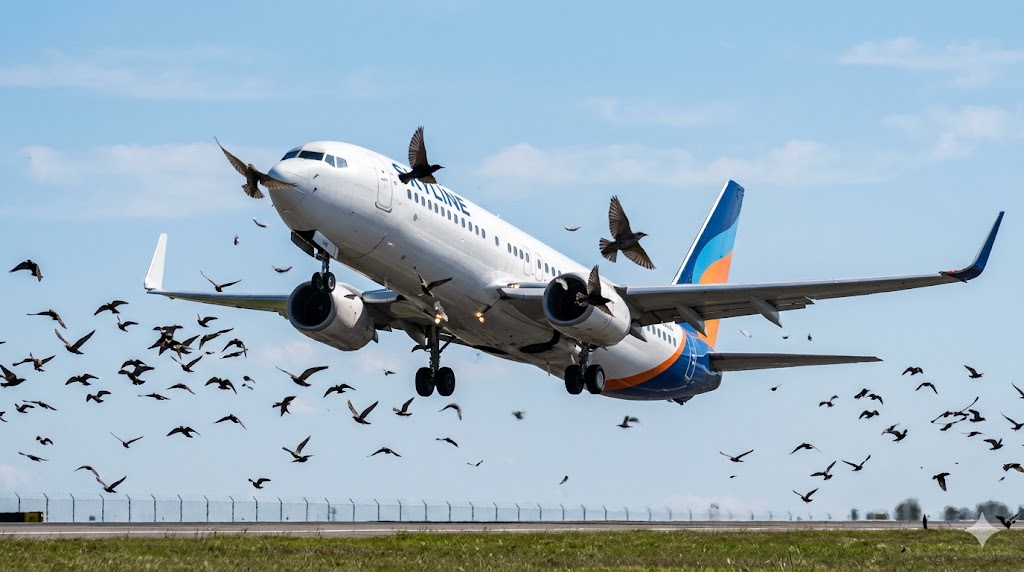
In 15 years as a flight dispatcher at a Korean LCC, I have handled bird strike reports more times than I can count. They are among the most common operational events in aviation — roughly 17,000 bird strikes are reported annually in the United States alone, and thousands more worldwide. The vast majority result in no damage, no disruption, and no danger whatsoever.
But when a bird strike makes the news — an engine fire, an emergency landing, or the tragic events that occasionally follow — it dominates headlines and terrifies passengers. The gap between the reality of bird strikes (routine, manageable, almost always harmless) and the perception of bird strikes (catastrophic, terrifying, a sign that flying is dangerous) is enormous. This article closes that gap.
Key Takeaways
- Bird strikes are extremely common — roughly 17,000 per year in the U.S. alone. The vast majority cause zero damage and zero disruption to the flight.
- Jet engines are certified to survive bird strikes. Before an engine is approved for commercial use, it must pass rigorous bird strike ingestion tests, including firing bird carcasses into a running engine.
- A bird strike causing a catastrophic accident is extraordinarily rare. The most famous example — the Hudson River landing in 2009 — involved a dual-engine bird strike from a flock of large Canada geese, and even that resulted in zero fatalities.
- Airports actively manage bird populations with wildlife control programs, habitat modification, and bird-scaring technology to reduce the frequency of bird strikes.
- The dispatcher’s role after a bird strike is to assess whether the aircraft can safely continue or needs to divert, based on crew reports, aircraft performance data, and maintenance guidance.
1. How Common Are Bird Strikes?
Bird strikes happen every single day in commercial aviation. The numbers are striking (no pun intended):
According to the FAA Wildlife Strike Database, U.S. airports recorded over 17,000 bird strike reports in 2023 — roughly 47 bird strikes per day. Globally, the number is estimated at 30,000-40,000 per year. And these are only the reported bird strikes; many minor strikes go unreported because the crew may not even be aware they occurred.
On our network — Korean LCC routes across Japan, China, and Southeast Asia — bird strike reports are a regular part of my operational reality. Certain airports on our network are particularly prone to bird strike activity:
Incheon (ICN): Located near tidal flats and wetlands that attract migratory birds, particularly during spring and autumn migration seasons. The airport has an active wildlife management program, but bird strike reports are still common during peak migration.
Southeast Asian coastal airports: Airports like Manila (NAIA), Da Nang, and Ho Chi Minh City are near coastal environments with significant bird populations. The tropical climate supports year-round bird activity, unlike temperate airports where bird strike risk is seasonal.
Japanese airports near water: Osaka Kansai (built on an artificial island) and Nagasaki attract seabirds that create bird strike risk during approach and departure.
Despite the high frequency, the overwhelming majority of bird strikes result in no significant damage. Studies of bird strike data consistently show that less than 5% of reported bird strikes cause any damage to the aircraft, and less than 1% cause damage significant enough to affect the flight. The reason is simple: most bird strikes involve small birds (sparrows, starlings, swallows) whose mass is insufficient to cause meaningful damage to a large commercial aircraft traveling at high speed.
2. What Happens During a Bird Strike: The Physics
To understand why most bird strikes are harmless — and why some are not — you need to understand the physics involved.
A bird strike is essentially a high-speed collision between a bird and an aircraft. The kinetic energy of the impact depends on two factors: the mass of the bird and the relative speed of the collision.
A small bird (100 grams) hitting an aircraft at 250 km/h produces a relatively minor impact — comparable to a tennis ball hitting a car windshield. The aircraft barely notices. But a large bird — a Canada goose at 6-7 kg, or a Baikal teal at 0.5 kg in a dense flock — hitting an aircraft at the same speed produces forces measured in tonnes. A 6.8 kg goose striking at 250 knots exerts a force of approximately 26 tonnes concentrated on a very small area. That kind of impact can dent airframes, crack windshields, and damage engine fan blades.
The most critical bird strike scenario is engine ingestion — when a bird (or multiple birds) is sucked into a running jet engine. The bird passes through the fan blades, which are spinning at 2,000-4,500 RPM. Depending on the bird’s size relative to the engine, the impact can bend or break fan blades, disrupt airflow, and in severe cases cause the engine to surge, lose power, or shut down.

However — and this is the crucial point — modern jet engines are designed and tested to handle bird strikes. The certification process requires engines to demonstrate that they can safely shut down (not explode, not catch fire, not shed debris) after ingesting a bird of specified size. This is not theoretical — it is physically tested before the engine is ever installed on an aircraft.
3. How Engines Are Tested for Bird Strike Survival

The bird strike certification process is one of the most dramatic tests in all of aviation engineering. Here is what happens:
Single large bird test: Under FAA (Part 33) and EASA (CS-E 800) standards, the engine must demonstrate that it can safely shut down after ingesting a single bird weighing up to 1.8 kg (4 lb). “Safely shut down” means no uncontained failure — no fan blade fragments penetrating the engine casing and damaging the aircraft. The engine does not have to keep running; it just has to fail safely.
Medium bird test: The engine must continue producing usable thrust for at least 20 minutes after ingesting a single bird weighing up to 1.15 kg. This simulates a scenario where the bird strike causes damage but the engine remains partially functional — giving the crew time to complete the flight or divert to a nearby airport.
Small bird flock test: The engine must survive the simultaneous ingestion of multiple small birds (up to 16 birds weighing 0.85 kg each, depending on the engine inlet area) without sudden, complete power loss.
These tests use real bird carcasses (typically chickens from commercial suppliers) fired from a pneumatic cannon into a running engine at simulated flight speeds. The testing is filmed with high-speed cameras to analyze the impact mechanics. Engine manufacturers like Rolls-Royce, GE Aviation, and Pratt & Whitney conduct these tests repeatedly during the certification process.
The result: every jet engine on every commercial aircraft you fly on has been proven to survive a bird strike of specified severity. This is why, when a bird strike occurs in real life, the outcome is almost always a safe shutdown (single bird strike on one engine) or continued safe operation (small bird strike with minor damage).
4. What the Dispatcher Does After a Bird Strike Report

When I receive a bird strike report from a crew, my response follows a structured assessment:
Step 1: Assess aircraft status. Is the aircraft flying normally? Are all engine parameters within limits? Any abnormal vibrations, warning lights, or unusual sounds reported by the crew? If everything is normal — which is the case in the vast majority of bird strikes — the flight continues to its destination with a maintenance inspection requested on arrival.
Step 2: If there are abnormal indications. If the crew reports abnormal engine parameters (vibration increase, EGT rise, oil pressure anomaly) or airframe damage (cracked windshield, unusual noise), I immediately coordinate with the crew and maintenance control. We assess whether the aircraft can safely continue to the destination or should divert to the nearest suitable airport.
Step 3: If an engine must be shut down. If a bird strike causes sufficient engine damage to require an in-flight shutdown, the crew follows standard single-engine procedures. The aircraft can fly, descend, and land safely on the remaining engine. I coordinate the diversion, notify the destination airport, and arrange for maintenance and fire services as precautions. This scenario is rare — but when it happens, it is well within the capabilities I plan for on every flight.
Step 4: Documentation. Every bird strike is documented in the aircraft’s technical log and reported to the relevant aviation authority. This data feeds into the wildlife strike databases that airports and regulators use to improve bird strike prevention programs. The reporting is important even for bird strikes that cause no damage, because the data helps identify patterns — which airports, which seasons, which bird species, and which flight phases are most at risk.
In my experience, roughly 90% of bird strike reports I handle result in “continue to destination, inspect on arrival.” About 8% result in “return to departure airport for precautionary inspection.” About 2% involve significant damage requiring immediate diversion or operational adjustments. These proportions align closely with industry-wide bird strike data.
5. The Famous Bird Strikes: What We Learned
Three bird strike events have shaped how the aviation industry thinks about bird strike risk. Each one taught us something valuable.
US Airways Flight 1549 — The Miracle on the Hudson (2009)
The most famous bird strike in aviation history. An Airbus A320 departing LaGuardia Airport struck a flock of Canada geese at approximately 2,800 feet, causing both engines to lose thrust simultaneously. Captain Sullenberger successfully ditched the aircraft in the Hudson River. All 155 occupants survived.
What we learned: Dual-engine bird strikes from large flocks of heavy birds can overwhelm even certified engines. The event drove improvements in engine bird strike certification standards (increasing the size and number of birds used in testing), enhanced airport wildlife management programs near major airports, and reinforced the importance of pilot training for ditching and total engine failure scenarios. As I discussed in my engine failure article, Flight 1549 demonstrated that even in the absolute worst-case bird strike scenario, the combination of aircraft design and pilot skill can produce a survivable outcome.
Jeju Air Flight 2216 — Muan, South Korea (2024)
A Boeing 737-800 crashed during landing at Muan International Airport in December 2024, killing 179 of 181 people on board. Investigators found bird strike evidence (feathers and blood) in both engines. A bird strike warning was issued by ATC shortly before the crew attempted to land.
What we learned (investigation ongoing): This tragedy — the worst aviation disaster in South Korea in decades — has intensified scrutiny of bird strike risk at airports near wetlands and migratory bird corridors. It has also raised questions about the interaction between bird strike damage, go-around decision-making, and airport infrastructure (the presence of a concrete wall at the end of the runway). The investigation is ongoing, and the full causal chain has not yet been established. As a Korean LCC dispatcher, this event is deeply personal to our industry and has reinforced my vigilance around bird strike risk at every airport on our network.
Ryanair Flight 4102 — Rome Ciampino (2008)
A Boeing 737-800 struck a flock of starlings during approach, causing both engines to fail. The crew landed safely at Ciampino but the landing gear collapsed during rollout. All passengers and crew survived.
What we learned: Multiple bird strikes during approach — when the aircraft is low, slow, and committed to landing — present a unique challenge. The crew’s decision to continue the landing (rather than attempt a go-around with compromised engines) was validated by investigators as the correct choice. This informs the guidance I give crews: after a bird strike on short final, continuing to land is generally safer than attempting a go-around with potentially damaged engines.
6. How Airports Prevent Bird Strikes
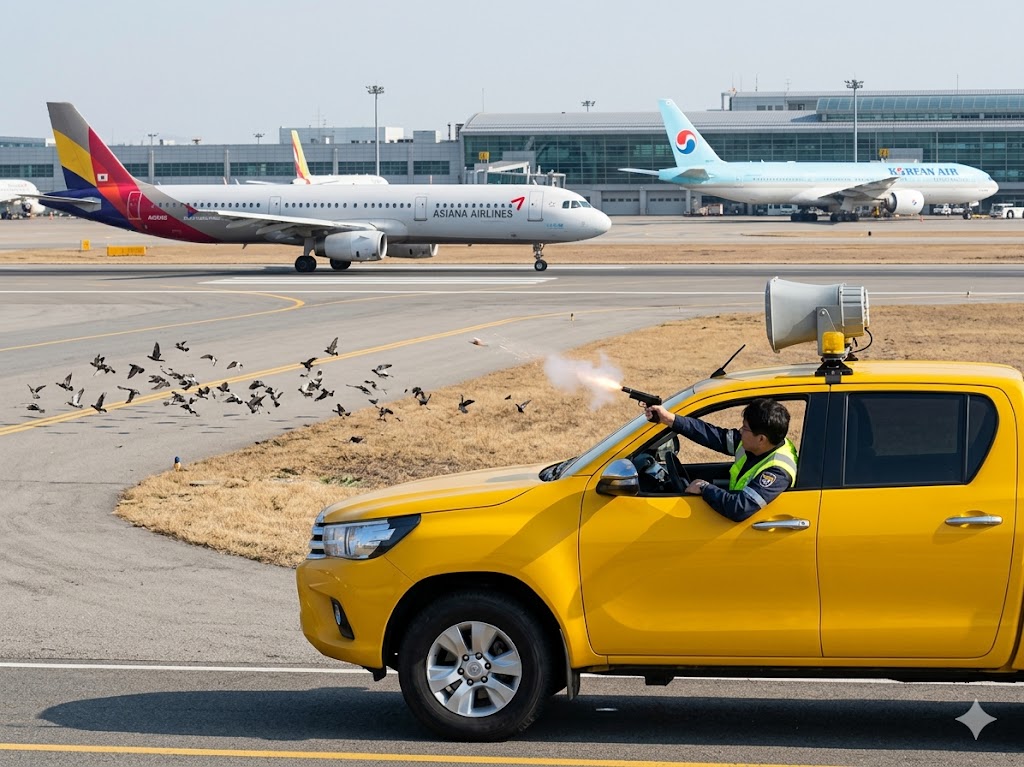
Preventing bird strikes is a continuous, multi-layered effort managed by airport authorities. The methods include:
Habitat modification. Airports reduce features that attract birds: mowing grass to heights that are less attractive for foraging, eliminating standing water, removing berry-producing trees, and covering waste disposal areas. The goal is to make the airport environment uninteresting to birds.
Active bird dispersal. Wildlife management teams use a range of tools to scare birds away from active runways: pyrotechnic cartridges (loud bangs), propane cannons, distress call speakers, laser devices, and even trained falcons or hawks that patrol the airfield. At some Asian airports, teams drive the runway perimeter regularly during peak bird activity periods.
Radar and detection systems. Advanced bird detection radar (avian radar) can track bird movements near the airport and alert ATC and wildlife teams when bird activity increases near active runways. ATC can then issue bird strike warnings to arriving and departing aircraft — as happened at Muan before the Jeju Air accident.
Data-driven management. Bird strike data — collected from every reported bird strike — is analyzed to identify patterns: which species are involved, at what times of year and day bird strikes are most common, and which runway approaches carry the highest bird strike risk. This data drives targeted management actions: if a specific bird species is causing a disproportionate number of bird strikes at a particular airport, wildlife managers focus their efforts on that species.
At Incheon, where our LCC is based, the airport operates one of the more sophisticated wildlife management programs in Asia, including dedicated wildlife officers, avian radar, and seasonal management plans that intensify during migratory bird seasons. Despite this, bird strikes still occur — because eliminating bird strike risk entirely is impossible. Birds and aircraft share the same low-altitude airspace, and no prevention program can remove every bird from every approach path.
7. What Passengers Should Know About Bird Strikes
You will probably never notice a bird strike. Most bird strikes involve small birds that produce a minor thump or no noticeable impact at all. Unless you are seated near the point of impact and happen to see feathers or blood on the window, you are unlikely to be aware that a bird strike occurred. The crew may not even announce it if the aircraft is operating normally.
If you do notice a bird strike, stay calm. A bird strike loud enough for you to hear — a bang on the fuselage, a visible bird hit on the window, or a flash near the engine — can be alarming. But remember: the aircraft is designed for this. The engines are tested for bird strike survival. The crew is trained for bird strike procedures. In the overwhelming majority of cases, the flight continues normally.
A bird strike does not mean the engine is destroyed. Media coverage of bird strikes often focuses on dramatic engine fire footage. These events are extremely rare. Most bird strikes that affect engines cause only minor blade damage that is repaired during routine maintenance after landing. As I described in my aviation safety article, the system has multiple layers of protection — and bird strike survival is one of them.
Bird strike risk is highest during takeoff and landing. Approximately 90% of bird strikes occur below 3,000 feet altitude, during the phases of flight when the aircraft is in the bird-rich zone near the airport. Once at cruise altitude (30,000+ feet), bird strike risk is essentially zero — birds do not fly at those altitudes.
Seasonal awareness helps. Bird strike risk increases during migratory seasons (spring and autumn) and during dawn and dusk when bird activity is highest. If you are tracking your flight and see ATC bird strike warnings at your destination airport, do not panic — it simply means the airport’s wildlife management system is working and crews are being advised to exercise heightened awareness.

8. A Dispatcher’s Perspective on Bird Strike Risk
After 15 years of managing bird strike reports, here is my honest assessment:
Bird strikes are a reality of aviation that cannot be eliminated. As long as aircraft fly through the atmosphere and birds inhabit the same low-altitude airspace near airports, bird strikes will occur. The industry’s approach — designing aircraft and engines to survive bird strikes, managing bird populations near airports, and training crews for bird strike scenarios — is the right one. It does not eliminate bird strike risk; it manages bird strike consequences to an acceptably safe level.
The catastrophic bird strike events are the extreme outliers. For every Flight 1549 that makes global headlines, there are tens of thousands of bird strikes that cause nothing more than a dent, a maintenance log entry, and a data point in the wildlife strike database. The system is designed so that even when the rare severe bird strike occurs, the outcome is overwhelmingly survivable.
Bird strike prevention is getting better. Avian radar technology, improved airport habitat management, enhanced engine certification standards, and data-driven wildlife management programs are all reducing both the frequency and severity of bird strikes. The trend lines are moving in the right direction — even as global air traffic and bird populations both increase.
When a bird strike makes the news, perspective matters. On the day any bird strike incident occurs, approximately 100,000 other flights operated safely around the world — many of them also encountering bird strikes that caused no damage and no disruption. The safety of flying is not defined by the rare dramatic event; it is defined by the millions of routine bird strikes that the system handles without incident, every single year.
A bird strike is nature reminding us that we share the sky. The aviation industry’s response — engineering resilience, operational preparedness, and continuous improvement — is one of the best examples of how aviation turns unavoidable risk into manageable reality.
Learn more about our mission and operational background on the About Aeruxo page.
Frequently Asked Questions
How often do bird strikes happen?
Approximately 17,000 bird strikes are reported annually in the United States alone, averaging about 47 per day. Globally, the number is estimated at 30,000-40,000 per year. However, the vast majority (over 95%) of bird strikes cause no damage to the aircraft. Bird strikes resulting in significant damage or operational disruption account for less than 1% of all reported bird strike events.
Can a bird strike bring down a plane?
It is extraordinarily rare. The most notable bird strike accident in recent decades was US Airways Flight 1549 in 2009, where a flock of large Canada geese disabled both engines simultaneously — and even that event resulted in zero fatalities thanks to the crew’s skill. Modern engines are certified to survive bird strikes of specified severity, and aircraft are designed so that a single engine loss (the most common consequence of a severe bird strike) does not prevent safe flight and landing. A catastrophic bird strike accident requires a very specific combination of factors that is extremely unlikely.
What happens to the engine when a bird strike occurs?
For small birds, the engine usually continues operating normally with no detectable effect. For larger birds, the impact can damage fan blades, causing vibration. In more severe bird strike cases, blade damage may trigger engine warning indications that lead the crew to precautionarily shut the engine down. In rare bird strike events involving very large birds or dense flocks, the engine may lose power or flame out. However, even when a bird strike causes an engine failure, the engine is designed to fail safely — without shedding debris that could damage the aircraft.
Why don’t airports just keep all birds away?
Airports invest heavily in bird strike prevention through habitat modification, active bird dispersal, and avian radar. However, completely eliminating birds from the airport environment is impossible. Birds are mobile, adaptable, and abundant — especially near coastal airports, wetlands, and agricultural areas. The goal of airport wildlife management is not to eliminate all bird strike risk (which is unachievable) but to reduce it to the lowest practical level. The combination of airport prevention, aircraft design resilience, and crew training creates a layered defense that manages bird strike risk effectively.
Are bird strikes more common at certain times of year?
Yes. Bird strike frequency increases during spring and autumn migratory seasons, when large flocks of birds move through low-altitude airspace near airports. Bird strikes are also more common during dawn and dusk, when bird feeding and flight activity peaks. In tropical regions (like our Southeast Asian destinations), bird strike risk is more constant year-round because tropical bird populations do not have the seasonal migration patterns that temperate-region birds do.
Should I be worried about bird strikes when I fly?
No. Bird strikes are one of the most thoroughly anticipated and engineered-for hazards in aviation. Engines are tested to survive them. Airports work actively to prevent them. Crews are trained to manage the consequences when they occur. The probability of a bird strike causing any harm to passengers is vanishingly small — far lower than the risks you accept routinely in everyday life, like driving to the airport. Fly with confidence; the system has bird strike risk well under control.
Have you experienced a bird strike as a passenger? I would be curious to hear your account — leave a comment below.
Disclaimer: The views expressed in this article are my own professional opinions based on 15+ years of operational experience. They do not represent the official position of any airline, aviation authority, or regulatory body.

Licensed Flight Dispatcher with 15+ years of experience in airline operations control. Holds FAA Aircraft Dispatcher Certificate and Republic of Korea Flight Dispatcher License (MOLIT). Specializes in flight watch, NOTAM analysis, flight planning, and operational control at a Korean LCC. IOSA audit participant and author of multiple airline operational manuals, including Emergency Response, De-icing, and OCC Procedures.