By Aeruxo — Licensed flight dispatcher (study guide) | 15+ Years in Airline Operations
It is 9:45 PM. Your flight to Bangkok departs at 10:30 PM. You are at the gate, boarding pass in hand. The aircraft is there. The weather is clear. Everything looks normal. Then the gate agent picks up the microphone: “Ladies and gentlemen, we regret to inform you that this flight has been cancelled due to crew availability.”
You look around. The aircraft is right there. The sky is perfectly clear. What do they mean, “crew availability”? Where did the crew go?
The crew did not go anywhere. They are still here — probably sitting in the crew room, frustrated. They want to fly your flight. But they cannot. Because their pilot duty time — the total number of hours they have been on duty today — has exceeded the legal limit. And no airline, no dispatcher, no captain can override that limit. It is the law. It exists because fatigued pilots make mistakes, and mistakes in aviation can be fatal.
After 15 years as a flight dispatcher, crew duty time is the invisible constraint that shapes more of my decisions than any other single factor. I manage it, calculate it, worry about it, and occasionally watch helplessly as it forces the cancellation of a perfectly flyable flight. This article explains how pilot duty time works, why it matters more than passengers realize, and what happens in the OCC when the clock runs out.

Key Takeaways
- Pilot duty time is legally limited to prevent fatigue. Depending on the regulatory framework, maximum duty periods range from 10 to 14 hours, with stricter limits for night operations and multiple-sector days.
- Duty time starts at report, not at takeoff. A pilot who reports at 6 AM for a 7 AM departure has their duty clock running from 6 AM — meaning a 14-hour limit expires at 8 PM, regardless of how many flights remain.
- Delays earlier in the day are the #1 killer of evening flights. A 2-hour morning delay can cascade through the day until the crew exceeds their duty limit on the last flight, forcing its cancellation.
- Minimum rest between duty periods is 10-12 hours. This is not negotiable. A crew that finishes duty at midnight cannot fly again until at least 10 AM the next morning — which may mean cancelling the first flight of the next day too.
- At a Korean LCC with limited reserve crews, a duty time cancellation can cascade for 24+ hours because there is no fresh crew available to take over at an outstation.
1. How Pilot Duty Time Actually Works

Pilot duty time regulations are set by national aviation authorities following ICAO standards. The specifics vary by country, but the core principles are universal.
Key Definitions
Duty period: The total time from when a pilot reports for duty until they are released from all duty obligations. This includes pre-flight briefing, the flight(s), turnarounds, post-flight duties, and any deadheading (traveling as a passenger on airline business). Crucially, duty time is not the same as flight time — it starts well before the engines spool up and ends after the post-flight paperwork is complete.
Flight duty period (FDP): The portion of the duty period from when the pilot reports for a flight until the aircraft parks at the final destination. This is the most regulated component and has the strictest limits.
Flight time: The time from when the aircraft first moves under its own power until it comes to a final stop. This is the narrowest definition — parking brake off to parking brake on.
Rest period: The continuous, uninterrupted time between duty periods when the crew is free from all obligations. Minimum rest is typically 10-12 hours, depending on the preceding duty length.
The Numbers
While exact limits vary by regulatory framework, here is a representative summary for a two-pilot crew on short-to-medium haul operations (like our Korean LCC network):
Maximum flight duty period: 10-14 hours, depending on the number of sectors (flights) and the time of day. A single-sector day typically allows up to 13 hours. A four-sector day might be limited to 11 hours. Night operations (starting between 2 AM and 6 AM) often have shorter limits — sometimes 2 hours less than the daytime equivalent.
Maximum flight time: 8-10 hours in a 24-hour period for a two-pilot crew.
Minimum rest: 10-12 consecutive hours between duty periods, including an opportunity for at least 8 hours of uninterrupted sleep.
Weekly/monthly limits: Typically 60-70 hours of flight time per week, 100-120 per month, and 900-1,000 per year.
These numbers may seem abstract. Let me make them real with an example from my desk.
2. A Day in the Life: How Duty Time Plays Out
Here is a realistic daily schedule for a crew at our airline, and how duty time accumulates:
05:30 — Crew reports for duty. Duty clock starts. FDP clock starts.
06:00 — Pre-flight briefing with dispatcher (me). I brief the crew on weather, fuel, route, NOTAMs, and any special considerations.
06:45 — First flight departs: Incheon → Osaka. Flight time: 1 hour 50 minutes.
08:35 — Arrival Osaka. Turnaround begins. Passengers deplane, cabin cleaned, new passengers board, refueling. Turnaround time: 50 minutes. Crew duty time so far: 3 hours 5 minutes.
09:25 — Second flight departs: Osaka → Incheon. Flight time: 2 hours.
11:25 — Arrival Incheon. Another turnaround: 55 minutes. Crew duty time so far: 5 hours 55 minutes.
12:20 — Third flight departs: Incheon → Da Nang. Flight time: 4 hours 30 minutes.
16:50 — Arrival Da Nang. Turnaround: 60 minutes. Crew duty time so far: 11 hours 20 minutes.
17:50 — Fourth flight departs: Da Nang → Incheon. Flight time: 4 hours 15 minutes.
22:05 — Arrival Incheon. Post-flight duties: 15 minutes.
22:20 — Crew released from duty. Total duty time: 16 hours 50 minutes.
Now here is the problem: if the maximum FDP for a four-sector day starting at 05:30 is 13 hours, the crew’s legal duty window closes at 18:30. The Da Nang return flight does not even depart until 17:50. This schedule does not work.
In reality, this is exactly the kind of calculation I perform before the crew even reports for duty. If the math does not work — if the planned schedule exceeds the crew’s legal duty limits — I flag it during the planning phase, and crew scheduling either adjusts the plan (shorter turnarounds, different crew pairing, split the schedule between two crews) or accepts that the last flight will require a separate crew.
3. When Delays Break the Clock: The Cascade That Cancels Your Flight

This is where pilot duty time intersects most painfully with the passenger experience. I explained the domino effect of delays in a previous article. Here is the crew-specific version:
Take the schedule above and add a 2-hour weather delay to the first flight. The Incheon-Osaka departure moves from 06:45 to 08:45. Every subsequent flight shifts by 2 hours. The Da Nang return flight, originally departing at 17:50, now departs at 19:50 and arrives at Incheon around midnight.
But the crew reported at 05:30. Their 13-hour FDP limit expired at 18:30. The Da Nang return flight would require duty until midnight — 5.5 hours past the legal limit. The flight cannot operate with this crew.
My options at this point:
Option A: Call a reserve crew. At a major airline with crew bases worldwide, this is the standard solution. At our Korean LCC with crews based in Incheon — and no reserve crews stationed in Da Nang — this option does not exist for the return flight. I could send a crew from Incheon to Da Nang, but they would arrive too late to operate the return.
Option B: Rest the crew in Da Nang overnight. The crew flies the outbound to Da Nang, then rests at a hotel overnight. They can operate the return flight the next morning after completing their minimum rest period. This saves the return flight but delays it by 12+ hours and cancels the aircraft’s first scheduled flight the next day because the aircraft is now in Da Nang instead of Incheon.
Option C: Cancel the Da Nang flights entirely. Keep the crew and aircraft in Incheon. Cancel both the outbound and return Da Nang flights. Preserve the crew and aircraft for tomorrow’s full schedule. Rebook the passengers on tomorrow’s service.
Each option has significant consequences. None of them makes passengers happy. But all of them are safer than putting a fatigued crew in the cockpit for a 4-hour night flight across the South China Sea.
4. Why These Rules Exist: The Human Cost of Fatigue
Pilot duty time limits are not bureaucratic inconveniences. They exist because fatigue kills.
The most cited case is Colgan Air Flight 3407 in February 2009. The Q400 turboprop crashed on approach to Buffalo, New York, killing all 49 on board plus one person on the ground. The NTSB investigation found that pilot fatigue was a contributing factor — both pilots had commuted long distances before their duty day, neither had adequate rest, and their performance degraded during the critical approach phase.
The crash led to sweeping regulatory changes in the United States, including the FAA’s Part 117 rules on flight and duty time limitations, which established science-based limits accounting for circadian rhythms, time of day, number of sectors, and cumulative fatigue. These rules are among the most evidence-based regulations in all of aviation.
The science is unambiguous: after 13-16 hours of wakefulness, human cognitive performance declines measurably. After 17 hours, performance impairment is equivalent to a blood alcohol content of 0.05% — legally drunk in many jurisdictions. After 24 hours without sleep, it is equivalent to 0.10% — over the legal driving limit everywhere.
A pilot managing an ILS approach to minimums in darkness, at 250 km/h, carrying 189 passengers, cannot be cognitively impaired. Not even slightly. Not even a little. This is why duty time limits are absolute, non-negotiable, and enforced with career-ending consequences for violations.
As I wrote in my aviation safety article: the system prioritizes safety above schedule, every single time. Crew duty time limits are one of the most important expressions of that priority.
5. The Dispatcher’s Role: Managing the Clock
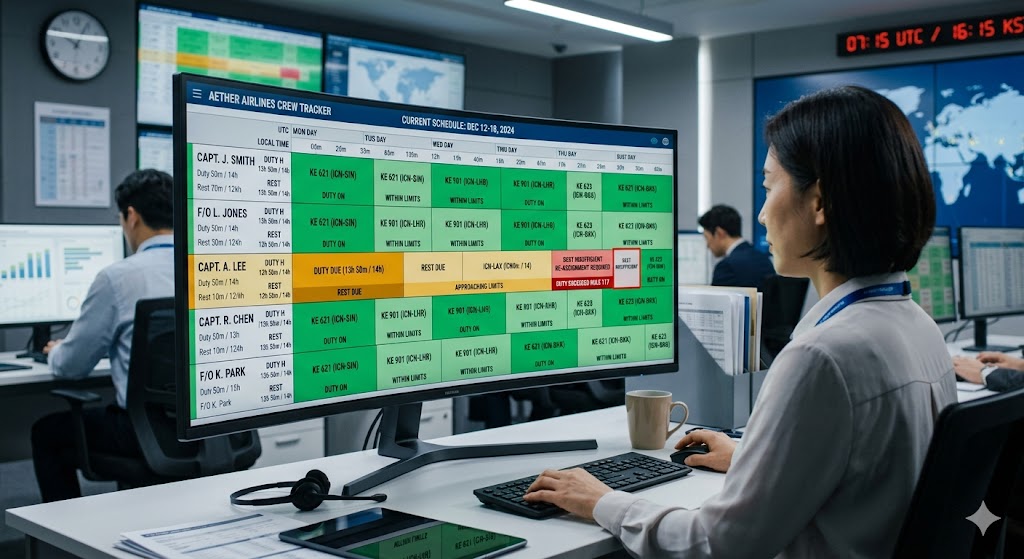
Managing pilot duty time is a collaborative effort between crew scheduling and the flight dispatcher. Here is how it works from my side:
Before the day begins: I review the planned crew assignments for all flights on my desk. I verify that the planned schedule — including expected turnaround times, taxi times, and buffer — fits within the crew’s legal duty window. If I see a potential exceedance, I flag it immediately.
During operations: As delays accumulate through the day, I continuously recalculate the crew’s projected duty time. If a 45-minute delay on the second flight means the crew will exceed their limit on the fourth flight, I alert crew scheduling now — while there is still time to arrange alternatives. Waiting until the crew actually exceeds the limit is too late; the damage is done.
The critical question I ask multiple times per shift: “If this delay holds, can the crew legally complete the round trip?” If the answer is no, I initiate the decision process — cancel the outbound now while passengers can still rebook, or send the flight outbound knowing the crew will overnight at the destination?
Communication with the crew: I keep the cockpit informed of their duty time status throughout the day. A crew that knows they are approaching their limit can help by optimizing turnaround efficiency, requesting direct routing from ATC to save time, or flagging when they believe fatigue is becoming a factor — which is their right and responsibility under the regulations.
6. The LCC Reality: Why Crew Limits Hit Harder
I have been honest throughout this blog about the structural differences between LCC operations and full-service carriers. Pilot duty time is where those differences create the most visible passenger impact.
Higher crew utilization. Our pilots fly more sectors per day than full-service carrier pilots. A typical crew day at our airline involves 3-4 sectors; at a full-service carrier, it might be 2. More sectors means more turnaround time counting against the duty clock, leaving less margin for delays.
Fewer reserve crews. A major airline might have 10-15 reserve crews on standby at any given time across multiple bases. Our LCC might have 2-3 reserves, all based in Incheon. If a crew times out at an outstation in Southeast Asia, there is no local reserve to take over. The recovery options narrow to overnight rest or cancellation.
Single crew base. With crews based primarily in Incheon, any crew timeout at a foreign outstation creates a positioning problem that takes 12-24 hours to resolve. A full-service carrier with crew bases in multiple cities can reposition crews faster.
This is the same trade-off I described in my delays article and my cancellation article: the efficiency that enables affordable fares also reduces the buffer that absorbs disruptions. Pilot duty time is the constraint that makes this trade-off most visible to passengers.
7. What Passengers Should Understand

The crew wants to fly your flight. No pilot enjoys telling passengers their flight is cancelled. The crew did not “decide” to stop working — they hit a legal limit that they cannot override. Blaming the crew for a duty time cancellation is like blaming a car for running out of fuel.
“Crew availability” is not a cover story. When the gate agent says “crew availability,” it genuinely means that no legal crew is available to operate the flight. It is not code for “the airline messed up” (although sometimes the underlying cause was a scheduling or operational error that led to the crew timing out).
Morning delays cause evening cancellations. If your evening flight is cancelled due to crew duty time, the root cause was almost certainly a delay earlier in the day — possibly on a completely different route that you never flew. The domino effect is the mechanism; duty time is the constraint that makes the final domino fall as a cancellation rather than just a delay.
Book morning flights if you want to minimize this risk. The first flight of the day uses a crew that has just completed their rest period. Their duty clock has just started. The probability of a duty time cancellation on the first flight is virtually zero. By the last flight of the day, the accumulated delays of the entire operation have eaten into the crew’s margins. As I always advise: early flights are the most reliable flights.
These rules protect you. The next time a flight is cancelled because the crew timed out, remember: the alternative was a flight operated by pilots whose cognitive performance was measurably impaired. I described the statistics in my safety article: the system is designed to prevent exactly this scenario. The cancellation is the system working — protecting you from a risk you would never see but that the regulations are specifically designed to prevent.
8. Looking Forward: Fatigue Risk Management

The aviation industry is moving beyond simple numerical duty time limits toward more sophisticated Fatigue Risk Management Systems (FRMS). Instead of relying solely on prescriptive limits (e.g., “maximum 13 hours”), FRMS uses data-driven analysis of fatigue factors: time of day, sleep history, workload, number of sectors, time zone changes, and individual pilot fatigue reports.
This evolution is important because fatigue is not a simple function of hours on duty. A pilot who slept 9 hours before a 12-hour daytime duty may be less fatigued than a pilot who slept 6 hours before a 10-hour night duty. FRMS allows airlines to manage fatigue more precisely, potentially enabling some schedule patterns that prescriptive rules would prohibit while restricting others that prescriptive rules would allow.
For passengers, the trajectory is clear: the industry is continuously investing in better understanding and managing pilot fatigue, driven by the unambiguous evidence that fatigue degrades performance and increases risk. The duty time limits that sometimes cancel your flight are not static — they are evolving to become smarter, more evidence-based, and ultimately more protective.
And from my desk in the OCC, managing crew duty time will remain one of the most consequential and least visible aspects of my job — a constraint that passengers rarely see but that shapes virtually every scheduling decision, every delay management strategy, and every cancellation call I make.
The clock is always running. My job is to make sure it never runs out in the wrong place at the wrong time.
Learn more about our mission and operational background on the About Aeruxo page.
Frequently Asked Questions
How many hours can a pilot fly in one day?
For a two-pilot crew on commercial operations, the maximum flight time is typically 8-10 hours in a 24-hour period. The maximum flight duty period (which includes pre-flight, turnarounds, and post-flight time) is typically 10-14 hours depending on the number of sectors, time of day, and regulatory framework. Night operations and multi-sector days have shorter limits. These limits are set by national aviation authorities following ICAO fatigue management standards.
Why was my flight cancelled due to “crew availability”?
This means the crew assigned to your flight has reached (or will reach) their maximum legal duty time and no replacement crew is available. The most common cause is cascading delays earlier in the day that consumed the crew’s duty time margin. At airlines with limited reserve crews (particularly LCCs), there may be no backup crew available to operate the flight, forcing a cancellation. The airline cannot legally operate the flight with a crew that has exceeded their duty limits.
Can the captain decide to keep flying past the duty time limit?
In most regulatory frameworks, there is a limited “captain’s discretion” provision that allows the captain to extend the duty period by a small amount (typically 1-2 hours) in unforeseen circumstances — for example, if the flight is already airborne and delays on approach would push past the limit. However, this discretion is narrow, must be reported, and cannot be used routinely. It exists for safety — it is safer to let a crew land their current flight than to divert simply because a clock expired. But it cannot be used to start a new flight that would exceed the limit.
How much rest do pilots get between flights?
The minimum rest period between duty days is typically 10-12 consecutive hours, including an opportunity for at least 8 hours of uninterrupted sleep. If the preceding duty period was particularly long or demanding, the required rest may be longer. During layovers at outstations, the rest period includes transportation time between the airport and the crew hotel, which is why airlines typically schedule 12 hours of rest to ensure 8 hours of actual sleep opportunity after accounting for travel and meal time.
Do cabin crew have the same duty time limits as pilots?
Cabin crew have their own duty time and rest requirements, which are similar in principle but may differ in specific limits from pilot regulations. In some jurisdictions, cabin crew limits are slightly more permissive than pilot limits. In practice, since the entire crew (pilots and cabin crew) must be available for a flight to operate, the most restrictive limit among any crew member determines whether the flight can proceed. I have seen flights cancelled because a cabin crew member exceeded their limit even though the pilots were still legal.
Why don’t airlines just hire more reserve crews?
Reserve crews are expensive. A reserve pilot on standby is being paid but not generating revenue. Full-service carriers maintain larger reserve pools because their revenue model supports it. LCCs operate with minimal reserves because the cost of maintaining extensive standby crews would increase ticket prices — undermining the low-fare business model. This is the fundamental trade-off: more reserves mean fewer cancellations but higher fares; fewer reserves mean lower fares but less resilience when disruptions occur. Each airline makes this trade-off differently based on their market, network, and operating philosophy.
Have you experienced a cancellation due to crew duty time? Share your experience in the comments — understanding the passenger perspective helps me explain these situations better.
Disclaimer: The views expressed in this article are my own professional opinions based on 15+ years of operational experience. They do not represent the official position of any airline, aviation authority, or regulatory body. Specific duty time limits vary by country and airline; the figures cited are representative examples.

Licensed Flight Dispatcher with 15+ years of experience in airline operations control. Holds FAA Aircraft Dispatcher Certificate and Republic of Korea Flight Dispatcher License (MOLIT). Specializes in flight watch, NOTAM analysis, flight planning, and operational control at a Korean LCC. IOSA audit participant and author of multiple airline operational manuals, including Emergency Response, De-icing, and OCC Procedures.