By Aeruxo — Licensed flight dispatcher (study guide) | 15+ Years in Airline Operations
Cabin pressure airplane effects begin the moment the doors close. You are cruising at 35,000 feet. Outside your window, the temperature is -56°C. The air pressure is roughly one quarter of what it is at sea level. The oxygen level would render you unconscious within 30 seconds if you were exposed to it directly. You are, quite literally, in an environment hostile to human life.
And yet you are sitting comfortably, reading on your phone, sipping coffee, breathing normally. You feel fine — maybe a little tired, maybe your ears popped during the climb, maybe your feet feel slightly swollen. But fine.
The reason you are alive and comfortable is cabin pressure on the airplane — a carefully engineered system that creates a miniature Earth-like atmosphere inside a metal tube hurtling through the upper atmosphere. It is one of the most important and least understood systems on the aircraft, and it affects your body in ways that most passengers never realize.
As a flight dispatcher who monitors pressurization status on every flight I manage, I want to explain exactly what cabin pressure does, how it works, what it does to your body, and what happens when — in extremely rare circumstances — it fails.
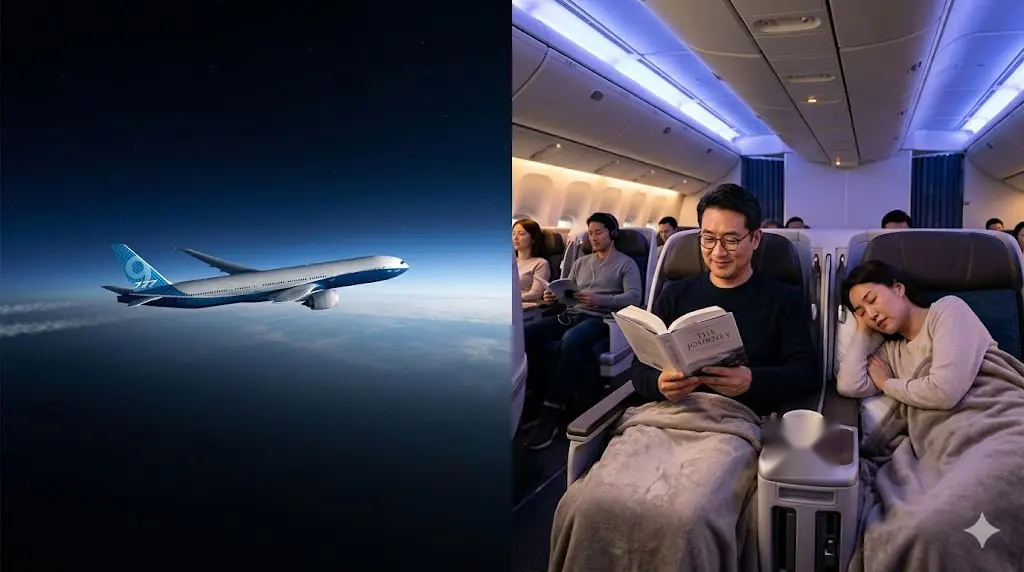
Key Takeaways
- At cruising altitude, your cabin is pressurized to the equivalent of 6,000-8,000 feet above sea level — similar to being on a moderate mountain. This is why you can breathe normally at 35,000 feet.
- Your ears pop because of pressure changes in the cabin during climb and descent. The eustachian tube in your ear needs to equalize the pressure between your middle ear and the cabin — swallowing, yawning, or chewing gum helps.
- Cabin pressure reduces your blood oxygen saturation by 3-4%, which is why you feel more tired on long flights. This is normal and harmless for healthy passengers, but can be significant for people with respiratory conditions.
- Gas in your body expands by approximately 30% at cabin altitude, causing mild bloating, abdominal discomfort, and the reason you should avoid carbonated drinks before flying.
- Loss of cabin pressure is extremely rare and immediately triggers oxygen masks and an emergency descent. Pilots train for this scenario regularly, and the aircraft is designed with multiple pressurization safeguards.
This article is based on operational experience monitoring aircraft systems and supporting flight crews in an airline Operations Control Center (OCC).
1. How Cabin Pressure on an Airplane Works
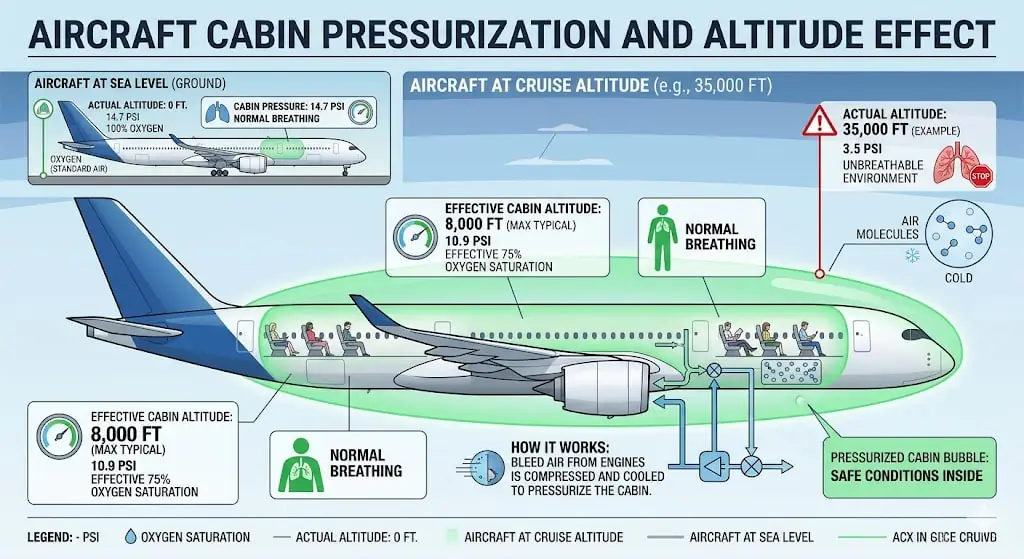
The principle is straightforward: the aircraft pumps compressed air into the cabin faster than it lets air escape, maintaining an internal pressure significantly higher than the outside atmosphere.
On most commercial aircraft, the compressed air comes from the engines. The jet engines compress incoming air to very high pressures during normal operation. A portion of this compressed air — called bleed air — is diverted from the engines, cooled, and fed into the cabin through the air conditioning system. (The Boeing 787 Dreamliner is an exception — it uses electrically driven compressors instead of engine bleed air, but the result for passengers is the same.)
The cabin pressure is regulated by an outflow valve — typically located in the rear fuselage — that controls how much air escapes from the cabin. By adjusting this valve, the pressurization system maintains the desired cabin altitude. The entire process is automatic, managed by digital pressure controllers that follow a pre-programmed schedule based on the flight’s planned altitude.
The key number: the FAA mandates that cabin altitude must not exceed 8,000 feet under normal operations. Most airlines target 6,000-7,000 feet for passenger comfort. Newer aircraft like the 787 and A350 can maintain even lower cabin altitudes (around 5,000-6,000 feet) thanks to advanced composite fuselage materials that handle greater pressure differentials.
For context: 8,000 feet is roughly the altitude of Aspen, Colorado, or the top of many popular hiking mountains. You can breathe normally at this altitude, exercise moderately, and function without impairment. It is not sea level — and your body does notice the difference — but it is well within the range where humans can operate safely and comfortably.
2. Seven Ways Cabin Pressure Affects Your Body
Now let me walk through the specific effects that cabin pressure has on your body during a flight. Understanding these helps you prepare, reduces anxiety, and explains sensations that might otherwise worry you.
Effect 1: Your Ears Pop
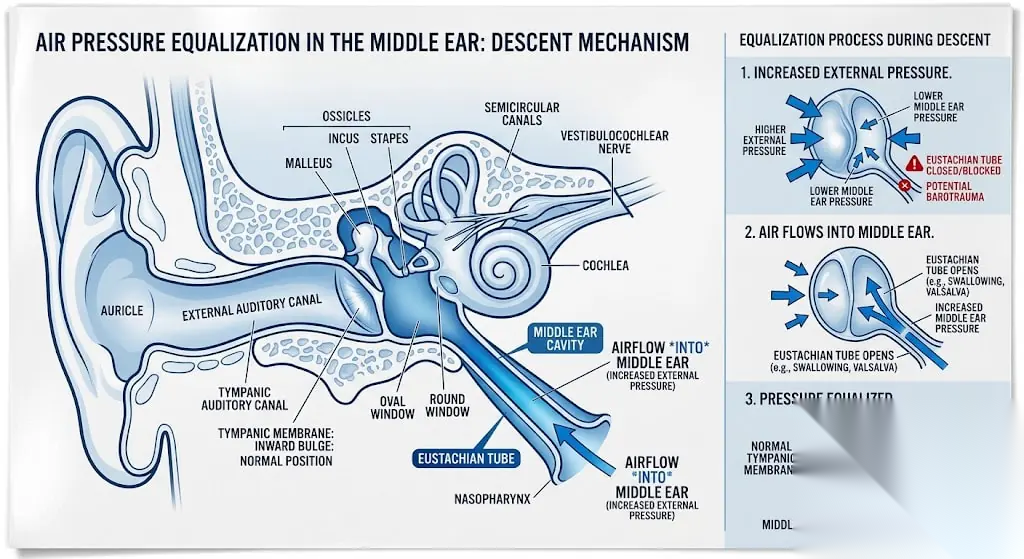
This is the most common and most noticed effect of cabin pressure changes. As the aircraft climbs after takeoff, the cabin pressure decreases (cabin altitude rises). The air trapped in your middle ear — behind your eardrum — is now at a higher pressure than the surrounding cabin. This pressure difference pushes your eardrum outward, causing a feeling of fullness or mild discomfort. The eustachian tube — a small passage connecting your middle ear to the back of your throat — opens to let the excess air escape. You hear a small “pop” as the pressure equalizes.
During descent, the opposite happens — and it is usually more uncomfortable. The cabin pressure increases as the aircraft descends, but the eustachian tube has a harder time letting air in to equalize the growing pressure difference. This is why your ears feel more blocked during landing than during takeoff.
What helps: Swallow frequently, yawn, chew gum, or use the Valsalva maneuver (pinch your nose and gently blow). For babies and toddlers, sucking on a bottle or pacifier during descent helps. If you have a cold or sinus congestion, the eustachian tube may be swollen and unable to equalize — making the discomfort significantly worse. The Mayo Clinic recommends using a nasal decongestant spray 30-60 minutes before descent if you are congested.
Effect 2: Your Blood Oxygen Drops Slightly
At sea level, your blood oxygen saturation (SpO2) is typically 96-99%. At a cabin altitude of 6,000-8,000 feet, it drops to approximately 90-94%. This is a 3-6% decrease — enough for your body to notice but not enough to cause problems in healthy individuals.
What you may feel: mild fatigue, slight drowsiness, and reduced concentration during long flights. This is not jet lag (which is a circadian rhythm issue) — it is your body operating at slightly reduced oxygenation for several hours. It is one of the reasons you feel inexplicably tired after a flight, even if you slept well.
For passengers with respiratory conditions (COPD, pulmonary fibrosis, severe asthma), this reduction can be more significant. As I discussed in my article on medical emergencies, pre-existing respiratory conditions can be exacerbated by the reduced oxygen environment in the cabin. Passengers with these conditions should consult their physician before flying and may need supplemental oxygen.
Effect 3: Gas in Your Body Expands
Boyle’s Law states that gas volume is inversely proportional to pressure. At cabin altitude, the pressure is about 25% lower than at sea level. This means gas trapped in your body cavities — your sinuses, your intestines, your middle ear — expands by approximately 30%.
The practical consequences: mild abdominal bloating and discomfort (as gas in your intestines expands), increased flatulence (your body needs to release the expanded gas somehow), and sinus pressure or pain if you have congested sinuses.
What helps: Avoid carbonated drinks and gas-producing foods (beans, broccoli, cabbage) before and during the flight. Eat light meals. Walk periodically to stimulate digestion. This is unglamorous advice, but it is based on the straightforward physics of gas expansion at altitude.
Effect 4: You Get Dehydrated
The air inside the cabin has a relative humidity of approximately 10-20% — far lower than the 40-60% most humans find comfortable. This extremely dry air is a consequence of the pressurization system: the air drawn from the engines (or compressors) at high altitude is naturally very dry, and the short transit time through the cabin does not allow much moisture to accumulate.
The effects: dry skin, dry eyes, dry throat, and progressive dehydration over the course of a flight. On a 4-6 hour flight to Southeast Asia, you can lose 1-2 liters of water through insensible loss (breathing and skin evaporation) without realizing it. This dehydration contributes to the fatigue, headache, and general malaise many passengers feel after landing.
What helps: Drink water consistently throughout the flight — not just when you feel thirsty. Avoid alcohol and caffeine, which are diuretics that accelerate dehydration. Use moisturizer and lip balm. This is the simplest and most effective thing you can do for your in-flight comfort, and I recommend it in nearly every travel advice article I write.
Effect 5: Your Feet and Ankles Swell
Reduced cabin pressure combined with prolonged sitting causes fluid to accumulate in your lower extremities. The lower air pressure slightly reduces the efficiency of your circulatory system’s venous return (the process of pushing blood back up from your legs to your heart), and gravity does the rest.
What helps: Move your feet and ankles regularly — flex, rotate, press against the floor. Walk the aisle every 1-2 hours on long flights. Compression socks genuinely work for reducing swelling and improving circulation. Avoid crossing your legs for extended periods.
Effect 6: Your Taste Changes
This one surprises most people. At cabin altitude, your ability to perceive sweet and salty flavors decreases by approximately 20-30%. The reduced humidity dries out your nasal passages, diminishing your sense of smell — and since smell is a critical component of taste, food and drinks taste blander at altitude.
This is why airline food is often seasoned more heavily than you might expect, and why tomato juice — which has a strong umami flavor that is less affected by altitude — is disproportionately popular on flights. It is also why your post-landing coffee tastes noticeably better than the one you had on the plane: your taste perception returns to normal once you are back at ground level.
Effect 7: You Feel More Anxious
This is the least discussed but most operationally relevant effect from my perspective. The combination of mild hypoxia (reduced oxygen), dehydration, caffeine sensitivity changes, physical confinement, and the unfamiliar sounds of the aircraft creates a physiological environment that can heighten anxiety — even in passengers who do not normally consider themselves anxious flyers.
The reduced oxygen level subtly affects cognitive function and emotional regulation. Add the fatigue, the dehydration, and the sensory disorientation of night flight or turbulence, and your brain is operating in a slightly stressed state — which makes it more reactive to stimuli that would not bother you on the ground.
As I wrote in my article on fear of flying, understanding why you feel anxious can significantly reduce the anxiety itself. Your body is responding to a genuine (but completely safe) environmental change. The pressurization system is maintaining your safety with extraordinary reliability. The discomfort you feel is the system working — not failing.
3. What Happens If Cabin Pressure Is Lost
This is the scenario passengers fear most — and the one that the entire pressurization system is designed to make virtually impossible.
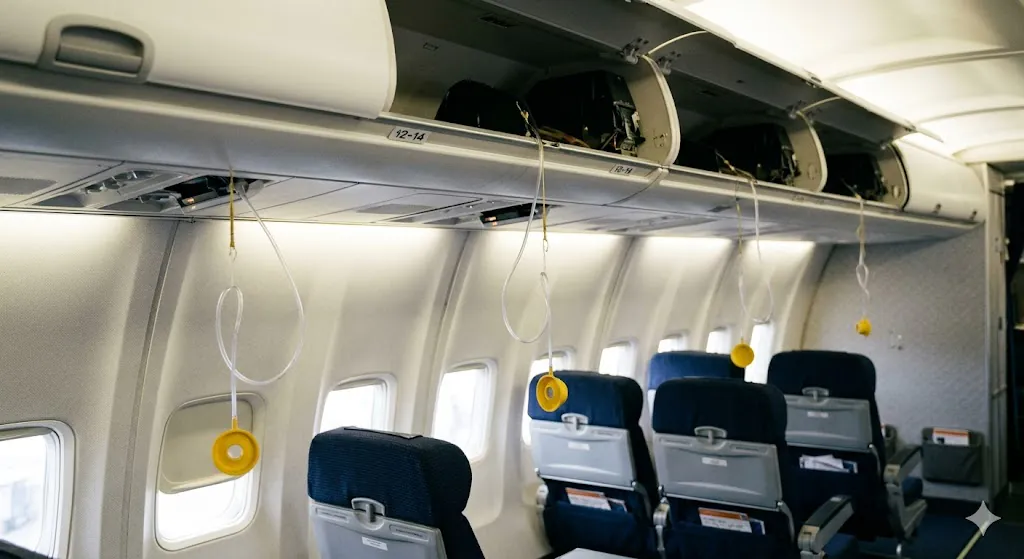
Loss of cabin pressure — also called depressurization — can occur gradually (a slow leak, a seal failure) or rapidly (a structural failure, a window or door seal breach). Both types trigger an immediate, automatic, and well-practiced response.
What happens automatically:
Oxygen masks deploy. When cabin altitude exceeds approximately 14,000 feet, the passenger oxygen masks drop from the overhead compartments automatically. Each mask provides approximately 12-15 minutes of supplemental oxygen — enough time for the pilots to descend to a safe altitude. This is why the safety briefing tells you to put your own mask on before helping others: at high altitude, you have only 15-30 seconds of useful consciousness without oxygen.
The crew initiates an emergency descent. Pilots are trained to immediately descend to 10,000 feet or below — an altitude where the outside air pressure is sufficient for normal breathing without supplemental oxygen. This descent is rapid (4,000-6,000 feet per minute) but controlled. Passengers may feel a steep descent and hear the engines change pitch dramatically as the crew accelerates the descent.
The aircraft diverts. After reaching a safe altitude, the crew diverts to the nearest suitable airport. The flight cannot continue at the planned cruise altitude without a functioning pressurization system.
What the Dispatcher Does
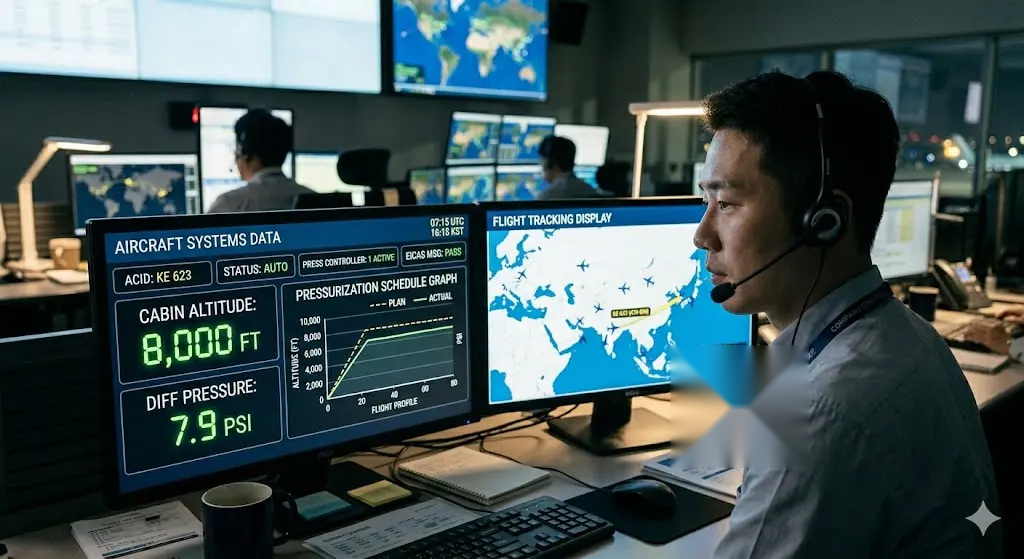
When I receive an ACARS message or radio report indicating a depressurization event, I immediately shift to emergency diversion mode — the same rapid response I described in my medical emergency article. The key difference is that a depressurization limits the aircraft to a maximum altitude of about 10,000 feet for the remainder of the flight, which dramatically increases fuel burn and reduces range. I must quickly identify a diversion airport that is reachable at low altitude with the remaining fuel.
On our Southeast Asia routes, a depressurization over the South China Sea is one of the scenarios I plan for during every flight plan. The ETOPS planning ensures that a suitable diversion airport is always within range, even at reduced altitude.
How Rare Is Depressurization?
Extremely rare. Significant depressurization events on commercial aircraft occur at a rate of roughly 1-2 per year globally across all commercial aviation. Catastrophic rapid depressurization (a large structural breach) is rarer still. The pressurization system has multiple redundancies: dual bleed air sources (one from each engine), backup pressurization controllers, and structural design that limits the size of any potential breach. The system is designed so that even if the primary pressurization source fails, backup systems maintain cabin pressure.
4. Newer Aircraft: Better Cabin Pressure for You
Aircraft design has been steadily improving the cabin pressure experience for passengers. Here is what has changed:
Boeing 787 Dreamliner: The 787’s composite fuselage can withstand a greater pressure differential than traditional aluminum airframes. This allows a cabin altitude of approximately 6,000 feet at cruise — compared to 7,000-8,000 feet on older types. Passengers consistently report feeling less fatigued and more comfortable on 787 flights, largely due to this lower cabin altitude and the higher humidity (15-20% vs 6-10%) that the composite structure enables.
Airbus A350: Similar to the 787, the A350’s composite structure allows a cabin altitude of approximately 6,000 feet, with improved humidity control.
The trend: Every new-generation aircraft type is targeting lower cabin altitudes and higher humidity. The physiological research is clear — lower cabin altitude means better passenger comfort, less fatigue, and reduced health effects. For passengers who are particularly sensitive to altitude effects, checking the aircraft type when booking and preferring newer composite-fuselage types can make a meaningful difference on long flights.
5. Practical Tips: Managing Cabin Pressure Effects

Here is my consolidated advice based on understanding the physics of cabin pressure and 15 years of observing passengers:
Before the flight: Avoid carbonated drinks and gas-producing foods for 2-3 hours before departure. Use a nasal decongestant spray if you have any sinus congestion. Hydrate well in the hours before boarding — starting hydrated is better than trying to catch up mid-flight.
During climb: Swallow or yawn frequently to help your ears equalize. If you have trouble, try the Valsalva maneuver gently. Give babies a bottle or pacifier. Do not sleep during the climb if you are prone to ear discomfort — you cannot equalize while sleeping.
During cruise: Drink water every 30-45 minutes. Avoid excessive alcohol (its effects are amplified at altitude due to reduced oxygen and dehydration). Move your feet and legs regularly. If you feel unusually fatigued or lightheaded, it is likely the combination of mild hypoxia and dehydration — water and movement usually help.
During descent: This is when ear pressure is most problematic. Start equalizing early — before you feel discomfort. Chew gum, swallow frequently, or use the Valsalva maneuver. Stay awake during descent. If you have a cold, this is the phase where congestion makes ear pressure most painful. The decongestant spray you used before the flight should still be active if you timed it correctly.
After landing: Rehydrate aggressively. Your body has lost more water than you realize. If your ears still feel blocked after landing, continue equalizing techniques — the blockage usually resolves within a few hours. If ear discomfort or hearing changes persist beyond 24 hours, see a doctor.
6. A Dispatcher’s Perspective on Cabin Pressure
From my desk in the OCC, cabin pressure is one of the many aircraft systems I monitor indirectly through crew reports and system status data. A pressurization anomaly — even a minor one — is treated with immediate attention. If a crew reports an unusual cabin altitude reading, or if the pressurization controller shows an abnormal trend, I begin planning for the possibility of a depressurization event: identifying diversion airports, checking weather, calculating low-altitude fuel requirements.
In 15 years, I have managed exactly two pressurization-related events — both were slow leaks that triggered a gradual increase in cabin altitude, detected by the crew well before any passenger noticed anything unusual. In both cases, the crew descended to a lower cruising altitude where the pressurization system could maintain normal cabin altitude, and the flights continued safely to their destinations without diversion. The passengers were never aware that anything had happened.
That is the system working as designed. Multiple layers of detection, trained crews, and a dispatcher on the ground ready to coordinate if needed. The cabin pressure system is one of the quietest, most reliable, and most essential safety systems on the aircraft. It works in the background, on every flight, keeping you alive in an environment that would otherwise be fatal — and doing it so seamlessly that you forget it is there.
As I always say: understanding the systems that protect you transforms anxiety into appreciation. The next time your ears pop during descent, do not think of it as discomfort — think of it as your body adjusting to an engineering marvel that is keeping you alive at 35,000 feet. Then take a sip of water. You are probably dehydrated.
Learn more about our mission and operational background on the About Aeruxo page.
Frequently Asked Questions
Why do my ears pop on an airplane?
Your ears pop because the air pressure in the cabin changes during climb and descent, creating a pressure difference between the cabin and your middle ear. The eustachian tube — a small passage connecting your middle ear to your throat — opens to equalize this difference, producing the “pop” sensation. During descent, equalization is harder because the tube must open against a pressure gradient. Swallowing, yawning, chewing gum, or the Valsalva maneuver (pinching your nose and gently blowing) all help the tube open and equalize the pressure.
What altitude is the cabin pressurized to?
Most commercial aircraft maintain a cabin altitude of 6,000-8,000 feet above sea level during cruise, regardless of the aircraft’s actual altitude (typically 30,000-40,000 feet). FAA regulations require that cabin altitude does not exceed 8,000 feet under normal operations. Newer aircraft like the Boeing 787 and Airbus A350 can maintain lower cabin altitudes (around 5,000-6,000 feet) thanks to their composite fuselage construction, which improves passenger comfort.
Can the cabin lose pressure?
Yes, but it is extremely rare — roughly 1-2 significant events per year across all global commercial aviation. If cabin pressure is lost, oxygen masks deploy automatically and the pilots immediately descend to a safe altitude (below 10,000 feet) where passengers can breathe normally. The aircraft then diverts to the nearest suitable airport. Pilots train for this scenario regularly, and the pressurization system has multiple built-in redundancies to prevent failure.
Why do I feel so tired after a flight?
Post-flight fatigue is caused by a combination of factors related to the cabin environment: mild hypoxia (3-4% reduction in blood oxygen saturation at cabin altitude), dehydration from the extremely dry cabin air (10-20% humidity), gas expansion causing abdominal discomfort, reduced sleep quality (even if you napped), and the physical effects of prolonged sitting. Staying hydrated, moving periodically, and avoiding alcohol during the flight can significantly reduce post-flight fatigue.
Is cabin pressure dangerous for people with health conditions?
For most healthy individuals, cabin pressure effects are minor and temporary. However, passengers with certain conditions should consult their physician before flying: severe COPD or pulmonary disease (the reduced oxygen may require supplemental oxygen), recent surgery (gas expansion can affect surgical sites — guidelines recommend waiting 14 days after major surgery), pneumothorax (untreated, the gas expansion at altitude can be dangerous), and recent scuba diving (flying too soon after diving risks decompression sickness). If you have any respiratory or cardiovascular condition, discuss air travel with your doctor before booking.
Why does food taste different on an airplane?
At cabin altitude, the dry air reduces your sense of smell (by drying out nasal passages), and the lower air pressure slightly dulls your taste receptors for sweet and salty flavors — reducing perception by approximately 20-30%. Umami flavors (savory, rich tastes) are less affected, which is why tomato juice is unusually popular on flights. Airlines compensate by seasoning food more heavily. Your taste perception returns to normal within hours of landing.
Have a question about cabin pressure or how flying affects your body? Leave a comment — I will answer from a dispatcher’s perspective.
Disclaimer: The views expressed in this article are my own professional opinions based on 15+ years of operational experience. They do not represent the official position of any airline, aviation authority, or medical organization. For specific health concerns related to air travel, consult your physician.

Licensed Flight Dispatcher with 15+ years of experience in airline operations control. Holds FAA Aircraft Dispatcher Certificate and Republic of Korea Flight Dispatcher License (MOLIT). Specializes in flight watch, NOTAM analysis, flight planning, and operational control at a Korean LCC. IOSA audit participant and author of multiple airline operational manuals, including Emergency Response, De-icing, and OCC Procedures.