By Aeruxo — Licensed Flight Dispatcher | 15+ Years in Airline Operations
After my turbulence article was published, the most common question I received was simple: “So where should I actually sit?” After my safety article, the question became: “What is the safest seat?” After my airplane sounds article: “Where is the quietest seat?”
Every traveler wants to know the best seat on a plane. And almost every article on the topic gives you the same vague advice: “Sit over the wings.” That is not wrong — but it is incomplete. The best seat depends entirely on what you are optimizing for: smoothness, quiet, speed of exit, legroom, view, or safety. And as a flight dispatcher who understands the physics of aircraft design, the mechanics of turbulence, and the operational realities of emergency procedures, I can give you a more complete answer than you have seen anywhere else.
This is the row-by-row, physics-based guide to choosing your seat — from someone who knows what every part of the airplane actually does.
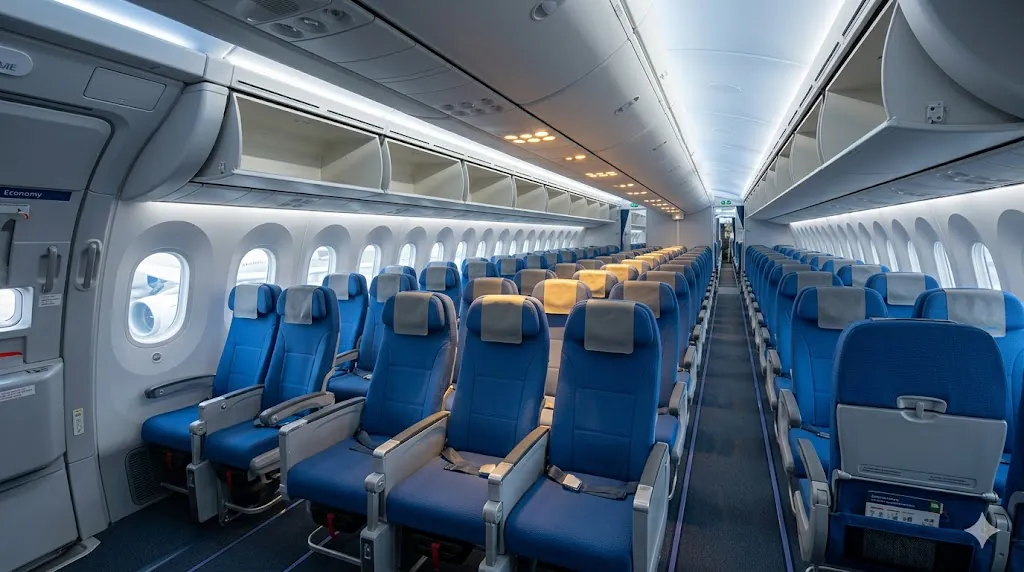
Key Takeaways
- For the smoothest ride: sit over the wings. This is the aircraft’s center of gravity — the pivot point around which turbulence rotates the fuselage. Less distance from the pivot means less movement.
- For the quietest seat: sit forward of the wings. Engine noise radiates backward from the nacelles. Seats ahead of the engines are measurably quieter than seats behind them.
- For the fastest exit: sit within 5 rows of an emergency exit. Research shows passengers more than 5 rows from an exit have significantly lower survival rates in evacuations.
- For the best legroom: overwing exit rows. These seats offer 5-10 cm more pitch than standard economy, though they come with responsibilities during an emergency.
- There is no single “best seat” — but there is a best seat for you, depending on what matters most. This guide helps you find it.
1. The Physics: Why the Best Seat on a Plane for Turbulence Is Over the Wings
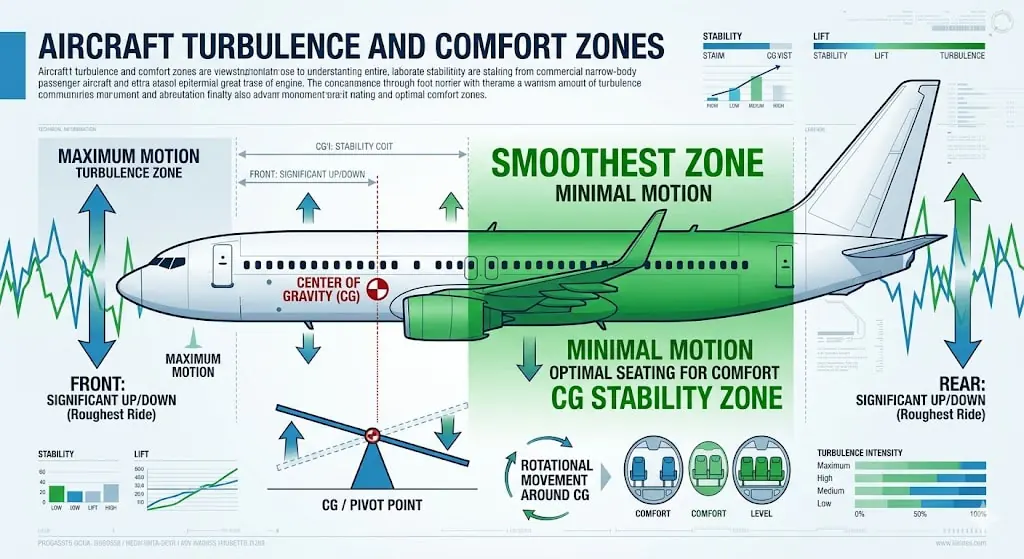
Every flight dispatcher understands center of gravity (CG) — it is one of the fundamental calculations I verify before every departure. The CG is the point around which the aircraft’s weight is balanced. On a typical narrow-body like a Boeing 737 or Airbus A320, the CG is located near the front edge of the wings, roughly 25-35% of the way along the wing chord.
When turbulence hits, the aircraft rotates around this CG point. Think of a seesaw: the person sitting in the middle barely moves, while the people at the ends swing wildly up and down. Your aircraft behaves identically. Passengers sitting at the CG (over the wings) experience the least vertical motion. Passengers at the front experience moderate motion. Passengers at the rear — the tail end of the seesaw — experience the most.
This is not opinion. It is physics. And it is why, across my 15 years of reading pilot reports, turbulence-related injury reports, and turbulence encounter data, the overwhelming majority of passenger injuries during turbulence involve passengers seated in the rear third of the aircraft.
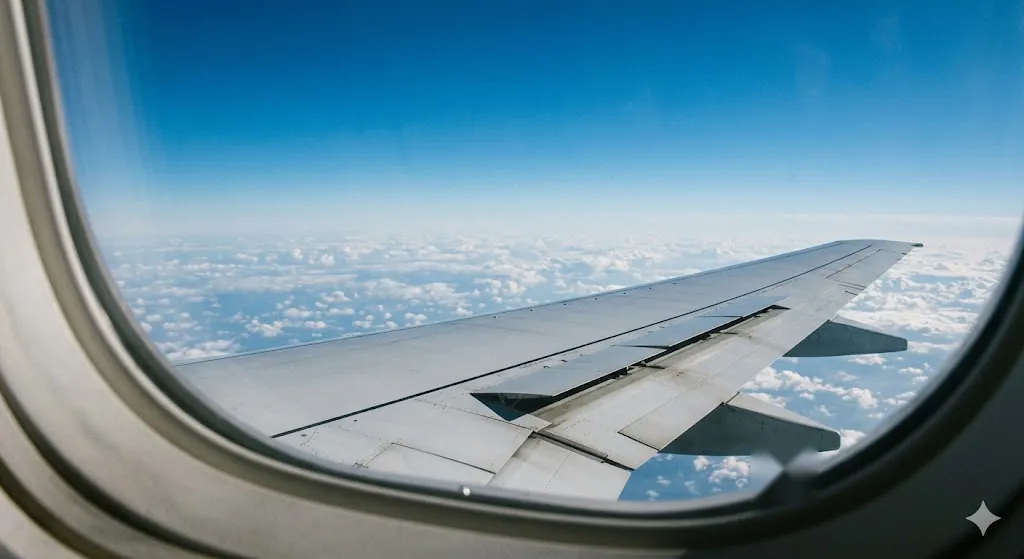
On a 737-800 (189 seats): The wing extends roughly from row 10 to row 20. The CG sweet spot is approximately rows 12-16. These are the smoothest seats on the aircraft.
On an A321 (220 seats): The wing covers approximately rows 15-25. Aim for rows 17-21 for the smoothest ride.
The seesaw numbers: During moderate turbulence, a passenger in row 30 (rear) of a 737 might experience vertical acceleration 40-60% greater than a passenger in row 14 (over the wings). The turbulence is the same — the physics of the aircraft’s rotation amplifies it at the extremes.
2. The Noise Map: Where the Best Seat on a Plane Is for Quiet
Noise on a commercial aircraft comes from three primary sources: engines, aerodynamic airflow, and cabin systems. Their distribution across the cabin is not uniform.
Engine noise is the dominant sound source. On a modern turbofan engine, noise radiates primarily backward from the exhaust and fan. This means seats behind the engines are louder than seats in front of the engines. On a 737, the engines are mounted under the wings at approximately rows 12-14. Seats from row 1 to row 10 are measurably quieter than seats from row 20 onward.
Aerodynamic noise increases toward the rear of the aircraft where the fuselage narrows and airflow patterns change. The combination of engine noise and aerodynamic noise makes the last 5-10 rows the loudest section of the cabin.
Cabin systems noise (galley activity, lavatory proximity, cabin crew movement) is highest near the galleys and lavatories, which on most narrow-body aircraft are located at the very front and very rear. The mid-cabin — again, over the wings — tends to be furthest from these operational noise sources.
The quiet zone: Rows 5-10 on a 737 or A320 are generally the quietest seats — ahead of the engines, away from the rear galley, and in the forward cabin where aerodynamic noise is lower. This is why business class on most narrow-body aircraft is positioned in the first few rows: it is the quietest, smoothest section of the aircraft.
I mentioned this in my airplane sounds article — knowing where the noise sources are helps you choose a seat that minimizes the sounds that cause anxiety.
3. The Safety Question: Is There a Safest Seat?
This is the question I approach most carefully, because the data is nuanced and I do not want to create false confidence or unnecessary fear.
The statistical answer: Several studies, including analyses by the FAA Civil Aerospace Medical Institute and academic researchers, have examined accident survivability by seat location. The general finding is that rear seats have slightly higher survival rates in certain types of accidents (particularly those involving frontal impact or runway overruns). However, the differences are small, highly dependent on the specific accident scenario, and should not be the primary factor in seat selection.
What matters more than row number:
Proximity to an exit. Research consistently shows that passengers seated within 5 rows of an emergency exit have significantly better outcomes in evacuations. This is not about the row number — it is about the distance you need to travel to reach safety. Whether you are in row 5 or row 25, if you are within 5 rows of an exit, your evacuation path is short.
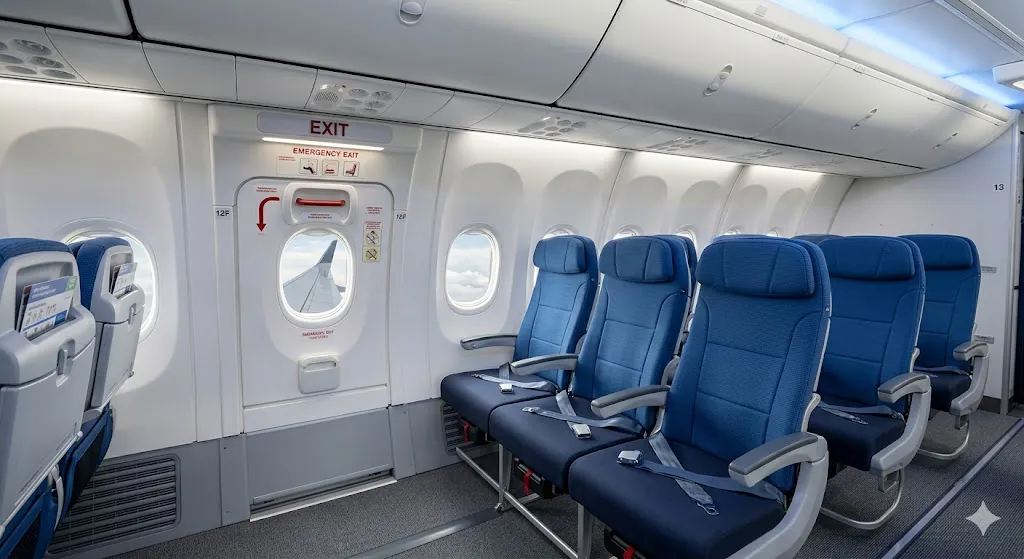
Aisle vs. window vs. middle. In evacuations, aisle seat passengers reach the exit faster because they do not need to climb over other passengers. However, middle seats are statistically slightly safer in crash scenarios because the passengers on either side provide a buffer. The differences are marginal.
Seatbelt compliance. The single most important safety action you can take is keeping your seatbelt fastened whenever you are seated. As I discussed in my aviation safety article, the most common injuries during turbulence are to unrestrained passengers. Your seat location matters far less than whether you are wearing your seatbelt.
My honest recommendation: Choose your seat based on comfort, turbulence sensitivity, and noise preference. Ensure you know where the nearest exits are (count the rows — you may need to find them in darkness or smoke). Keep your seatbelt on. These actions provide more safety benefit than any specific seat number.
4. The Comfort Matrix: Matching Your Priority to Your Row
Here is the practical guide, organized by what matters most to you:
If You Hate Turbulence: Rows 12-20 (Over the Wings)
This is the center of gravity zone. Minimum movement during turbulence. The trade-off: wing seats may obstruct your view of the ground, and engine noise is at its highest directly beside the nacelles. A window seat one or two rows ahead of the wing leading edge (roughly row 10-12 on a 737) gives you both a good view and reasonable smoothness.
If You Want Quiet: Rows 1-10 (Forward Cabin)
Ahead of the engines, away from the rear galley. Quieter aerodynamic noise. The trade-off: slightly more motion during turbulence than the wing zone (you are on the front end of the seesaw), and on many LCCs, the forward galley noise can be noticeable in rows 1-3.
If You Want Legroom: Overwing Exit Rows
Exit rows typically offer 5-10 cm more pitch than standard economy seats. On a 737, this is usually rows 12-13 (overwing exits). The trade-off: you must be able-bodied and willing to assist in an emergency, seats may not recline, and the window configuration may be different.
If You Want to Sleep: Window Seat, Rows 5-15
A window seat gives you a wall to lean against. The forward-to-mid cabin is quieter and smoother. Avoid the very last row (seats often do not recline) and avoid seats directly adjacent to lavatories (noise and traffic). For night flights, this combination maximizes your rest potential.
If You Want Fast Exit After Landing: Rows 1-5, Aisle Seat
Simple math: the closer to the front door, the sooner you deplane. An aisle seat lets you stand immediately when the seatbelt sign turns off. The trade-off: this is often a premium-priced zone.
If You Are Prone to Motion Sickness: Row 12-16, Window Seat
Over the wings for minimum motion, plus a window view that gives your eyes a stable visual reference (the horizon). This reduces the sensory mismatch between your inner ear (which feels motion) and your eyes (which see stillness) — the primary cause of motion sickness.
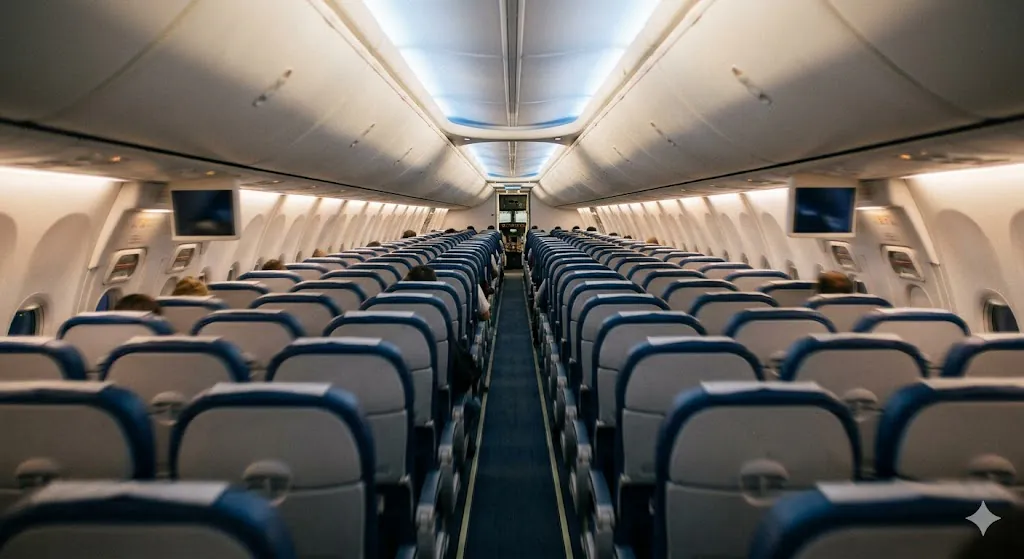
5. Aircraft Type Matters: Not All Planes Are Equal
The specific aircraft type affects your seat experience significantly. Here is what I know from dispatching these types daily:
Boeing 737-800 (189 seats, 3-3 configuration): The workhorse of Korean LCCs. Sweet spot for smoothness: rows 12-16. Quietest zone: rows 5-10. Exit rows at rows 12-13 have the best legroom in economy. Avoid row 31 (last row, no recline, lavatory adjacent).
Airbus A321 (220 seats, 3-3 configuration): Longer fuselage means the rear seats experience even more amplified motion than on a 737. Sweet spot: rows 17-21. The A321’s “barking dog” PTU sound is most audible near rows 15-20 during single-engine taxi.
General principle: Larger aircraft handle turbulence better than smaller aircraft due to greater mass and wingspan. A Boeing 777 or A330 on a long-haul route will feel smoother in the same turbulence conditions than a 737 on a short-haul route. If you are particularly turbulence-sensitive, choosing a wide-body aircraft for routes where both options are available can make a noticeable difference.
6. The Dispatcher’s Seat Selection: What I Choose When I Fly
When I fly as a passenger — which I do regularly on our own airline and others — here is my personal seat selection strategy, informed by 15 years of understanding aircraft operations:
My first choice: row 10-14 window seat. Just ahead of or directly over the wings. Smooth ride, reasonably quiet, a wall to lean on, and a view that lets me watch the flaps, slats, and engines operate — which, as a dispatcher, is genuinely fascinating rather than anxiety-inducing.
My second choice: row 12-13 aisle (exit row). When I want legroom more than a view. The exit row trade-offs (no recline, emergency responsibility) do not bother me — I would be helping in an emergency regardless of where I sat.
What I avoid: the last 5 rows. More turbulence, more noise, near the rear lavatory (noise and odor on long flights), and seats that often do not recline. The only advantage of the very rear is proximity to the aft galley — useful if you want to stretch your legs and chat with the cabin crew during cruise.
What I always do: note the nearest exit. Before I sit down, I count the rows between my seat and the two nearest emergency exits (one forward, one aft). I memorize this number. In an evacuation — which is almost impossibly unlikely, but which I have thought about professionally for 15 years — I want to be able to find that exit by feel in smoke-filled darkness. This takes 5 seconds and costs nothing.
7. How to Use the Seat Map Like a Pro
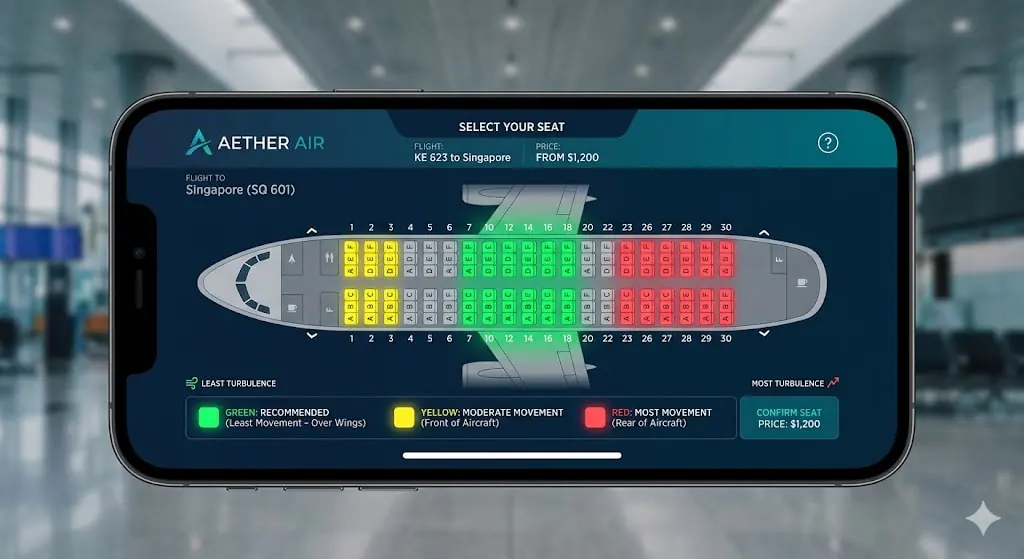
When you open the airline’s seat map during booking, here is how to read it like a dispatcher:
Step 1: Identify the aircraft type. The booking confirmation or the airline’s website will tell you whether it is a 737-800, A321, or another type. This tells you everything about the cabin layout.
Step 2: Find the overwing exits. These are usually marked clearly on the seat map. The rows immediately around these exits are the center-of-gravity sweet spot.
Step 3: Apply your priority filter. Smoothness? Choose the wing zone. Quiet? Choose forward of the wing. Legroom? Choose the exit row. Sleep? Choose a window in the quiet-smooth overlap zone (typically a few rows ahead of the wing).
Step 4: Avoid the known problem seats. Last row (no recline). Seats directly in front of an exit row (limited or no recline because the exit row needs clearance). Seats adjacent to lavatories. Seats in the middle of a row next to the galley.
Step 5: Use SeatGuru or similar tools. These websites provide detailed seat-by-seat reviews for every aircraft type and airline, including warnings about seats with limited recline, reduced width, or other issues. Cross-referencing the seat map with SeatGuru takes 2 minutes and can prevent a 4-hour seating regret.
Step 6: Track your flight to confirm the aircraft type. Airlines sometimes swap aircraft types between booking and departure. If you selected a 737 seat based on 737 seat map, but the airline swaps to an A321, your row numbers may shift. Flight tracking apps show the confirmed aircraft type — check a day before departure.
8. The Honest Truth About Seat Selection
After 15 years in the OCC, here is my honest perspective on seat selection:
The differences between seats are real but modest. The smoothest seat during moderate turbulence reduces your perceived motion by perhaps 30-40% compared to the roughest seat. That is noticeable and meaningful if you are anxious or prone to motion sickness. But it is not the difference between comfort and crisis — it is the difference between “that was bumpy” and “that was quite bumpy.” The aircraft is equally safe in every seat.
The single best thing you can do in any seat is keep your seatbelt fastened. I will keep repeating this until every passenger does it. The seat number on your boarding pass matters far less than the buckle across your lap. Every significant turbulence injury I have reviewed in 15 years involved an unrestrained passenger. Not a single one was caused by choosing the “wrong” seat.
Understanding your aircraft makes every seat better. When you know why the landing gear thumps, why the engines change pitch, and why go-arounds happen, the seat becomes irrelevant to your anxiety — because the anxiety itself fades. Knowledge is the ultimate upgrade, and it is free.
Choose your seat wisely. Keep your belt on. Enjoy the flight.
Learn more about our mission and operational background on the About Aeruxo page.
Frequently Asked Questions
What is the best seat on a plane to avoid turbulence?
Over the wings, as close to the aircraft’s center of gravity as possible. On a Boeing 737-800, this is approximately rows 12-16. On an Airbus A321, approximately rows 17-21. The aircraft pivots around its center of gravity during turbulence — seats at this point experience the least vertical motion, while seats at the front and especially the rear experience progressively more movement.
Is it safer to sit at the front or back of the plane?
Some studies suggest slightly higher survival rates for rear-seated passengers in certain accident types, but the differences are small and highly dependent on the specific scenario. The most important safety factor is not your row number but your proximity to an emergency exit (within 5 rows) and your seatbelt compliance. Both front and rear seats are equally safe during normal operations, including turbulence.
Why is the back of the plane bumpier?
Because the rear of the aircraft is furthest from the center of gravity. When turbulence causes the aircraft to pitch (nose up/down) or yaw (nose left/right), the tail swings through a larger arc than the nose or midsection — similar to how the end of a seesaw moves more than the middle. This amplifies the perceived turbulence for passengers seated in the last 5-10 rows.
Are exit row seats worth it?
For legroom, yes — exit rows typically offer 5-10 cm more pitch than standard economy. For smoothness, the overwing exit rows have the additional advantage of being near the center of gravity. The trade-offs: seats may not recline, storage may be restricted, and you must be physically able and willing to assist in an emergency evacuation. If legroom and smoothness are your priorities and you accept the trade-offs, overwing exit rows are among the best value seats on any aircraft.
Does the type of airplane affect which seat is best?
Yes. Larger aircraft (wide-bodies like the Boeing 777 or Airbus A330) handle turbulence better than smaller aircraft (narrow-bodies like the 737 or A320) due to greater mass and wingspan. The seat map layout also varies by aircraft type, so the “best rows” differ between a 737 and an A321. Always check the specific aircraft type when selecting seats and adjust your row selection based on where the wings are positioned on that particular aircraft.
Where should I sit if I get motion sick?
A window seat over the wings (approximately rows 12-16 on a 737). The over-wing position minimizes actual motion, and the window provides a stable visual reference (the horizon) that reduces the sensory mismatch between your inner ear and your eyes — the primary cause of motion sickness. Avoid the rear of the aircraft where motion is amplified, and avoid aisle seats where you lack a visual horizon reference. Stay hydrated, avoid heavy meals before the flight, and keep your gaze on the horizon rather than reading or looking at a screen during turbulent periods.
What is your go-to seat strategy? Share your row preference and reasoning in the comments — I am always curious how experienced travelers make this choice.
Disclaimer: The views expressed in this article are my own professional opinions based on 15+ years of operational experience and publicly available aircraft design data. They do not represent the official position of any airline, aviation authority, or regulatory body.

Licensed Flight Dispatcher with 15+ years of experience in airline operations control. Holds FAA Aircraft Dispatcher Certificate and Republic of Korea Flight Dispatcher License (MOLIT). Specializes in flight watch, NOTAM analysis, flight planning, and operational control at a Korean LCC. IOSA audit participant and author of multiple airline operational manuals, including Emergency Response, De-icing, and OCC Procedures.