By Aeruxo — Licensed flight dispatcher (study guide) | 15+ Years in Airline Operations
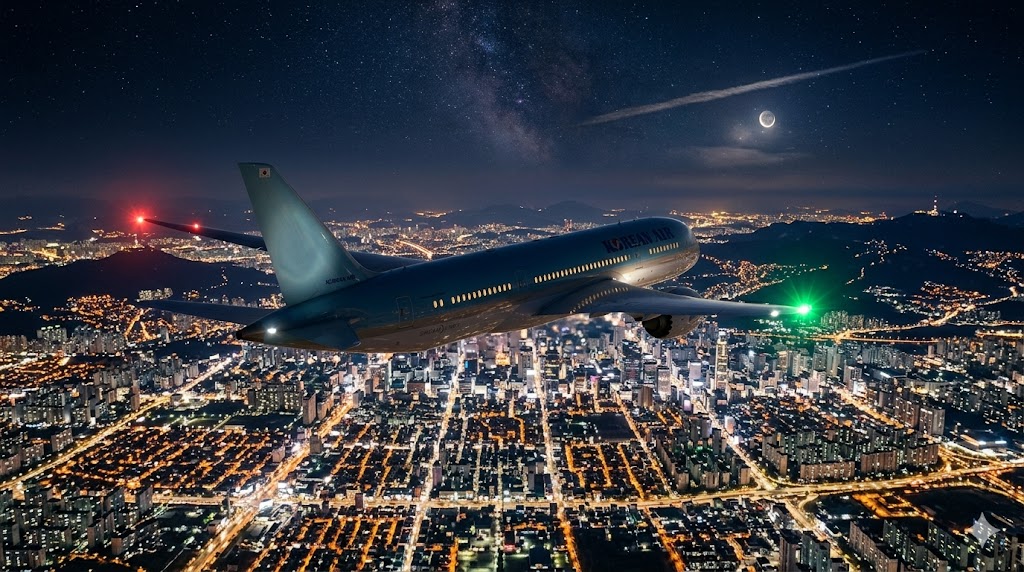
It is 2 AM. The OCC is quiet. Most of the day-shift dispatchers have gone home. But on my screens, dozens of aircraft are crossing the night sky — Seoul to Bangkok, Incheon to Manila, Gimhae to Tokyo. Night flights are in the air, carrying thousands of passengers through darkness at 900 km/h, and I am watching every one of them.
Passengers on night flights often ask the same question: “Is it safe to fly at night? Can the pilots even see anything?” I understand the anxiety. Flying through total darkness, unable to see the ground, the horizon, or anything outside the window except blackness and distant lights — it feels more dangerous than a daytime flight. Your instincts tell you that darkness equals danger.
Your instincts are wrong. And after 15 years of dispatching night flights across Japan, China, and Southeast Asia, I can explain exactly why.
Key Takeaways
- Night flights are just as safe as daytime flights. Commercial pilots do not fly by looking out the window — they fly by instruments, and those instruments work identically whether it is noon or midnight.
- Pilots are specifically trained and certified for night operations. Night flying requires additional training, currency requirements, and proficiency checks. No pilot flies at night without demonstrating competence.
- Night flights often have fewer delays because air traffic is lighter, convective weather (thunderstorms) is less common, and airports are less congested.
- Landing at night uses dedicated lighting systems — approach lights, runway lights, and PAPI/VASI guidance — that provide precise visual guidance even in complete darkness.
- The dispatcher’s night shift is a different kind of vigilance — fewer flights but longer routes, more oceanic crossings, and the unique challenge of managing disruptions when ground services operate with skeleton crews.
This article is based on real operational experience monitoring night flights in an airline Operations Control Center (OCC), including overwater routes, red-eye operations, and real-time flight safety decisions.
1. Why Night Flights Are Not More Dangerous
The fear of flying at night is rooted in a simple human instinct: darkness obscures danger. On the ground, this instinct serves you well. In the air, it is irrelevant — because commercial pilots do not fly by visual reference to the ground.
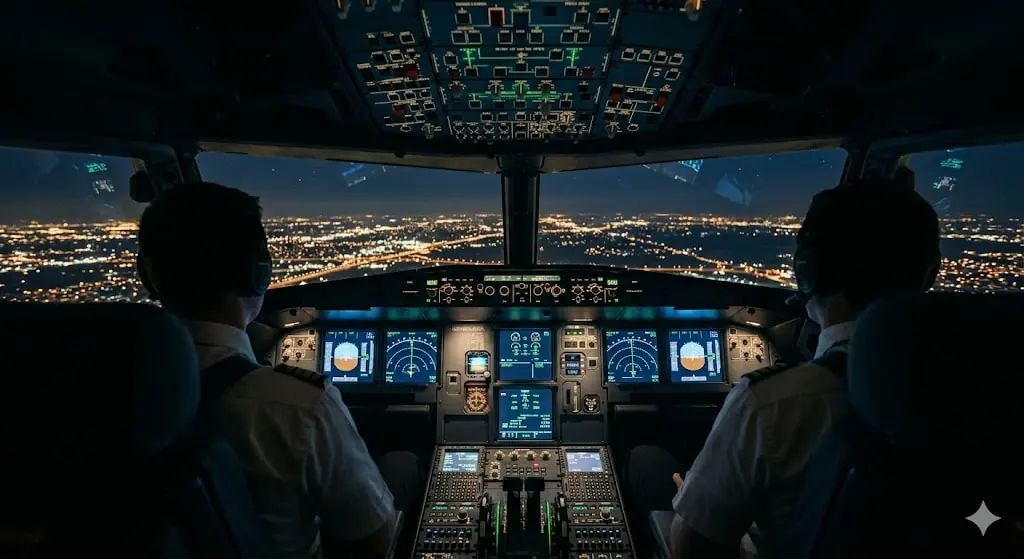
Modern commercial aviation is built on instrument flight. From the moment the aircraft lifts off until it touches down, the pilots navigate using GPS, inertial navigation systems, radio navigation aids, and flight management computers that calculate the aircraft’s position, altitude, speed, and trajectory with extraordinary precision. These systems do not need sunlight. They do not need to “see” the ground. They work in complete darkness exactly the same way they work at noon on a clear day.
The aircraft’s autopilot — which manages most of the cruise portion of any flight — is equally indifferent to lighting conditions. It follows the programmed route, maintains the assigned altitude, and adjusts for wind regardless of whether it is day or night. The pilots monitor, verify, and intervene when necessary, but the fundamental navigation is instrument-based.
In fact, as I discussed in my article on aviation safety, the entire safety architecture of commercial aviation — the redundant systems, the pilot training, the ATC network, the dispatch system — is designed to be independent of visual conditions. If safety depended on the pilots being able to see the ground, aviation could not operate in clouds, fog, rain, or darkness. But it operates in all of these conditions, routinely and safely, because the system was designed for exactly this.
2. How Pilots Land at Night: The Lighting System You Never Noticed
If there is one moment during night flights that makes passengers most anxious, it is the approach and landing. The aircraft descends toward what appears to be total darkness, then suddenly a runway appears, illuminated like a landing strip in a movie. How does the pilot find it? How do they judge height and distance in the dark?
The answer is a sophisticated lighting system designed specifically for this purpose.
Approach Lighting Systems (ALS)
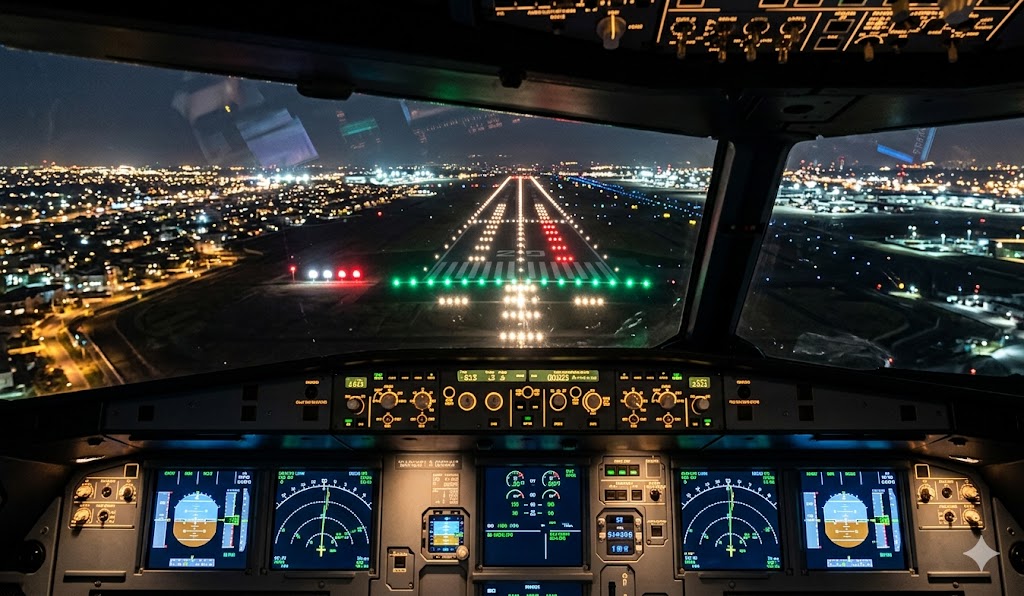
Major airports have approach lighting systems that extend up to 900 meters before the runway threshold. These are a series of progressively brighter lights that guide the pilot’s eye from the approach path down to the runway itself. At night, the ALS is the first visual cue the pilot sees as they descend below the cloud layer or approach from open darkness. It creates a visual “funnel” that leads directly to the landing point.
PAPI / VASI: The Glide Path Indicator
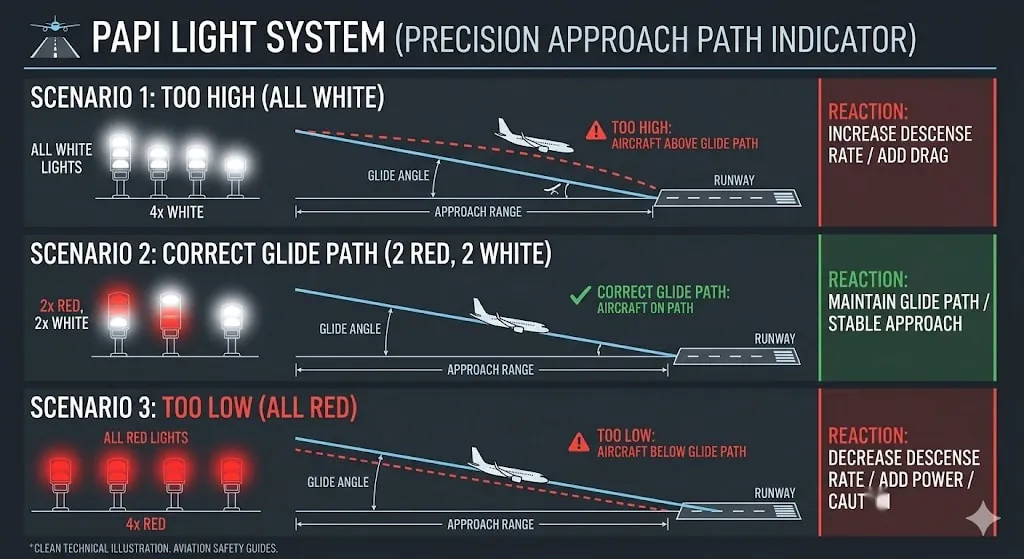
The PAPI (Precision Approach Path Indicator) is a set of four lights beside the runway that tells the pilot whether they are on the correct descent angle. The system is elegantly simple: two red and two white lights means you are on the correct 3-degree glide path. Three or four white lights means you are too high. Three or four red lights means you are too low. The pilot adjusts their descent to maintain the two-red-two-white indication, and this guides them precisely to the touchdown zone.
This system works in complete darkness because it does not depend on seeing the terrain — it depends on seeing the lights, which are visible from several miles away. Every time I build a flight plan for a night arrival, I verify that the destination airport’s approach lighting and PAPI/VASI systems are operational. If they are not (due to maintenance or a NOTAM), I assess whether the approach can still be safely conducted or whether an alternate airport with functioning lighting should be selected.
Runway Lighting
Runways themselves are outlined with edge lights (white or yellow), threshold lights (green at the beginning, red at the end), and in many cases centerline lights that guide the pilot along the exact center of the runway during the landing roll. Taxiway lights (blue) guide the aircraft from the runway to the gate after landing. The entire airport surface becomes a navigable light map at night.
ILS: The Instrument Approach
For night flights into airports with Instrument Landing System (ILS) approaches, the pilots can fly a precision approach entirely by instruments — the ILS provides both lateral guidance (localizer) and vertical guidance (glide slope) that the autopilot can follow automatically down to as low as 200 feet above the runway. At that point, the pilot visually acquires the runway lights and completes the landing manually. If they do not see the lights at the decision altitude, they execute a go-around — exactly the same procedure as in daytime low-visibility conditions.
3. The Surprising Advantages of Night Flights
Here is something most passengers do not realize: night flights have several operational advantages over daytime flights.
Smoother air. Convective turbulence — the bumpy kind caused by the sun heating the earth’s surface and creating rising air currents — is a daytime phenomenon. At night, the atmosphere cools and stabilizes. Night flights, particularly in tropical regions like Southeast Asia, are often noticeably smoother than afternoon flights over the same route. As I explained in my turbulence article, convective activity peaks in the afternoon and diminishes significantly after sunset.
Less air traffic congestion. Most commercial flights operate during the day. Night flights operate in airspace that is significantly less crowded, which means fewer ATC delays, fewer holding patterns, and more direct routing. From a dispatcher’s perspective, night flight plans are often simpler because I have more flexibility in route selection.
Better on-time performance. This follows from the previous two points. With less air traffic and fewer weather-related disruptions, night flights tend to depart and arrive closer to schedule. The domino effect that cascades delays throughout the day has largely dissipated by evening — the night’s first departure starts with a clean slate.
Cooler temperatures improve aircraft performance. Aircraft engines and wings perform better in cooler, denser air. At night, surface temperatures are lower, which means the aircraft can carry more payload, use less runway for takeoff, and climb more efficiently. For dispatchers planning flights from hot Southeast Asian airports, a 2 AM departure can offer meaningfully better performance than a 2 PM departure on the same aircraft.
4. The Dispatcher’s Night Shift: A Different Kind of Work
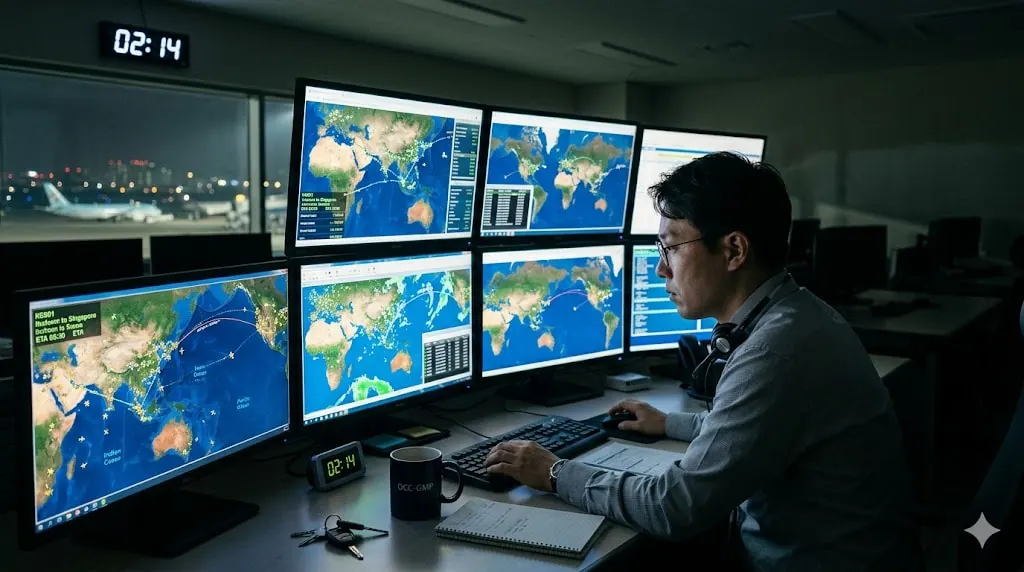
The OCC never sleeps. When daytime dispatchers hand over to the night shift, the character of the work changes — but the responsibility does not.
Fewer flights, longer routes. Our night schedule consists primarily of red-eye flights to Southeast Asian destinations — 4-6 hour sectors to Bangkok, Manila, Ho Chi Minh City, and Denpasar. These are longer than our typical daytime Japan hops, which means more time monitoring each flight and more fuel planning complexity.
Oceanic and overwater monitoring. Many night flights route over the South China Sea or the East China Sea, where radar coverage is limited and communication relies on HF radio or satellite. I pay particular attention to these overwater segments because diversion options are more limited than over land. If an engine issue or medical emergency occurs over water at 3 AM, the nearest suitable airport might be 90 minutes away, and the ground services there might be operating with minimum night staff.
Disruption management is harder at night. When a problem occurs on a night flight — a diversion, a mechanical issue, a crew timing problem — the recovery options are more limited. Many airports reduce operations or close entirely at night. Ground handling staff is minimal. Hotels near airports may have no availability at 3 AM for stranded passengers. Every disruption during the night shift requires more creative problem-solving because the support infrastructure is thinner.
The fatigue factor is real — for the dispatcher too. I am honest about this: working the night shift requires discipline. Just as pilots must manage fatigue through regulated rest periods and crew resource management, I manage my own alertness during long night shifts. Coffee helps. But more importantly, the structure of our monitoring procedures — systematic flight checks at regular intervals, mandatory weather updates, standardized communication protocols — keeps me engaged and thorough even at 4 AM when my body wants to sleep.
5. What About Pilot Fatigue on Night Flights?
This is a legitimate question, and I want to address it honestly because pilot fatigue is a genuine safety concern that the industry takes very seriously.
Pilots flying night sectors are subject to the same ICAO-aligned fatigue management regulations as all commercial pilots. These regulations limit maximum duty time, require minimum rest periods, and impose stricter limits for flights during the “window of circadian low” (typically 2 AM to 6 AM) when human alertness is at its lowest.
In practice, this means:
Crew scheduling for night flights is specifically managed. Crews assigned to red-eye flights have their preceding rest periods carefully calculated to ensure they begin the flight with adequate sleep opportunity. They are not simply the same crew who flew all day and are now flying all night.
Duty time limits are often shorter for night operations. Depending on the regulatory framework, the maximum duty period for a night flight may be shorter than for a daytime flight, reflecting the increased fatigue risk.
Two-pilot monitoring protocols are critical at night. On a night cruise where the autopilot is managing the aircraft, the risk is that both pilots become complacent or drowsy. Standard Operating Procedures require regular cross-checks, periodic communication, and structured task-sharing to maintain vigilance. Some airlines implement “controlled rest” protocols that allow one pilot to take a brief rest while the other actively monitors — a formalized approach to managing the reality that humans are not naturally alert at 3 AM.
From my desk, I support crew fatigue management by ensuring that night flight plans are as clean and simple as possible — minimizing the need for complex decision-making during the circadian low window. I also monitor weather and operational factors that might extend the crew’s duty day (like a diversion or delay) and flag potential duty time exceedances early.
6. The Sounds and Sensations of Night Flights
In my article on airplane sounds, I decoded every noise you hear during a flight. Night flights have the same sounds, but they feel different because the cabin is darker, quieter, and your senses are heightened.
Engine noise feels louder at night. It is not actually louder — but with the cabin lights dimmed and most passengers asleep, the ambient noise is reduced and the engine hum becomes more prominent. This is completely normal. The engines are operating at the same power settings they would during a daytime cruise.
Turbulence feels more intense at night. Again, the actual turbulence is often milder at night (less convective activity). But in a dark cabin, when you cannot see the horizon or the ground, any motion feels amplified because you lack visual references. Your inner ear senses the motion, but your eyes cannot confirm it against a stable visual reference point. This sensory mismatch increases the subjective intensity of the experience.
The landing gear and flap sounds are more noticeable. In a quiet night cabin, the thunk of the landing gear extending and the whir of the flaps deploying are more audible than during a daytime flight with active cabin noise. The sounds are the same — but they stand out more in the silence.
The solution to night-flight anxiety from sounds is the same as for any flight: understanding what each sound means. Once you know that the thunk is the gear, the whir is the flaps, and the engine change is a normal power adjustment, the darkness stops amplifying your fear because your brain has an explanation for every sensation.
7. Practical Tips for Night Flight Passengers
Book a window seat if you enjoy the view. Night flights over cities offer spectacular views — particularly departures from Incheon over Seoul’s glittering skyline or arrivals into Bangkok over the illuminated sprawl. The view from 35,000 feet on a clear night, with city lights below and stars above, is genuinely beautiful.
Book an aisle seat if you want to sleep. If your priority is rest, an aisle seat gives you easier bathroom access without climbing over sleeping neighbors. Pair it with a neck pillow, eye mask, and earplugs for the best chance at sleep.
Stay hydrated. The dry cabin air dehydrates you regardless of the time of day, but on night flights where you might sleep through the service, it is easy to arrive at your destination significantly dehydrated. Drink water before boarding and ask for water during any service passes.
Adjust your expectations for sleep. Airline seats are not beds. Even on a red-eye flight, most passengers get fragmented, light sleep rather than deep rest. If you have an important meeting or event the morning after a red-eye, plan for the fatigue — you will likely feel the effects regardless of how “well” you slept on the plane.
Track your flight before leaving for the airport. Night flights can be affected by issues that developed during the day’s operations — aircraft positioning problems, crew delays from earlier flights, or weather at the aircraft’s previous station. Checking 3-4 hours before your late-night departure can save you a wasted midnight trip to the airport if the flight has been delayed or cancelled.
8. Night Flights on Our Southeast Asia Network
At our Korean LCC, night flights are a significant part of the schedule. Red-eye departures from Incheon to Southeast Asian destinations are popular because they maximize both the airline’s aircraft utilization and the traveler’s time — depart late at night, arrive early morning, and have a full day at the destination.
From a dispatcher’s perspective, these night flights have specific characteristics I plan for:
Southeast Asian destination weather. The monsoon season and volcanic activity can affect these routes year-round. For night arrivals, I pay extra attention to destination weather because if conditions deteriorate and a diversion is needed, the options at 4 AM local time are more limited than at 4 PM.
Overwater segments over the South China Sea. Most of our night Southeast Asia routes cross significant stretches of open water. I ensure that the ETOPS-related planning (single-engine diversion airports within range at all points) is thorough, with particular attention to airports that maintain 24-hour operations.
Arrival airport ground services. Not all destination airports have full ground handling at 5 AM. I verify that the airport and our ground handling agent will be operational for our scheduled arrival time. A flight that arrives before the ground handler starts their shift creates delays before the passengers even deplane.
9. The Beauty of Night Operations

I want to end with something personal. The night shift is exhausting. It disrupts my sleep cycle. It makes my social life complicated. But I have never regretted choosing a career that includes night operations, because there is a quiet beauty to working the night shift in an OCC that daytime dispatchers never experience.
At 3 AM, when the office is silent and the screens glow with dozens of aircraft icons crossing dark oceans and sleeping cities, I feel the full weight and privilege of the job. Each of those icons represents 180 people who trusted the system enough to fall asleep in an aluminum tube at 35,000 feet. They trusted the pilots, the engineers, the controllers, and — whether they know it or not — the dispatcher on the night shift watching over them.
When the first red-eye flight lands safely at 5 AM at its Southeast Asian destination, and the green “ARRIVED” status appears on my screen, I feel the same quiet satisfaction I have felt for 15 years. Another night. Another set of flights. Everyone safe.
That is what night flights are. Not dangerous. Not scary. Just the aviation system doing what it does best — carrying people safely through the sky, in daylight and in darkness, every hour of every day.
Learn more about our mission and operational background on the About Aeruxo page.
Frequently Asked Questions
Are night flights more dangerous than daytime flights?
No. Commercial night flights are subject to the same safety standards, the same aircraft systems, and the same pilot training requirements as daytime flights. Navigation is instrument-based and works identically in darkness. Airports have sophisticated lighting systems designed specifically for night operations. In some respects, night flights are operationally smoother — less air traffic, fewer thunderstorms, and less turbulence — which can actually reduce certain types of risk compared to busy daytime operations.
How do pilots land a plane at night if they cannot see the ground?
Pilots use a combination of instrument approaches (ILS, GPS) and airport lighting systems. The Instrument Landing System provides precise electronic guidance to the runway. Approach lights, runway edge lights, and PAPI/VASI glide path indicators provide visual guidance in the final stage. Pilots transition from instruments to visual references at a defined decision altitude — typically 200 feet above the runway. If they cannot see the runway lights at that altitude, they execute a go-around and try again or divert.
Are pilots more likely to be tired on night flights?
Pilot fatigue is a recognized risk factor that the industry manages through strict fatigue management regulations. Crews assigned to night flights have mandatory rest periods before the duty, shorter maximum duty times during the circadian low period, and structured monitoring protocols to maintain alertness. While the fatigue risk is real, the regulatory and procedural safeguards are robust. Airlines that fail to comply with fatigue management requirements face serious regulatory consequences.
Why are red-eye flights cheaper?
Red-eye flights are often priced lower because demand is lower — most passengers prefer daytime departures. Airlines price based on demand, so fewer people wanting to fly at midnight means lower fares. From the airline’s operational perspective, night flights are valuable because they maximize aircraft utilization (the aircraft would otherwise sit idle overnight) and allow passengers to arrive at their destination in the morning without “losing” a day to travel.
Is turbulence worse at night?
Typically the opposite. Convective turbulence — caused by sun-heated air rising from the ground — peaks in the afternoon and diminishes significantly after sunset. Night flights often experience smoother air than afternoon flights over the same route. However, clear-air turbulence (CAT) at high altitude can occur at any time. Also, turbulence feels more intense at night because you lack visual references in the dark cabin, which amplifies the sensation. The actual turbulence is usually milder.
What should I do if I am nervous about flying at night?
The same strategies that help with daytime flight anxiety apply at night: understand the safety systems protecting you (start with my aviation safety article), learn what the sounds mean, choose a seat over the wings for the smoothest ride, and keep your seatbelt fastened. For night-specific anxiety, try looking out the window — the view of city lights from altitude can transform anxiety into wonder. And remember: the entire aviation system that keeps you safe during the day is equally active and equally vigilant at night.
Have you taken a memorable night flight? I would love to hear about it in the comments — the view, the experience, or even the anxiety. Every perspective helps other travelers.
Disclaimer: The views expressed in this article are my own professional opinions based on 15+ years of operational experience. They do not represent the official position of any airline, aviation authority, or regulatory body.

Licensed Flight Dispatcher with 15+ years of experience in airline operations control. Holds FAA Aircraft Dispatcher Certificate and Republic of Korea Flight Dispatcher License (MOLIT). Specializes in flight watch, NOTAM analysis, flight planning, and operational control at a Korean LCC. IOSA audit participant and author of multiple airline operational manuals, including Emergency Response, De-icing, and OCC Procedures.