By Aeruxo — Licensed flight dispatcher (study guide) | 15+ Years in Airline Operations
Flight cancellation decisions are one of the most complex parts of airline operations. They involve safety, legal constraints, and operational trade-offs that are not visible to passengers.
A flight cancellation is not a decision made lightly. It is not made by an algorithm alone, or by a single person clicking a button. It is the product of a complex, multi-factor analysis that balances safety, legality, operational feasibility, passenger impact, and financial cost — often under severe time pressure. And it is made by people like me: flight dispatchers sitting in the Operations Control Center, weighing variables that passengers never see.
In over 15 years at a Korean low-cost carrier, I have participated in hundreds of flight cancellation decisions. Some were obvious — a typhoon closing the airport makes the choice easy. Others were agonizing judgment calls where the right answer was genuinely unclear until the last possible moment. This article explains how those decisions actually get made, from the inside.
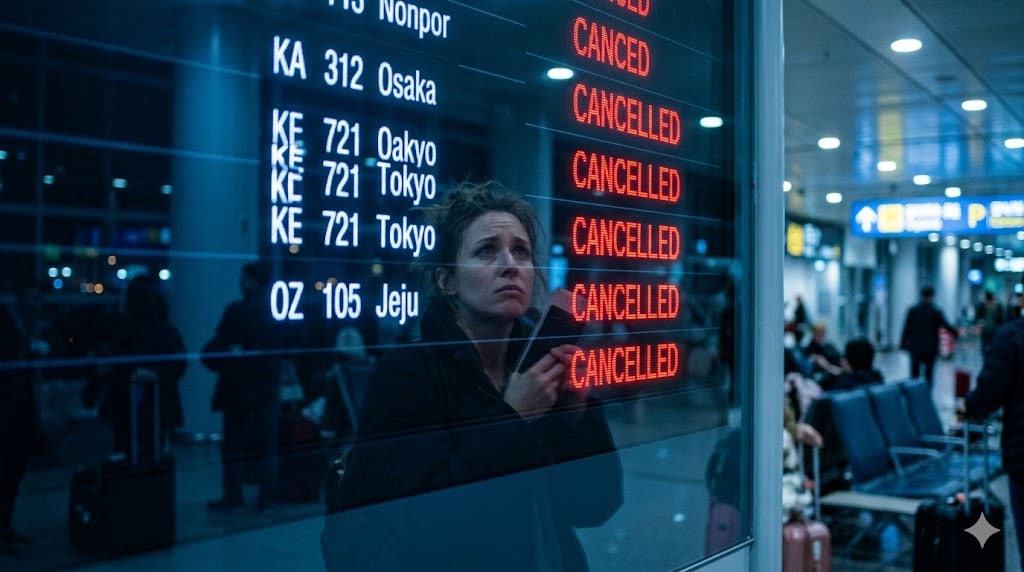
Key Takeaways
- Flight cancellation decisions are made collaboratively in the OCC by dispatchers, operations controllers, crew schedulers, and managers — not by a single person or a simple algorithm.
- The decision framework follows a strict hierarchy: safety first, then regulatory compliance, then network impact, then cost. Revenue or passenger convenience never overrides safety.
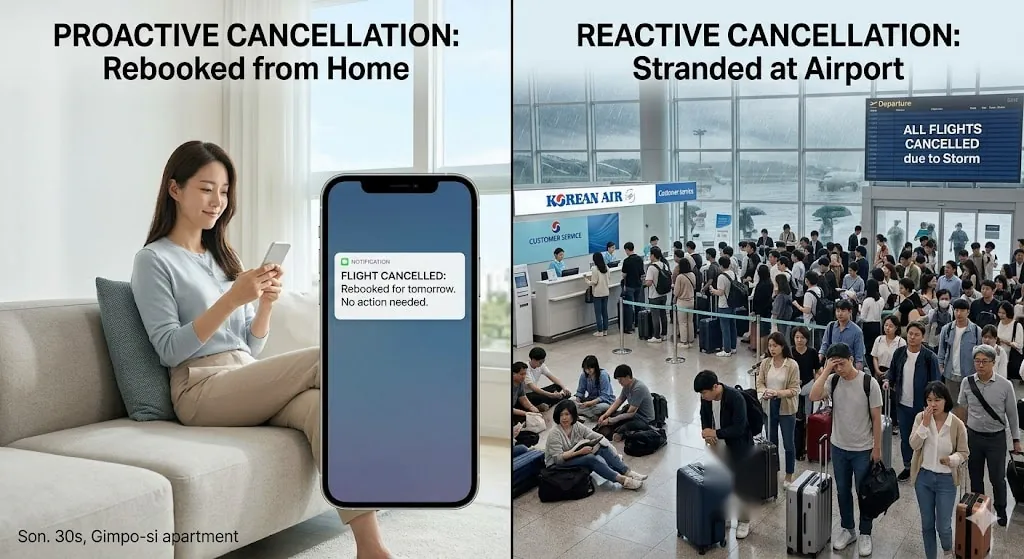
- Proactive cancellations (24-48 hours ahead) are better for everyone than reactive cancellations at the gate. Early cancellation gives passengers time to adjust and prevents aircraft and crews from getting stranded.
- “Controllable” vs “uncontrollable” matters for your rights. A cancellation caused by maintenance (controllable) triggers different passenger care obligations than a cancellation caused by weather (uncontrollable).
- At an LCC, every cancellation hurts more because there are fewer spare aircraft, no interline rebooking agreements, and tighter schedules. This is why LCCs often cancel proactively — the cost of getting it wrong is disproportionately high.
This article is based on real-world experience inside an airline Operations Control Center (OCC), where flight cancellation decisions are made daily under operational constraints.
1. Who Actually Makes the Flight Cancellation Decision?
Passengers often imagine that a faceless bureaucrat somewhere pushes a button and their flight disappears. The reality is far more collaborative — and far more agonized.
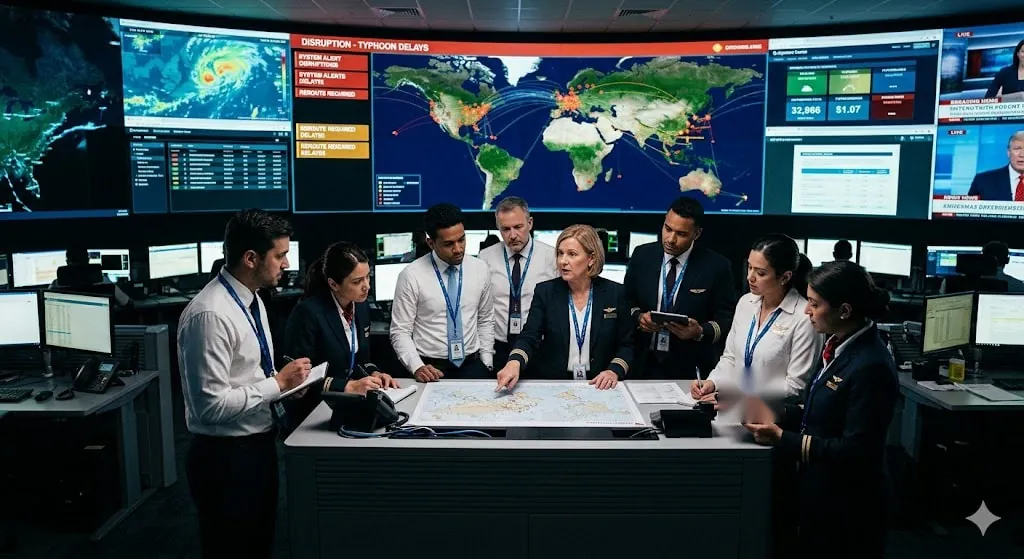
At our airline, a flight cancellation typically involves input from at least four roles in the OCC:
The Flight Dispatcher (me): I assess weather conditions, aircraft performance limitations, fuel feasibility, and route safety. If the weather at the destination is forecast to be below minimums during our arrival window with no improvement expected, or if the route is blocked by weather that cannot be safely navigated, I flag the flight for potential cancellation. I also assess whether the flight can operate with modifications — different routing, additional fuel, different alternate airports — before recommending cancellation.
The Operations Controller: They look at the network-wide picture. If this flight is cancelled, what happens to the aircraft’s subsequent flights? Where does the aircraft end up at the end of the day? Can we swap a different aircraft onto this route? The operations controller sees the chess board; I see the individual piece.
The Crew Scheduler: They assess crew availability. Can the assigned crew legally operate this flight given their accumulated duty time? If the flight is delayed rather than cancelled, will the crew time out before they can complete the round trip? Is a reserve crew available if needed?
The Duty Manager: They make the final authorization. Once the dispatcher, operations controller, and crew scheduler have each assessed the situation, the duty manager weighs the collective input and makes the call. In straightforward cases (obvious weather closure), this takes minutes. In borderline cases, it can involve extended discussion and multiple rounds of analysis.
This is not a rubber-stamp process. I have seen cancellation discussions where the dispatcher recommended cancelling but the operations controller found an aircraft swap that made the flight viable. I have seen cases where the crew scheduler identified a duty time problem that no one else had noticed, forcing a last-minute cancellation of a flight that was otherwise ready to go. The collaborative model exists because no single person has all the information needed to make the best decision.
2. The Six Reasons Airlines Cancel Flights
In my experience, flight cancellations fall into six categories. Understanding which category applies to your cancelled flight matters — because it determines your rights and the airline’s obligations.
2.1 Weather: The Most Common and Most Frustrating
Weather-related cancellation is the most frequent cause on our Japan and Southeast Asia network. I covered the weather dimension extensively in my articles on typhoon season and winter operations, but from a cancellation decision perspective, here is what matters:
The cancellation threshold is not “bad weather.” It is “weather that makes safe operations impossible or imprudent.” Light rain does not cancel flights. Moderate turbulence does not cancel flights. What cancels flights is: visibility below approach minimums with no forecast improvement, runway closures for snow or ice with no reopening timeline, typhoon conditions making approach and landing unsafe, or volcanic ash contamination in the flight corridor.
The frustration for passengers is that weather at their airport might be fine. As I explained in my article on delays, weather at the destination, along the route, or at the aircraft’s previous station can all force a cancellation at your departure airport on a perfectly clear day.
Weather cancellations are classified as “uncontrollable” — meaning the airline’s passenger care obligations may be limited depending on jurisdiction. This is the category that generates the most passenger complaints, because it feels arbitrary even when it is entirely justified.
2.2 Mechanical: The Safety-First Cancellation
When an aircraft develops a mechanical issue that cannot be repaired in time for the scheduled departure — or that removes the aircraft from service for an extended period — the flight is cancelled.
Here is a scenario I deal with regularly: an aircraft arrives from Osaka at 14:00 with a reported hydraulic caution light. Maintenance inspects it and determines it needs a component replacement that will take 6 hours. The aircraft was scheduled to fly to Bangkok at 16:00 and return by midnight. Neither flight can operate on this aircraft.
At a large airline with spare aircraft, the operations controller would swap in a replacement. At our LCC, with high utilization and minimal spares, there may be no replacement available. Two flights — four sectors — are cancelled because of one hydraulic component.
Mechanical cancellations are classified as “controllable” in most regulatory frameworks, which means the airline has greater obligations to provide passenger care: meals, accommodation, rebooking, and potentially compensation depending on the jurisdiction.
2.3 Crew: When the Pilots Cannot Legally Fly
Crew-related cancellations are among the most operationally frustrating because they often result from cascading disruptions rather than a single event.
The scenario: a typhoon delayed the morning schedule by three hours. The crew assigned to the evening flight to Manila was the same crew that operated the delayed morning flight. Their accumulated duty time, including the morning delay, now exceeds the legal maximum. They cannot operate the Manila flight. No reserve crew is available (our LCC has limited reserves). The Manila flight is cancelled.
The cause of the cancellation was ultimately weather (the typhoon), but the proximate cause was crew unavailability. How this is classified — controllable or uncontrollable — depends on the specific circumstances and the regulatory framework. This gray area is one of the most contentious aspects of passenger rights disputes.
2.4 Aircraft Positioning: The Domino Cancellation
This is the cancellation type that passengers understand the least. Your flight is cancelled not because of any problem with your flight, but because the aircraft that was supposed to operate your flight is stuck somewhere else.
A blizzard in Sapporo yesterday stranded one of our aircraft overnight. That aircraft was supposed to ferry back to Incheon this morning and then operate your afternoon flight to Da Nang. The Sapporo airport reopened late, the ferry flight arrived behind schedule, and by the time the aircraft reached Incheon, there was not enough time for the turnaround before your flight’s departure window closed.
Your Da Nang flight is cancelled because of snow in Sapporo — a city you have never been to and had no plans to visit. The weather in both Incheon and Da Nang is perfect. I understand why this feels unfair. But from the OCC’s perspective, there is simply no aircraft available to operate the flight.
2.5 ATC and Airspace Restrictions
Air traffic control can impose flow restrictions, ground delay programs, or airspace closures that make certain flights operationally unfeasible. Chinese airspace is particularly unpredictable in this regard — military exercises can close sectors with minimal notice, adding hours to flight times or making routes impassable. When the added flight time pushes crew duty times past legal limits or requires more fuel than the aircraft can carry, the flight must be cancelled.
2.6 Commercial Cancellations: The Uncomfortable Truth
I want to be honest about this category because it exists, even though airlines rarely discuss it publicly.
Occasionally, flights are cancelled for commercial reasons — typically very low load factors on specific dates. If a flight has only 30 passengers booked on a 189-seat aircraft, the airline may cancel the flight and consolidate those passengers onto another flight the same day, or onto the next day’s service. The revenue from 30 passengers does not cover the direct operating cost of the flight.
At our LCC, this is rare — our load factors are typically very high. But it does happen during off-peak periods. These cancellations are classified as “controllable” and the airline must provide full passenger care and rebooking.
I want to be clear: commercial cancellations never factor into my decision-making as a dispatcher. My domain is safety, weather, and operational feasibility. Commercial decisions are made at a different level of the organization. But I include this category because passengers deserve transparency about why flights are sometimes cancelled on seemingly normal operating days.
3. The Decision Timeline: When Flight Cancellation Decisions Get Made
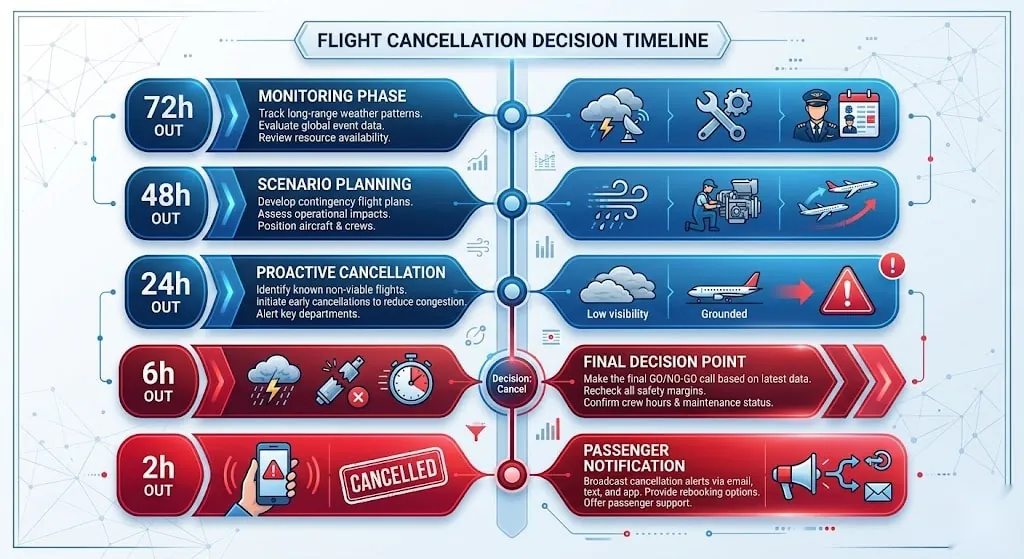
One of the most important things passengers should understand is that cancellation decisions are not instantaneous. They unfold over a timeline, and the earlier the decision is made, the better the outcome for everyone.
72-48 hours before departure: Monitoring and scenario building. For weather-driven events (typhoons, major winter storms), I begin monitoring 3-5 days before the potential impact. At 72 hours, the forecast is usually reliable enough to start building scenarios. I prepare contingency plans but typically do not recommend cancellations yet.
48-24 hours: Decision zone for proactive cancellations. This is when the most consequential calls are made. If a typhoon is confirmed to close the destination airport during our arrival window, I recommend proactive cancellation. If a major snowstorm is forecast, we begin cancelling flights into the affected airports. Proactive cancellation at this stage gives passengers time to rebook, adjust travel plans, or cancel with a refund.
24-6 hours: Final operational assessment. By this point, most weather-related cancellations have already been decided. The cancellations happening in this window are typically maintenance-driven (an aircraft going out of service unexpectedly), crew-driven (a preceding delay causing duty time exceedance), or positioning-driven (an aircraft stuck at a different airport).
6-0 hours: Last-resort cancellations. These are the most disruptive and the most frustrating for passengers, because they often occur after the passenger has already arrived at the airport. They happen when a mechanical issue is discovered during pre-flight checks, when weather deteriorates faster than forecast, or when a last-minute crew timing problem emerges. I do everything in my power to avoid cancellations in this window, but sometimes they are unavoidable.
4. Why Proactive Cancellation Is Better Than Waiting
This is the concept that is most counterintuitive for passengers but most obvious from the OCC.
A proactive cancellation 48 hours before departure is far better than a reactive cancellation at the gate. Here is why:
For the passenger: A 48-hour advance cancellation gives you time to rebook on an alternative flight (which still has available seats), adjust your hotel and ground arrangements, inform people at your destination, and make an informed decision about whether to travel at all. A gate cancellation gives you none of this — you are at the airport, your plans are shattered, and you are competing with 180 other passengers for limited rebooking options.
For the airline: A proactive cancellation keeps the aircraft in a known, controllable location. It prevents the crew from being positioned at an outstation where they might get stranded. It avoids the massive cost of accommodating stranded passengers overnight at a remote airport. And it preserves the aircraft and crew for subsequent flights that can actually operate.
I described this principle in detail in my typhoon season article: early cancellations are a feature, not a failure. The airline that cancels proactively is making a mature, safety-conscious decision. The airline that waits until the last possible moment — hoping the weather will improve, hoping the maintenance will finish, hoping the crew will make it — is gambling. And when that gamble fails, the consequences for passengers are far worse.
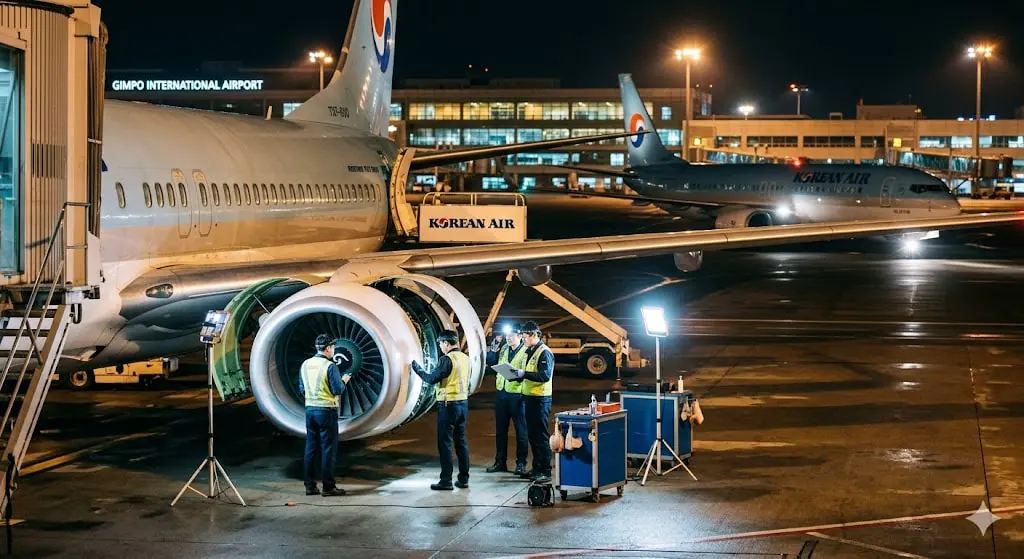
5. Before We Cancel: Everything We Try First
I want passengers to know that a flight cancellation is never the first option. It is the last resort after we have exhausted multiple alternatives.
Aircraft swap. Can we assign a different aircraft to this flight? If an aircraft is going out of service for maintenance, maybe another aircraft that was scheduled for a less critical flight can be reassigned. This requires reshuffling the entire day’s schedule — a complex puzzle that the operations controller manages.
Delay instead of cancel. If the problem is temporary (a passing weather system, a maintenance repair with a defined timeline), we may delay the flight rather than cancel it. A 3-hour delay is inconvenient but vastly preferable to a cancellation from the passenger’s perspective. However, delays carry risks: if the delay extends beyond the crew’s legal duty time, the delayed flight becomes a cancelled flight anyway.
Route modification. For weather-related issues, I may be able to save the flight by modifying the route. If the standard route to Bangkok is blocked by a massive thunderstorm complex, can we route around it? The detour might add 45 minutes and burn more fuel, but the flight can operate. I always explore this before recommending cancellation.
Alternate destination. In some cases — particularly during diversion scenarios — we can operate the flight to a nearby alternate and arrange ground transportation for passengers. This is operationally complex but sometimes preferable to a full cancellation.
Crew substitution. If the original crew is unavailable, can a reserve crew be called in? At a Korean LCC with limited reserves, this option is often unavailable, but when it is, it can save a flight.
Only when all of these alternatives have been evaluated and found insufficient do we proceed with the cancellation decision. I want passengers to understand this: nobody in the OCC wants to cancel your flight. Every cancellation costs the airline money, damages customer loyalty, and creates cascading operational problems. We cancel because we have determined that it is the safest and most operationally sound decision available.
6. The LCC Cancellation Reality
I have been transparent throughout this blog about the structural differences between LCC operations and full-service carrier operations. Flight cancellation is where those differences become most visible to passengers.
Fewer spare aircraft = more cancellations. A major airline with 200+ aircraft might have 5-10 spares available on any given day. Our LCC fleet is a fraction of that size, and most days every aircraft is assigned to a revenue flight. When one aircraft goes down for maintenance, there is often no replacement. The flights assigned to that aircraft are cancelled.
No interline agreements = harder rebooking. When a full-service carrier cancels your flight, they may rebook you on a partner airline flying the same route. When our LCC cancels, the only rebooking option is typically the next available flight on our own airline — which might be tomorrow or, on routes with limited frequency, in two days.
Tighter schedules = less buffer. Our aircraft fly more sectors per day with shorter turnarounds. This maximizes revenue efficiency but minimizes the ability to absorb disruptions. A 90-minute delay on the first flight of the day can cascade into a cancellation of the last flight because the cumulative delays exceed the crew’s legal duty limits.
This is the trade-off that enables affordable fares. A ₩50,000 ticket to Osaka exists because the airline operates with maximum efficiency and minimum redundancy. The flip side is that when things go wrong, the recovery is slower and the options are more limited. Understanding this trade-off is important for managing expectations during disruptions.
7. What to Do When Your Flight Is Cancelled
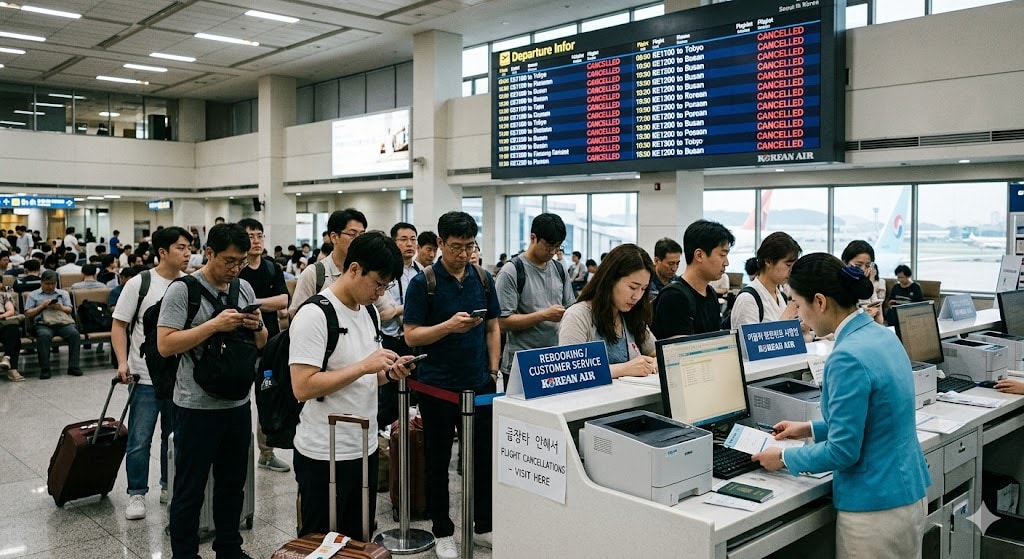
Based on 15 years of watching passengers handle cancellations — some brilliantly, some disastrously — here is my practical advice.
Rebook immediately through the app. The moment you receive a cancellation notification, open the airline’s app and rebook yourself onto the next available flight. Do not wait. Do not call. Do not go to the counter first. Seats on alternative flights fill up within minutes of a cancellation announcement, especially during peak travel or widespread disruptions. The passengers who rebook fastest get the best options.
If the app does not work, call and go to the counter simultaneously. Put your phone on speaker, dial the airline, and walk to the rebooking counter at the same time. Whichever channel gets you through first wins.
Know the difference between controllable and uncontrollable. This matters for your rights. If the cancellation was caused by something within the airline’s control (maintenance, crew scheduling, commercial decision), the airline generally has stronger obligations: meals, accommodation, and potentially compensation. If it was caused by something outside the airline’s control (weather, ATC restrictions, security incidents), the obligations are typically limited to rebooking and refund options. Korean consumer protection laws and international conventions (Warsaw/Montreal Convention) provide a framework, but specifics vary.
Always ask for the cancellation reason in writing. If you plan to file an insurance claim or request compensation, having the official cancellation reason documented is essential. Ask the gate agent or call center for a written or emailed confirmation of why the flight was cancelled.
Keep all receipts. If you incur additional costs (meals, hotel, ground transportation, alternative flights), keep every receipt. You will need them for insurance claims or airline reimbursement requests.
Travel insurance is your best friend during cancellations. Especially on LCCs with limited rebooking options, a good travel insurance policy covers the gap between what the airline provides and what you actually need. Hotel nights, meal costs, and alternative transportation can add up quickly during a multi-day disruption. As I have consistently advised across this blog, travel insurance during typhoon season or winter travel is not optional — it is essential.
8. A Cancellation Decision I Still Think About
Every dispatcher has cancellation calls that stay with them. Here is one of mine.
It was a Friday evening — the start of a holiday weekend. We had a full Incheon-to-Manila flight with 189 passengers, many traveling for family events. The aircraft was ready. The crew was ready. The weather in both Incheon and Manila was acceptable.
But the TAF for Manila showed a rapid deterioration expected 30 minutes before our estimated arrival time. A tropical depression was moving through, bringing thunderstorms and potential visibility below minimums for a 2-3 hour window — exactly when we would arrive.
I ran the scenarios. If we departed on time, we would arrive during the worst of the weather. With full fuel (including extra for holding), we could hold for about 30 minutes. If the weather did not improve in that window, we would need to divert to Clark — an airport 80 km from Manila with limited facilities, no hotels nearby, and no onward ground transportation at midnight.
If we delayed the departure by 3 hours, we would arrive after the weather was expected to clear. But the crew would then exceed their duty time for the return flight. We would need to overnight the aircraft and crew in Manila and cancel the return flight the next morning — affecting another 189 passengers.
If we cancelled now, all 189 passengers could rebook onto tomorrow’s flight (which had availability) or receive full refunds. Many could adjust their holiday plans with 6 hours of advance notice.
I recommended cancellation. The duty manager agreed. We cancelled.
The social media backlash was immediate. “Clear weather and you cancel? Incompetent airline.” “Never flying this airline again.” One passenger posted a photo of the perfectly clear Incheon sky with the caption, “Explain this.”
Three hours later, Manila airport closed for 2.5 hours due to the tropical depression — exactly as the TAF had predicted. If we had operated the flight, 189 passengers would have been stranded at Clark International Airport at midnight, with no hotel, no ground transportation, and no return flight available until the system recovered.
We had made the right call. The passengers who were angry with us at 6 PM would have been far angrier at midnight in Clark. But they will never know that, because the proactive cancellation prevented the scenario from ever happening.
That is the fundamental challenge of the flight cancellation decision. When you make the right call proactively, no one sees the disaster you prevented. They only see the inconvenience you caused. It is a thankless decision, and I make it with the knowledge that it is always the right one when the alternative is worse.
9. A Note on Transparency
If there is one thing I wish the airline industry would improve, it is communication during cancellations. I have sat in the OCC and watched perfectly justified cancellation decisions turn into PR disasters because the airline failed to explain the reasoning to passengers.
“Your flight has been cancelled due to operational reasons” tells the passenger nothing. “Your flight has been cancelled because severe weather at Manila is forecast to close the airport during our arrival window, and operating the flight would risk stranding you overnight at a diversion airport” tells them everything. The first message generates rage. The second generates understanding.
I cannot change how every airline communicates. But through this blog, I can give you the context that the departure board does not provide. Every cancellation has a reason. Every reason has a logic behind it. And in the vast majority of cases, that logic — however frustrating — exists to protect you from something worse.
As I wrote in my article on aviation safety: the system prioritizes safety above schedule, every single time. Flight cancellation is one of the most visible — and most misunderstood — expressions of that priority.
Learn more about our mission and operational background on the About Aeruxo page.
Frequently Asked Questions
Why was my flight cancelled when the weather was fine at my airport?
Weather-related cancellations can be triggered by conditions at the destination, along the route, or at the airport where your aircraft was coming from. Additionally, the cancellation might be based on a forecast of future weather — the airport is clear now, but is expected to close during your arrival window. Finally, a previous weather event might have disrupted aircraft positioning, leaving no aircraft available for your flight even though today’s weather is fine. I explained these cascading effects in detail in my article on flight delays.
How early do airlines decide to cancel flights?
It depends on the cause. For predictable events like typhoons or major winter storms, airlines may cancel 48-72 hours in advance. For maintenance issues, the decision might come 6-12 hours before departure when the scope of the repair becomes clear. For crew-related cancellations due to cascading delays, the decision might not be made until 2-4 hours before departure. Airlines aim to decide as early as possible to give passengers time to adjust.
Can I get compensation for a cancelled flight?
It depends on the cause and the applicable regulations. In Korea, airlines must provide rebooking or refunds for all cancellations regardless of cause. Additional compensation (meals, accommodation, monetary compensation) typically applies only to “controllable” cancellations — those caused by the airline’s own operational issues. Weather, ATC restrictions, and security events are generally classified as uncontrollable, with more limited obligations. EU Regulation 261/2004 provides stronger passenger rights for flights departing from or arriving in EU countries. Always check the specific airline’s conditions of carriage and applicable consumer protection laws.
Why doesn’t the airline just delay instead of cancelling?
Sometimes delay is the better option, and we choose it whenever possible. But delays carry risks: a 3-hour delay might push the crew past their legal duty time, turning the delay into a cancellation anyway. A delay might strand an aircraft overnight at an outstation, cancelling multiple subsequent flights. Or the condition causing the delay (weather, maintenance) might have no clear resolution timeline, making an indefinite delay worse for passengers than a clear cancellation with rebooking. When we cancel instead of delaying, it is usually because the delay scenario was assessed and found to create worse outcomes overall.
What should I do the moment I learn my flight is cancelled?
Rebook immediately through the airline’s app — this is the fastest channel and seats fill up quickly. If the app is not working, call the airline and go to the rebooking counter simultaneously. Ask for the official cancellation reason in writing for insurance or compensation purposes. Keep all receipts for expenses incurred. Check your travel insurance policy for coverage. And stay calm — the gate agents and call center staff are dealing with the same disruption from the other side and are generally doing their best to help.
Do LCCs cancel more flights than full-service carriers?
Not necessarily more, but the recovery experience is typically different. LCCs have tighter schedules, fewer spare aircraft, and limited interline agreements, which means: disruptions cascade faster, rebooking options are more limited (usually only on the same airline), and recovery to normal schedule can take longer. The safety standards are identical. But the operational resilience — the ability to absorb and recover from disruptions — is structurally lower at most LCCs. This is the trade-off for lower fares, and it is why travel insurance is especially important when flying LCC during weather-vulnerable seasons.
Have a question about why your flight was cancelled? Drop it in the comments — I will do my best to explain the likely reasoning from an OCC perspective.
Disclaimer: The views expressed in this article are my own professional opinions based on 15+ years of operational experience. They do not represent the official position of any airline, aviation authority, or regulatory body.

Licensed Flight Dispatcher with 15+ years of experience in airline operations control. Holds FAA Aircraft Dispatcher Certificate and Republic of Korea Flight Dispatcher License (MOLIT). Specializes in flight watch, NOTAM analysis, flight planning, and operational control at a Korean LCC. IOSA audit participant and author of multiple airline operational manuals, including Emergency Response, De-icing, and OCC Procedures.