By Aeruxo — Licensed flight dispatcher (study guide) | 15+ Years in Airline Operations
Here is something most passengers do not know: every single commercial flight I have ever planned — every one of the tens of thousands I have dispatched in 15 years — was planned with the assumption that an engine might fail. Not because engine failure on an airplane is likely. It is extraordinarily rare. But because my job as a flight dispatcher is to ensure that if an engine fails at the worst possible moment, the flight can still be completed safely.
I calculate engine-out drift-down altitudes. I verify obstacle clearance along the entire route with one engine inoperative. I select alternate airports that are reachable on a single engine. For oceanic crossings, I build ETOPS flight plans that guarantee a suitable diversion airport is always within single-engine range. This is not extra work I do occasionally — it is a fundamental part of every flight plan I create.
So when someone asks me, “What happens if the engine fails?” — I do not speculate. I know exactly what happens, because I have already planned for it. This article is that plan, explained in full.

Key Takeaways
- A modern twin-engine commercial aircraft can fly perfectly safely on one engine. Every aircraft type is certified to take off, climb, cruise, and land with a single engine inoperative. This capability is tested, proven, and practiced extensively.
- Engine failure on an airplane is extraordinarily rare — approximately 1 event per 100,000 flight hours for modern turbofan engines. Most pilots will go their entire career without experiencing one.
- Every flight plan already accounts for engine failure. As a flight dispatcher, I calculate single-engine performance, drift-down altitudes, and obstacle clearance for every flight before it departs.
- Pilots train for engine failure more than almost any other scenario. Every six months, pilots practice engine failures at the worst possible moments in the simulator — during takeoff, during approach, over mountains, over ocean.
- Both engines failing simultaneously is almost unheard of — it requires an external event (bird strike, volcanic ash, fuel exhaustion) affecting both engines at the same time. Even then, the aircraft can glide and the crew is trained to manage the situation.
This article is based on real-world operational experience planning and monitoring flights in an airline Operations Control Center (OCC), where engine failure scenarios are accounted for in every dispatch.
1. Can a Plane Fly with One Engine? The Definitive Answer
Yes. Unequivocally, completely, absolutely yes.
Every commercial twin-engine aircraft — the Boeing 737, Airbus A320, Boeing 777, Airbus A330, and every other type you are likely to fly on — is designed, tested, and certified to operate safely on a single engine. This is not an emergency capability bolted on as an afterthought. It is a fundamental design requirement that the aircraft must demonstrate before it is ever allowed to carry passengers.
During type certification, the aircraft manufacturer must prove to regulatory authorities (the FAA, EASA, or equivalent) that the aircraft can:
- Continue takeoff after an engine failure at the most critical moment (V1 speed, just before the point of no return)
- Climb to a safe altitude on a single engine after takeoff
- Cruise at a reduced altitude on one engine for extended periods
- Approach and land safely with one engine inoperative
The aircraft is not just barely capable of doing these things — it must demonstrate adequate performance margins. A twin-engine airliner on a single engine is not limping along on the edge of controllability. It is flying with reduced but entirely adequate performance, under full pilot control, with all essential systems operational.
2. How Rare Is Engine Failure on an Airplane?
Let me put the numbers in perspective.
Modern commercial turbofan engines have an in-flight shutdown rate of approximately 1 per 100,000 flight hours. To understand how rare that is: a typical Boeing 737 at our airline flies about 3,000-3,500 hours per year. At that rate, a single aircraft would statistically experience one engine shutdown every 28-33 years of continuous operation.
And the vast majority of those shutdowns are precautionary — the crew detects an abnormal indication (an oil pressure warning, a vibration alert, an exhaust temperature anomaly) and shuts the engine down as a precaution. True catastrophic, uncontained engine failures — the dramatic ones you see in news footage — are even rarer, on the order of 1 per million flight hours.
For dual engine failure — both engines failing simultaneously — the probability is so low that it requires an external event affecting both engines at the same time. The most famous example is US Airways Flight 1549 (the “Miracle on the Hudson”), where a bird strike knocked out both engines simultaneously during climb-out from LaGuardia in 2009. Captain Sullenberger’s successful water landing saved all 155 people on board. But even this extreme scenario — which is the absolute worst case — resulted in zero fatalities precisely because the aircraft could still glide and the crew was trained for the situation.
In my 15 years of dispatching, I have managed flights that experienced engine-related precautionary shutdowns in flight. The count? Less than five across my entire career. In every case, the crew followed standard procedures, the aircraft diverted safely to the nearest suitable airport, and the passengers were never in danger. That is not a statistical anomaly. That is the system working as designed.
3. What the Dispatcher Plans for: Engine Failure on Every Flight
This is the part of the story that is unique to the dispatcher’s perspective — and it is the part that should reassure you the most.

Every flight plan I build includes engine-out analysis. This is not optional. It is a regulatory requirement, and even if it were not, I would do it anyway because it is the foundation of safe dispatch.
3.1 Drift-Down Analysis
When a twin-engine aircraft loses one engine at cruising altitude (say, FL370 — 37,000 feet), it cannot maintain that altitude on the remaining engine. The single engine does not produce enough thrust to sustain level flight at that height. The aircraft must descend — gradually and controllably — to a lower altitude where the remaining engine can maintain level flight. This controlled descent is called a “drift-down.”
The drift-down altitude depends on the aircraft type, weight, temperature, and remaining engine performance. For a 737-800 at typical weights, the single-engine ceiling might be around FL200-FL250 (20,000-25,000 feet). The aircraft descends to this altitude over a period of 15-20 minutes, fully controlled and at a comfortable descent rate.
My job is to ensure that during this drift-down, the aircraft clears all terrain and obstacles along the route with a regulatory minimum margin. On a flat route over the sea — like Incheon to Manila — this is straightforward. On a route that crosses mountainous terrain, it requires careful analysis.
3.2 Obstacle Clearance Over Mountains
Consider a flight from Incheon to Southeast Asia that routes over or near mountainous terrain in China or Vietnam. If an engine fails at the worst possible point — directly over the highest terrain — the aircraft must be able to drift down to its single-engine ceiling while clearing all mountains with a safe margin.
I verify this for every flight. If the numbers do not work at the planned weight — meaning the aircraft at maximum takeoff weight cannot clear the terrain on one engine — I have several options: I can route the flight around the mountains (longer but safer), I can restrict the takeoff weight (fewer passengers or less cargo), or I can plan a higher initial cruising altitude that gives more drift-down margin. Each option has trade-offs, and finding the right balance is a core skill of the flight dispatcher.
3.3 ETOPS: Engine Failure Over Open Ocean
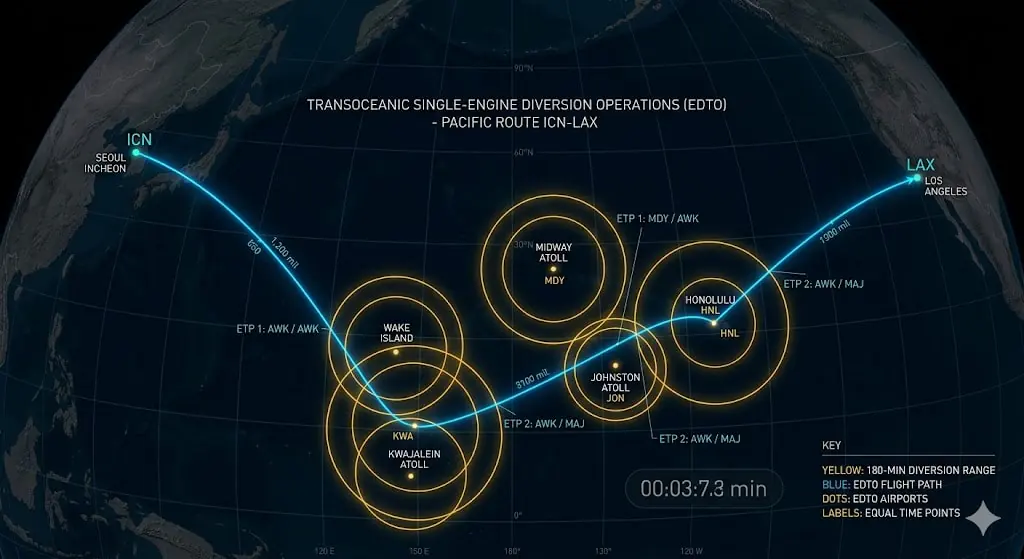
For oceanic crossings where diversion airports are hundreds of miles apart, ETOPS (Extended Operations) regulations add another layer of planning specifically for the engine failure scenario.
An ETOPS flight plan must ensure that the aircraft is always within a certified diversion time (e.g., 120, 180, or 240 minutes) of a suitable airport — using single-engine performance. I calculate the “critical fuel scenario”: engine failure at the worst point, combined with depressurization requiring descent to 10,000 feet (where fuel burn is much higher), flying through forecast headwinds, and holding at the diversion airport. The aircraft must carry enough fuel to complete this entire worst-case scenario and still land with required reserves.
This is the most demanding fuel calculation I perform, and it is done for every single ETOPS flight. The result is a flight plan where engine failure at any point along the oceanic route leads to a manageable, pre-planned diversion — not a desperate scramble.
4. What Happens in the Cockpit: The Pilot’s Response

Pilot training for engine failure is extensive, repetitive, and deliberately stressful. Here is what happens when an engine actually fails — or, far more commonly, what happens during the simulator session where pilots practice it.
4.1 Engine Failure During Takeoff (The Most Critical Scenario)
This is the scenario that aviation focuses on most intensely, because it combines low altitude, high workload, and the need for immediate, precise action.
During takeoff, there is a specific speed called V1 (decision speed). Before V1, if an engine fails, the takeoff is rejected — the pilot applies maximum braking and brings the aircraft to a stop on the remaining runway. After V1, the takeoff must continue — there is not enough runway remaining to stop safely.
If an engine fails after V1, the pilot does the following within seconds: maintains directional control with the rudder (the asymmetric thrust from one engine creates a yaw that must be countered), rotates and lifts off at the normal rotation speed, and climbs away on the single engine. The aircraft is designed and the speeds are calculated to ensure this is possible — even at maximum takeoff weight, on a wet runway, at the maximum allowable crosswind.
As the flight dispatcher, I have already verified that the aircraft can achieve this. Before every departure, I confirm that the takeoff performance data — V1, VR (rotation speed), V2 (takeoff safety speed) — provides adequate margins for an engine failure at the most critical moment. If the runway is too short, or the temperature is too high, or the aircraft is too heavy, I adjust the plan until the numbers work. Sometimes this means reducing payload. Sometimes it means selecting a longer runway. But the flight never departs unless the engine-out takeoff is demonstrably safe.
4.2 Engine Failure During Cruise
An engine failure during cruise is far less dramatic than during takeoff — which is ironic because it is the scenario passengers worry about most.
At cruise altitude, the crew has time, altitude, and airspeed on their side. When an engine indication triggers, the crew follows a systematic checklist. They identify which engine is affected. They attempt to diagnose the issue. If the engine must be shut down, they do so deliberately and methodically. The aircraft begins a controlled drift-down to the single-engine ceiling altitude. The crew contacts ATC to declare the situation and request priority handling. They coordinate with me (the dispatcher) via ACARS for diversion options, weather at diversion airports, and fuel status.
The entire process is measured, calm, and procedural. There is no panic. There is no frantic scrambling. The crew has practiced this scenario dozens of times in the simulator, and the flight dispatcher has already built the plan that tells them exactly where to go if this happens at any point along the route.
4.3 Engine Failure During Approach
If an engine fails during approach, the crew has several options depending on when and where it occurs. If they are on a stable approach and close to landing, they may continue and land — a single-engine landing is a well-practiced maneuver. If they are higher or further from the runway, they may execute a go-around on the single engine (yes, this is possible and practiced) and reposition for another approach.
Single-engine landings are entirely routine from a pilot training perspective. The approach speed is slightly higher than normal, and the crew may request a longer runway if available, but the landing itself is a standard procedure that every commercial pilot has performed numerous times in the simulator.
5. What Passengers Experience During an Engine Failure
If an engine shuts down during cruise flight, here is what you would likely notice as a passenger:
A change in engine sound. The most noticeable cue is that the ambient noise changes. One side of the aircraft becomes quieter. You might sense a subtle asymmetry in the sound that is difficult to pinpoint but noticeable.
A gentle descent. The aircraft will descend from its cruising altitude to a lower altitude over 15-20 minutes. The descent rate is similar to a normal approach — comfortable and gradual. You may feel your ears adjusting to the pressure change.
A PA announcement. After the crew has completed their immediate procedures and stabilized the situation (which takes a few minutes), the Captain will make an announcement. It will typically explain that an engine has been shut down as a precaution, that the aircraft is flying safely on the remaining engine, and that the flight will be diverting to a nearby airport.
Emergency vehicles on the ground. When you land at the diversion airport, you will likely see fire trucks and emergency vehicles positioned alongside the runway. This is standard precautionary protocol for any single-engine landing — it does not mean there is a fire or an emergency in progress. It means the airport is following procedures to have resources in place just in case.
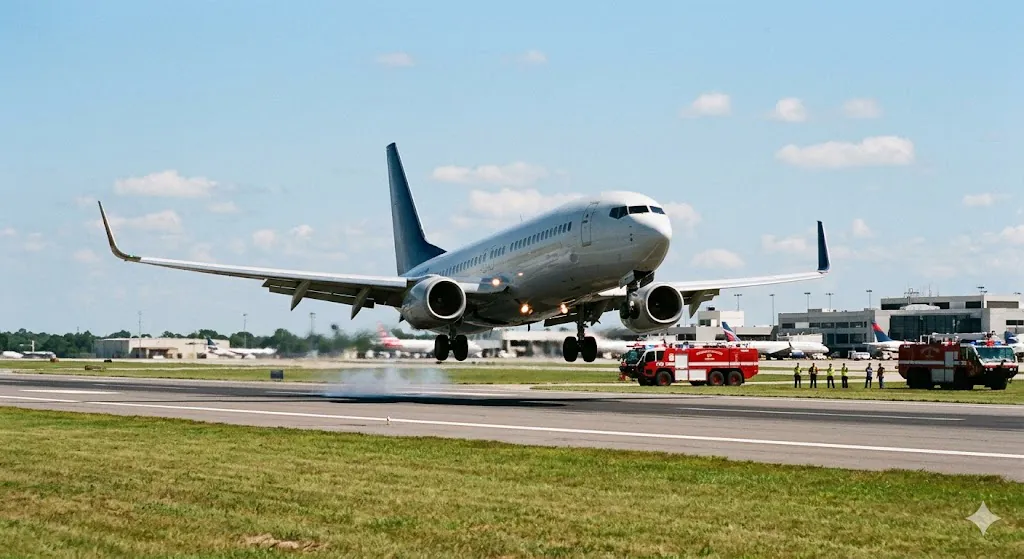
What you will not experience: a sudden loss of altitude, a loss of cabin pressure (unless the engine issue causes a separate pressurization problem, which is rare), or any dramatic maneuvers. A single-engine diversion is, from a passenger experience standpoint, a gradual descent followed by a normal landing at a different airport than you expected. The drama is in the situation, not in the flying.
6. The Question Everyone Asks: Both Engines?
Yes, let me address the big one. What if both engines fail?
First, the probability. Dual engine failure requires an external event affecting both engines simultaneously. The engines are completely independent systems — they do not share fuel lines, electrical systems, or control systems in a way that would allow a single failure to propagate from one to the other. For both to fail at the same time, something must happen to both of them from outside: a massive bird strike (as in the Hudson River landing), volcanic ash ingestion, or fuel exhaustion (which is a planning failure, not a mechanical failure).
Second, even if both engines fail, the aircraft does not fall from the sky. A commercial airliner has a glide ratio of approximately 10:1 to 17:1 depending on the type. This means that from a cruising altitude of 36,000 feet (approximately 6 miles), the aircraft can glide 60-100 miles forward while descending. That is a lot of distance to find a suitable landing site.
Third, pilots train for total engine failure. It is a simulator scenario that every airline includes in recurrent training. The crew knows the procedure: maintain best glide speed, start the APU (auxiliary power unit) for electrical power, attempt engine restart, identify landing options, and fly the aircraft to the safest available landing point.
As I discussed in my article on aviation safety, the layered redundancy of modern aviation means that dual engine failure resulting in loss of life is vanishingly rare. Captain Sullenberger’s successful ditching of Flight 1549 — with zero fatalities — demonstrates that even in the absolute worst-case scenario, the combination of aircraft design, pilot training, and crew professionalism can produce survivable outcomes.
7. Why Engine Failure on an Airplane Should Not Scare You
After 15 years of planning for engine failure on every single flight I dispatch, here is my honest perspective:
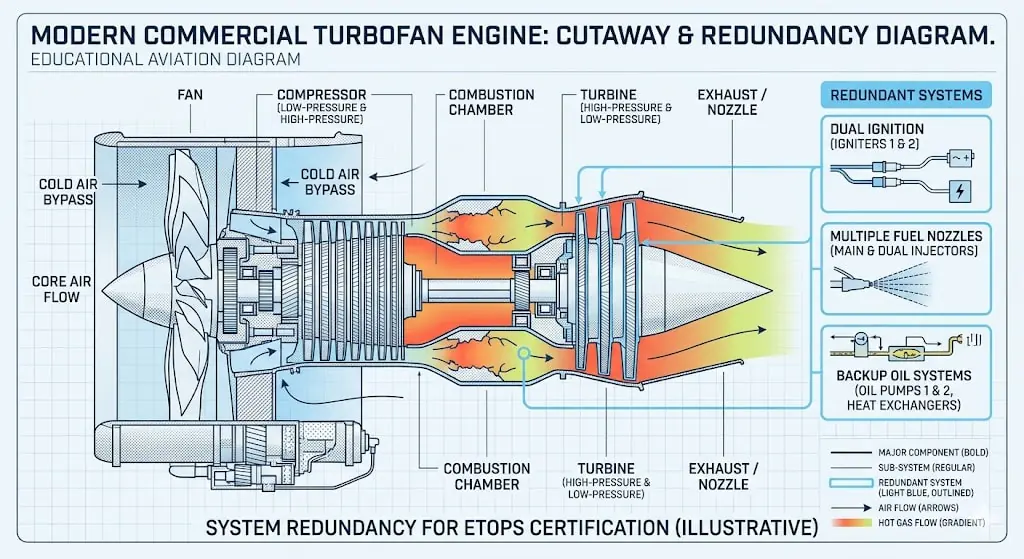
Engine failure is one of the most thoroughly anticipated, planned for, and practiced scenarios in all of aviation. There is no other failure mode that receives more attention from designers, regulators, training departments, and dispatchers. The entire system — from the engine’s multiple redundant internal systems to the pilot’s simulator training to my flight plan’s engine-out calculations — is designed around the assumption that an engine might fail at any moment.
And because of that preparation, when an engine actually does fail — which is already extraordinarily rare — the outcome is almost always a routine, safe diversion followed by a normal landing. Not a headline. Not a disaster. A well-executed plan.
The next time you hear your engines roar during takeoff and feel that familiar flutter of anxiety, remember this: someone on the ground — a flight dispatcher sitting in an OCC much like mine — has already calculated exactly what would happen if one of those engines stopped working right now. And the answer is: you would be fine. Because we planned for it.
That is what we do. That is what flight planning really means. Not just getting you from A to B — but getting you from A to B safely, even when things do not go perfectly.
And after tens of thousands of flights planned across Japan, China, and Southeast Asia — through typhoons, winter storms, turbulence, and every kind of delay imaginable — every single flight has arrived safely. Engine failure included.
Learn more about our mission and operational background on the About Aeruxo page.
Frequently Asked Questions
Can a plane fly with one engine?
Yes. Every modern commercial twin-engine aircraft is designed, tested, and certified to fly safely on a single engine. The aircraft can take off, climb, cruise at a reduced altitude, and land with one engine inoperative. This is a fundamental design requirement, not an emergency capability. Pilots practice single-engine operations regularly in the simulator, and flight dispatchers plan every flight to be safe even with one engine inoperative.
How common is engine failure on an airplane?
Extremely rare. Modern turbofan engines experience in-flight shutdowns at a rate of approximately 1 per 100,000 flight hours. For a typical aircraft flying 3,000-3,500 hours per year, that translates to one event every 28-33 years of continuous operation. Most of these shutdowns are precautionary — the crew detects an abnormal indication and shuts the engine down deliberately. True catastrophic engine failures are even rarer, approximately 1 per million flight hours.
What happens if both engines fail on a plane?
Dual engine failure is almost unheard of and requires an external event (massive bird strike, volcanic ash, fuel exhaustion) affecting both independent engines simultaneously. Even if it occurs, the aircraft does not fall — it glides. A commercial airliner can glide approximately 60-100 miles from cruising altitude with no engine power. Pilots train for this scenario regularly. The most famous example, US Airways Flight 1549, resulted in zero fatalities when Captain Sullenberger successfully landed on the Hudson River after dual engine failure from a bird strike.
Will the plane just fall if the engine stops?
No. Absolutely not. An airplane is not held up by its engines — it is held up by its wings generating lift. Engines provide thrust (forward motion), and as long as the aircraft has airspeed, the wings continue generating lift regardless of whether the engines are running. An aircraft with no engine power is a glider, not a falling object. It will descend gradually and controllably while the crew manages the situation and navigates to a landing site.
Do pilots practice engine failure in training?
Yes, extensively. Engine failure scenarios are among the most frequently practiced maneuvers in airline simulator training. Every six months, pilots must demonstrate competence in handling engine failures during takeoff, cruise, and approach. They practice the decision-making (continue or reject takeoff), the flying technique (asymmetric thrust management), and the procedural response (checklists, communication, diversion planning). By the time a pilot encounters an actual engine failure, the response is essentially automatic.
Does the flight dispatcher plan for engine failure?
On every single flight. Before any commercial flight departs, I verify that the aircraft can safely complete the takeoff with an engine failure at the most critical moment, that the route provides adequate terrain clearance with one engine inoperative, and that suitable diversion airports are within single-engine range at all points along the route. For ETOPS oceanic flights, I calculate the worst-case fuel scenario assuming engine failure combined with depressurization and adverse winds. Engine failure planning is not an occasional extra step — it is a fundamental, mandatory part of every flight plan I create.
Have a question about engine failure or aircraft systems? Leave a comment — I will answer from an operational perspective.
Disclaimer: The views expressed in this article are my own professional opinions based on 15+ years of operational experience. They do not represent the official position of any airline, aviation authority, or regulatory body.

Licensed Flight Dispatcher with 15+ years of experience in airline operations control. Holds FAA Aircraft Dispatcher Certificate and Republic of Korea Flight Dispatcher License (MOLIT). Specializes in flight watch, NOTAM analysis, flight planning, and operational control at a Korean LCC. IOSA audit participant and author of multiple airline operational manuals, including Emergency Response, De-icing, and OCC Procedures.