\
\
By Aeruxo — Licensed flight dispatcher (study guide) | 15+ Years in Airline\
Operations
\
\
The call came from the station manager in Osaka at 1840 local\
time: “We have a security hold. Passenger Yamamoto checked in\
a bag for Flight 714 but did not board. Bag is loaded in the\
forward hold. Captain is requesting confirmation of offload\
before pushback.” I pulled up the Baggage Reconciliation System,\
confirmed the bag tag number against the passenger manifest,\
and authorized the offload. Ground handlers removed the bag in\
eleven minutes. The flight pushed back fourteen minutes late.\
The alternative — departing with an unaccompanied bag belonging\
to a no-show passenger — is not an option under international\
aviation security regulations. It does not matter that the\
passenger almost certainly missed the flight due to a connection\
delay rather than malicious intent. The bag comes off. Every\
time. That eleven-minute delay affected 186 passengers because\
of one piece of lost luggage that was never actually lost — it\
was in exactly the right place. Its owner was not.
\
\
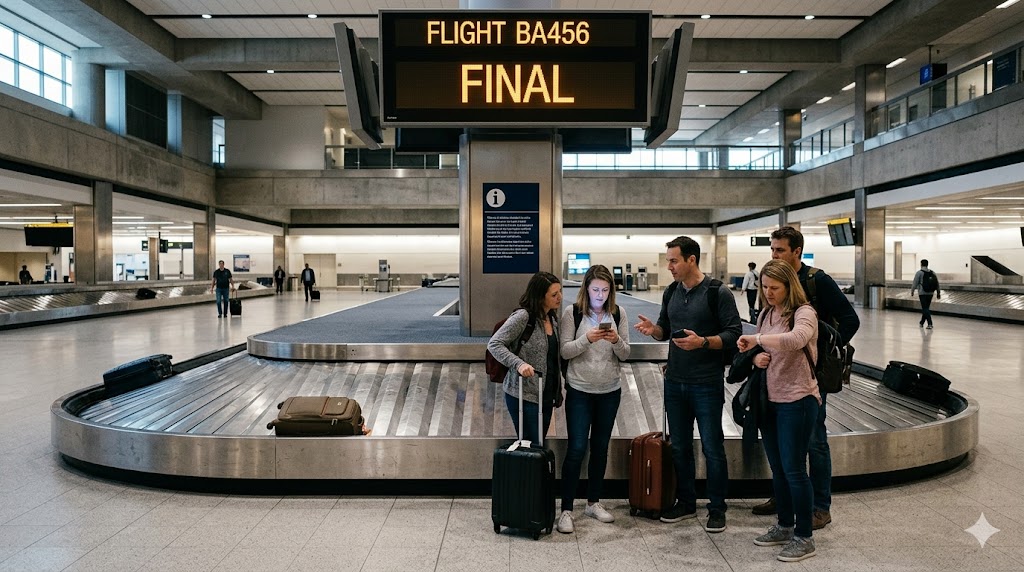
Lost luggage is one of the most frustrating problems \
in air travel — but in most cases, your bag is not actually lost.
\
\
As a flight dispatcher with 15+ years in airline operations, \
I’ve handled baggage incidents in real time — from security offloads \
to delayed transfers. This guide explains exactly what happens \
to lost luggage, why bags disappear, how airlines track them \
using the BRS system, and what you must do in the first \
30 minutes to get your bag back fast.
\
\
According to SITA’s annual air transport IT report, \
the global air transport industry mishandled approximately \
26 million bags in 2022 — roughly 7.6 bags per 1,000 passengers. \
Most of those bags were not lost. They were delayed, misdirected, \
or offloaded for the security reason I just described, \
and the majority were reunited with their owners within 48 hours. \
After 15 years in airline operations — watching the baggage system work \
from the inside, understanding why it fails, and managing the security \
and operational consequences when it does — I want to explain exactly \
what happens to your bag from the moment you check it in to the moment \
it may not appear at the carousel.
\
\
\
the belt empties, and the bag is not there. In most cases, the\
bag is not lost — it is in a specific, traceable location in the\
airline’s system. Knowing what to do in the next 30 minutes\
is the difference between a 24-hour delay and a week-long\
dispute.
\
\
\
\
The dispatcher’s direct involvement with baggage is more specific \
than most passengers imagine. The critical intersection is \
the security offload: when a passenger checks in a bag but does not board, \
the bag cannot fly. That sounds straightforward — but in practice, \
with 180 passengers boarded, a 40-minute ground time, and a departure slot \
to hold, extracting one bag from a loaded hold requires coordination \
between the ground handler, the load controller, and me. I have authorized security \
offloads with the aircraft already pushed back from the gate, \
engines not yet started. The ground team re-docks, opens the hold, \
removes the bag, re-secures, and pushes again. The flight departs 18 minutes late. \
The alternative — departing with an unaccompanied bag — is not an option \
under any circumstances, on any airline, in any country. \
That is not a policy. It is an absolute rule.
\
\
What Is Lost Luggage?
\
Lost luggage refers to checked baggage that does not arrive \
on the same flight as the passenger, usually due to delays, \
misrouting, or security offloads. In most cases, the bag is tracked \
and returned within 48 hours rather than permanently lost.
\
\
Key Takeaways
\
\
- \
- Most lost luggage is not lost — it is delayed or\
misdirected. Over 80 percent of mishandled bags are\
reunited with their owners within 48 hours. True permanent loss\
represents a small fraction of the 7.6 per 1,000 mishandling rate. - The Baggage Reconciliation System (BRS) tracks every\
checked bag from check-in tag printing to aircraft hold\
loading. If your bag did not make your flight, the system knows\
exactly where it is. - Security regulations require offloading any bag\
belonging to a no-show passenger:a rule that causes\
deliberate lost luggage delays for innocent connecting passengers\
and is non-negotiable under international aviation security law. - Filing a Property Irregularity Report (PIR) at the\
airport — not online, not later — is the critical first step.\
Most airline lost luggage claim deadlines begin at the moment\
you leave the baggage claim area. - Your legal compensation rights for lost luggage\
are significantly stronger than most passengers realize,\
with the Montreal Convention providing international standards\
that many airlines do not proactively disclose.
\
\
\
\
\
\
\
This article is based on real-world experience in an airline \
Operations Control Center (OCC), managing baggage flow, flight operations, \
and security-related baggage decisions.
\
\
\
\
1. Where Your Bag Actually Goes After Check-In
\
\
\
airport processes thousands of bags per hour using laser barcode\
scanners and automated routing switches. Each bag’s tag is scanned\
multiple times between check-in and aircraft loading — creating a\
digital trail that makes truly lost luggage significantly rarer\
than passengers imagine.
\
\
When you hand your bag to the check-in agent, a unique barcode\
tag is printed and attached. That barcode is the bag’s identity\
in the airline’s baggage system — linking it to your passenger name\
record, your flight, your destination, and any connecting flights.\
From that moment, the bag enters an automated sorting system\
at major airports that uses laser scanners at multiple points\
along the conveyor belt network to read the barcode and route\
the bag to the correct aircraft makeup area. At each scan point,\
the system logs the location and time — creating a digital trail\
that, in theory, makes truly lost luggage a solvable problem\
rather than a mystery.
\
\
The bag travels from the check-in area through the sorting\
system to the departure hall’s baggage makeup zone, where ground\
handlers load it into containers or directly into the aircraft\
hold in the correct sequence for the destination. At each stage,\
the barcode is scanned again. When the bag is loaded onto the\
aircraft, the loading scan creates the final entry in the bag’s\
movement record before flight. At transit airports, the process\
repeats — the bag is offloaded, scanned, re-routed through the\
connecting airport’s sorting system, and loaded onto the onward\
flight. Every scan is a data point. Every failed scan — when the\
barcode is obscured, the tag is torn, or the routing mechanism\
misreads the destination — is a point where the bag diverges from\
the intended path and a lost luggage situation begins.
\
\
\
\
2. The Security Rule That Creates Deliberate Lost Luggage
\
\
\
bag to a boarded passenger in real time. A red flag — bag loaded,\
passenger not boarded — triggers the mandatory offload sequence\
regardless of the reason the passenger did not board. The system\
exists because the 1988 Lockerbie bombing used an unaccompanied\
bag to bring down Pan Am Flight 103.
\
\
The single most common cause of deliberate lost luggage delays\
for innocent passengers is the security rule that I described\
in the opening of this article: any bag checked onto a flight\
by a passenger who subsequently does not board must be removed\
from the aircraft before departure. This rule — mandated under\
international aviation security standards following the 1988\
Lockerbie bombing of Pan Am Flight 103, which used an unaccompanied\
bag to carry the explosive device — applies without exception. The\
reason the passenger did not board is irrelevant to the offload\
requirement. A passenger who missed their connection due to a\
delayed inbound flight, a passenger who was denied boarding at\
the gate due to a document issue, and a passenger who simply\
changed their mind are treated identically under the security\
regulation: their bag comes off.
\
\
For passengers on connecting itineraries, this creates the\
most frustrating form of lost luggage: the bag that was correctly\
transferred to the connecting flight and correctly loaded, only\
to be offloaded because the connecting passenger — delayed on the\
inbound flight — did not board in time. The bag then sits at the\
transit airport awaiting the passenger’s arrival on a later\
flight, which may be hours or the following day. From the\
passenger’s perspective, their bag disappeared without explanation.\
From the operational perspective, the system worked exactly as\
designed — the bag was tracked, identified as belonging to a\
no-show passenger, and removed in compliance with mandatory\
security requirements. The outcome looks like lost luggage;\
it is actually lost luggage prevention operating at the cost\
of a delivery delay.
\
\
\
\
3. The Five Most Common Causes of Lost Luggage
\
\
\
the lost luggage prevention chain. A scan failure — due to a\
damaged barcode, a torn tag, or a mis-read routing code — is\
where most lost luggage stories begin. Attaching a secondary\
label inside the bag is the most effective passenger-side\
protection against tag failure.
\
\
Short connection times are the primary cause\
of lost luggage in normal operations. When a passenger’s connection\
is 45 minutes at a major hub, the bag must be offloaded from\
the inbound aircraft, transported to the baggage sorting system,\
re-sorted to the outward departure hall, loaded onto the connecting\
aircraft, and reconciled against the passenger manifest — all within\
the time between the inbound aircraft’s block-in and the outward\
aircraft’s cutoff for baggage loading. At busy airports, this\
sequence routinely takes 45 to 60 minutes for a straightforward\
transfer. A 45-minute connection with a 10-minute late arrival\
on the inbound flight leaves a bag transfer window that cannot\
be met. The passenger makes the connection; the bag does not.\
Damaged or missing bag tags are the second cause.\
A tag that is torn during the sorting process, rendered unreadable\
by moisture, or falls off the bag entirely removes the bag from\
the automated routing system. A bag without a readable tag becomes\
a lost luggage item that ground handlers must resolve manually’\
a process that takes hours rather than minutes, and that depends\
on contact information inside the bag to identify the owner.
\
\
Misrouting at sorting system junctions occurs\
when the automated switching mechanism sends a bag to the wrong\
makeup zone — either through a mechanical fault, a scan error,\
or a routing code conflict when two flights have similar\
destination codes. Security offloads, as\
described above, create the deliberate category. Theft\
‘while significantly less common than the other categories — does\
occur, primarily at airports with inadequate secure baggage\
handling areas or in destinations with documented history of\
baggage interference. According to the\
SITA Baggage IT Insights 2023\
report, transfer mishandling accounts for the largest\
single category of lost luggage — 46 percent of all mishandled\
bags — confirming that the connection time issue is the dominant\
operational cause rather than any single system failure.
\
\
Why Lost Luggage Happens
\
\
- \
- Short connection times at busy hub airports
- Damaged or missing baggage tags
- Sorting system routing errors
- Security-related offloading
- Human handling mistakes
\
\
\
\
\
\
\
\
\
4. What to Do in the First 30 Minutes After Lost Luggage
\
\
\

leaving the arrivals hall is the single most time-critical action\
after discovering lost luggage. The reference number generated\
activates the tracing system and establishes the formal record\
that any subsequent compensation claim depends on.
\
\
The actions you take in the 30 minutes after discovering lost\
luggage at the baggage claim carousel determine how quickly your\
bag is returned and whether your compensation claim succeeds.\
Do not leave the arrivals area before filing a Property\
Irregularity Report (PIR) at the airline’s baggage desk.\
The PIR is the formal document that activates the airline’s\
lost luggage tracing system, generates a reference number for\
tracking, and establishes the timeline that compensation claims\
are measured against. Most airlines require the PIR to be filed\
before the passenger leaves the airport — claims filed online\
after departure from the arrivals hall are often rejected or\
processed under less favorable terms.
\
\
At the PIR desk, provide: your bag tag receipt (the sticker\
affixed to your boarding pass at check-in), a detailed description\
of the bag including color, size, brand, and any distinctive\
features, your destination address and contact information, and\
your onward travel plans if you are continuing to another\
destination. Request the World Tracer reference\
number:the global baggage tracing system used by most\
IATA member airlines — and confirm that the agent has activated\
the trace before you leave the desk. World Tracer matches\
your description against all unidentified bags reported to\
the system globally and automatically notifies you when a match\
is found. Document everything immediately:\
photograph your bag tag receipt, the PIR form, and the agent’s\
name before leaving. This documentation is your evidentiary\
base for any compensation claim that follows if the lost luggage\
is not recovered promptly.
\
\
\
\
5. Your Legal Rights for Lost Luggage
\
\
Passenger legal rights for lost luggage are substantially\
stronger than most affected passengers realize — and most airlines\
do not proactively disclose the full extent of the compensation\
available. The Montreal Convention of 1999,\
ratified by most ICAO member states, establishes the international\
legal framework for lost luggage claims. Under the Montreal\
Convention, airlines are liable for lost luggage up to\
approximately 1,288 Special Drawing Rights (approximately\
USD 1,700 at 2024 exchange rates) per passenger — regardless\
of the actual value of the bag, and regardless of whether\
the airline was negligent. This is a strict liability standard\
that applies automatically without requiring the passenger to\
prove fault.
\
\
For delayed rather than permanently lost luggage, the Montreal\
Convention also covers reasonable expenses incurred due to the\
delay — replacement clothing, toiletries, and essential items\
purchased because the delayed bag was not available. These\
expenses must be reasonable and evidenced with receipts, but\
the principle is that the airline bears the cost of the practical\
consequences of their mishandling. In the European Union,\
EU 261/2004 overlaps with the Montreal Convention for\
delay situations, and the combination of the two frameworks\
provides stronger protection than either alone. Critically,\
the timeline for claiming matters: under the Montreal\
Convention, claims for damaged baggage must be filed within 7\
days of receipt, and claims for delayed baggage must be filed\
within 21 days of the date the bag was received. After those\
deadlines, the right to claim is extinguished. According to\
the IATA baggage liability reference,\
the Montreal Convention limits are the global standard, but\
individual airlines may voluntarily apply higher limits — a\
detail worth checking before accepting any settlement offer\
that appears below the standard limit.
\
\
\
\
What the Dispatcher Knows About Lost Luggage
\
\
The dispatcher’s interaction with baggage is primarily through\
two operational intersections: the security offload sequence\
and the weight and balance implications of last-minute bag\
removals. When a security offload is required — a passenger did\
not board and their bag is loaded — the ground team notifies\
operations, and the weight and balance document must be revised\
to reflect the removed bag weight before the aircraft can\
legally push back. On a large aircraft with 200 kilograms\
of removed baggage, this affects the center of gravity\
calculation and may require repositioning of remaining cargo.\
The eleven-minute delay I described in the opening is typical’\
finding the specific bag in a loaded hold, removing it, and\
revising the weight and balance takes precisely that amount\
of time even when the ground team works efficiently.
\
\
The second intersection is interline transfer tracking. When\
our aircraft is the inbound leg of a connection and I know the\
inbound will arrive late, I flag the connection to station\
management at the transit airport — not just for the passenger\
connection, but for the bag transfer window. If the connection\
is achievable for the passenger but not for the bag, the station\
needs to initiate the delayed bag tracing protocol before the\
passenger even arrives at the connecting gate. Proactive tracing\
initiated before the passenger discovers the lost luggage\
significantly reduces the resolution time. The lost luggage\
that reaches a passenger 24 hours after arrival has often been\
traced and located within the first four hours — the delay between\
location and delivery is logistics, not mystery. For how tight\
connections create cascading operational problems beyond the\
baggage system, my\
\
why flights get delayed (dispatcher explanation) explains \
the network effects of short minimum connection times across \
the full passenger and crew ecosystem.
\
\
\
delivery to the hotel within 24 to 48 hours in the majority of\
cases. The bag was never truly lost — it was in the World Tracer\
system with a known location from within hours of the original\
missed connection. Getting it to the passenger is logistics,\
not recovery.
\
\
\
\
How to Protect Your Bag From Getting Lost
\
\
Book connections with adequate minimum connection\
times. The minimum connection time published by an airline\
is the theoretical minimum under ideal conditions — inbound on\
time, bags transferred without issue, short walking distance\
between gates. In practice, adding 30 to 60 minutes above the\
published minimum at major hub airports dramatically reduces\
the probability of lost luggage on transfer. A connection that\
costs 45 extra minutes of waiting time is a cheap insurance\
policy against a 48-hour delayed bag. Use a distinctive,\
easily identifiable bag:a bright color, a luggage strap,\
or a unique tag reduces the probability of your bag being\
picked up by mistake at the carousel and makes identification\
faster if it enters the lost luggage system.
\
\
Always put contact information inside the bag:\
not just on the external tag. A card with your name, phone number,\
email address, and destination hotel inside the main compartment\
is the recovery mechanism when the external tag is damaged or\
lost. Ground handlers who open an untagged bag to identify its\
owner rely entirely on internal documentation. Consider\
an AirTag or similar GPS tracker in the main compartment’\
not as a replacement for filing a PIR, but as an independent\
verification of your bag’s location that gives you more specific\
information to provide the baggage desk agent than your description\
alone. A passenger who can tell the agent “my bag is in Terminal\
2 of your Frankfurt hub, not at my destination” receives\
significantly faster resolution than one who simply reports\
a bag missing. Photograph your bag and its contents\
before travel — not for sentimental reasons, but because a\
compensation claim for lost luggage requires documented evidence\
of the bag’s contents and their value, and memory is unreliable\
under the stress of discovering missing luggage after a long\
international flight.
\
\
\
\
\
Related Reading from Aeruxo:
\
- \
- Airline Overbooking: Why It Happens (Explained by a Flight Dispatcher)
- How Airlines Handle Flight Diversions: Inside OCC Decisions
- How Airlines Decide to Cancel Flights
\
\
\
\
Frequently Asked Questions
\
\
What is the difference between lost luggage and delayed\
luggage?
\
Delayed luggage is a bag that did not travel on the same\
flight as the passenger but has been located in the airline’s\
baggage system and will be delivered within a defined period’\
typically 24 to 48 hours for domestic delays and 48 to 72 hours\
for international ones. Lost luggage is a bag that cannot be\
located in the tracing system after a defined period — under the\
Montreal Convention, luggage is considered lost after 21 days\
of delay, at which point the full liability for its value applies\
rather than the delayed baggage expenses reimbursement regime.\
In practice, over 80 percent of mishandled bags are recovered\
and returned within 48 hours.
\
\
What is a Property Irregularity Report and why does it\
matter?
\
A Property Irregularity Report (PIR) is the formal document\
filed at the airline’s baggage desk when a passenger reports\
lost luggage. It captures the bag description, tag number,\
passenger contact details, and delivery address, and generates\
a World Tracer reference number that activates the global\
baggage tracing system. Filing a PIR before leaving the airport\
is critical because most airlines and international conventions\
require the report to be made while the passenger is still at\
the baggage claim facility — claims filed online afterward may\
be subject to less favorable terms or outright rejection.
\
\
What is the World Tracer system?
\
World Tracer is a global baggage tracing system operated by\
SITA and used by the majority of IATA member airlines. When a\
passenger files a PIR for lost luggage, their bag description\
is entered into World Tracer, which matches it against all\
unidentified bags reported by any participating airline worldwide.\
When a match is found — either because the bag was found at the\
wrong airport or identified in a lost property facility — the\
system automatically notifies both the passenger and the handling\
airline, initiating the delivery process. World Tracer processes\
millions of bag traces annually and is the backbone of the\
global lost luggage recovery system.
\
\
How much compensation am I entitled to for lost luggage?
\
Under the Montreal Convention of 1999, which governs international\
air travel between signatory states, airlines are liable for\
lost luggage up to approximately 1,288 Special Drawing Rights\
per passenger — roughly USD 1,700 at current exchange rates.\
This is a strict liability standard: the passenger does not\
need to prove negligence. For delayed baggage, the airline\
is also liable for reasonable expenses incurred due to the\
delay, evidenced with receipts. Claims must be filed within\
7 days of receiving damaged luggage or within 21 days of\
receiving delayed luggage — after which the right to claim is\
extinguished.
\
\
Why was my bag removed from the plane even though I checked\
it in?
\
International aviation security regulations require the\
offloading of any bag belonging to a passenger who does not\
board the aircraft — regardless of the reason for non-boarding.\
This rule was implemented after the 1988 Lockerbie bombing used\
an unaccompanied checked bag to introduce an explosive device.\
If you were denied boarding, missed the flight due to a late\
connection, or did not board for any reason, your bag was\
offloaded in compliance with a mandatory security requirement\
that applies without exception. The bag will be held at the\
departure airport or the transit airport until your next flight\
is confirmed.
\
\
Does an AirTag actually help recover lost luggage?
\
An AirTag or similar GPS tracker provides independent location\
data that can significantly accelerate the resolution of a lost\
luggage situation. A passenger who can tell the baggage desk\
agent the specific airport and terminal where their bag is\
located — rather than describing it from memory — provides the\
agent with actionable information that bypasses part of the\
World Tracer matching process. However, an AirTag does not\
replace filing a PIR, does not entitle the passenger to access\
restricted baggage areas to retrieve the bag themselves, and\
does not accelerate the physical delivery logistics once the\
bag is located. It is most valuable as a communication tool\
that gives the passenger specific, verifiable location data\
to share with the airline.
\
\
What should I do if my bag never arrives after 21 days?
\
After 21 days, the Montreal Convention classifies delayed\
luggage as lost, and the airline’s liability shifts from delayed\
baggage expenses reimbursement to full lost luggage compensation\
up to the Convention limit. At this point, file a formal\
written claim with the airline’s customer relations department,\
referencing your PIR number, the World Tracer reference, and\
the 21-day Convention timeline. Provide a documented inventory\
of the bag’s contents and their estimated value. If the airline\
disputes the claim or offers below the Convention limit, contact\
the relevant national aviation authority or consumer protection\
body — most jurisdictions have formal complaint mechanisms for\
Montreal Convention disputes that produce resolution significantly\
faster than direct airline negotiation.
\
\
\
\
Have you ever had a bag delayed or lost? Did you know\
about the World Tracer system or your Montreal Convention rights\
before you needed them? Share your experience in the comments’\
passenger accounts of lost luggage situations help others know\
exactly what to do in the critical first 30 minutes.
\
\
Disclaimer: The views expressed in this article are my own\
professional opinions based on 15+ years of operational experience.\
They do not represent the official position of any airline, aviation\
authority, or regulatory body. Specific compensation entitlements\
vary by jurisdiction, carrier, and individual circumstances’\
consult the applicable aviation authority or a consumer rights\
advisor for guidance on your specific situation.
\
\
\

Licensed Flight Dispatcher with 15+ years of experience in airline operations control. Holds FAA Aircraft Dispatcher Certificate and Republic of Korea Flight Dispatcher License (MOLIT). Specializes in flight watch, NOTAM analysis, flight planning, and operational control at a Korean LCC. IOSA audit participant and author of multiple airline operational manuals, including Emergency Response, De-icing, and OCC Procedures.