By Aeruxo — Licensed flight dispatcher (study guide) | 15+ Years in Airline Operations
The crew reported it as a “severe jolt” that lasted approximately
four seconds. They were 7 nautical miles behind an Airbus A380 on
approach to the same runway — well outside the standard ATC separation
minimum, or so the initial report suggested. What the investigation
revealed was a wind shift that had caused the A380’s wake turbulence
to drift laterally, placing it directly in the following aircraft’s
path despite the published separation distance. The following aircraft
rolled 25 degrees and lost 400 feet before the crew recovered.
Everyone on board was fine. The event generated a full safety report,
an operational review, and a temporary increase in separation
minima for that airport’s prevailing wind condition.
Wake turbulence is the aviation hazard that most passengers have
never heard of and that every pilot thinks about every time a large
aircraft passes ahead of them. Unlike the turbulence caused by
storms, jet streams, or terrain — phenomena that originate in the
atmosphere — wake turbulence is entirely manufactured by the aircraft
itself. It is invisible, it persists for minutes after the generating
aircraft has passed, and in the wrong conditions it can roll a
following aircraft faster than its control surfaces can respond.
After 15 years dispatching flights and analyzing operational
incidents across Asia, I want to explain exactly what wake turbulence
is, why the size of the aircraft in front of you matters enormously,
and what the aviation system does to keep following aircraft safe.
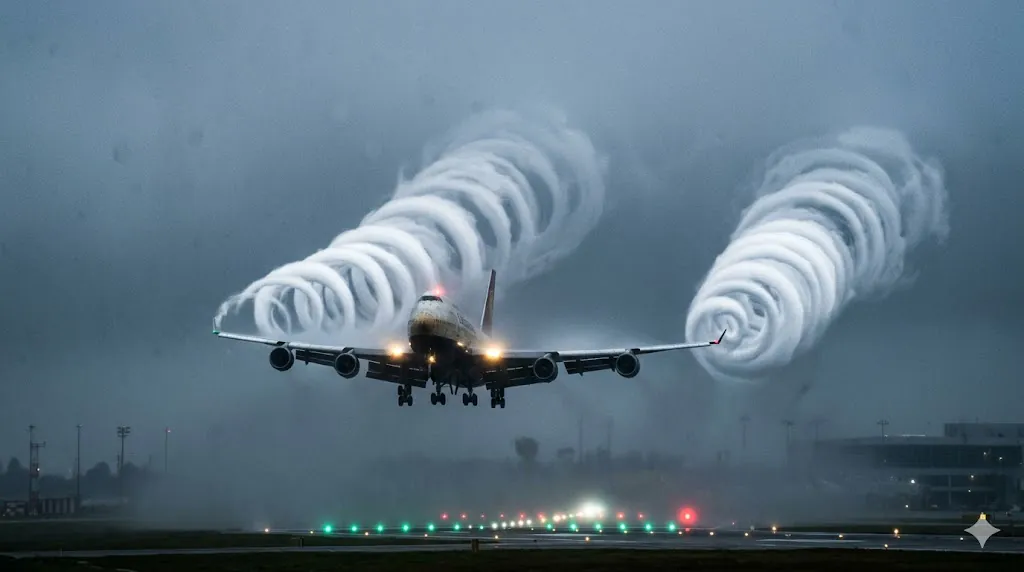
counter-rotating cylinders of air trailing from each wingtip. They
are always there, invisible in dry conditions, and they persist
and descend for several minutes after the generating aircraft
has passed.
Key Takeaways
- Wake turbulence is generated by every aircraft in
flight, but its intensity scales with aircraft weight.
The heavier the aircraft, the stronger and more persistent the
vortices it leaves behind. - Wingtip vortices rotate inward and downward
from each wingtip, descending below the generating aircraft’s
flight path. An aircraft flying through them can experience
sudden rolling forces far beyond normal turbulence. - ATC applies mandatory separation standards
between aircraft based on the wake category of the leading
aircraft. These standards are larger than standard en-route
separation and are specifically calculated for wake turbulence
avoidance. - Wind is the critical variable. Wake turbulence
drifts with the wind, making it unpredictable outside of
controlled approach and departure corridors. A crosswind can
carry vortices directly into the path of an aircraft on a
parallel runway. - The most dangerous wake turbulence scenarios
involve a heavy or super-heavy aircraft followed by a light or
medium aircraft during approach and departure — low altitude,
low speed, minimum control margin, and no room to descend away
from the vortex.
This article is based on real-world operational experience monitoring flight operations and aircraft systems in an airline Operations Control Center (OCC), where these sounds are routinely analyzed and understood.
1. What Wake Turbulence Actually Is
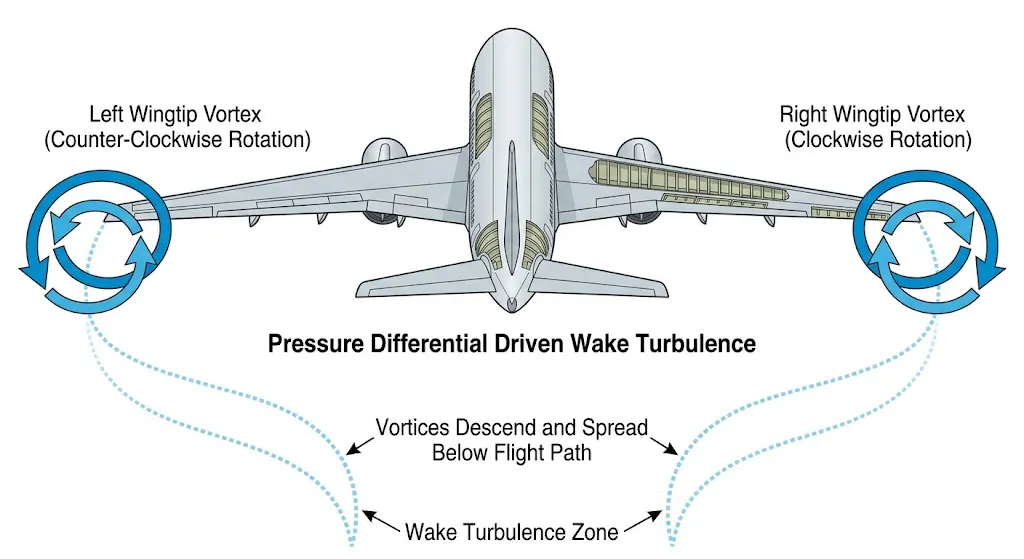
upper and lower wing surfaces. At the wingtip, high-pressure air
from below spills over to the low-pressure area above, creating a
rotating vortex. The left and right vortices counter-rotate and
descend together below the aircraft’s flight path.
An aircraft generates lift by creating a pressure differential
between its upper and lower wing surfaces — lower pressure above, higher
pressure below. At the wingtip, where the wing ends, the higher-pressure
air beneath the wing spills upward around the tip toward the
lower-pressure area above, creating a rotating column of air that
trails behind the aircraft. The left wingtip produces a
counter-clockwise vortex; the right wingtip produces a clockwise one.
These two vortices trail behind the aircraft, counter-rotating inward
toward each other and slowly descending below the generating aircraft’s
flight path.
The intensity of the vortex is directly proportional to the
aircraft’s weight. A heavy aircraft generates more lift to support
its greater mass, which means a larger pressure differential across
the wing and a proportionally stronger vortex. An Airbus A380 at
maximum takeoff weight generates wake turbulence on an entirely
different scale from a Boeing 737 — the vortices are larger in diameter,
higher in rotational velocity, and persist for significantly longer
before dissipating. An aircraft encountering a strong vortex can
experience a rolling moment that exceeds the maximum roll rate the
ailerons can produce, leaving the crew unable to stop the roll until
the aircraft exits the vortex or the vortex dissipates around them.
This is not turbulence that shakes you in your seat — it is turbulence
that inverts the aircraft.
2. Wake Categories: Why the Aircraft Ahead of You Matters
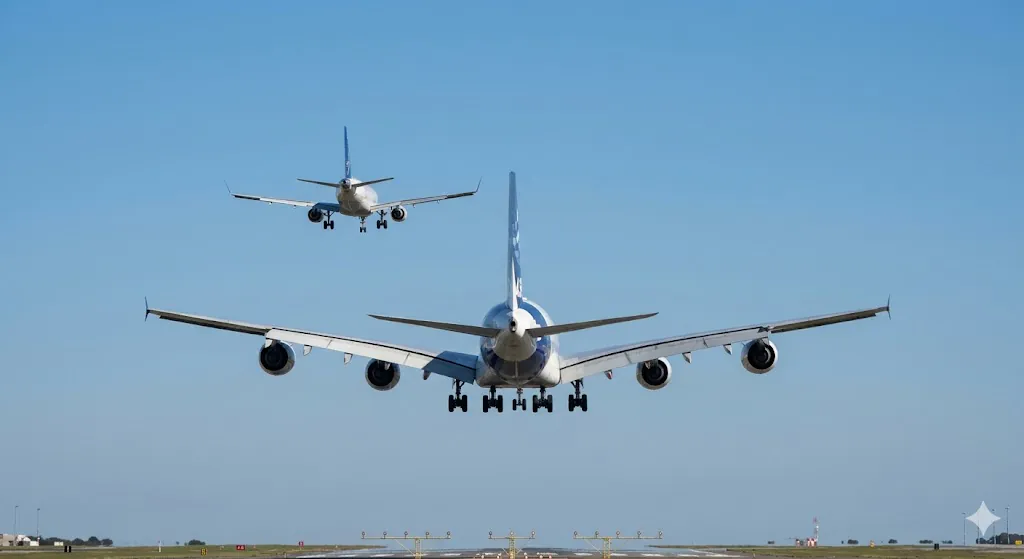
aircraft is the core of the wake turbulence hazard. The small
aircraft’s control authority may be insufficient to overcome the
rolling moment imposed by the heavy aircraft’s vortices.
ICAO classifies aircraft into wake turbulence categories based on
maximum certified takeoff weight, and ATC separation standards are
applied based on the combination of leading and following aircraft
categories. The current ICAO wake turbulence categories range from
Super (A380, An-225) through Heavy (aircraft above 136,000 kg),
Medium (aircraft between 7,000 and 136,000 kg), and Light (aircraft
below 7,000 kg). When a Super or Heavy aircraft is leading, ATC
applies significantly increased separation to all following aircraft’
not just light ones — because the vortex intensity of the largest
aircraft is sufficient to challenge even medium-category jets.
The RECAT (Wake Turbulence Re-categorization) system, developed
by the FAA and now adopted at many major airports, refines these
categories further by adding sub-categories that account for wingspan
and wake generation characteristics within each weight class. An
Airbus A380 and a Boeing 747 — both classified Heavy under the original
system — generate meaningfully different wake turbulence profiles that
the original four-category system did not distinguish. RECAT allows
airports to apply more precise separation that avoids both the safety
gap of treating different heavies identically and the capacity
penalty of over-separating aircraft that do not require it. According
to SKYbrary’s wake turbulence reference,
RECAT implementation at high-traffic airports has improved both
safety margins and runway throughput by replacing the blunt
four-category system with one that reflects actual aerodynamic
differences between aircraft types.
3. The Rules ATC Uses to Protect Following Aircraft
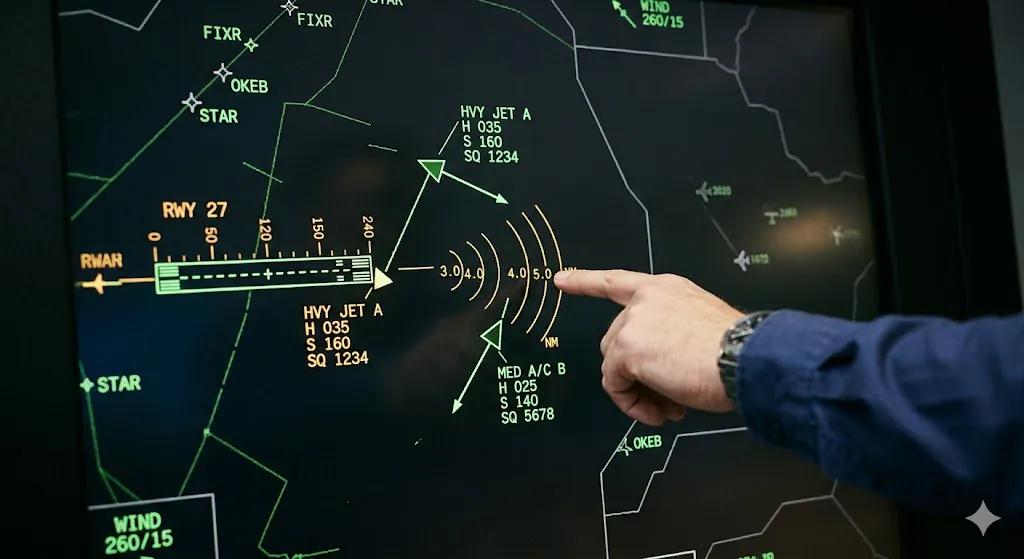
radar — the separation distance between a heavy leader and a medium
follower on approach is typically 5 to 6 nautical miles, compared
to the standard 3-nautical-mile minimum for same-category aircraft.
ATC separation for wake turbulence is applied in time and distance,
depending on whether radar separation or procedural separation is in
use. On radar approach, the standard minimum separation between a
Heavy leading aircraft and a Medium following aircraft is typically
5 nautical miles — compared to the standard 3-nautical-mile minimum
between same-category aircraft. Behind a Super category aircraft like
the A380, the minimum for a Medium follower extends to 6 nautical
miles. These distances are not arbitrary — they are derived from
empirical measurements of vortex persistence and drift at approach
speeds and standard approach altitudes.
Wind is the critical variable that ATC cannot fully
control. Wake turbulence separation standards are calibrated
for calm or light wind conditions, in which the vortices descend
predictably below the generating aircraft’s path and dissipate over
a calculable distance. A crosswind component carries the vortices
laterally — potentially across the centerline of a parallel runway
or into the path of an aircraft on an offset approach. ATC controllers
are trained to anticipate wake turbulence drift in crosswind conditions
and increase separation or change runway configurations accordingly,
but the physics of vortex drift in variable winds introduces an
irreducible uncertainty margin that explains why wake turbulence
encounters still occur despite separation compliance.
Pilots also have independent responsibility for wake
turbulence avoidance. When following a known heavy aircraft
on approach, crews maintain their assigned altitude until established
on the glideslope and ensure they cross the threshold at or above
the heavy aircraft’s threshold crossing point — staying above the
flight path where vortices have descended below. In departures behind
a heavy aircraft, crews are instructed to rotate before the heavy
aircraft’s rotation point and climb on a diverging track. These pilot
procedures are taught during initial training and reinforced in
recurrent simulator sessions specifically because ATC separation alone
cannot account for every wind condition.
4. The Most Dangerous Wake Turbulence Scenarios
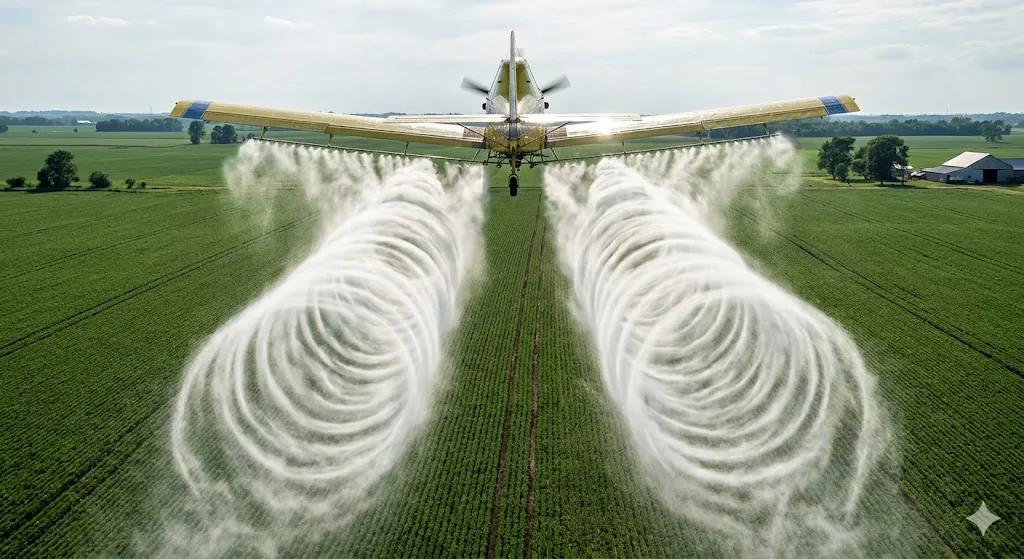
briefly visible as tight corkscrew spirals of condensed moisture’
a rare glimpse of a hazard that is always present but almost never
seen. The rotational velocity inside these spirals can exceed 90
metres per second in extreme cases behind super-heavy aircraft.
Approach and departure at low altitude are the
highest-risk phases for a wake turbulence encounter. At altitude,
an aircraft entering a vortex has vertical space to recover, speed
to maneuver, and time before reaching terrain. On final approach at
200 feet and approach speed, the same encounter leaves none of those
margins. The vortex descends into the approach corridor, the following
aircraft has minimum airspeed and maximum configuration drag, and
the ground is seconds away. This is why wake turbulence separation
standards are specifically designed for the approach and departure
environment rather than en-route flight, where the hazard is present
but the recovery margin is vastly greater.
Parallel runway operations in crosswind are the
second high-risk scenario. When two runways are in simultaneous use’
a common configuration at major hubs — the wake from a heavy aircraft
on one runway can drift laterally into the approach path of the
parallel runway. ATC procedures account for this with staggered
thresholds and offset approach paths, but the unpredictability of
surface wind near major airports means the drift cannot always be
precisely predicted. Several documented wake turbulence incidents
have involved aircraft on parallel approaches rather than directly
behind the generating aircraft on the same runway. Light
aircraft following heavies on intersecting runways present
a third variant — a heavy aircraft departing on a crossing runway
leaves a vortex that can persist across the intersection long after
the heavy has cleared, placing a departing light aircraft directly
in the vortex path if separation timing is inadequate.
5. What the Dispatcher Considers Regarding Wake Turbulence
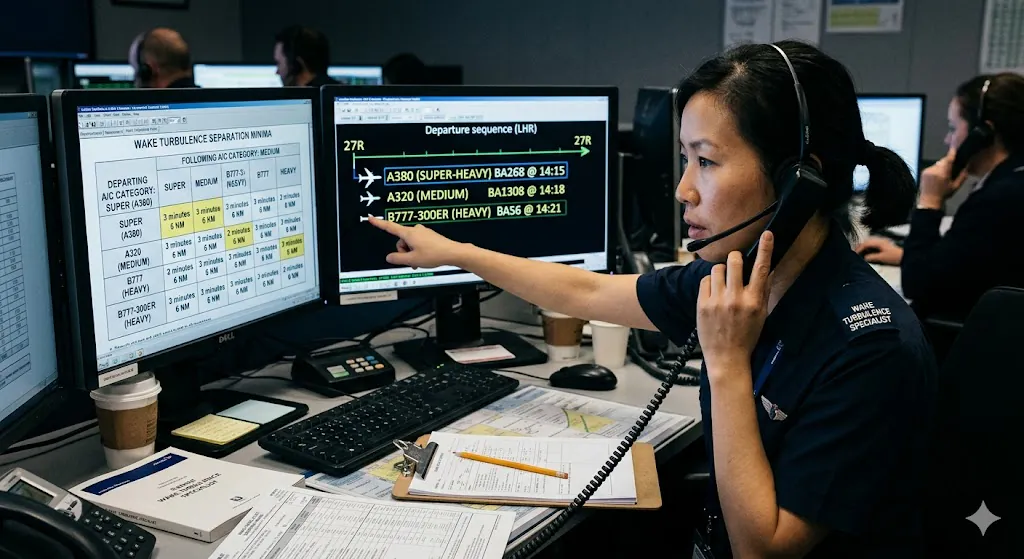
congested airports. When our aircraft follows an A380 or 747 on
departure, I factor the extended separation time into the block
time estimate and flag it in the flight plan remarks for the crew.
Wake turbulence is primarily an ATC and crew management issue
rather than a dispatcher function, but it intersects my work in
several specific ways. Departure sequencing at congested
airports is the most direct: when our narrow-body aircraft
is scheduled to depart behind an A380 or 747, the extended separation
requirement adds measurable time to the departure sequence. At slot-
restricted airports with precise departure windows, a heavy aircraft
ahead in the queue can cause our departure to slip a slot if ATC
cannot accommodate the separation within the assigned window. I flag
this in the operational plan and build the additional time into
the block estimate to avoid misleading the crew on expected departure
time.
Alternate airport planning at high-traffic hubs
is the second intersection. Airports with high proportions of A380
and 747 operations — Dubai, Los Angeles, London Heathrow — have approach
and departure environments where wake turbulence separation
requirements reduce effective runway capacity. During high-traffic
periods, the reduced throughput can cause significant arrival delays
that affect fuel planning. I account for extended holds at these
airports when calculating destination fuel, particularly on routes
where the alternate requires substantial fuel reserve. The combination
of wake turbulence-driven sequencing delays and strong headwinds
has caused fuel-critical situations at hub airports on our network’
a scenario that my
ETOPS and long-haul planning article covers in the context of
extended operations fuel planning.
Incident reports involving wake turbulence encounters
generate a dispatcher review just as any other in-flight abnormal
does. If a crew reports a wake turbulence encounter severe enough
to cause injury or structural concern, I coordinate the post-flight
inspection, assess whether the encounter falls within the parameters
ATC separation was intended to cover, and contribute to the safety
report. Wake turbulence incidents that occur within ATC separation
standards — as in the opening scenario of this article — typically
indicate a wind drift component that was not anticipated, and the
safety report drives a review of the separation standard for that
specific airport and wind condition.
6. What Passengers Should Know About Wake Turbulence
The turbulence you feel behind a large aircraft is different
from storm turbulence. Standard atmospheric turbulence
produces a buffeting, multi-directional shaking that may last minutes
and varies in intensity. Wake turbulence produces a sudden, sharp
rolling or pitching input — often a single strong jolt or a brief
rolling motion — that typically lasts two to four seconds as the
aircraft passes through the vortex. The distinction matters because
wake turbulence encounters, while potentially severe, are brief and
localized. The aircraft exits the vortex as quickly as it entered
it, and the crew’s primary job is to hold the controls firm and let
the aircraft fly through. For a broader explanation of how different
turbulence types compare, my
turbulence guide covers the full spectrum of in-flight turbulence
causes and what the aircraft is designed to withstand.
The size of the aircraft in front of you at the gate is
relevant. If you are boarding a regional jet or narrow-body
that will be departing shortly after an A380 or 747, ATC is already
accounting for the required separation. The extended separation time
may add a few minutes to your pushback or initial climb, but it
exists specifically to ensure your aircraft does not enter the
wake of the preceding heavy aircraft at a phase of flight where
the encounter would be hardest to manage. The most important
passenger action during a wake turbulence encounter is keeping the
seatbelt fastened. Because wake turbulence is invisible and
typically occurs without prior warning — unlike thunderstorm turbulence,
which is usually preceded by visible weather — the seatbelt sign may
not be illuminated when the encounter occurs. Keeping the seatbelt
loosely fastened throughout the flight, as crew consistently
recommend, is the single most effective passenger precaution against
injury in any unexpected turbulence event, wake or otherwise.
Related Reading from Aeruxo:
- How Turbulence Works and How Flights Stay Safe
- Landing in Fog Explained: How Aircraft Land in Near-Zero Visibility
- Best Seat on a Plane: A 15-Year Dispatcher’s Row-by-Row Guide
Frequently Asked Questions
What is wake turbulence?
Wake turbulence is the disturbed air generated by an aircraft in
flight, specifically the pair of counter-rotating vortices that trail
from each wingtip as a consequence of lift generation. These vortices
rotate inward and descend below the generating aircraft’s flight path,
persisting for several minutes before dissipating. Any aircraft flying
through them experiences sudden rolling or pitching forces proportional
to the generating aircraft’s weight and the following aircraft’s size.
Wake turbulence is entirely different from atmospheric turbulence — it
is created by the aircraft itself, not by weather.
Why is wake turbulence dangerous?
Wake turbulence from heavy and super-heavy aircraft can generate
rolling moments that exceed the maximum roll rate a following aircraft’s
ailerons can produce — meaning the crew cannot stop the roll until the
aircraft exits the vortex or the vortex dissipates. At low altitude
during approach and departure, where there is no vertical space to
recover and airspeed is at approach minimum, a severe wake turbulence
encounter can progress to terrain contact before the crew can
intervene. This is why the separation standards for approach and
departure are significantly larger than en-route separation minima.
What are wake turbulence categories?
ICAO classifies aircraft into wake turbulence categories — Super,
Heavy, Medium, and Light — based on maximum certified takeoff weight.
ATC applies different separation standards depending on the category
of the leading aircraft. A Super category Airbus A380 requires the
largest following separation. The RECAT system, adopted at many major
airports, adds sub-categories that distinguish aircraft within each
weight class based on wingspan and actual wake generation profile,
allowing more precise separation that reflects aerodynamic differences
the original four-category system did not capture.
How does ATC protect aircraft from wake turbulence?
ATC applies mandatory minimum separation distances between aircraft
on approach and departure, based on the wake category of the leading
aircraft. A Heavy leading aircraft requires 5 to 6 nautical miles of
separation for following medium aircraft, compared to the standard
3-nautical-mile minimum between same-category aircraft. Controllers
also account for crosswind conditions that can drift vortices into
parallel approach paths, adjusting sequencing and runway configuration
as needed. Pilots carry independent responsibility for maintaining
safe crossing points and rotation points relative to the preceding
heavy aircraft.
Can wake turbulence occur at cruise altitude?
Yes. Wake turbulence is generated at all flight phases, including
cruise. En-route wake turbulence encounters are typically less
dangerous than approach-phase encounters because the aircraft has
altitude to recover, airspeed for control authority, and time before
terrain contact. However, en-route wake turbulence can still produce
severe upset if a following aircraft is directly behind and at the
same altitude as a heavy aircraft. ATC vertical separation standards
account for this — aircraft at the same altitude on the same route
maintain longitudinal separation that prevents most en-route vortex
encounters.
What should passengers do during a wake turbulence encounter?
Keep the seatbelt fastened throughout the flight — not just when the
seatbelt sign is illuminated. Wake turbulence is invisible and provides
no advance warning visible from the cabin. The encounter itself is
typically brief — two to four seconds of sharp rolling or pitching — and
the crew will manage the aircraft through it. Unfastened passengers
can be thrown against the overhead compartments or ceiling during
a severe encounter, causing serious injury from an event the aircraft
handled without damage. The seatbelt is the only passenger protection
against wake turbulence injury.
Is wake turbulence the same as jet wash?
No, though they are related. Jet wash refers to the high-velocity
exhaust gases from an aircraft’s engines — a hazard primarily on the
ground behind an aircraft at high thrust settings. Wake turbulence
refers specifically to the wingtip vortices generated by lift
production and exists throughout flight regardless of thrust setting.
Both are invisible, both are dangerous in different contexts, and
both are managed through ATC separation and ground movement
procedures — but they are aerodynamically and operationally distinct
phenomena.
Have you experienced a sudden sharp roll or jolt during a
flight that lasted only a few seconds? It may have been a wake
turbulence encounter. Share what you felt in the comments — passenger
accounts help others recognize what wake turbulence actually feels
like from the cabin.
Disclaimer: The views expressed in this article are my own
professional opinions based on 15+ years of operational experience.
They do not represent the official position of any airline, aviation
authority, or regulatory body.
Licensed Flight Dispatcher with 15+ years of experience in airline operations control. Holds FAA Aircraft Dispatcher Certificate and Republic of Korea Flight Dispatcher License (MOLIT). Specializes in flight watch, NOTAM analysis, flight planning, and operational control at a Korean LCC. IOSA audit participant and author of multiple airline operational manuals, including Emergency Response, De-icing, and OCC Procedures.