By Aeruxo — Licensed Flight Dispatcher | 15+ Years in Airline Operations
The pilot’s voice was calm: “Incheon Dispatch, we just took a lightning hit. No abnormal indications. Continuing to destination. Will request maintenance inspection on arrival.” I noted the time, checked the aircraft’s system status on my screen—all green—and logged the event. The passengers probably heard a loud crack and saw a flash. The flight continued without incident. The aircraft landed on schedule.
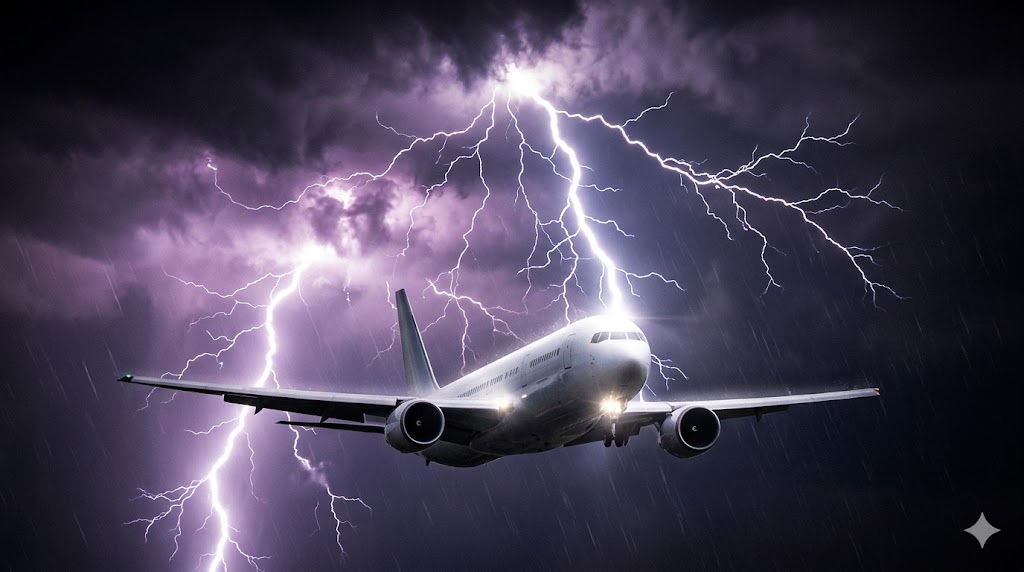
An airplane lightning strike sounds terrifying. Two hundred thousand amperes of electricity hitting a metal tube full of people at 35,000 feet—how can that possibly be safe? And yet it is. Commercial aircraft are struck by lightning an average of once or twice per year, and the last time a lightning-related accident brought down a modern commercial jet was over 60 years ago.
After 15 years as a flight dispatcher routing aircraft around thunderstorms across Asia, I have handled dozens of lightning strike reports. This article explains what actually happens when lightning hits your plane, why the aircraft is designed to survive it, and why the loud crack you hear is dramatic but not dangerous.
Key Takeaways
- Commercial aircraft are struck by lightning 1-2 times per year on average—roughly once per 1,000 flight hours. It is a routine event, not an emergency.
- During an airplane lightning strike, the aircraft acts as a Faraday cage. The current flows along the conductive outer skin and exits through static wicks—never passing through the cabin.
- The last lightning-caused crash of a commercial jet was in 1963 (Pan Am Flight 214). Since then, design standards have eliminated the vulnerabilities that caused that accident.
- Most strikes cause only minor cosmetic damage—small scorch marks at entry and exit points—that is repaired during routine maintenance after landing.
- Pilots and dispatchers actively avoid thunderstorms not primarily because of lightning risk, but because of the severe turbulence and wind shear inside them.
1. How Often Do Planes Get Hit by Lightning?
More often than you think. According to the National Weather Service and aircraft manufacturers like Airbus, a typical commercial aircraft experiences a lightning event once or twice per year—approximately once per 1,000 flight hours.
Most strikes occur between 5,000 and 15,000 feet during climb and descent, where the aircraft passes through the electrically active layers of cumulonimbus clouds. At cruise altitude (30,000+ feet), lightning is much less common because the aircraft is typically above the thunderstorm activity.
Here is a fact that surprises most people: aircraft often trigger their own lightning. The aircraft’s presence in an electrically charged atmosphere enhances the ambient electric field. The aircraft essentially acts as a conductor that bridges the gap between areas of different electrical potential, initiating the discharge. So rather than being a passive victim of a bolt from the sky, the aircraft is frequently the catalyst for the event.
On our Korean LCC network, lightning events are most common during the summer monsoon season (June-September) when convective activity is highest across East Asia, and during the transitional seasons when frontal systems produce embedded thunderstorms that are harder to detect and avoid.
2. What Happens During an Airplane Lightning Strike
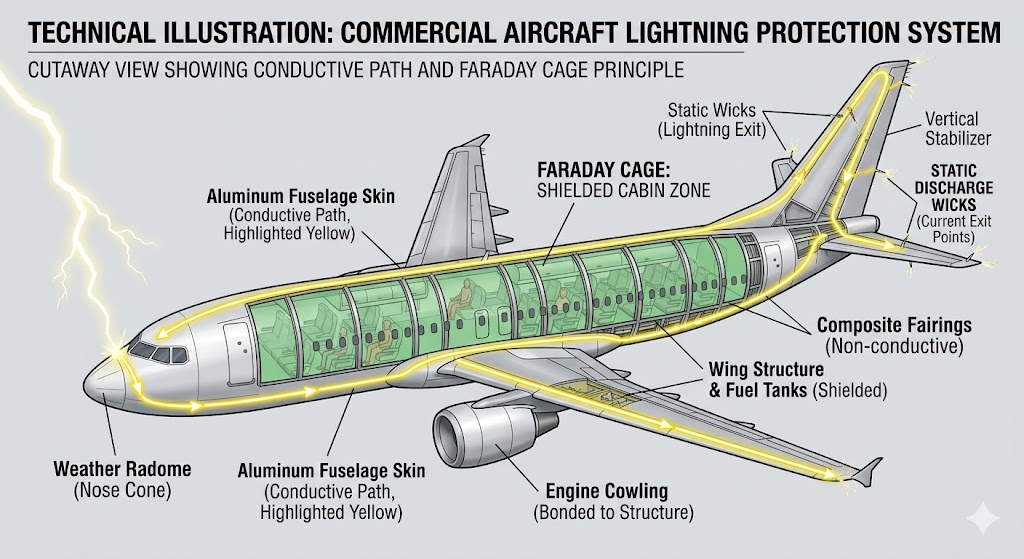
When lightning contacts the aircraft, the sequence happens in microseconds:
Entry point: The bolt typically attaches to a forward extremity—the nose radome, a wingtip, or an engine nacelle. These are the points closest to the approaching lightning channel.
Conduction along the skin: The current—up to 200,000 amperes—flows along the aircraft’s outer surface. On aluminum aircraft, the metal skin is an excellent conductor. The current travels through the fuselage from entry to exit point without penetrating the interior. This is the Faraday cage principle: a continuous conductive shell shields everything inside from external electrical fields.
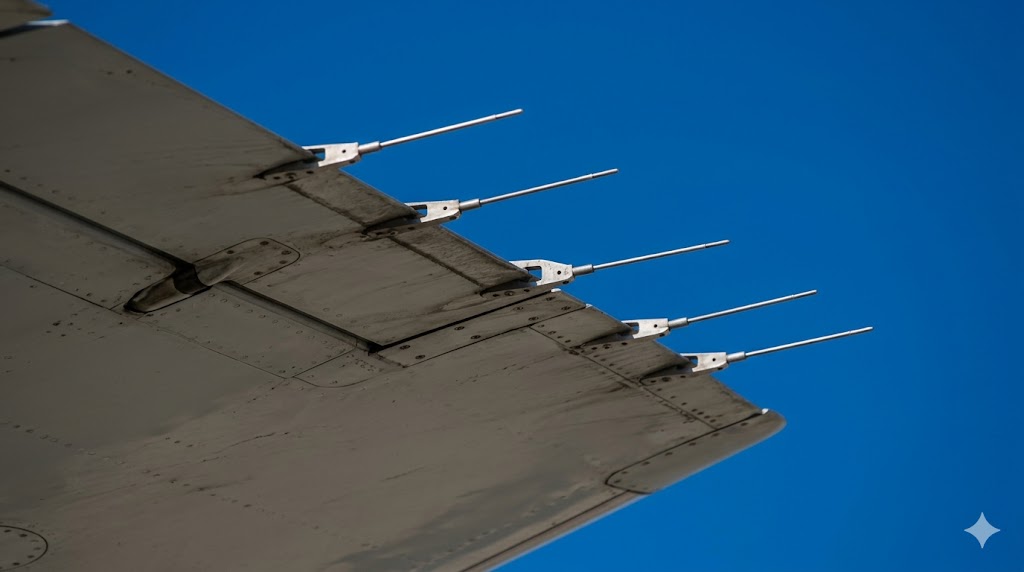
Exit point: The current exits at a trailing extremity—typically the tail cone or the static discharge wicks mounted on the trailing edges of the wings and tail. These small metal rods are specifically designed to safely dissipate electrical charge from the aircraft.
What passengers experience: A bright flash (visible through windows), a loud crack or bang, and possibly a momentary flicker of cabin lights. That is typically all. The loud noise can be startling, but it is simply the sound of the electrical discharge—not structural damage.
What happens to the aircraft systems: In most cases, nothing. The electrical shielding protects avionics and wiring from surge damage. Occasionally, a transient electrical disturbance may cause a brief instrument anomaly or a minor system reset, but these are designed to be non-critical and self-correcting.
3. Why Modern Aircraft Survive Lightning: Engineering That Protects You
The reason modern aircraft handle lightning safely is not luck—it is decades of deliberate engineering driven by the one airplane lightning strike accident that changed everything.
The Pan Am Flight 214 Legacy (1963)
On December 8, 1963, a Pan American Boeing 707 was struck by lightning while in a holding pattern near Elkton, Maryland. The bolt ignited fuel vapor in a wing tank, causing an explosion that destroyed the aircraft, killing all 81 on board. The investigation revealed that the fuel tank design allowed lightning energy to reach the fuel/air mixture inside.
This tragedy drove sweeping changes in aircraft design standards that remain in effect today:
Fuel tank protection. Aircraft skin around fuel tanks must be thick enough to prevent burn-through. All structural joints, fasteners, access doors, fuel filler caps, and vents must be designed and tested to prevent any spark from reaching fuel vapors. Modern fuel formulations also produce less explosive vapor.
Electrical bonding. Every component of the aircraft is electrically bonded to create continuous conductive paths. This ensures that lightning current flows along the intended route (the outer skin) rather than arcing across gaps where sparks could occur.
Lightning certification testing. Before any commercial aircraft enters service, it undergoes rigorous airplane lightning strike testing. Engineers simulate strikes at various points, measuring current paths, temperatures, and spark potential. The aircraft must demonstrate it can withstand repeated events without safety compromise.
The Composite Aircraft Challenge
Modern aircraft like the Boeing 787 and Airbus A350 use carbon fiber composite materials that are significantly less conductive than aluminum. This created a new engineering challenge: how to maintain Faraday cage protection with a non-metallic skin.
The solution: embedded conductive layers. Composite aircraft incorporate a mesh of copper or aluminum foil within the composite structure, creating conductive paths that carry airplane lightning strike current around the exterior just as aluminum skin does. These aircraft undergo even more extensive testing than their all-metal predecessors.
4. What the Dispatcher Does After a Lightning Report

When I receive an airplane lightning strike report from a crew, my response follows a structured assessment:
Step 1: Confirm aircraft status. Are all systems operating normally? Any abnormal indications? In the vast majority of cases—the crew reports all normal. The flight continues to its destination.
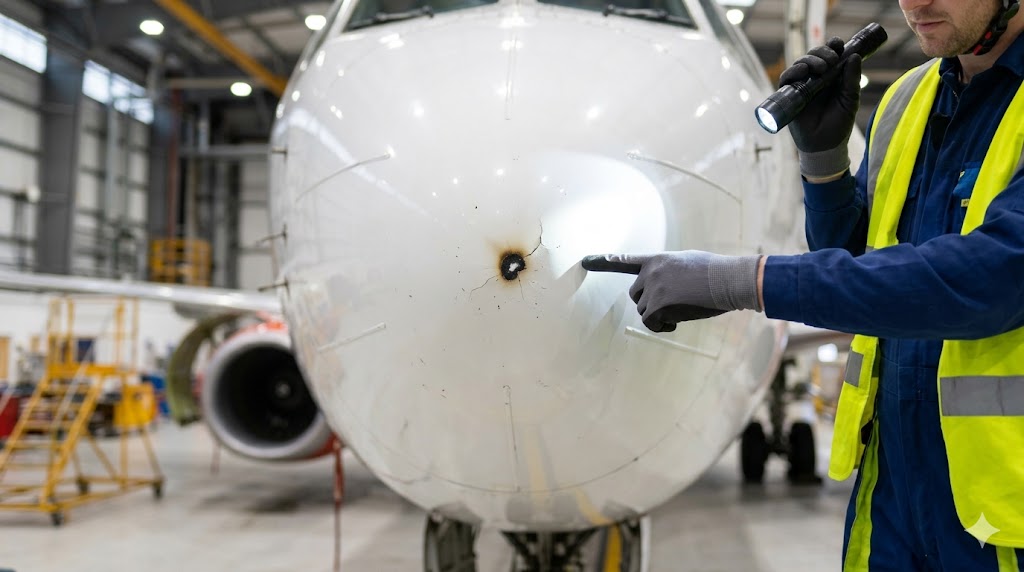
Step 2: Request maintenance inspection on arrival. Every lightning event requires a post-flight inspection, regardless of whether damage is apparent. Maintenance crews examine the entry and exit points for scorch marks, check the radome, inspect static wicks, and test avionics systems.
Step 3: Assess schedule impact. If the inspection reveals damage requiring repair, the aircraft may be taken out of service temporarily. This can cascade into delays or cancellations on subsequent flights. The maintenance time is usually 2-4 hours for minor damage, but can extend longer if radome replacement or composite repair is needed.
Step 4: If the crew reports abnormal indications. If the strike caused any system anomalies—a compass deviation, an avionics reset, or (rarely) an engine indication change—I coordinate with the crew for a possible diversion to the nearest suitable airport. This is uncommon but well within standard procedures.
In my 15 years, every airplane lightning strike report I have handled resulted in the flight continuing safely to its destination with normal systems. Post-landing inspections found minor cosmetic damage—scorch marks, small pits in the radome—but never structural compromise.
5. Why We Avoid Thunderstorms Anyway
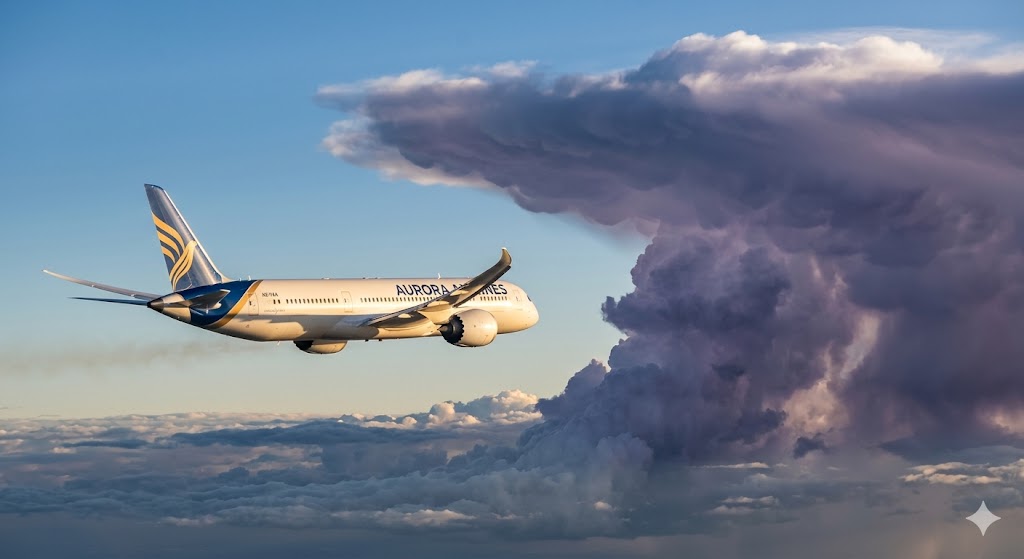
If aircraft can survive lightning, why do pilots and dispatchers work so hard to avoid thunderstorms? Because lightning is actually the least dangerous thing about a thunderstorm.
Inside a mature cumulonimbus cloud, the real threats are:
Severe turbulence. Vertical air currents inside thunderstorms can exceed 100 km/h, creating turbulence violent enough to injure passengers and, in extreme cases, stress the airframe beyond design limits.
Wind shear. Rapid changes in wind speed and direction—particularly microbursts on approach and departure—can cause sudden altitude loss that the pilot cannot recover from at low altitudes.
Hail. Thunderstorms produce hail that can damage the aircraft’s radome, windshield, leading edges, and engines. Unlike lightning, hail causes physical impact damage that cannot be “conducted away.”
Icing. The supercooled water droplets inside thunderstorm clouds can cause rapid ice accumulation on the aircraft, affecting aerodynamic performance.
Standard procedure—which I enforce from the OCC and pilots follow from the cockpit—is to maintain a minimum of 20 nautical miles lateral separation from any cumulonimbus cell. This protects against turbulence, wind shear, and hail far more than it protects against lightning. During typhoon season across our Asian network, thunderstorm avoidance is one of my most time-consuming planning tasks—rerouting flights around cells, calculating fuel for deviations, and coordinating with crews in real-time as weather develops.
6. What Passengers Should Know
If your plane is struck, you are safe. During an airplane lightning strike, the Faraday cage principle ensures the current stays on the outside. You may hear a loud crack and see a flash—that is the extent of your experience.
The flight will almost certainly continue normally. Unless the crew detects a system abnormality (which is rare), the flight proceeds to its destination. The aircraft will be inspected after landing as a precaution.
Lightning does not cause turbulence. These are separate phenomena. A storm produces both, but the lightning itself does not make the aircraft shake. If you experience turbulence near a storm, it is caused by the air currents, not the electrical discharge.
The loud bang is not the aircraft breaking. It is the sound of the electrical discharge—similar to thunder on the ground, but much closer. Understanding what the sound means transforms it from terrifying to merely surprising.
Your best protection is already built in. Every commercial aircraft you fly on has been certified to survive lightning. The design, testing, and ongoing maintenance ensure this protection throughout the aircraft’s service life. As I always say in my safety article: the system is designed to protect you from hazards you never even notice.
Learn more about our mission and operational background on the About Aeruxo page.
Frequently Asked Questions
How often does an airplane lightning strike happen?
On average, each commercial aircraft is struck once or twice per year—roughly once per 1,000 flight hours. Most events occur between 5,000 and 15,000 feet during climb and descent through electrically active cloud layers. Despite this frequency, lightning-caused damage to modern commercial aircraft is extremely rare and almost always limited to minor cosmetic marks.
Can lightning bring down a commercial airplane?
In modern aviation, no. The last crash attributed to an airplane lightning strike was Pan Am Flight 214 in 1963. Since then, sweeping design changes—fuel tank protection, electrical bonding, certification testing—have eliminated the vulnerabilities. Modern aircraft are specifically designed and tested to survive these events without any safety compromise.
What do passengers experience during a strike?
Typically a bright flash visible through the windows and a loud crack or bang. Cabin lights may flicker momentarily. In most cases, that is the full extent of the experience. The aircraft continues flying normally, and many passengers do not even realize what happened. The Faraday cage design ensures that no electrical energy reaches the cabin interior.
Does the pilot land immediately after a strike?
Usually not. If all systems operate normally after an airplane lightning strike—which is the typical outcome—the flight continues to its planned destination. A mandatory post-flight inspection is requested for after landing. Only if the crew detects a system anomaly would they consider diverting, and this is uncommon.
Are composite aircraft (787, A350) safe from lightning?
Yes. Although carbon fiber composites are less conductive than aluminum, modern composite aircraft incorporate embedded conductive mesh (copper or aluminum foil) that creates the same Faraday cage effect. These aircraft undergo even more extensive lightning certification testing than all-metal designs. The protection is engineered into the composite structure and is equally effective.
Why do pilots avoid thunderstorms if lightning is not dangerous?
Because thunderstorms contain hazards far more dangerous than lightning: severe turbulence, wind shear, hail, and icing. Standard procedure is to maintain at least 20 nautical miles from any cumulonimbus cell. Lightning is the least concerning element of a thunderstorm for a modern aircraft—the violent air currents and ice are the real threats that pilots and dispatchers actively avoid.
Have you experienced a lightning event on a flight? Describe what you saw and heard in the comments—your perspective helps other travelers understand the experience.
Disclaimer: The views expressed in this article are my own professional opinions based on 15+ years of operational experience. They do not represent the official position of any airline, aviation authority, or regulatory body.