By Aeruxo — Licensed Flight Dispatcher | 15+ Years in Airline Operations
You are three hours into a flight from Seoul to Honolulu. You look out the window: water. Endless, deep blue Pacific Ocean in every direction. No land. No ships. And your aircraft has only two engines.
A thought crosses your mind: “What happens if one engine fails out here?”
The answer is a safety framework that the industry originally called ETOPS—and that ICAO has since replaced with a broader, more modern system called EDTO (Extended Diversion Time Operations). Whatever the name, the principle is the same: it guarantees that your twin-engine aircraft can always reach a safe airport within a certified time, no matter where it is over the ocean.
After 15 years as a flight dispatcher planning oceanic routes across the Pacific and the South China Sea, this planning is one of the most critical parts of my job. This article explains how the system evolved from the original ETOPS into today’s EDTO, how it works, and why you should feel completely safe crossing any ocean on a modern two-engine jet.

Key Takeaways
- ETOPS has evolved into EDTO. In 2012, ICAO replaced the original twin-engine-only framework with Extended Diversion Time Operations (EDTO), which applies to all multi-engine aircraft—not just twins.
- The FAA kept the term “ETOPS” but redefined it as “Extended Operations” rather than the original “Extended-range Twin-engine Operational Performance Standards.” EASA uses both terms. The practical safety principles are identical.
- Modern EDTO ratings reach up to 370 minutes (over 6 hours)—meaning the aircraft can be 6 hours from the nearest airport on one engine and still land safely.
- Both the aircraft and the airline must be certified. The aircraft type passes rigorous reliability testing; the airline demonstrates strict maintenance and operational procedures.
- The flight dispatcher plans every oceanic route to ensure diversion airports are reachable at every point—accounting for weather, runways, and fuel reserves.
1. From ETOPS to EDTO: Why the Framework Changed
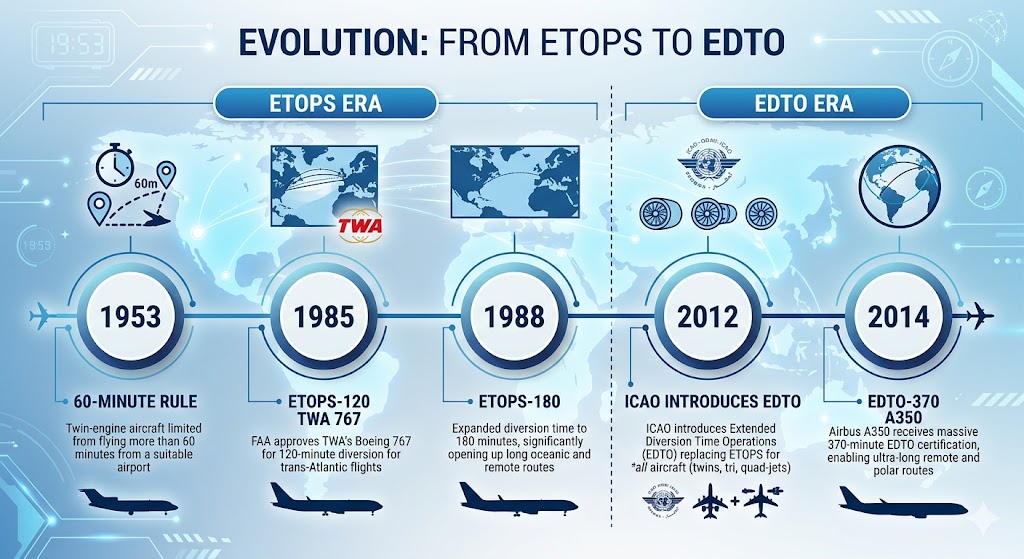
The original ETOPS—Extended-range Twin-engine Operational Performance Standards—was created in 1985 specifically for twin-engine aircraft. The 60-minute rule at the time banned two-engine planes from flying more than an hour from the nearest suitable airport, effectively reserving oceanic routes for three- and four-engine aircraft like the Boeing 747.
As twin-engine reliability improved, regulators progressively relaxed the limits: 120 minutes in 1985, 180 minutes in 1988, and 330 minutes by 2007. But by 2012, a fundamental question arose: if engine reliability had improved so dramatically that twin-engine jets were flying the most remote routes on Earth, shouldn’t the same diversion-time standards apply to all aircraft—including three- and four-engine types?
The answer was yes. In 2012, ICAO introduced EDTO through Amendment 36 to Annex 6 Part 1, replacing the twin-engine-only framework with a broader system that governs any turbine-engine aircraft operating beyond a threshold time from suitable diversion airports. Under EDTO, even a four-engine Boeing 747-8 must comply with extended diversion time requirements on ultra-remote routes—something the old rules never required.
The Naming Confusion
The terminology varies by regulator, which creates confusion:
ICAO: Uses EDTO (Extended Diversion Time Operations) as the official term since 2012. This is the global standard.
FAA (United States): Kept the abbreviation “ETOPS” but redefined it as “Extended Operations”—dropping the “Twin-engine” reference. The FAA’s rules are functionally identical to ICAO’s EDTO.
EASA (Europe): Uses “ETOPS” for twin-engine operations in its original meaning, and “LROPS” (Long Range Operations) for three- and four-engine aircraft on extended routes.
In daily operations at our Korean LCC, we follow Korean aviation authority regulations that align with ICAO’s EDTO framework. However, the term “ETOPS” remains universal in cockpit and dispatch communication because everyone in the industry understands it. Throughout this article, I will use both terms: EDTO when discussing the current framework, and ETOPS when referencing the historical context or the commonly used terminology.
2. How the EDTO Certification Works
The certification operates on two levels, identical in concept to the original ETOPS but broader in scope.
Aircraft Type Certification
The manufacturer must demonstrate that the airframe-engine combination meets specific reliability standards—proving that engines have an in-flight shutdown rate below a defined threshold, that critical systems (electrical, hydraulic, pressurization, fire suppression) have adequate redundancy, and that the aircraft can fly for the rated EDTO time on a single engine.
Current EDTO/ETOPS ratings for common aircraft types:
Boeing 737-800: 180 minutes (3 hours from diversion airports).
Boeing 777: 330 minutes (5.5 hours). Certified for the most remote oceanic routes.
Boeing 787 Dreamliner: 330 minutes. Designed from inception for extended oceanic operations.
Airbus A350: 370 minutes (over 6 hours). The highest rating ever achieved—covering 99.7% of the Earth’s surface.
Airline Operator Certification
The airline must separately prove that its maintenance program, crew training, and dispatch procedures meet EDTO standards. This includes demonstrating successful operations at lower ratings before approval for higher ones, and maintaining detailed records of any relevant in-service events.
For our Korean LCC, our maintenance team follows EDTO-specific inspection protocols before every oceanic flight, our crews complete specialized training (including single-engine procedures and oceanic emergency scenarios), and I—as the dispatcher—am qualified in the unique planning requirements of extended diversion time operations.
3. How I Plan an ETOPS/EDTO Flight
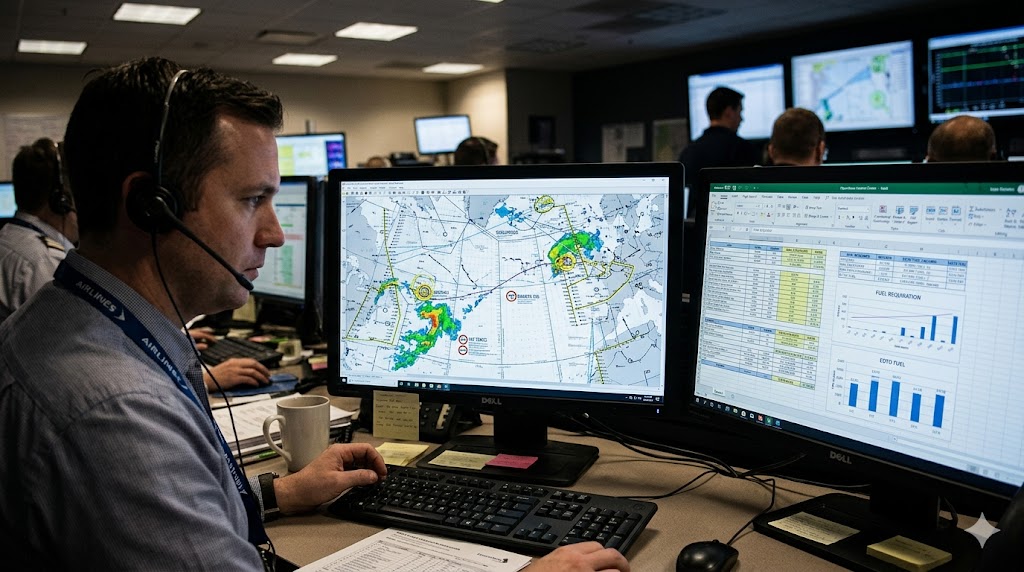
Whether we call it EDTO or ETOPS, the dispatcher’s planning process is identical in practice. Here is what I do before every oceanic crossing:
Step 1: Identify the entry and exit points. These mark where the aircraft enters and exits the extended diversion time area—the zone more than 60 minutes from suitable airports.
Step 2: Identify diversion airports. Along the route, I identify all airports that could serve as alternates if an engine failure or other emergency requires a diversion. Each must have adequate runway length, weather above minimums, fire and rescue services, and navigation aids.
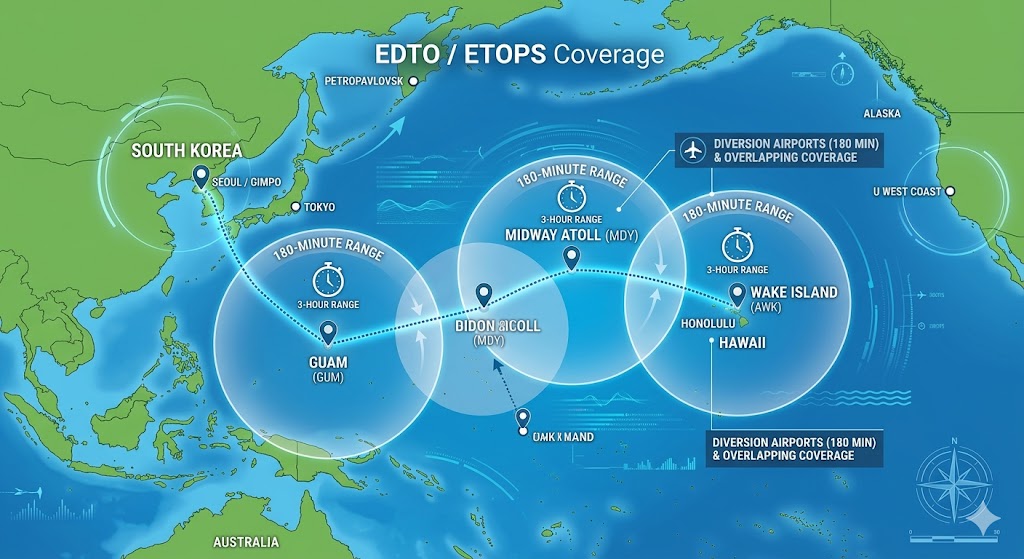
Step 3: Verify coverage. I draw range circles around each diversion airport representing the maximum single-engine diversion time. The circles must overlap continuously. Any gap means the route cannot be flown under EDTO rules—I must adjust the routing or find additional alternates.
Step 4: Calculate EDTO-specific fuel. The aircraft must carry enough fuel to reach the most distant alternate on one engine, in worst-case winds, plus mandatory reserves. This requirement often significantly exceeds normal fuel planning.
Step 5: Check weather at every alternate. If a typhoon closes one of my planned alternates, I must find a replacement, adjust the route, or—in extreme cases—cancel the flight.
Step 6: Verify aircraft dispatch status. Maintenance confirms all EDTO-critical systems are operational and pre-departure checks are complete. If any critical item is deferred, the aircraft cannot fly the oceanic route.
This process takes me 30-45 minutes per oceanic flight. But it ensures your aircraft is never, at any point over the ocean, beyond guaranteed reach of a safe airport.
4. Why Two Engines Are Actually Safer Than Four
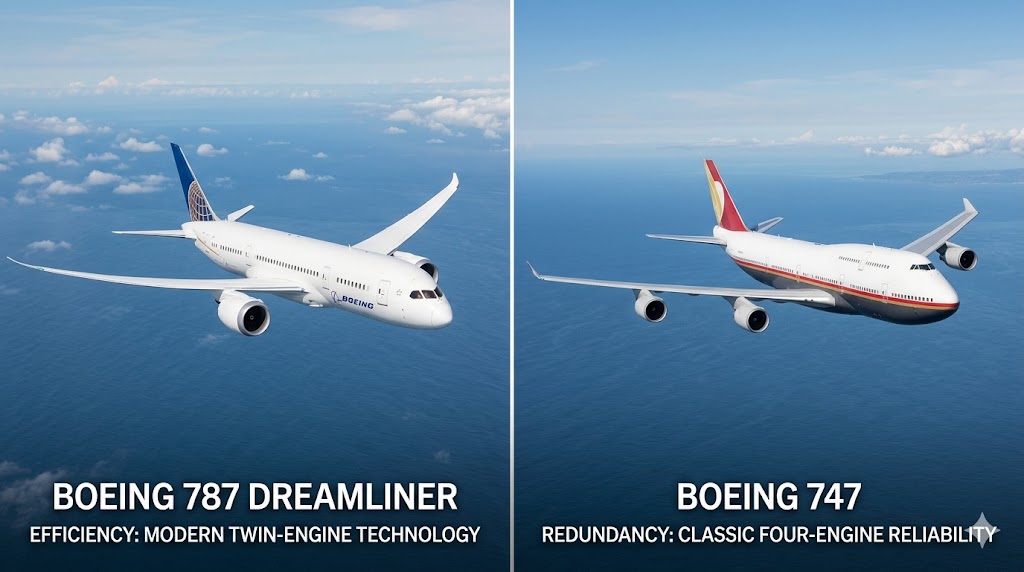
This sounds counterintuitive, but the data supports it:
Fewer engines means fewer failure points. Each engine is a complex system that can fail. Four engines means four potential failure sources. When per-engine reliability is extremely high, fewer engines actually reduces total system failure probability.
EDTO maintenance is more rigorous. Aircraft on extended diversion time certifications undergo more stringent inspections targeting systems critical to oceanic flight—engines, generators, hydraulics, fire suppression, pressurization. This enhanced maintenance further improves reliability.
Modern engine shutdown rates are extraordinary. In the 1960s, an engine might fail once every 10,000 hours. Today, engines like the GE90 and Rolls-Royce Trent XWB achieve in-flight shutdown rates below 1 per 500,000 hours. Both engines failing simultaneously is astronomically improbable.
The EDTO framework adds safety layers that never existed before. The old four-engine jets flew over oceans without specific alternate airport requirements. Under today’s EDTO rules, every aircraft on extended oceanic routes—regardless of engine count—must have guaranteed diversion airports within reach. This is actually a higher safety standard than what the 747 operated under for decades.
5. EDTO on Our Korean LCC Network
At our airline, extended diversion time rules apply primarily to Southeast Asian routes crossing the South China Sea and any seasonal routes venturing further over water.
Our 737-800 fleet operates within the 180-minute rating, covering routes to Bangkok, Manila, Ho Chi Minh City, and Denpasar. For most of these, the oceanic segment is 1-2 hours across the South China Sea.
Even “short” oceanic segments require full EDTO planning. I identify diversion airports along the crossing—Clark (Philippines), Kaohsiung (Taiwan), Da Nang (Vietnam), Hong Kong—and verify suitability for every flight. During typhoon season, when some alternates become weather-affected, planning grows more complex because coverage must be maintained without gaps.
On night flights across the South China Sea, I verify that alternates maintain 24-hour operations. An airport that closes at midnight is useless for a 2 AM diversion. This kind of detail is exactly what the planning process catches—protecting passengers without them ever knowing.
6. What Passengers Should Know
You have almost certainly flown under these rules. If you have crossed an ocean on a twin-engine aircraft—Boeing 777, 787, 767, or Airbus A330, A350—your flight operated under EDTO certification. The FAA calls it ETOPS; ICAO calls it EDTO. The safety is identical.
The “Engines Turn or Passengers Swim” joke is inaccurate. This dark humor acronym fundamentally misrepresents the system. Even with one engine out, the aircraft can fly for hours and reach a suitable airport. The probability of losing both simultaneously is vanishingly small.
Your safety over the ocean is not reduced. Thanks to certified aircraft, enhanced maintenance, trained crews, and meticulous dispatch planning, your risk over the ocean equals your risk over land.
If you track your flight across the ocean, you may notice the route is not perfectly straight. Oceanic routes sometimes curve to stay within diversion range. That curve is the EDTO safety planning at work.

7. The Future: Going Even Further
The EDTO framework continues to evolve. The Airbus A350’s 370-minute rating enables previously impossible routes, including transpolar and extreme southern Pacific crossings. The Boeing 777X, entering service now, will achieve similarly high ratings.
The trajectory is clear: four-engine aircraft are being retired in favor of twin-engine jets that are more fuel-efficient, cheaper to maintain, and equally safe under EDTO rules. The last Boeing 747 was delivered in 2023. The A380 production line closed in 2021. The future of long-haul aviation is twin-engine and fully EDTO-certified.
And from my desk in the OCC, that future means more oceanic planning, more diversion assessments, and more of the meticulous work that ensures every ocean crossing is as safe as any overland flight. Complex, demanding, and invisible to passengers—exactly how a good safety system should work.
Learn more about our mission and operational background on the About Aeruxo page.
Frequently Asked Questions
What is the difference between ETOPS and EDTO?
ETOPS (Extended-range Twin-engine Operational Performance Standards) was the original 1985 framework that applied only to twin-engine aircraft. In 2012, ICAO replaced it with EDTO (Extended Diversion Time Operations), which applies to all multi-engine aircraft—including three- and four-engine types. The FAA kept the abbreviation “ETOPS” but redefined it as “Extended Operations” (dropping the twin-engine reference). The practical safety requirements are identical; the key change is that EDTO’s scope is broader. In the industry, both terms are still used interchangeably in daily operations.
Is it safe to fly over the ocean on a plane with only two engines?
Yes. Modern twin-engine aircraft under EDTO rules have safety records equal to or better than four-engine aircraft. Engine in-flight shutdown rates are below once per 500,000 hours. The framework—certified aircraft, enhanced maintenance, trained crews, and meticulous dispatch planning—ensures a suitable airport is always within reach. Both engines failing simultaneously is astronomically improbable.
What happens if an engine fails over the ocean?
The aircraft continues safely on the remaining engine. Modern jets are designed to fly, climb, descend, and land on a single engine. The crew follows standard procedures, contacts ATC and the dispatcher, and diverts to the nearest suitable alternate—which, under EDTO rules, is always within the certified diversion time. As I described in my engine failure article, this scenario is well-planned and well-practiced.
Why did ICAO change from ETOPS to EDTO?
By 2012, engine and aircraft reliability had improved so dramatically that twin-engine jets were flying the most remote routes on Earth. ICAO recognized that the same diversion-time safety standards should apply to all aircraft—not just twins. A four-engine 747-8 flying a transpolar route faces the same remoteness challenges as a twin-engine 787. EDTO ensures every aircraft type on extended routes meets consistent safety standards, regardless of engine count.
Does the flight dispatcher plan differently for EDTO flights?
Yes, significantly. I must identify and verify diversion airports along the entire oceanic route, calculate specific fuel reserves for single-engine diversions, check weather at every alternate, confirm the aircraft’s dispatch status with maintenance, and ensure continuous coverage with no gaps. This process takes 30-45 minutes per oceanic flight—much more than a domestic plan.
Can I tell if my flight is operating under EDTO rules?
If your flight crosses a significant body of water on any commercial aircraft, it almost certainly operates under EDTO (or the FAA’s equivalent extended operations framework). You will not see “EDTO” on your boarding pass, but the entire safety system—the maintenance, crew training, and dispatch planning—is working behind the scenes on every oceanic crossing.
Have you ever thought about engine reliability while flying over the ocean? Share your thoughts in the comments.
Disclaimer: The views expressed in this article are my own professional opinions based on 15+ years of operational experience. They do not represent the official position of any airline, aviation authority, or regulatory body.