By Aeruxo — Licensed Flight Dispatcher | 15+ Years in Airline Operations
Flying in snow is one of the most operationally complex challenges in aviation…
It was a December morning, and New Chitose Airport in Sapporo was disappearing. Not gradually—rapidly. The METAR I pulled at 08:00 local showed 3,000 meters visibility with light snow. By 08:30, it was 800 meters. By 09:00, the airport had dropped to 200 meters visibility in heavy snow with blowing drifts across the runway. Two of our flights were inbound, one was 45 minutes out, and the other was just pushing back from Incheon.
Welcome to winter operations. In the aviation world, snow and ice are not just weather—they are an entirely different operating environment that changes every rule, every calculation, and every timeline. And for a flight dispatcher at a Korean LCC with heavy exposure to Japanese winter destinations, the months from December through February are a constant test of planning, adaptation, and quick decision-making.
This is the complete story of what happens when winter arrives at the airport—from the deicing trucks on the ramp to the fuel calculations on my screen to the moment your aircraft touches down on a cleared runway. If you have ever wondered why flying in snow creates so many delays, or whether it is actually safe, this article has your answers.
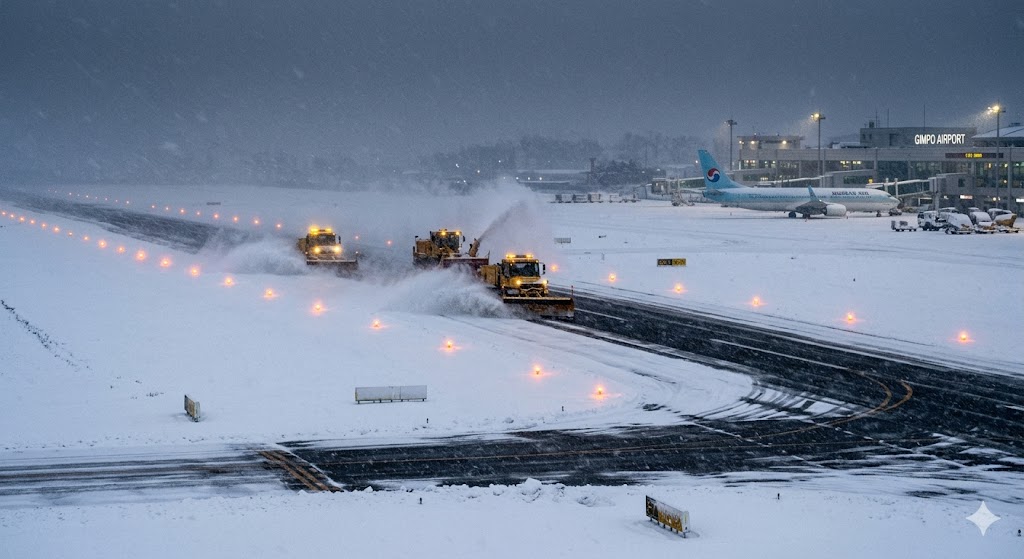
Key Takeaways
- Yes, planes can fly in snow. Modern commercial aircraft are designed and certified for winter operations. The challenge is not flying through snow—it is ensuring the aircraft is clean before takeoff and the runway is safe for landing.
- Deicing adds 20-45 minutes to your departure and is the single biggest cause of winter delays. It is also absolutely non-negotiable—even a thin layer of frost on the wings can prevent the aircraft from generating enough lift to fly safely.
- Winter delays cascade faster than summer delays because deicing queues, runway closures for snow removal, and reduced visibility all compound on top of normal operational constraints.
- Hokkaido airports (New Chitose, Asahikawa) are the most winter-challenging destinations on our network. Rapid snowfall, blowing snow, and temperatures below -15°C create conditions that test every aspect of the operation.
- The dispatcher’s winter workload doubles. Every flight requires additional analysis: runway conditions, deicing holdover times, contaminated runway performance calculations, and constantly updating alternate airport assessments as weather changes by the hour.
1. Can Planes Actually Fly in Snow? The Short Answer
Yes. Absolutely yes. Commercial aircraft routinely fly in snow, through snow, and to snow-covered airports. At cruising altitude—around 35,000 feet—the outside temperature is typically -40°C to -60°C. The aircraft is designed for this environment. Snow and cold are not inherently dangerous for a properly prepared airplane.
The challenges of winter aviation are almost entirely about two things: the ground and the transition between ground and air. Specifically:
Ice and snow on the aircraft’s surfaces must be removed before takeoff. Even a thin, almost invisible layer of frost on the wings disrupts the carefully engineered shape that produces lift. I will explain exactly why—and what we do about it—in the deicing section below.
Runway conditions change constantly during active snowfall. A runway that was cleared and safe 30 minutes ago might be covered with new accumulation or have reduced braking action. This affects takeoff and landing performance calculations significantly.
Visibility can drop suddenly during snow squalls, bringing operations to a halt within minutes. This is the most operationally disruptive aspect of winter weather on our Japan routes—visibility can go from 5 km to 300 meters in the time it takes to drink a cup of coffee.
So when your winter flight is delayed, it is not because the aircraft cannot handle the cold. It is because the ground environment requires additional preparation, verification, and sometimes patience before the aircraft can safely depart or land.
2. Deicing: The 30 Minutes That Keep You Alive
If there is one thing I want every winter traveler to understand, it is deicing. It is the most visible cause of winter delays, the most complained-about procedure, and quite possibly the most important safety operation in all of aviation.
Why Deicing Matters
SKYbrary’s aircraft de-icing reference. Aircraft wings are engineered to a precise aerodynamic shape. That shape generates lift—the force that keeps 70 tonnes of metal in the air. Ice, snow, or even frost disrupts this shape. The roughness on the wing surface breaks up the smooth airflow, reducing lift and increasing drag. The effect is not subtle: studies have shown that contamination as thin as sandpaper on the wing’s leading edge can reduce lift by up to 30% and increase drag by 40%.
At takeoff, when the aircraft is heavy, slow, and close to the ground, this loss of lift can be catastrophic. There have been accidents in aviation history directly caused by attempting takeoff with ice-contaminated wings. This is why deicing is never optional, never abbreviated, and never skipped to save time. As a flight dispatcher, I will never release a flight during winter conditions without confirming that deicing has been completed—or is not required (the “clean aircraft concept” check).
The Two-Step Process
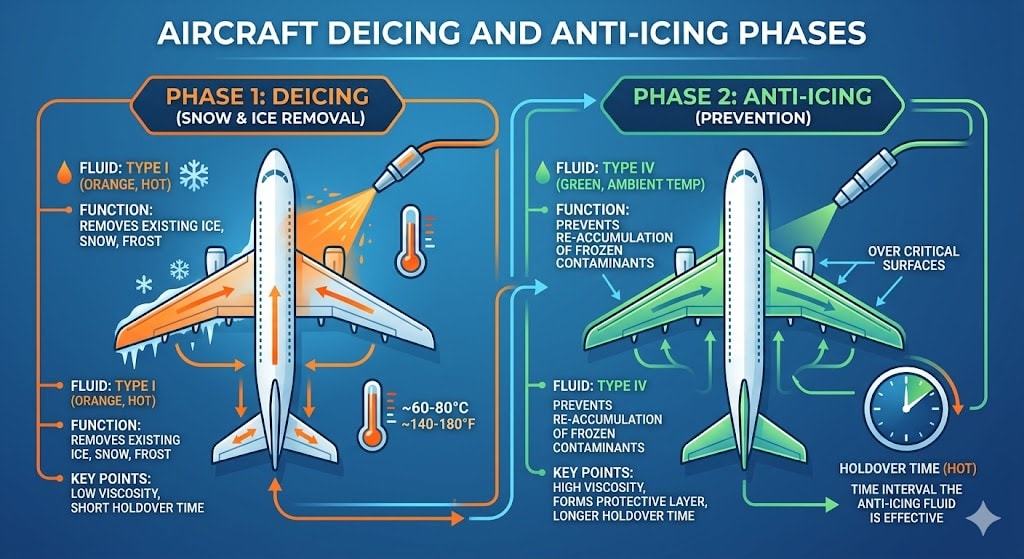
Step 1: Deicing (Type I Fluid). Hot fluid (typically heated to 60-80°C)—usually orange in color—is sprayed over the wings, tail, and fuselage to melt and remove any existing ice, snow, or frost. This is the “cleaning” step. The hot fluid melts the contamination and flows off the aircraft surfaces, taking the ice with it.
Step 2: Anti-icing (Type IV Fluid). A thicker, usually green fluid is then applied over the cleaned surfaces. This fluid forms a protective gel layer that prevents new ice or snow from accumulating during the time the aircraft taxis from the deicing pad to the runway. This protection is temporary—it has a specific holdover time that depends on the temperature and the type and intensity of precipitation.
Here is where it gets operationally critical: holdover time is a countdown clock. From the moment anti-icing fluid is applied, the crew has a limited window to reach the runway and begin the takeoff roll. If the holdover time expires—because of a long taxi, a departure queue, or ATC delays—the aircraft must return to the deicing pad and start the entire process over. I have seen this happen multiple times at congested airports during heavy snowfall, and each re-deicing cycle adds another 20-30 minutes to the delay.
The Deicing Queue
At airports with heavy winter traffic, the deicing pad itself becomes a bottleneck. Imagine 15 aircraft all needing deicing within the same hour. Each one takes 15-25 minutes (longer for larger aircraft). The deicing trucks—specialized vehicles with boom-mounted spray nozzles—are limited in number. The result is a queue that can add 30-60 minutes to your departure even before you reach the runway.
On our Japan routes, deicing is most frequently required at Sapporo New Chitose, Asahikawa, and occasionally at Narita and Kansai during cold snaps. At Incheon during Korean winter, deicing is routine from December through February. The logistics of deicing at each airport differ—some have dedicated deicing pads, others deice at the gate, and the fluid types and availability vary. As a dispatcher, I need to factor all of this into my departure time estimates.
3. The Dispatcher’s Winter Workload: Everything Gets Harder
If summer is when I deal with typhoons and monsoon thunderstorms, winter is when I deal with slow, grinding, compounding delays that build throughout the day. The nature of the challenge is completely different.
Additional Calculations for Every Flight
Every winter flight requires calculations that do not exist in summer:
Contaminated runway performance. When a runway is wet, covered with compacted snow, or icy, the aircraft needs significantly more distance to stop. I must recalculate landing performance using the reported runway condition code (a standardized assessment of braking action). A runway with “medium” braking action might require 30-50% more landing distance than a dry runway. If the required landing distance exceeds the available runway length at the destination, the flight cannot operate to that airport. I either need to reduce the aircraft weight (fewer passengers or cargo), select an alternate with a longer runway, or delay until conditions improve.
Takeoff performance on contaminated runways. The same principle applies to departure. Snow or slush on the runway reduces acceleration and increases the required takeoff distance. I calculate these numbers before every winter departure and compare them against the available runway length. On a short-runway regional Japanese airport during snowy conditions, the margins can get tight enough to require payload restrictions.
Additional fuel for winter operations. Winter flights typically carry more fuel than their summer equivalents for several reasons: longer taxi times due to deicing and snow removal operations, potential holding at the destination due to runway closures for snow clearing, higher probability of go-arounds due to visibility fluctuations, and the possibility of diversion if the destination closes unexpectedly.
Alternate airport assessment becomes more complex. In summer, selecting an alternate is usually straightforward—pick an airport with good weather nearby. In winter, the same weather system that is affecting your destination might also affect the obvious alternate. When Sapporo New Chitose is buried in snow, Asahikawa—the logical alternate—might be even worse. I sometimes need to look as far as Sendai or even Haneda for a viable alternate, which significantly increases the fuel requirement.
Constant Weather Monitoring
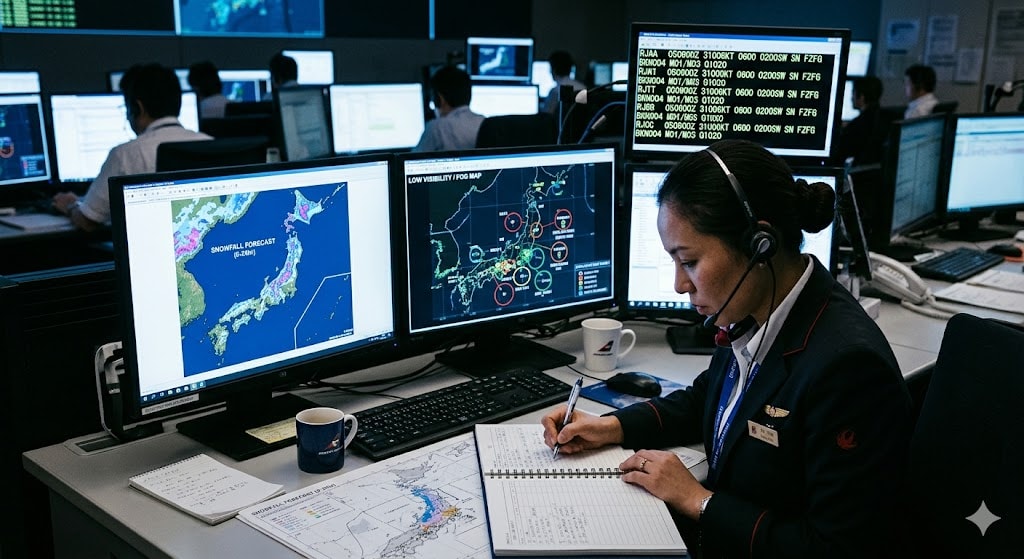
Winter weather changes faster than summer weather in many of the regions I cover. A frontal passage can bring a Hokkaido airport from VFR (Visual Flight Rules) conditions to below ILS minimums in 20 minutes. I monitor METARs every 15-30 minutes for destination and alternate airports during active winter weather, and I watch the SPECI (special) reports that airports issue when conditions change rapidly.
One technique I have developed over the years: I read the synoptic charts first thing at the start of my shift, not just the TAFs. Understanding the broader weather pattern—where the fronts are, how fast they are moving, what is behind them—gives me a mental model that helps me anticipate changes faster than waiting for the forecasts to update. When I see a front approaching Hokkaido at 30 knots, I can estimate when conditions will deteriorate and plan accordingly, sometimes before the TAF has been amended.
4. Hokkaido: My Winter Classroom
If you want to understand winter operations, study Hokkaido. In my 15 years, no destination has taught me more about winter flying than Sapporo New Chitose Airport.
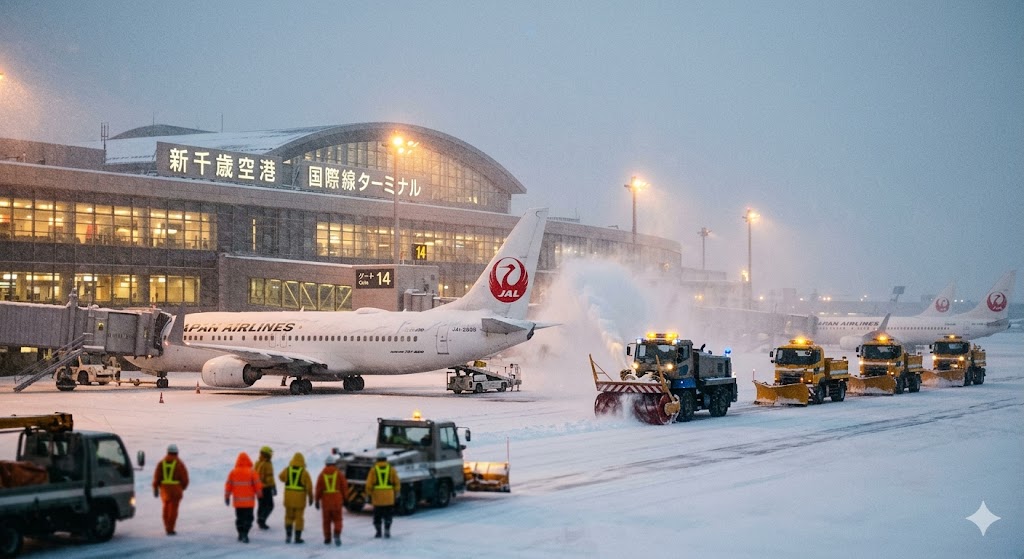
New Chitose receives some of the heaviest snowfall of any major commercial airport in the world. During peak winter, snowfall rates can exceed 5 cm per hour for extended periods. The airport has an impressive snow removal operation—dedicated fleets of snowplows, rotary blowers, and sweepers that work continuously to keep the runways operational. But even with this capability, the airport frequently closes temporarily for snow clearing operations, typically for 30-60 minutes at a time.
Here is what a typical challenging Hokkaido day looks like from my desk:
06:00: I check the TAF for New Chitose. It shows TEMPO (temporary) heavy snow with 500m visibility between 09:00 and 15:00 local. I have three flights planned to Sapporo today: 08:00 departure, 11:00 departure, and 14:00 departure.
07:30: The 08:00 flight is ready to depart Incheon. Current New Chitose weather is still acceptable—2,000m visibility, light snow. I release the flight with extra fuel (1,500 kg above minimum) for possible holding and a go-around. Alternate is Asahikawa, but I note that Asahikawa’s TAF also shows deteriorating conditions. I add Hakodate as a second alternate option in my notes.
09:15: The first flight is 30 minutes from landing. New Chitose METAR has dropped to 800m visibility in heavy snow. The airport announces a 30-minute runway closure for snow removal. I send an ACARS message to the crew: “CTS runway closed for snow removal. Expected reopen 09:45. Fuel check please.” The crew has enough fuel to hold for 45 minutes. We hold.
09:50: Runway reopens. The crew makes an approach. Visibility is now 1,200m—above minimums. They land successfully. But the 30-minute hold and the deicing required at New Chitose for the return flight mean the aircraft will depart Sapporo at least 90 minutes late. The domino effect has begun—the 11:00 Incheon departure that was supposed to use this aircraft will now depart around 14:00.
10:30: I am now recalculating the entire afternoon schedule. The 14:00 departure to Sapporo might not have an aircraft available until 16:00. The crew for the 14:00 departure has a duty time limit that expires at 22:00. Can they still complete the round trip if the departure slips to 16:00? I check the numbers. It is going to be extremely tight. I alert crew scheduling that we may need a crew swap.
This kind of cascading winter disruption—slower, more grinding, and more complex than a typhoon cancellation but just as demanding—is the daily reality of winter dispatching to Hokkaido. And it continues, day after day, for three months.
5. The Runway Condition Report: Reading the Surface
One of the most important tools in winter operations is the runway condition report—a standardized assessment of what is actually on the runway surface and how it affects aircraft braking.
FAA winter operations guidelines. ICAO introduced the Global Reporting Format (GRF) for runway conditions, which standardizes how airports around the world report surface contamination. The runway is divided into thirds, and each third receives a condition code from 0 to 6:
- 6: Dry — normal braking
- 5: Wet — slightly reduced braking
- 3-4: Compacted snow, slush — significantly reduced braking
- 1-2: Ice, wet ice — severely reduced braking
- 0: Unreliable braking — operations may not be possible
When I receive a runway condition report showing codes of 3 or below, I must recalculate landing performance to ensure the aircraft can stop safely within the available runway distance. On a 3,000-meter runway at New Chitose with a condition code of 3 (compacted snow), the required landing distance for a fully loaded 737-800 might increase from 1,800 meters to 2,600 meters. The margins shrink. And if the code drops to 2 or lower, I may not be able to dispatch the flight to that airport at all—the numbers simply do not work.
This is a calculation I perform before every winter departure to a potentially affected airport, and I update it as new runway condition reports come in. Conditions can change between the time I release the flight and the time it arrives, which is why I monitor continuously and communicate with the crew en route if the situation deteriorates.
6. Why Winter Delays Cascade Faster
In my article on flight delays, I explained the domino effect—how one delayed flight cascades through an aircraft’s daily schedule. In winter, this effect is amplified by multiple compounding factors:
Deicing adds time at every stop. A 25-minute deicing procedure at departure, plus another 25 minutes at the turnaround station, adds nearly an hour to a round trip that might only have a 30-minute buffer in the schedule. The buffer is consumed before the aircraft even gets airborne.
Runway closures for snow removal are unpredictable and recurring. An airport might close for 30 minutes every 2 hours during steady snowfall. Each closure delays every flight in the queue, and the delays stack on top of each other.
Reduced visibility causes go-arounds, holdings, and diversions. Each of these events adds 15-60 minutes to the flight, and the fuel consumed during holding may require additional refueling at the turnaround—adding even more time.
Ground handling slows down. Loading and unloading baggage in snow and ice takes longer. Pushback tractors may have difficulty on slippery ramps. Fueling trucks move slower. Every ground operation takes 10-20% longer in winter conditions.
The net effect is that a schedule that works perfectly in summer becomes structurally stressed in winter. An airline running a 737-800 on a Seoul-Sapporo-Seoul-Osaka-Seoul rotation with 45-minute turnarounds in summer will almost certainly fall behind schedule in winter, because those 45-minute turnarounds become 65-minute turnarounds with deicing—and that 20-minute overage on every stop adds up to a 60-80 minute total delay by the end of the day.
This is not the airline being inefficient. It is the fundamental physics of winter operations. And it is why, as I said in my article on aviation safety, patience during winter travel is not just a virtue—it is a necessity.
7. Korean Winter vs. Japanese Winter: Two Different Challenges
Most passengers assume winter is winter. But from a dispatcher’s perspective, winter operations at Incheon and winter operations at Sapporo are entirely different challenges.
Incheon (ICN) in winter typically sees moderate cold (around -5°C to -10°C), occasional light snowfall, and periodic freezing fog. Deicing is required frequently but snowfall accumulation is usually manageable. The airport’s snow removal capability is excellent, and runway closures for snow clearing are relatively short. The biggest winter challenge at Incheon is usually freezing fog or black ice on taxiways, which slows ground operations.
Sapporo New Chitose (CTS) in winter is an entirely different animal. Heavy, wet Sea of Japan effect snowfall can dump 10-20 cm per hour during peak events. Temperatures can drop below -15°C. Visibility can fluctuate wildly—clear one moment, near-zero the next as a snow squall moves through. The airport has world-class snow removal capability (it has to), but even so, temporary closures are frequent and extended closures during blizzard conditions are not uncommon.
The intermediate destinations—Osaka Kansai, Fukuoka, Nagoya Chubu—rarely see significant winter weather, but when they do, these airports are less prepared than Hokkaido airports because snow events are infrequent. I actually worry more about a rare snow event at Kansai than a routine snowfall at New Chitose, because New Chitose has the equipment, procedures, and experience to handle it. Kansai does not receive heavy snow often enough to maintain the same level of winter operations readiness.
8. Practical Tips for Winter Travelers
Based on 15 winters of dispatching flights across Japan and Korea, here is my honest advice.
Book the earliest flight of the day. Winter delays compound throughout the day. The first morning departure has the least accumulated delay, the freshest crew, and the cleanest aircraft (if overnight parking was in a heated hangar or the deicing queue is shortest). By afternoon, the cascading effects of multiple deicing cycles, runway closures, and ground delays have stacked up.
Allow generous connection times in winter. If you are connecting through Incheon in January, do not book a 1.5-hour connection. Make it 3-4 hours minimum. A deicing delay on your inbound flight, combined with a gate change and a security recheck, can easily consume 2 hours.
Pack essentials in your carry-on. During winter disruptions, checked baggage may not follow you if you are rebooked onto a different flight. Keep medications, phone chargers, a change of clothes, and any critical items in your carry-on.
Download the airline’s app and monitor actively. Winter schedule changes can happen rapidly. An 11:00 departure might become a 13:00 departure by mid-morning as the deicing queue grows. Check your flight status frequently—every 30 minutes during active winter weather is not excessive.
If flying to Hokkaido in winter, build in a buffer day. I give the same advice for winter Hokkaido trips that I give for typhoon season destinations: add a buffer day to your itinerary. A one-day delay in Sapporo due to a blizzard is annoying but manageable if you have flexibility. It becomes a crisis if you have a non-refundable commitment the next morning in Seoul.
Dress for the tarmac, not the terminal. If your flight diverts or if you need to deplane via stairs at a winter airport, you may be walking across a frozen ramp in whatever you are wearing. Having a warm layer accessible is practical, not paranoid.
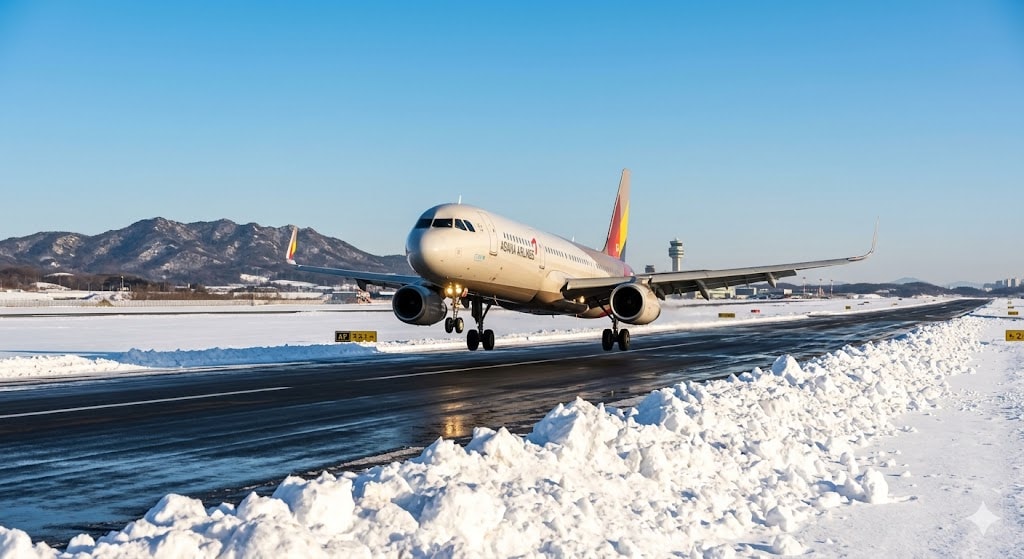
9. A Closing Thought: The Beauty of Winter Operations
I complain about winter operations a lot during the season. The workload is relentless. The delays are frustrating. The cascading disruptions test my patience daily.
But there is something quietly beautiful about winter aviation that I have come to appreciate over the years. Watching a deicing crew work in -10°C snowfall at 5 AM, methodically spraying down an aircraft that will carry 180 people safely across the Sea of Japan—that is dedication. Hearing a crew report “runway in sight” after holding for 30 minutes above Sapporo waiting for a snow squall to pass—that is skill. Successfully guiding an aircraft through a Hokkaido blizzard to a safe landing, then turning it around for the return flight with a re-planned fuel load, a fresh deicing, and a crew that still has the hours to fly—that is the flight planning system working at its absolute best under the most demanding conditions.
Winter does not make flying dangerous. It makes flying harder. And the entire aviation system—the dispatchers, the pilots, the deicing crews, the snow removal teams, the air traffic controllers—rises to meet that challenge every single day, in every snowstorm, so that you can visit Sapporo’s snow festival, ski in Niseko, or watch the drift ice in Abashiri, and arrive safely.
That is something worth being delayed for.
Learn more about our mission and operational background on the About Aeruxo page.
Frequently Asked Questions
Can planes take off and land in snow?
Yes. Commercial aircraft regularly operate in snowy conditions worldwide. The key requirements are: the aircraft must be deiced before departure to ensure clean aerodynamic surfaces, and the runway must be adequately cleared with acceptable braking conditions. Airports in snowy regions like Hokkaido, Scandinavia, and northern North America have extensive snow removal and deicing capabilities specifically for this purpose. Flying in snow is routine—it just requires additional preparation time.
Why does deicing take so long?
The deicing process itself typically takes 15-25 minutes for a narrow-body aircraft. However, the total delay includes waiting in the deicing queue (which can be 30-60 minutes at busy airports during heavy snow), the possibility of needing a second deicing if holdover time expires during taxi delays, and the slower ground operations that accompany winter weather. Each of these elements adds time. The process is thorough because it is safety-critical—rushing deicing to save time has caused fatal accidents in aviation history.
Is it more dangerous to fly in winter?
No. Winter flying is not more dangerous—it is more operationally complex. The additional procedures (deicing, contaminated runway calculations, enhanced weather monitoring) exist precisely to maintain the same level of safety regardless of season. The risk of winter flying is not safety-related; it is schedule-related. You are more likely to experience delays, go-arounds, and diversions during winter, but the safety of the flight itself is not compromised. As I discussed in my aviation safety article, the system is designed to adapt to conditions while maintaining safety standards.
What happens if the runway is too icy for landing?
If the runway condition report shows braking action that is below safe limits for the aircraft type and weight, the flight cannot land at that airport. The options are: hold and wait for conditions to improve (if fuel permits), divert to an alternate airport with better conditions, or in some cases, wait for the airport to perform additional runway treatment (applying chemicals or additional clearing). As the flight dispatcher, I make this assessment before departure and continuously during the flight. No aircraft under my dispatch will attempt to land on a runway that does not meet the required performance criteria.
Why was my flight cancelled when there was only light snow?
Several reasons. The “light snow” at your airport might be heavy snow at the destination or at the airport where your aircraft is coming from (the domino effect). Or the forecast might show conditions deteriorating later—and cancelling proactively avoids stranding passengers and aircraft at an airport where they cannot return from. Or the accumulated delays from deicing and runway closures throughout the day have pushed the crew past their legal duty limits. Winter cancellations are often the result of multiple compounding factors rather than a single dramatic event.
Do I need to worry about ice on the plane’s wings during flight?
No. Modern commercial aircraft have anti-icing systems that prevent ice accumulation during flight. These systems use hot air from the engines (bleed air) or electrical heating elements to keep critical surfaces ice-free in flight. The concern about ice is primarily on the ground, before takeoff—which is why the deicing process is so important. Once the aircraft is airborne and the anti-icing systems are operating, in-flight icing on the wings is managed automatically by the aircraft’s systems.
Flying to Hokkaido this winter? Have a question about winter operations? Leave a comment—I will answer from a dispatcher’s perspective.
Disclaimer: The views expressed in this article are my own professional opinions based on 15+ years of operational experience. They do not represent the official position of any airline, aviation authority, or regulatory body.