By Aeruxo — Licensed Flight Dispatcher | 15+ Years in Airline Operations
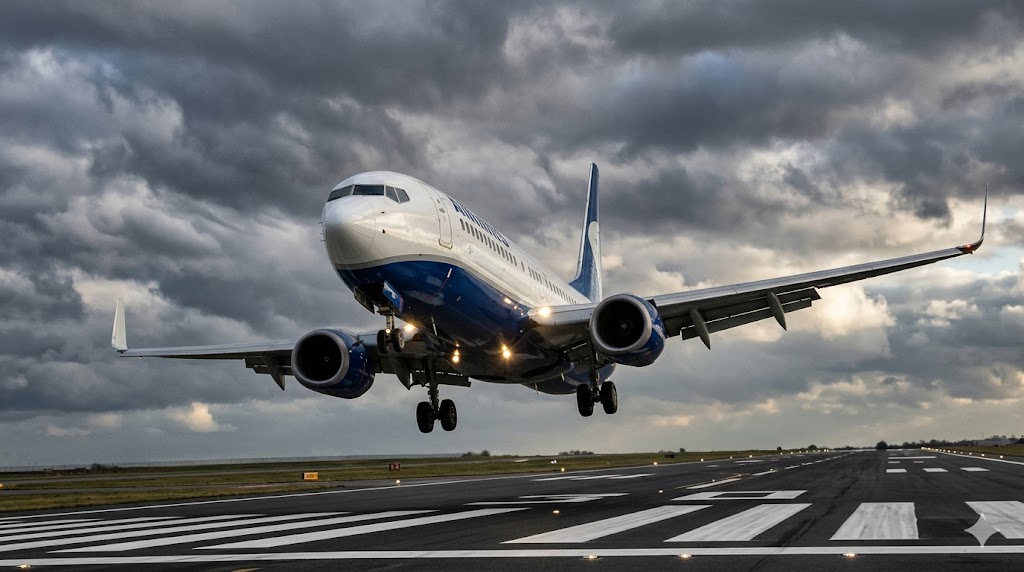
You have seen the videos. A commercial aircraft approaching a runway sideways, nose pointed 20 degrees off the centerline, wings rocking, the whole thing looking like a controlled disaster. Then—impossibly—the pilot straightens out at the last second, plants the wheels on the pavement, and rolls to a stop. The YouTube comments explode: “How is this legal?” “I would never fly in this.” “Those passengers must be terrified.”
I have watched those crosswind landing videos too. And every time, I think the same thing: that is a pilot demonstrating extraordinary skill in a completely normal situation.
A crosswind landing is not a near-miss. It is not an emergency. It is a standard, trained, and routine maneuver that every commercial pilot performs regularly. After 15 years as a flight dispatcher calculating wind components for every arrival on my desk, I can tell you that most flights involve some degree of sideways wind. You have almost certainly experienced this technique without noticing.
This article explains what actually happens during a crosswind landing, why it looks so dramatic on camera, how pilots execute the maneuver, what limits exist, and why the scariest video you have ever seen was almost certainly a perfectly safe operation.
Key Takeaways
- A crosswind landing is not an emergency. It is a standard technique pilots use on the majority of flights, because wind is almost never perfectly aligned with the runway.
- Every commercial aircraft has a certified wind limit—typically 33-38 knots for narrow-body jets. Pilots will not attempt an approach above this limit; they will divert or wait.
- Two techniques are used: crabbing and sideslip. “Crabbing” (flying nose into the wind) looks scary from outside but feels smooth for passengers. The pilot straightens out just before touchdown.
- This skill is tested every 6 months in simulator checks. Pilots practice at maximum limits in conditions far worse than they typically encounter in real operations.
- As a dispatcher, I calculate the wind component before every flight. If the forecast exceeds limits, I coordinate with the crew—and we do not attempt it.
1. What Is a Crosswind Landing?
Put simply, a crosswind landing is any landing where the wind blows at an angle to the runway rather than straight down it. That is the entire definition. Nothing dramatic. Nothing emergency-related. Just wind from the side.
Runways are built to align with the prevailing wind direction at each airport. But wind does not always cooperate. When it shifts—due to weather fronts, local terrain, or normal atmospheric variation—it creates a sideways component that the pilot must compensate for during the approach and touchdown.
Here is the key fact most passengers miss: some degree of sideways wind exists on the majority of flights. Wind is almost never perfectly aligned with the runway. A 5-knot sideways component? Completely unnoticeable. A 15-knot component? A slight drift the pilot corrects smoothly. A 30-knot component? Now we are in the territory of the dramatic videos—and even these are within normal operating limits for most commercial aircraft.
The approach only looks dramatic when the wind is strong enough to visibly offset the aircraft’s heading from the runway direction. At that point, the aircraft appears to be flying “sideways.” But from the pilot’s perspective, it is simply compensating for a known force using trained techniques.
2. The Two Techniques: Crab and Sideslip
Commercial pilots use two primary methods for handling sideways wind during approach and touchdown, often combining them.
The Crab Technique
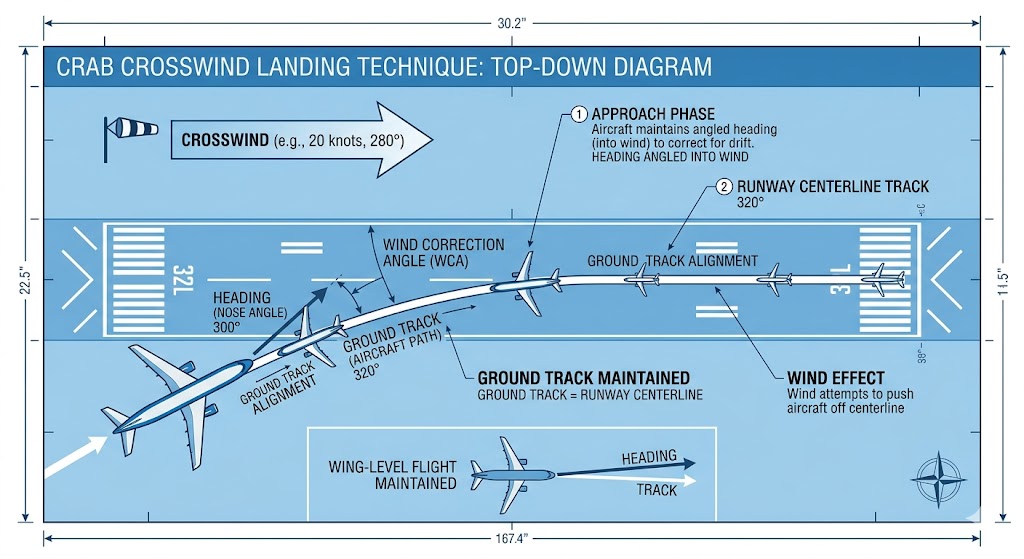
This is the method responsible for 90% of those “scary” videos. The pilot points the aircraft’s nose into the wind to compensate for the sideways push, keeping the ground track aligned with the runway centerline.
From outside, the crabbed approach looks alarming: the aircraft appears to fly sideways, nose pointing 10-20 degrees off center. From inside the cabin, however, passengers barely notice. The wings are level, the ride is smooth, and the aircraft feels straight. The visual disconnect between the ground observer’s perspective and the passenger’s experience is enormous.
Just before touchdown, the pilot applies rudder to “kick” the nose straight—aligning the fuselage with the runway in the final 1-3 seconds. Executed well, this de-crab happens in a single fluid motion that passengers perceive as a slight yaw—if they notice at all.
The Sideslip (Wing-Low) Technique
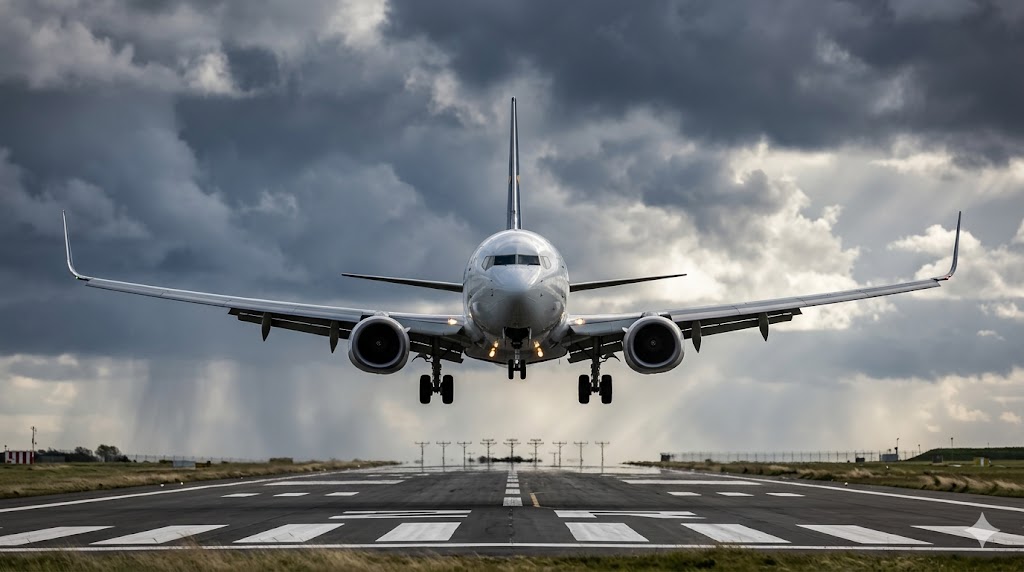
The sideslip takes a different approach. Instead of pointing the nose into the wind, the pilot banks toward the wind (lowering the upwind wing) and applies opposite rudder to keep the fuselage aligned with the runway.
From outside, this looks like the aircraft is tilting with one wing noticeably lower. Passengers feel pushed slightly toward the low-wing side—less comfortable than the crab but well within normal ranges.
The aircraft touches down on the upwind main gear first, then the second gear settles, followed by the nose wheel. This one-wheel touchdown is completely normal—the landing gear is engineered for asymmetric loads.
The Real-World Combination
In practice, most commercial pilots use a combination: crabbing during the approach (comfortable for passengers) and transitioning to a sideslip in the final seconds before touchdown. This “crab-and-kick” technique is the standard method taught at airlines worldwide and is what you see in those viral videos.
3. Wind Limits: When Pilots Do Not Attempt the Approach
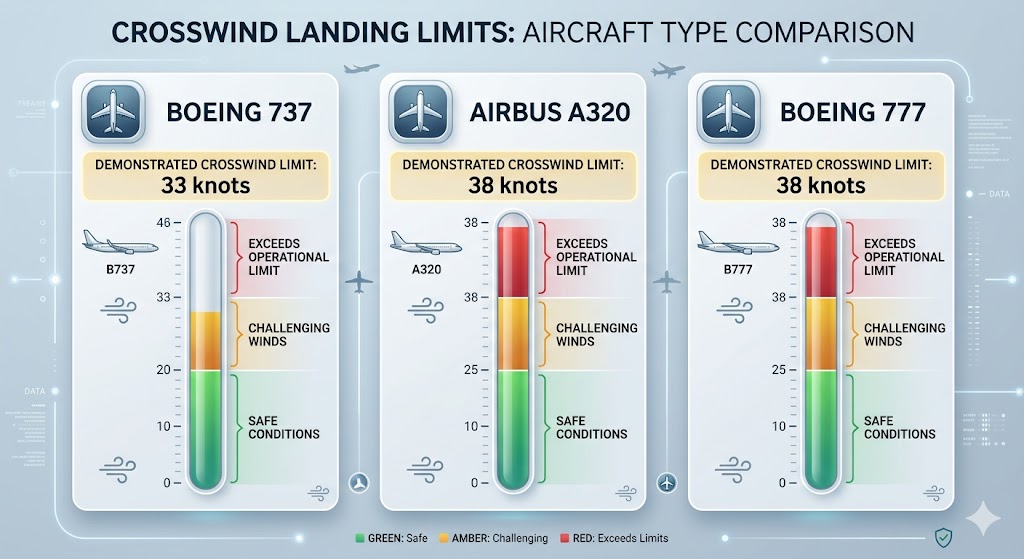
Every commercial aircraft has a demonstrated crosswind component—the maximum perpendicular wind speed at which the aircraft has been successfully landed during FAA or EASA certification flight testing. Typical values:
Boeing 737-800: 33 knots (61 km/h).
Airbus A320/A321: 38 knots (70 km/h).
Boeing 777: 38 knots (70 km/h).
These are not theoretical—test pilots actually performed landings at these wind speeds during certification. Airlines may set lower operational limits based on runway conditions, crew experience, and company policy.
What happens when the wind exceeds the limit? The crew does not attempt the approach. They go around and either wait for conditions to improve or divert to an airport with a better-aligned runway. This is exactly what I plan for in the flight plan—selecting alternates specifically for strong-wind scenarios.
The Dispatcher’s Wind Calculation
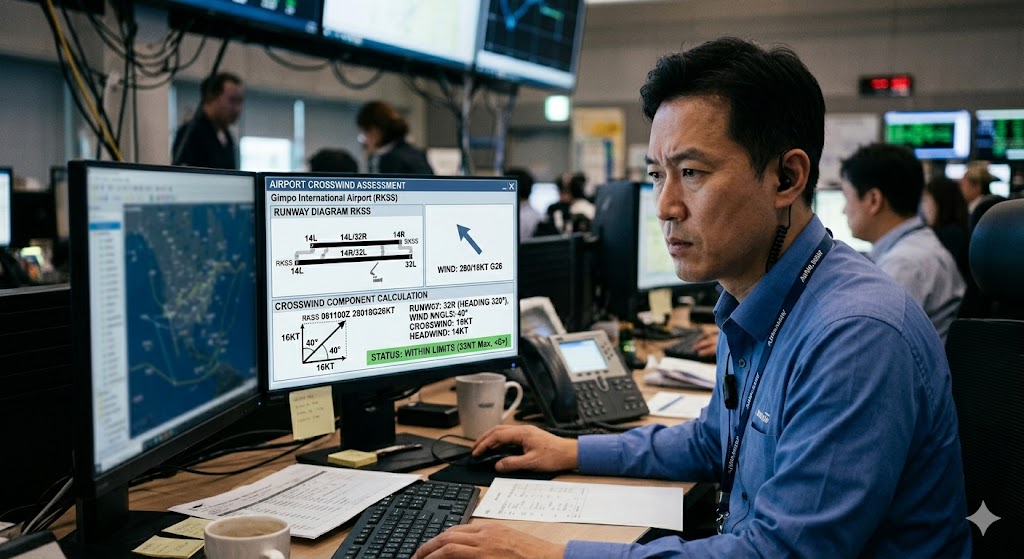
Before every flight, I check the forecast wind and calculate the perpendicular component—a simple trigonometric calculation. If the result approaches or exceeds the aircraft’s limit, I flag it and brief the crew.
A typical brief: “Destination wind 270/32G45. Runway 36 component 32 knots steady, gusting 45. Limit 33 knots. Recommend alternate runway 27 if available, or diversion to Gimhae where 36L is aligned.”
This pre-departure assessment is one of the ways the dispatch system protects you. If conditions make a safe approach unlikely, we adjust the plan proactively.
4. Why the Videos Look Scarier Than the Reality
The gap between how these approaches look and how they feel is the biggest source of passenger anxiety. Here is why:
Camera perspective distorts reality. Videos are filmed from the ground using telephoto lenses that compress depth and amplify the apparent angle. A 10-degree crab—barely noticeable inside—looks like the aircraft is flying completely sideways through a telephoto lens.
Wing rocking looks violent from outside. In gusty conditions, the pilot continuously adjusts bank angle. From outside, this resembles loss of control. From inside, passengers feel gentle swaying—less than a car on a curvy road. As I explained in my aviation safety article, aircraft movements feel much milder from inside.
The “kick” looks desperate. The de-crab maneuver at the last moment looks like a panicked save. In reality, the timing is deliberate and practiced extensively in simulator training every six months.
The one-wheel touchdown looks wrong. In a sideslip approach, one main gear contacts before the other. Video viewers assume something failed. It did not—this is the correct technique, and the landing gear is designed for exactly this load pattern.
5. Airports on Our Network Known for Challenging Winds
Certain airports on our Korean LCC network are particularly prone to strong perpendicular winds:
Jeju (CJU): Jeju Island’s exposed position in the Korea Strait makes it one of the windiest airports on our network. During winter, strong northwesterly winds regularly approach aircraft limits. Multiple go-arounds per winter season are routine here.
Osaka Kansai (KIX): Built on an artificial island, Kansai is exposed to sea winds from all directions. The single-runway configuration means there is no option to switch to a wind-favorable runway—the crew either executes within limits or diverts.
Da Nang (DAD): During the northeast monsoon (October-February), Da Nang’s coastal position creates persistent perpendicular wind conditions. I routinely load extra fuel for winter Da Nang flights to account for possible go-arounds.
Narita (NRT): Winter wind patterns occasionally create challenging conditions, particularly on gusty days when the wind oscillates between headwind and perpendicular components.
Understanding which airports present challenges helps me plan proactively—additional fuel, alternate selection, crew briefing, and contingency plans for schedule disruption.
6. What Passengers Actually Feel
Here is what you experience from your seat—not what the video shows:
During the crab approach: Nothing unusual. Wings are level, the aircraft feels straight. You may notice through the window that the runway appears at an angle. Inside, the sensation is normal.
During the de-crab: A brief sideways swinging sensation lasting 1-2 seconds as the pilot straightens the nose. Some passengers describe this as a “fishtail” feeling. Momentary and mild.
During touchdown: The landing may feel slightly firmer than on a calm day. In a sideslip approach, you may feel a brief tilt as one gear contacts before the other. The aircraft settles smoothly within 1-2 seconds.
During rollout: The pilot applies rudder to keep tracking straight—the wind still pushes sideways on the ground. This feels like minor side-to-side corrections, similar to driving in a strong side gust.
In my airplane sounds article, I explained that unfamiliar sensations create anxiety. The same applies here: once you know what the feelings mean, they stop being frightening.
7. Why This Skill Matters So Much
Wind-condition proficiency is one of the most heavily tested pilot skills. Here is why:
Windy approaches contribute to runway excursions. A runway excursion—where the aircraft leaves the runway surface—is one of the most common accident categories. Perpendicular wind contributes to approximately one-third of these events, making this technique critical.
The condition cannot be avoided entirely. Unlike typhoons or volcanic ash, which are dramatic but infrequent, perpendicular wind is a daily reality. Pilots must master this because they encounter it constantly.
Simulator training pushes beyond normal. During recurrent checks every six months, pilots practice at the aircraft’s maximum demonstrated component—and sometimes beyond. By the time a pilot encounters a challenging real-world scenario, they have already succeeded at equal or greater severity dozens of times.
The go-around is always available. If the approach is not stabilized, the pilot goes around. As I described in my go-around article, this provides a safe exit from any approach that does not meet standards.
8. A Windy Approach I Remember
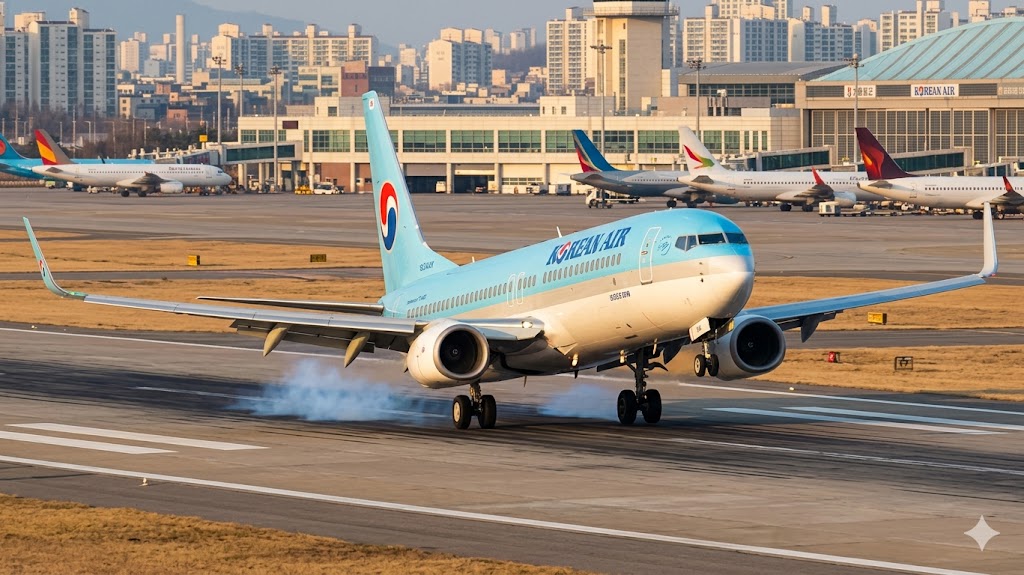
Winter at Jeju. The forecast: 280/28G40—wind from 280 degrees at 28 knots gusting 40. Our runway 07/25 created a perpendicular component of 26 knots steady, gusting to 37. The 737-800’s demonstrated limit was 33 knots. Steady: within limits. Gusts: beyond.
I briefed the crew: “Component within limits for steady wind but gust factor exceeds. Recommend one approach attempt. If gusts prevent a stabilized touchdown, go around and divert Gimhae. Fuel sufficient for one attempt plus diversion.”
The crew acknowledged. They attempted the approach. On short final, a gust pushed the perpendicular component momentarily to 38 knots. The Captain went around. Textbook. No drama. Professional decision-making.
They diverted to Gimhae, where the runway was aligned with the wind. Passengers landed safely, 45 minutes late and at a different airport. Some were frustrated. None were in danger. The crosswind landing was not completed because conditions exceeded safe limits, and the system—crew training, the go-around procedure, my fuel planning, the pre-briefed diversion—worked exactly as designed.
That is what this operation really looks like. Not the dramatic YouTube clip. It is a careful, professional assessment: can we execute this safely? If yes, proceed with confidence. If no, go around and divert. Either outcome is a success, because the safety system prioritizes the right outcome over the convenient one.
Learn more about our mission and operational background on the About Aeruxo page.
Frequently Asked Questions
Is a crosswind landing dangerous?
No. When performed within the aircraft’s certified limits, this is a standard maneuver that every commercial pilot is extensively trained to execute. Pilots practice this technique in the simulator every six months, often at conditions more severe than real-world encounters. If the wind exceeds the demonstrated limit, the pilot will not attempt the approach—they will go around and divert instead.
Why does the plane look like it is flying sideways?
The pilot uses “crabbing”—pointing the nose into the wind to compensate for the sideways push. This keeps the ground track aligned with the runway despite the angled fuselage. From inside the cabin, the wings are level and passengers feel nothing unusual until the pilot straightens the nose just before touchdown.
What is the maximum wind for this type of approach?
Typical demonstrated limits range from 33 to 38 knots (61-70 km/h). The Boeing 737-800 is certified at 33 knots; the Airbus A320 at 38 knots. Limits may be reduced for wet or contaminated runways. If conditions exceed the aircraft’s capability, crews will not attempt the approach.
Do passengers feel anything during a crosswind landing?
In most cases, very little—a brief sideways swaying before touchdown and a slightly firmer contact than normal. In stronger wind, the sensation is more noticeable: a clear yaw correction, possible wing rocking, and a one-wheel-first touchdown. These sensations reflect the pilot executing a practiced technique skillfully and are not dangerous.
Can autopilot handle sideways wind approaches?
Most autopilots can execute the crabbed approach phase, but the final de-crab and touchdown are typically performed manually. Modern autoland systems can handle moderate conditions automatically, but most airlines prefer manual execution because pilots adapt better to gusty, variable conditions than current automation.
What if the pilot cannot land due to wind?
The pilot executes a go-around and repositions for another attempt. If conditions do not improve, the aircraft diverts to an alternate with a better-aligned runway. As the dispatcher, I select alternates specifically for windy scenarios and ensure sufficient diversion fuel. A go-around followed by diversion is a routine, pre-planned outcome—not an emergency.
Have you experienced a dramatic approach in windy conditions? Describe what it felt like in the comments—I am always interested in the passenger perspective versus what we see from the OCC.
Disclaimer: The views expressed in this article are my own professional opinions based on 15+ years of operational experience. They do not represent the official position of any airline, aviation authority, or regulatory body.