By Aeruxo — Licensed Flight Dispatcher | 15+ Years in Airline Operations
You have been descending for twenty minutes. You felt the landing gear drop—that reassuring thunk. Through the window, you can see the runway. Houses, cars, the airport fence. You are almost there. You tighten your seatbelt. Ten more seconds and you will be on the ground.
Then the engines roar.
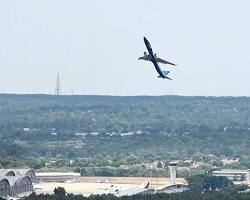
Not the gentle hum of a normal landing—a full, aggressive surge of power that pushes you back into your seat. The nose pitches up. The ground that was right there a moment ago starts falling away. You are climbing. Fast. The runway disappears behind you.
Nobody is saying anything. The cabin crew looks busy but calm. The passenger next to you grabs the armrest. Someone behind you whispers, “Oh my God.” Five of the longest seconds of your life pass before the Captain’s voice comes over the PA: “Ladies and gentlemen, we have executed a go-around. We will be making another approach shortly.”
I know exactly what just happened—because I was probably on the other end of the radio when it did. As a flight dispatcher with over 15 years at a Korean low-cost carrier, I have monitored hundreds of go-arounds from the OCC. I can tell you with absolute confidence: what you just experienced was not an emergency. It was the safety system working exactly as it should.
Key Takeaways
- A go-around is not an emergency—it is a standard, pre-planned safety procedure that every commercial pilot practices extensively and executes without hesitation when conditions are not perfect for landing.
- Go-arounds happen roughly 1-3 times per 1,000 approaches globally. At the 30 busiest U.S. airports, the rate was approximately 0.39% in 2023—about one per 250 approaches.
- The most common triggers are weather (low visibility, sudden wind shifts), unstable approaches (too fast, too high), runway obstructions (another aircraft or vehicle), and ATC instructions for traffic spacing.
- Pilots prepare for the go-around before every single approach. The missed approach procedure is briefed, programmed into the flight computer, and mentally rehearsed—it is never a surprise to the crew.
- From the dispatcher’s perspective, the critical question after a go-around is fuel. Does the aircraft have enough fuel for another approach? For holding? For diversion to an alternate? That calculation is already built into the flight plan I created before departure.
1. What Is a Go-Around, Exactly?
A go-around (also called a missed approach during instrument approaches) is simply this: the pilot decides not to continue the landing and instead climbs the aircraft away from the runway to attempt another approach or proceed to an alternate plan.
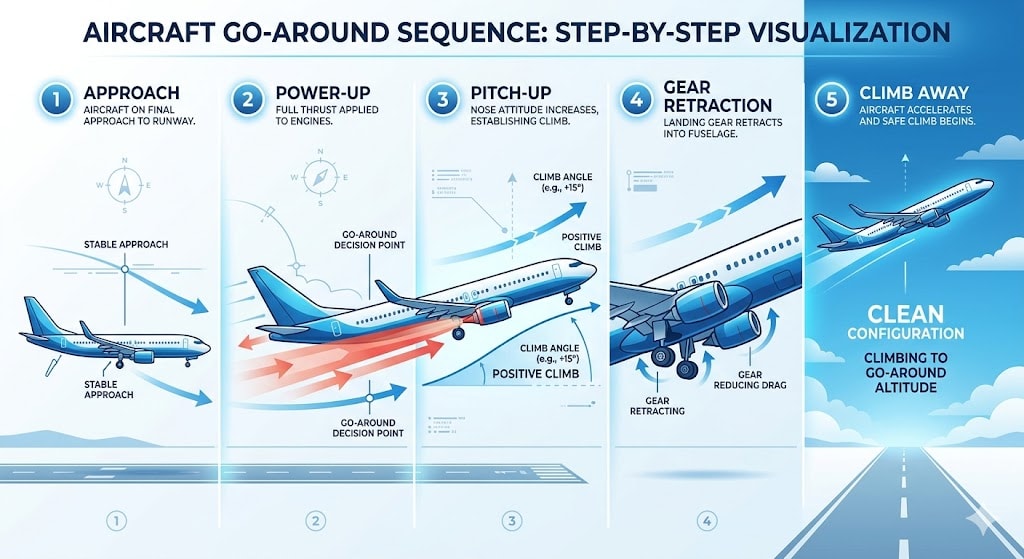
The mechanics are straightforward. The pilot pushes the thrust levers to TOGA (Takeoff/Go-Around) power—essentially full engine thrust. The aircraft nose pitches up into a climb attitude. The landing gear retracts. The flaps are gradually cleaned up. The aircraft follows a pre-programmed missed approach path that was briefed and loaded into the flight management computer before the approach even started.
The entire sequence from decision to stable climb takes roughly 10-15 seconds. For passengers, those seconds can feel like an eternity. For the pilots, they are executing a procedure they have practiced in simulators hundreds of times and rehearsed mentally before every single approach.
Here is the key point that most passengers miss: the go-around was already planned for before the aircraft started its descent. Every instrument approach in the world has a published missed approach procedure—a specific route and altitude to fly if the landing cannot be completed. Before beginning the approach, both pilots brief this procedure, program it into the flight computer, and mentally prepare for the possibility. The go-around is never a surprise to the crew. It is always an option they have already discussed.
In the pilot community, there is a well-known saying: “Every approach is a missed approach until it becomes a landing.” The default assumption is that the aircraft will go around. Landing is the outcome they work toward, but going around is the outcome they are always prepared for.
2. Why Go-Arounds Happen: The Real Reasons from My Desk
In my 15 years of monitoring flights across Japan, China, and Southeast Asia, I have observed go-arounds triggered by nearly every conceivable reason. Here are the most common ones, with real examples from our network.
2.1 Weather: The Most Common Trigger
By far the most frequent cause of go-arounds on our routes is weather—specifically, visibility dropping below minimums at the last moment.

Here is a scenario I have watched unfold dozens of times: a winter flight into New Chitose (Sapporo). The METAR 30 minutes before arrival showed 1,500 meters visibility—above minimums. The crew began the ILS approach. But during the final two minutes of descent, a snow squall moved across the airport. Visibility dropped to 400 meters. The crew reached decision altitude—the point where they must either have the runway in sight or go around—and could not see it. They went around.
From the OCC, I watched this happen on the flight tracking screen: the aircraft descending steadily toward the runway, then suddenly climbing away and turning. My immediate response was to check the weather trend. Was this a passing squall or a persistent system? I checked the latest METARs, the TAF, and the real-time satellite imagery. If the squall was likely to pass quickly, the aircraft could hold for 10-15 minutes and try again. If conditions were not going to improve, I would coordinate a diversion to an alternate airport.
Southeast Asian airports bring a different flavor of weather go-arounds. During monsoon season, Tan Son Nhat (Ho Chi Minh City) can go from clear skies to torrential downpour in minutes. I have seen flights execute go-arounds at Ho Chi Minh City when a sudden thunderstorm cell parked itself directly over the approach path. Ten minutes later, the cell moved, the rain stopped, and the aircraft landed normally on the second attempt. That 10-minute wait felt like an eternity for the passengers, but it was a routine operational adjustment for the crew and for me.
2.2 Unstable Approach: The Professional Decision
This is the go-around reason that demonstrates the highest level of pilot professionalism—and it is the one passengers are least likely to understand.
Airlines define strict criteria for a “stabilized approach.” Typically, by 1,000 feet above the runway (or 500 feet for visual approaches), the aircraft must be at the correct speed, on the correct flight path, in the correct configuration (landing gear down, flaps set), and with the correct rate of descent. If any of these parameters are not met—the aircraft is too fast, too high, or not properly aligned—the approach is considered “unstable” and the crew is required to go around.
The problem is that a pilot’s natural instinct is to try to “save” the approach—to correct the deviations and land anyway. This instinct has contributed to numerous runway overrun and hard landing incidents throughout aviation history. The industry has responded by making the go-around from an unstable approach a mandatory, no-questions-asked procedure at virtually every airline in the world. There is no penalty for going around. There are consequences for continuing an unstable approach.
On our routes, I see unstable approach go-arounds most frequently at airports with challenging terrain or approach paths. Osaka Kansai on a gusty day, for example, can produce wind conditions that make maintaining a stable approach genuinely difficult. I would rather have a crew go around three times and land safely on the fourth than push through an unstable approach once. And every airline safety department in the world agrees with me.
2.3 Traffic on the Runway
Sometimes the runway is simply not clear. Another aircraft has not exited the runway fast enough after landing. A vehicle has entered the runway area. ATC has misjudged the spacing between arriving aircraft. In all of these cases, ATC will instruct the approaching aircraft to go around—or the crew will initiate one themselves if they see the obstruction.
At congested airports like Tokyo Narita during peak hours, runway occupancy is tightly managed but occasionally miscalculated. I have monitored flights executing go-arounds at Narita because the preceding aircraft was still on the runway during their final approach. The go-around added 15 minutes and some extra fuel burn. The alternative—landing on an occupied runway—does not bear thinking about.
2.4 Wind Shear and Sudden Gusts
Wind shear—a sudden change in wind speed or direction at low altitude—can make a stable approach instantly unstable. Modern aircraft are equipped with predictive wind shear detection systems that alert the crew to dangerous wind conditions. When a wind shear warning triggers during approach, the crew is trained to immediately execute a go-around.
I particularly watch for this on our flights into airports prone to terrain-induced wind effects. Certain Japanese airports near mountainous terrain can produce sudden downdrafts on approach that trigger wind shear alerts. The crew goes around, the turbulence settles, and they land safely on the next attempt. The system works.
3. What the Dispatcher Does During a Go-Around
When I see one of my flights execute a go-around on the tracking screen, I shift from monitoring mode to active management mode instantly.

My first question is always: fuel.
Every flight plan I build includes fuel for the possibility of a go-around and subsequent diversion to an alternate airport. But the actual fuel remaining depends on what happened during the flight—headwinds stronger than forecast, ATC-directed deviations, or holding en route all consume fuel that was planned as margin. After a go-around, I need to quickly assess: does this aircraft have enough fuel for another approach? For two more approaches? For holding? For diversion to the alternate if the weather does not improve?
I send an ACARS message to the crew: “Confirm fuel remaining.” The crew responds. I compare that number to the minimums I calculated in the flight plan. If the fuel situation is comfortable, the crew makes another approach. If fuel is getting tight, I recommend either an immediate second approach (no holding) or a direct diversion to the alternate.
My second concern is why the go-around happened. If it was weather, I check the trend. Is the weather improving, stable, or deteriorating? This determines whether a second approach is likely to succeed or whether we should cut our losses and divert. If it was a traffic conflict or unstable approach, the cause is likely resolved and the second approach should be straightforward.
My third concern is schedule impact. A go-around typically adds 10-20 minutes to the flight. That might not seem like much, but on a tight LCC schedule, those 20 minutes can cascade through the rest of the day’s flight rotation, causing delays on subsequent flights. I begin calculating the impact and communicating with the operations team about downstream effects.
One real example: a few years ago, one of our flights into Manila executed three consecutive go-arounds due to thunderstorms on the approach path. After the third go-around, the Captain contacted me: “Fuel status is approaching alternate fuel. Request diversion to Clark.” I had already pulled up Clark’s weather and confirmed it was clear. “Clark approved. Weather VMC. Ground handling coordinated.” The aircraft diverted, refueled at Clark, and flew to Manila two hours later when the storms passed. The passengers arrived late but safe. My planning—the extra fuel I loaded for exactly this scenario, the alternate airport I selected with this possibility in mind—made the diversion routine rather than desperate.
4. How Often Do Go-Arounds Actually Happen?
Much more often than you think—and much less often than the dramatic media coverage would suggest.
Global data indicates that go-arounds occur at a rate of approximately 1-3 per 1,000 approaches. At the 30 busiest U.S. airports, FAA data from 2023 showed a rate of about 0.39% according to the FAA Aviation Data & Statistics portal—roughly one go-around per 250 approaches. Some airports with challenging conditions or heavy traffic see higher rates. Washington Reagan National (DCA) had a rate of about 0.8%, while Los Angeles (LAX) was around 0.2%.
For an average commercial pilot flying short-haul routes (like our Japan and Southeast Asia network), a go-around might happen once or twice per year. For long-haul pilots, maybe once every 2-3 years. It is uncommon enough to be noteworthy but common enough that every pilot is extensively trained and constantly prepared for it.
From my desk, I probably observe 20-30 go-arounds per year across all the flights I monitor. During monsoon season or winter weather patterns, that number increases. During calm, clear weather periods, I might go weeks without seeing one. It is a normal part of the operational rhythm—a safety valve that activates when needed and deactivates when it is not.
5. Why a Go-Around Is Safer Than “Forcing” the Landing
This is the most important thing I want you to understand about go-arounds, and it comes from the most sobering statistic in aviation safety.
Approximately half of all commercial jet accidents as documented in the SKYbrary go-around decision-making reference between 2012 and 2021 occurred during the approach, landing, and go-around phases of flight. And the single leading risk factor in approach and landing accidents is the failure to go around when conditions warranted it.
Read that again. The danger is not in going around. The danger is in not going around when you should.
Studies have shown that only an estimated 3-5% of unstabilized approaches actually result in a go-around. That means 95-97% of the time, pilots continue approaches that do not meet stabilization criteria—and most of the time, they get away with it. But the small percentage of times they do not “get away with it” accounts for a disproportionate share of landing accidents.
This is why the entire aviation industry—airlines, regulators, safety organizations—has spent decades building a culture where going around is never punished and always supported. No pilot will face disciplinary action for executing a go-around. No dispatcher will question a crew’s decision to go around. The phrase you hear in flight training is: “There is no penalty for going around. There is no second chance for a bad landing.”
When I think about go-arounds from my 15 years of experience, I think about the accidents that did not happen because a crew made the right call. Every go-around is a potential accident prevented. You will never see that on the news, because “pilot makes safe decision and nothing bad happens” is not a headline. But from where I sit in the OCC, it is the headline that matters most.
6. What Passengers Should Do (and Not Do) During a Go-Around
Stay seated with your seatbelt fastened. The go-around involves a sudden increase in engine thrust and a steep climb. Unsecured items can shift. This is not the time to stand up, reach for the overhead bin, or lean across the aisle.
Do not panic. I know this is easier said than done when the engines suddenly roar and the ground falls away. But the crew is executing a procedure they have practiced hundreds of times. The aircraft is performing exactly as designed. You are safe.
Wait for the announcement. The pilots will explain what happened once they have completed the go-around procedure and stabilized the aircraft. Their first priority is flying the airplane—not making PA announcements. Give them 30-60 seconds.
Do not take your frustration out on the cabin crew. They did not make the decision to go around (that was the Captain’s call) and they have no control over the weather, traffic, or approach conditions. They are managing the cabin environment during a high-workload moment for the entire crew.
Understand that the second approach will almost certainly succeed. The vast majority of go-arounds are followed by a successful landing on the next attempt. The condition that triggered the go-around—a passing weather cell, a traffic conflict, an unstable approach—is usually resolved by the time the aircraft comes around for the second approach. Multiple go-arounds on the same flight are rare.

7. A Go-Around I Will Never Forget
Let me close with a story that captures why I believe so deeply in the go-around culture.
It was a winter evening, and one of our flights was approaching Osaka Kansai. The weather had been marginal all day—low clouds, intermittent rain, gusty crosswinds. The crew briefed for a possible go-around. I had loaded extra fuel for exactly this scenario.
On the first approach, the crosswind gusted above limits at 200 feet. The crew went around. Routine. On the second approach, the gust subsided but visibility dropped. Another go-around. Less routine—now we were burning into the fuel margins I had carefully calculated.
I sent an ACARS message: “Fuel status check. Chubu weather VMC if needed.” The Captain responded: “Fuel sufficient for one more approach. If negative, divert Chubu.” We agreed. One more try.
On the third approach, the weather cooperated. The winds were within limits. The visibility held. The aircraft touched down smoothly. A hundred and eighty passengers arrived in Osaka, probably annoyed about the 25 extra minutes in the air but completely unaware of the collaborative decision-making between the cockpit and the OCC that got them there safely.
That is what a go-around is. Not a failure. Not an emergency. Not a sign that something is wrong with your airplane. It is two pilots and a flight dispatcher making the safest possible decision, every single time, until the conditions are right to bring you home.
As I wrote in my previous article on aviation safety: the system works. The go-around is one of the most important reasons why.
Learn more about our mission and operational background on the About Aeruxo page.
Frequently Asked Questions
Is a go-around the same as an emergency landing?
No. A go-around is a routine, pre-planned safety procedure. An emergency landing involves declaring an emergency (Mayday or Pan Pan) due to a serious issue requiring immediate priority handling. Go-arounds happen several times per day at busy airports worldwide and are a normal part of aviation operations. They are not emergencies by any definition.
How often do go-arounds happen?
Globally, approximately 1-3 per 1,000 approaches. At the 30 busiest U.S. airports, the rate was about 0.39% in 2023—roughly one per 250 approaches. An average short-haul pilot might experience 1-2 go-arounds per year. They are uncommon for any individual passenger but a routine part of daily airline operations system-wide.
Does the plane have enough fuel to go around?
Yes. Every flight plan includes fuel reserves that account for the possibility of one or more go-arounds plus a diversion to an alternate airport. As a flight dispatcher, I calculate this fuel requirement for every flight before departure. The crew will never be in a situation where a go-around leaves them without sufficient fuel—that scenario is planned for and prevented by the fuel calculations built into every flight plan.
What happens after a go-around? Will we land eventually?
In the vast majority of cases, the aircraft makes a second approach and lands successfully within 10-20 minutes. If the condition that caused the go-around persists (weather not improving, runway remaining blocked), the crew may hold briefly or divert to an alternate airport. Multiple go-arounds on the same flight are rare but can happen in persistent weather conditions—in which case diversion becomes the likely outcome.
Should I be scared if my flight goes around?
No. A go-around means the safety system is working exactly as designed. The crew identified that conditions were not optimal for landing and made the professional decision to try again rather than press on with an approach that had risk. This is the system protecting you. The go-around itself is a well-practiced, routine maneuver that the crew executes with confidence. After the initial surprise of the engine surge and climb, try to relax—you are in the hands of trained professionals doing exactly what they are trained to do.
Can a pilot be punished for executing a go-around?
No. At every reputable airline in the world, a go-around is a supported and protected decision. No pilot faces disciplinary action for executing a go-around. In fact, the opposite is true: the aviation industry has identified the failure to go around when warranted as a leading risk factor in landing accidents. The culture is clear: going around is always the right call when conditions are not perfect. It is one of the strongest safety cultures in any industry.
Have you experienced a go-around as a passenger? I would love to hear about it in the comments—what did it feel like, and how did the crew handle the communication?
Disclaimer: The views expressed in this article are my own professional opinions based on 15+ years of operational experience. They do not represent the official position of any airline, aviation authority, or regulatory body.